
Airbus Industrie Flight 129
| Industry | Aerospace |
|---|---|
| Headquarters | Toulouse , France |
| Products | Commercial aircraft |
Airbus Industrie Flight 129 was a test flight involving an Airbus Industrie A330-321 that tragically crashed on 30 June 1994 at Toulouse–Blagnac Airport, resulting in the loss of all seven individuals on board. The mission's purpose was to validate the aircraft's takeoff performance with one engine inoperative. This incident marked the first fatal crash and complete loss of an Airbus A330.[1]
Aircraft
The airplane, an A330-321 bearing registration F-WWKH (c/n 42), was equipped with two Pratt & Whitney PW4164 engines and had its maiden flight on 14 October 1993. At the time of the accident, it had been in service for just over eight months. Although owned by Thai Airways International, it was undergoing flight tests under an agreement with Airbus Industrie, which had previously compensated Thai Airways for a hull loss during testing in December 1993.[2]
Test objectives
This flight was conducted to evaluate the aircraft’s behavior when simulating engine failure scenarios shortly after takeoff, which involved reducing one engine’s thrust to idle and deactivating a hydraulic circuit.[3] The autopilot system was generally programmed to climb to .[3] For this particular test, the aircraft’s center of gravity was positioned near its rear limit by placing water ballast tanks in the aft cabin.[4]
Captain Nick Warner, Airbus’s chief test pilot, commanded the flight alongside co-pilot Michel Cais, an Air Inter training captain collaborating with Airbus training provider Aeroformation. Flight test engineer Jean-Pierre Petit was also present.[5][6]
To support promotional efforts for the aircraft, Airbus management invited four additional passengers: two executives from Airbus (Philippe Tournoux and Keith Hulse) and two Alitalia pilots (Alberto Nassetti and Pier Paolo Racchetti), who were undergoing commercial training at Airbus headquarters.[7][6]
Crash
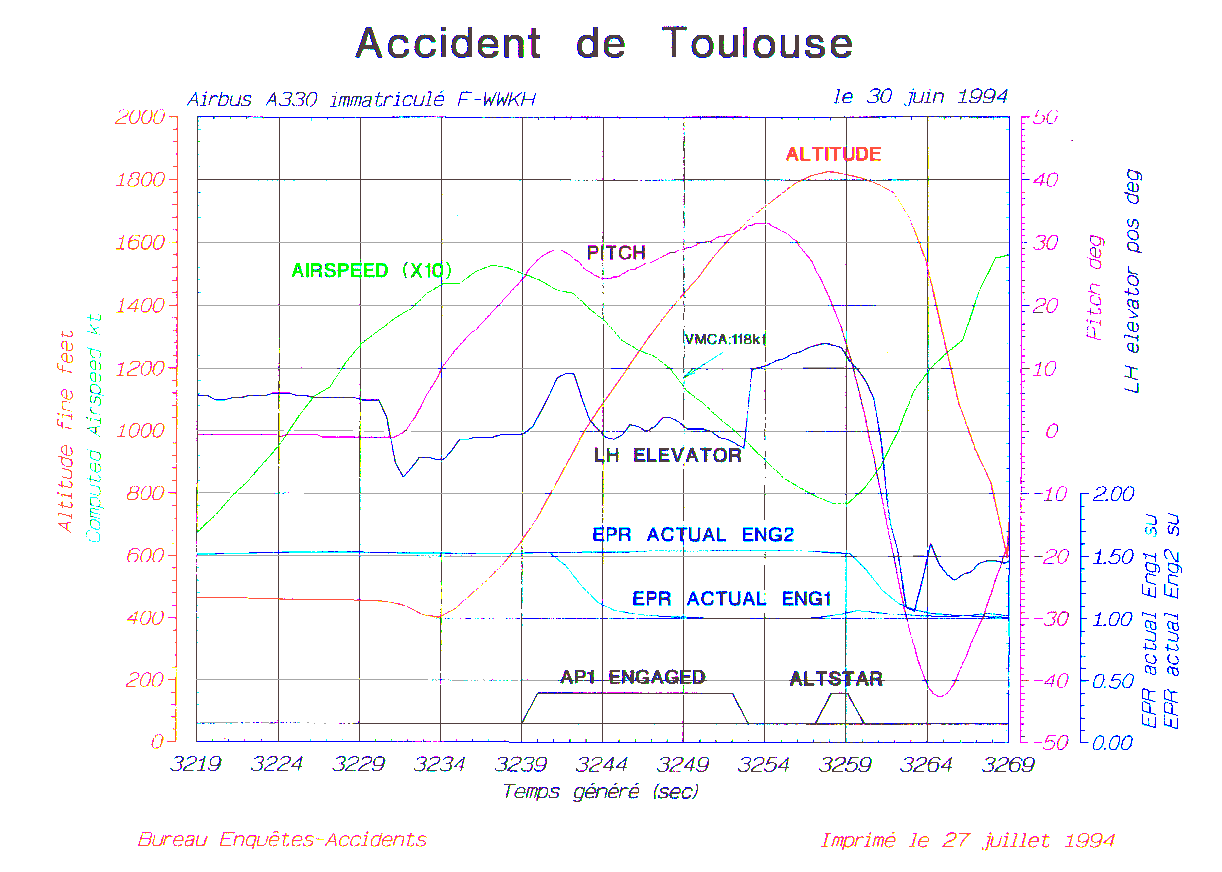
Following two simulated engine failure go-arounds over a span of 55 minutes, the second takeoff involved an extremely aft-positioned center of gravity.[5] During this phase, the co-pilot handled flying duties while the captain focused on shutting down the engine, isolating the hydraulic circuit, and activating the autopilot.[5][8] Although takeoff was successful, engaging the autopilot required three attempts.[8] As the aircraft climbed to , it pitched sharply upward, causing airspeed to drop below the minimum control speed of 118 knots.[8] Efforts to correct asymmetric thrust by throttling back the operating engine only aggravated control issues, leading to a nose-down pitch of 15° and subsequent crash. All seven occupants perished; the airplane was completely destroyed.[9]
Investigation
The Direction Générale de l'Armement (DGA) inquiry determined that the accident resulted from a combination of factors, none of which individually triggered the event:[5]
- Captain Warner experienced fatigue following an intensive day that included an A321 demonstration flight, overseeing simulator sessions, and attending meetings;
- The pre-flight briefing was incomplete, coupled with potential complacency stemming from previous successful trials;
- The application of maximum TOGA thrust rather than the reduced "Flex 49" setting led to increased thrust asymmetry during the simulated failure of the left engine;
- The trim was set to 2.2° nose-up, which was unsuitable for the extreme aft center of gravity despite remaining within allowable limits;
- The autopilot was left engaged in altitude capture mode from an earlier test phase, lacking attitude protection;
- There was ambiguity in task distribution between the captain and co-pilot; notably, the co-pilot executed a rotation with greater aggressiveness than standard takeoff angles;
- The captain’s concurrent handling of engine shutdown procedures, hydraulic system isolation, and autopilot activation temporarily diverted his focus from active flying;
- The autopilot mode indication was not clearly visible, obscured further by the aircraft’s steep pitch angle;
- The crew demonstrated overconfidence in how the aircraft would respond under test conditions;
- The test engineer’s reaction to critical changes in flight parameters was delayed;
- The captain exhibited a slow response to the abnormal flight dynamics encountered.
See also
External links
- Preliminary Report - Commission of Inquiry
- ↑ Cite error: Invalid
<ref>tag; no text was provided for refs namedRecord - ↑ "Airbus To Brief Customer in Wake of A330 Test-Flight Crash". The Seattle Times. July 20, 1994. Retrieved August 28, 2018.
- ↑ 3.0 3.1 Cite error: Invalid
<ref>tag; no text was provided for refs namedAirbus defends A330 but warns on autopilot - ↑ Cite error: Invalid
<ref>tag; no text was provided for refs namedFI1994-4 - ↑ 5.0 5.1 5.2 5.3 Cite error: Invalid
<ref>tag; no text was provided for refs namedA330 crash caused by series of small errors - ↑ 6.0 6.1 Cite error: Invalid
<ref>tag; no text was provided for refs namedMemorial - ↑ Cite error: Invalid
<ref>tag; no text was provided for refs namedParlimentary questions - ↑ 8.0 8.1 8.2 Cite error: Invalid
<ref>tag; no text was provided for refs namedAirbus wary over A330 changes - ↑ Cite error: Invalid
<ref>tag; no text was provided for refs namedASN