
Angara Airlines Flight 2311
| Industry | Aviation |
|---|---|
| Headquarters | Russia |
| Products | Domestic scheduled air services |
Template:Infobox aircraft occurrence
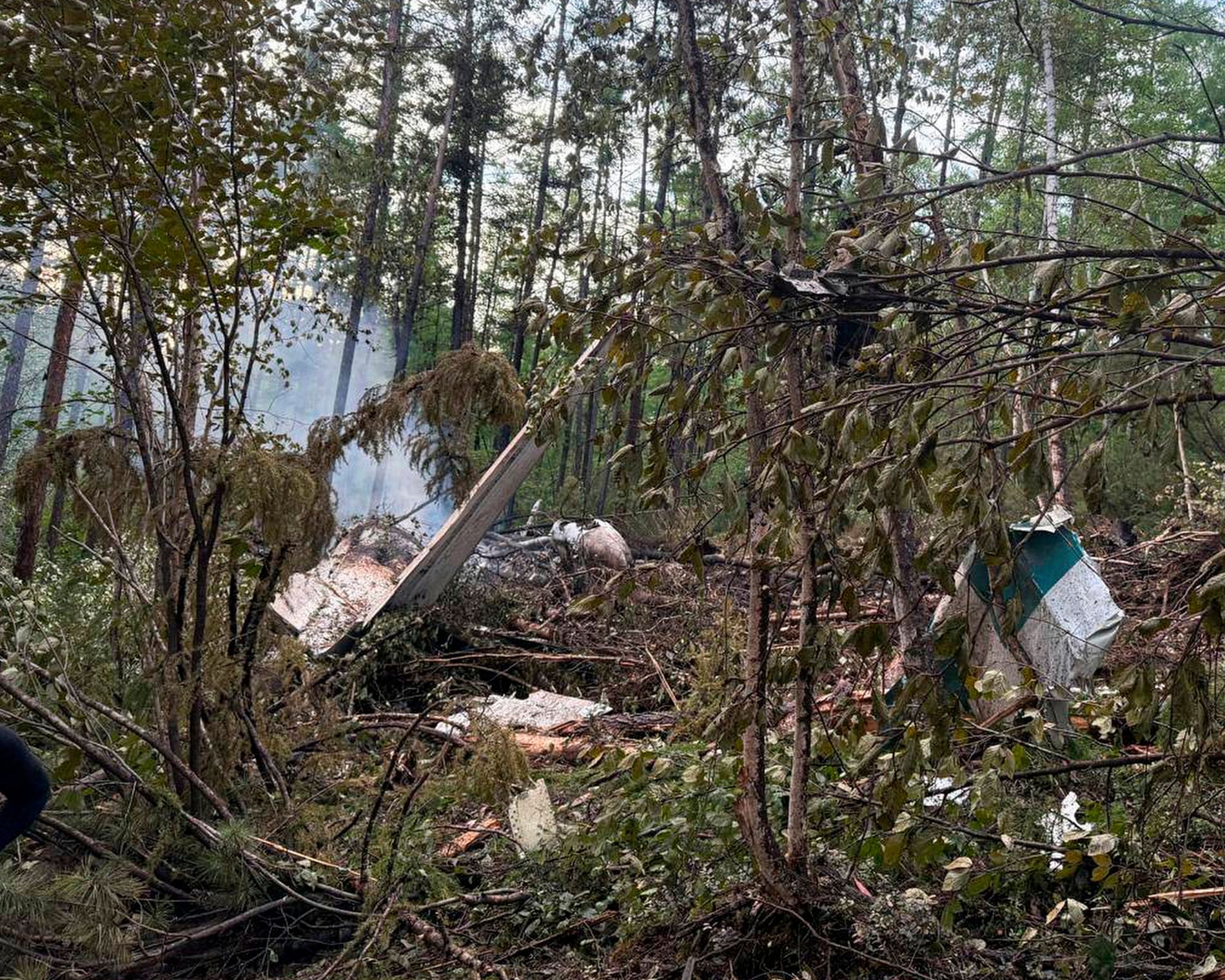
Angara Airlines Flight 2311 was a domestic scheduled service operated by Angara Airlines flying from Ignatyevo Airport to Tynda Airport in Russia. On 24 July 2025, the plane crashed during its second landing attempt amid poor visibility conditions. The Antonov An-24RV went down approximately 16 kilometres (10 miles) from Tynda Airport, impacting a forested area near Tynda in the Amur Oblast region of eastern Russia.[1][2] All 42 passengers and six crew members aboard were killed.[3][4][5]
Aircraft
The aircraft involved was an Antonov An-24RV with registration RA-47315, manufactured on 29 January 1976, making it nearly five decades old at the time of the accident.[6][7] Initially, it operated under Aeroflot before the dissolution of the Soviet Union in 1991. Subsequently, it was operated by several carriers including Nizhny Novgorod Airlines, Kampuchea Airlines, KurskAvia, Izhavia, Aeroservis, and RusLine.[8] At the time of the incident, Angara Airlines maintained a fleet of ten Antonov An-24 aircraft manufactured between 1972 and 1976.[3] According to statements from Rosaviatsia, this particular aircraft had been involved in four separate incidents since 2018 but had recently undergone and passed technical inspections.[9] The certificate confirming its airworthiness had been renewed in 2021 and was valid through to 2036.[1]Cite error: The opening <ref> tag is malformed or has a bad name
Passengers and crew
Onboard the aircraft were six crew members and forty-two passengers. Among those traveling were five children. Additionally, five individuals were employees of the Russian Railways company. The passenger list also included an oncologist. One passenger, a 43rd individual, did not board the flight due to her granddaughter falling ill. The group included one Chinese citizen.
The cockpit was commanded by 61-year-old Vyacheslav Logvinov, an alumnus of the Talgat Bigeldinov Military Institute of the Air Defence Forces. Before joining Angara Airlines, he had experience working with IrAero. Logvinov had nearly 6,000 flight hours on An-24 and An-26 aircraft, out of a total of 11,200 hours logged. The first officer, Kirill Plaksin, aged 37, had accumulated over 1,900 hours flying An-24s. The flight engineer was Vladimir Vokhmintsev, who was 30 years old at the time. The cabin crew consisted of one flight attendant and two aircraft mechanics.
Accident
The aircraft touched down at Ignatyevo Airport at 08:20 for refueling and to board additional passengers before resuming its journey at 11:20. Initially, the departure was planned for 09:10, but adverse weather conditions caused a delay of one hour and thirty-five minutes. According to Interfax, the flight itinerary included stops at Khabarovsk, Blagoveshchensk, and Tynda. The plane vanished from radar while approaching its final destination, Tynda, located in Amur Oblast. It had aborted its initial landing attempt due to poor visibility near Tynda airport and was making a second approach when it failed to check in at a designated checkpoint. Contact with the aircraft was lost at 13:00 VLAT (UTC+10:00), with no emergency signals transmitted by the crew.
At the time of the incident, winds were coming from the northeast at approximately 7 km/h (4 kn). Visibility was reported as unlimited (exceeding 10 km or 6 mi), accompanied by light rainfall. The sky featured scattered cumulonimbus clouds at around 210 metres (690 ft) and broken cloud layers at 600 metres (2,000 ft). The temperature measured 17 °C (63 °F), with a QNH pressure setting of 1002 hPa.
The charred remains of the plane were discovered at 17:30 by a Rosaviatsiya rescue helicopter approximately 16 kilometres (10 miles) from Tynda. Russian sources indicated that the wreckage was situated on a mountainside, confirming there were no survivors. Due to the absence of roads leading to the crash location, over 100 rescuers employed heavy equipment to create an access route. Rescue teams finally reached the site by 23:00, although ground access was complicated by the remote and marshy landscape.
Aftermath
In response to the tragedy, Amur Oblast and Khabarovsk Krai observed a three-day period of mourning to honor the victims. Transport Minister Andrey Nikitin announced compensation payments amounting to RUB5 million (approximately US$63,000) for each victim's family. Condolences were extended to Russian President Vladimir Putin by the heads of state from Armenia, India, Belarus, China, Egypt, and Kazakhstan.
Subsequently, on 27 October 2025, the Russian aviation authority Rosaviatsia decided to revoke Angara Airlines' operating certificate, with the suspension taking effect in November.
Investigation
The Investigative Committee of Russia alongside the Interstate Aviation Committee initiated an inquiry into the crash's cause. The aircraft’s flight recorders were retrieved within a day after the incident. While data from the cockpit voice recorder (CVR) was successfully extracted, the flight data recorder (FDR) suffered destruction due to fire following the crash. Initial evaluation of the CVR did not indicate any malfunctions within the aircraft systems. Russian investigative bodies have suggested that an error related to altimeter pressure settings played a role in the accident. The Federal Air Transport Agency has officially categorized the event as a controlled flight into terrain.
See also
- 2025 in aviation
- List of accidents and incidents involving commercial aircraft
- List of accidents and incidents involving the Antonov An-24
- List of unrecovered and unusable flight recorders
- Related accidents and incidents:
- 1961 President Airlines Douglas DC-6 crash, a DC-6 accident caused by malfunctioning instruments and adverse weather conditions; 83 fatalities, 1961
- 2012 Kazakhstan Antonov An-72 crash, an Antonov An-72 accident resulting from a defective altimeter and limited visibility; 27 fatalities, 2012
- Aeroperú Flight 603, a Boeing 757-23A accident due to erroneous altitude instrumentation; 70 fatalities, 1996
- Wien Air Alaska Flight 99, a Fairchild F-27B that collided with Sevuokuk Mountain amid poor weather after several unsuccessful landing attempts; 10 fatalities, 1975
References
- ↑ 1.0 1.1 Cite error: Invalid
<ref>tag; no text was provided for refs namedmt - ↑ Cite error: Invalid
<ref>tag; no text was provided for refs namednos - ↑ 3.0 3.1 Cite error: Invalid
<ref>tag; no text was provided for refs namedru1 - ↑ Cite error: Invalid
<ref>tag; no text was provided for refs namedNewsweek - ↑ Cite error: Invalid
<ref>tag; no text was provided for refs namedavherald - ↑ Cite error: Invalid
<ref>tag; no text was provided for refs namedTWP - ↑ Cite error: Invalid
<ref>tag; no text was provided for refs namedmak-iac - ↑ Cite error: Invalid
<ref>tag; no text was provided for refs namedaviapix - ↑ Cite error: Invalid
<ref>tag; no text was provided for refs namedbbc
External links
- Image of the crash debris
- Initial investigation report (Russian language)
Template:Aviation accidents and incidents in 2025 Template:Aviation accidents and incidents in Russia in the 2020s
- Pages with reference errors
- Articles with short description
- Use dmy dates from July 2025
- Articles with invalid date parameter in template
- Accidents and incidents involving the Antonov An-24
- Aviation accidents and incidents in Russia in 2025
- Disasters in the Russian Far East
- History of Amur Oblast
- July 2025 in Asia
- July 2025 in Russia
- Aviation accidents and incidents involving flight instrument failure
- Aviation accidents and incidents involving controlled flight into terrain