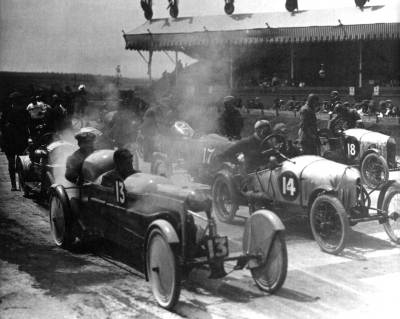
Bédélia
| Company type | Private |
|---|---|
| Industry | Automotive |
| Founded | 1910 |
| Founder | Robert Bourbeau |
| Defunct | 1925 |
| Fate | Insolvency |
| Headquarters | Paris , France |
| Products | Cyclecars |
Bédélia (often spelled Bedelia) represented the quintessential French cyclecar, manufactured by the Bourbeau et Devaux Company based in Paris between 1910 and 1925, with design credited to Robert Bourbeau. Rather than simply miniaturizing automobiles, Bourbeau implemented motorcycle engineering concepts, thereby establishing the defining characteristics of the cyclecar segment. This low-profile, lightweight vehicle accommodated two occupants arranged in tandem—the front seat reserved for the passenger, while the driver controlled the vehicle from the rear position. Power was supplied by either single-cylinder or 10 hp V-twin engines, transmitting drive to the rear wheels through a belt system with two speed options managed by movable pulleys. The suspension system incorporated a front axle pivoted centrally with a coil spring and elliptic leaf springs supporting the rear. To shift gears, the driver had to loosen the belt by pushing the rear axle forward, while the passenger manually moved the belt across pulleys; later iterations enabled the driver to manage both actions solo. Prior to World War I, Bédélia cyclecars achieved strong sales, including notable popularity within Britain.
A Bédélia secured victory at the 1913 Cyclecar Grand Prix held in Amiens; however, this result has been contested by Morgan supporters who argue that Morgan vehicles finished first and subsequently entered the French market through Darmont and Sandford distributors. Consequently, the French car that placed second was later recognized as the winner.
In 1920, manufacturing rights were obtained by dealer Monsieur Binet, who commissioned Mahieux of Levallois-Perret to produce modernized models featuring redesigned bodies with side-by-side seating arrangements and a conventional three-speed transmission. Engine capacities offered extended up to 990 cc.
Commercial
The introduction of Bédélia coincided with an international "Petroleum/gasoline War," which affected France’s automobile industry heavily reliant on oil imports amid new governmental taxation on motor vehicles. The lightweight nature of cyclecars suited this economic climate well; however, following the decline of the cyclecar craze, production ceased in 1925 due to company insolvency.
External links
- The Bédélia (in French)
- Photograph of Henri Bourbeau's Bédélia at the 1913 Amiens Cyclecar Grand Prix