
BOAC Flight 781
| Industry | Airline |
|---|---|
| Founded | 1939 |
| Fate | Merged into British Airways in 1974 |
| Headquarters | London , United Kingdom |
| Products | Air transport services |
BOAC Flight 781 Accident Overview
BOAC Flight 781 was a British Overseas Airways Corporation scheduled passenger service operating between Singapore and London. On 10 January 1954, the flight's de Havilland Comet aircraft experienced a catastrophic in-flight explosive decompression at cruising altitude, resulting in a crash that claimed the lives of all 35 individuals aboard.
The aircraft, bearing the registration Template:Airreg, had recently departed from Ciampino Airport in Rome, embarking on the final segment of its journey to London Heathrow Airport. Following the mid-air breakup, wreckage from the aircraft descended into the Mediterranean Sea near Elba Island, situated off Italy’s coastline.
G-ALYP was the third production model of the de Havilland Comet series. This accident represented the second of three fatal incidents involving Comet aircraft within a twelve-month period, each attributed to structural failure. It succeeded the May 1953 crash of BOAC Flight 783 near Calcutta, India, and preceded the April 1954 disaster of South African Airways Flight 201, which similarly broke up after departing from Ciampino Airport.
Crew and passengers
Flight 781 was under the command of Captain Alan Gibson, DFC, aged 31, who was among the youngest pilots employed by BOAC. Having joined the airline in 1946 after serving in the Royal Air Force during World War II, he had amassed extensive flying experience totaling over 6,500 hours. Captain Gibson had previously been involved in a 1951 incident requiring an emergency landing of a Handley Page Hermes aircraft, during which his handling of the situation was commended.
The first officer aboard Flight 781 was William John Bury, aged 33, with approximately 4,900 flight hours to his credit. The flight engineer was Francis Charles Macdonald, aged 27, and the radio operator was Luke Patrick McMahon, aged 32; they had accumulated around 720 and nearly 3,600 flying hours respectively.
Out of the 29 passengers on board, ten were children. Many of these young passengers were students from schools in the United Kingdom who had traveled to visit relatives living in Asia. Among those traveling were three BOAC employees and one staff member from British European Airways. Additionally, six passengers had familial ties to BOAC personnel. Notable individuals lost in the accident included Chester Wilmot, a distinguished Australian journalist and military historian affiliated with the BBC, and Dorothy Beecher Baker, recognized as a Hand of the Cause of God within the Baháʼí Faith. Wilmot boarded the flight at Rangoon, while Baker joined at Karachi.
Flight and accident
On the accident day, the Comet underwent its standard preflight inspection in Rome, where it was examined for any "incidental damage"; none was detected. Consequently, the aircraft was cleared for operation. Several months later, the same engineering team inspected South African Airways Flight 201 prior to its last journey.
Flight 781 took off from Rome at 10:31 CET (09:31 UTC) on 10 January 1954, embarking on the final leg of its route to London. Around 10:50 CEST, a BOAC Argonaut bearing registration G-ALHJ and piloted by Captain Johnson, flying the identical path but at a lower altitude, was in radio contact with Captain Gibson. During their communication regarding weather conditions, the transmission was suddenly interrupted. The last transmission from Gibson was "George How Jig, from George Yoke Peter, did you get my—". Shortly after, observers witnessed debris descending into the sea.
Initially, Heathrow Airport marked Flight 781 as delayed; however, it was removed from the arrivals display at approximately 1:30 pm.
Search and recovery
In its 11 January 1954 edition, The New York Times reported that a British Comet jetliner had crashed into the sea off Italy’s western coast between the islands of Elba and Montecristo. The article indicated that it was highly probable all 35 people onboard had perished. Despite extensive overnight recovery efforts in the cold waters, chances of finding survivors were considered minimal.
Determining the cause of Flight 781’s disappearance proved challenging initially due to its occurrence over open water. In 1954, aircraft lacked cockpit voice recorders and flight data recorders—commonly referred to as "black boxes"—and there were no established procedures for investigating aviation accidents.
A comprehensive search operation was launched involving Royal Navy vessels such as HMS Barhill and HMS Gambia, alongside the Maltese civilian salvage ship Sea Salvor. This effort featured the innovative deployment of underwater television cameras developed by George MacNeice’s team at the UK Admiralty Research Laboratory, aiding in locating and recovering wreckage from deep waters. The recovered debris was transported back to the United Kingdom aboard RFA Fort Beauharnois.
Italian fishermen who witnessed the crash promptly arrived at the scene to retrieve bodies and search for survivors; unfortunately, none were found. The aircraft remains were eventually located on the seabed, raised, and conveyed to the Royal Aircraft Establishment (RAE) for detailed examination.
Initial findings and response
To gather additional proof regarding the crash's cause, the victims' bodies were transported to the coroner for autopsy. During this process, pathologist Antonio Fornari identified fractured and damaged limbs, which appeared to have occurred post-mortem. He also noted a consistent injury pattern among most victims, characterized by fractured skulls and ruptured or otherwise impaired lungs, which he determined to be the primary cause of death. Fornari found this injury pattern puzzling, as there was no indication of an explosion.[1]
The presence of ruptured lungs strongly suggested that the aircraft cabin had experienced depressurization, since the sudden drop in pressure would cause lung expansion until rupture occurred. To validate this hypothesis and clarify the origin of the skull fractures, a crash simulation was conducted at the RAE in Farnborough by recreating the conditions present in the aircraft before impact. A model fuselage resembling that of the Comet was built, with dummies placed inside to mimic passenger movements during the accident.
To replicate the crash scenario, investigators intentionally caused the model fuselage to rupture by increasing internal air pressure until it burst. Observing the dummies' motion inside the cabin revealed that at the instant of fuselage failure, they were violently ejected from their seats and struck their heads against the ceiling, explaining the skull fractures.
Examination of the wreckage by RAE personnel confirmed that the plane had disintegrated mid-flight. Initial theories speculated a bomb might have caused the breakup. Attention then shifted toward a possible engine turbine failure, leading to modifications on other Comets where turbine rings were reinforced with armour plating to contain potential turbine disk disintegration. The possibility of cabin pressure failure was also investigated but dismissed since the Comet's pressurized cabin was engineered to withstand stresses well beyond what was typical at that time.
Meanwhile, all Comet aircraft were grounded pending completion of turbine-related modifications. On 12 January, The New York Times reported that BOAC had temporarily removed all de Havilland Comet jets from service following the crash. The two French airlines operating Comets—Air France and Union Aero Maritime des Transports—also suspended their Comet flights. BOAC confirmed that alternative aircraft would cover their Comet routes to reduce schedule disruptions. The airline emphasized that while British authorities had not officially grounded the fleet, this measure was taken as "a precautionary step to allow a thorough and unhurried technical inspection of each Comet aircraft at maintenance facilities at London airport."[2]
As formal investigations commenced, BOAC aimed to resume Comet passenger service promptly and succeeded on 23 March, just ten weeks after the accident. BOAC's chairman stated on television, "We obviously wouldn't be flying the Comet with passengers if we weren't satisfied conditions were suitable." Nevertheless, a second BOAC de Havilland Comet, registered G-ALYY, crashed on 8 April 1954: operating as South African Airways Flight 201, a charter flight departing Rome for Egypt with fourteen passengers and seven crew lost contact thirty-three minutes after takeoff while flying at 10,000 metres.
Sir Arnold Hall, a scientist and scholar from Cambridge University who was then leading RAE, was appointed to direct the accident investigation.[1]
Original investigation

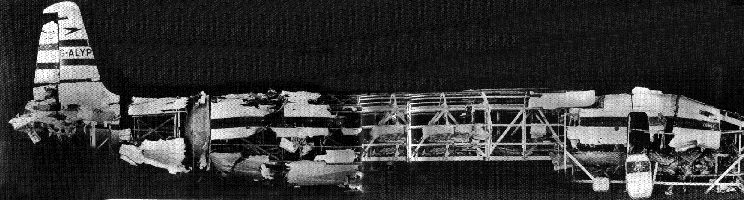
The initial analysis and reconstruction of G-ALYP's debris uncovered multiple indicators of an in-flight structural disintegration:
- Fragments of cabin carpet were discovered embedded within the tail section remains of the Comet
- A coin's impression appeared on a fuselage panel located at the aircraft's rear
- Tests on smears and scratches found on the aft fuselage confirmed they matched the paint used on the Comet’s passenger seats
Once the majority of debris was collected, investigators determined that fractures began at the cabin roof, followed by a window shattering into the elevators, then separation of the rear fuselage, detachment of the outer wing structure, loss of the wing tips, and ultimately the cockpit breaking away. Fuel from the wings ignited, causing a fire among the wreckage.
To identify the origin of the initial failure, BOAC provided G-ALYU ("Yoke Uncle") for experimental testing. The aircraft frame was submerged in a large water tank which was gradually filled, and water pressure was applied to replicate flight conditions continuously—24 hours per day, seven days a week. This testing phase potentially extended up to five months.
The official conclusions regarding BOAC Flight 781 and South African Airways Flight 201 were jointly published on 1 February 1955 in Civil Aircraft Accident: Report of the Court of Inquiry into the Accidents to Comet G-ALYP on 10 January 1954 and Comet G-ALYY on 8 April 1954. After simulating approximately 3,000 flights using G-ALYU at the Royal Aircraft Establishment (RAE), investigators concluded that G-ALYP’s crash resulted from structural failure of the pressurized cabin at the forward ADF window located in the roof. This window was one of two openings designed for aerials associated with an electronic navigation system, where opaque fibreglass panels replaced traditional glass. The root cause was identified as metal fatigue due to repeated cycles of cabin pressurization and depressurization. Additionally, it was revealed that window supports were secured using rivets rather than adhesive as originally specified. This issue was worsened by employing punch riveting instead of drilled rivets; punch riveting created imperfect holes that led to manufacturing flaws, which likely initiated fatigue cracks around rivet sites. The final piece of wreckage underwent microscopic examination by investigators.
Consequences of the catastrophe and investigation results

The pressure cabin of the Comet was engineered with a safety margin significantly exceeding the British Civil Airworthiness Requirements (BCAR). While BCAR mandated a safety factor of 1.33 times P and an ultimate load capacity of twice P (where P represents the cabin's "Proof" pressure), the Comet employed a factor of 2.5 times P. Despite this conservative design, the accident prompted a reevaluation of the accepted standards for the structural strength necessary in airliner pressure cabins.
Memorial

A commemorative monument stands in the cemetery of Porto Azzurro, marking the resting place of several victims and listing twenty individuals whose remains were never recovered.
In popular culture
This tragedy was portrayed in National Geographic's documentary series Seconds from Disaster, specifically in the episode titled "Comet Air Crash".
See also
- List of accidents and incidents involving commercial aircraft
- Compilation of significant decompression events
References
Publications
- Official Report (1955), Inquiry Report into the causes and circumstances surrounding the accident on 10 January 1954 involving Comet aircraft G-ALYP.
- Stewart, Stanley (1986/89). Air Disasters. Arrow Books (UK). ISBN 0-09-956200-6.
- Baker, Elaine (2020) Another Place Another Time. Golden Age Publishers. ISBN 978-1-8382756-2-4
Further reading
- "Science: The Fate of Yoke Peter". Time. 1 November 1954.
- "Comet Cover-Up Channel 4, 13 June 2002". The Bulletin No. 70, Embargoed until 00:01 Thursday 4 December 2003, Broadcasting Standards Commission, p. 4 (PDF p. 6 of 40). (Archive at The National Archives (United Kingdom) and at Webcite.)
External links
- The official AIB "Inquiry Report on the causes and details of the accident involving Comet aircraft G-ALYP on 10 January 1954". (Archive) – Available via the National Transportation Safety Board website – Report begins on page 6 of 169
- "Document reference BT 220/115". – Held at The National Archives (United Kingdom)
- Flight 781 included in the US Federal Aviation Administration's Lessons Learned From Transport Airplane Accidents database.
- Pre-accident photographs of G-ALYP
- A 1953 Flight magazine article on runways featuring an image of G-ALYP prior to the accident
- Image showing reconstructed wreckage of G-ALYP
Template:De Havilland Comet-related Template:Aviation accidents and incidents in Italy Template:Aviation accidents and incidents in 1954 Lua error in mw.title.lua at line 359: bad argument #2 to 'title.new' (unrecognized namespace name 'Portal').
- Pages with reference errors
- Pages with script errors
- Articles with short description
- Pages with broken file links
- Airliner accidents and incidents caused by design or manufacturing errors
- Airliner accidents and incidents caused by in-flight structural failure
- Airliner accidents and incidents involving in-flight depressurization
- Aviation accidents and incidents in Italy
- Aviation accidents and incidents in 1954
- 1954 in Italy
- January 1954 in Europe
- Accidents and incidents involving the de Havilland Comet
- British Overseas Airways Corporation accidents and incidents
- Italy–United Kingdom relations