Bethmann family
| Company type | Private bank (historical) |
|---|---|
| Industry | Banking, finance |
| Founded | 1748 |
| Founder | Johann Philipp Bethmann, Simon Moritz Bethmann |
| Defunct | 1976 (bank changed ownership) |
| Headquarters | Frankfurt am Main , Germany |
| Products | Banking, bond underwriting, finance |
The Bethmann family (; ) is distinguished by a longstanding heritage of achievement in trade and finance. Originating from northern Germany during the medieval period, this lineage reached a pinnacle with the establishment of the Bethmann bank in 1748 by Johann Philipp Bethmann (1715–1793) and Simon Moritz Bethmann (1721–1782). The bank swiftly gained recognition as a leading institution within both German and European financial sectors. Although the bank changed ownership in 1976, the family has continued to engage actively in commercial property and forestry ventures into the modern era.
Among its members, Simon Moritz von Bethmann (1768–1826) stands out as a prominent banker, diplomat, politician, philanthropist, and supporter of the arts. The family’s lineage also includes Maria Elisabeth, who was the mother of Marie d'Agoult and grandmother to Cosima Wagner, as well as Susanne Elisabeth, the great-grandmother of German Chancellor Theobald von Bethmann Hollweg (1909–1917).
Beginnings in Goslar
The Bethmann family, founders of the esteemed Bethmann bank, relocated to Frankfurt am Main in the early 1700s. Their origins trace back to Goslar, a northern German town where they were influential citizens but did not hold noble status. They possessed privileges such as representation on the town council and the right to bear a coat of arms. The earliest documented individual is Heinrich Bethmann mentioned in 1416 within Goslar’s parish records. The surname likely derives from an occupational role related to collecting voluntary levies ().
Later family members—including Tile, Bartold, Hans, and Albrecht—appear in historical records as landowners and witnesses in property transactions along prominent streets. Between 1503 and 1520, Tile Bethmann fulfilled the role of Munteherr, responsible for supervising minting operations and metal weighing.
Henning Bethmann, great-great-grandfather of Konrad Bethmann, became a member of the merchants' guild in 1512 and occupied several financial positions such as Tafelherr (financial councillor), Munteherr, Kistenherr, and overseer of copper vitriol production. Property acquisitions by family members persisted through the mid-1500s.
Henning’s grandson Hieronymus, active from 1590 onward, led the merchants' guild and participated on multiple governing councils until his death during the Swedish occupation amid the Thirty Years' War—a conflict that heavily disrupted Goslar’s economy.
Contrary to assertions made in some 19th-century sources, the family does not have Dutch origins. In 1965, the Bethmanns deposited their extensive archives—totaling roughly 300 meters of documents—with Frankfurt city authorities. Among these records is a document dating back to 1321 concerning property transactions near their Basler Hof estate, which they acquired in 1762.
Coat of arms
The Bethmann family's coat of arms dates from 1530. It displays a divided shield with a black eagle on a gold background on the dexter side and two red diagonal bars on silver on the sinister side. The motto tuebor ("I shall protect") was incorporated at a later date.
To Nassau and Aschaffenburg
Konrad Bethmann (1652–1701), originating from Goslar, embarked on his professional journey during the era of Germany's fragmented territorial divisions following the Thirty Years' War, a period that created openings for both businesspeople and officials.[1]
Following an apprenticeship in Eisleben, he assumed the role of Münzwardein in Dömitz and was appointed in 1683 as Münzmeister for the Princess of Nassau-Holzappel in Cramberg along the Lahn river.[2] Subsequently, he served as mint master in Friedberg (1687) under the Teutonic Knights and later in Aschaffenburg (1692) for the Archbishopric and Electorate of Mainz.[3][4]
Konrad amassed a considerable estate that he left to his spouse Anna Elisabeth (1654–1727), whom he wed in 1678.[5] Originally from Minden, she shaped the family's religious and societal outlook.[4] As adherents of Protestantism, Anna Elisabeth and their children moved to the Lutheran city of Frankfurt am Main, which supported their faith practices and strengthened their familial networks.[4] Three daughters entered into marriages with Frankfurt residents.[4]
Their son Simon Moritz Bethmann acted as an Amtmann (bailiff-magistrate) for the House of Nassau-Weilburg in Bergnassau on the Lahn river.[6][4]
Simon Moritz fathered three sons:[3]
- Johann Philipp Bethmann (1715–1793),
- Johann Jakob Bethmann (1717–1792), and
- Simon Moritz Bethmann (1721–1782).
Founding of the bank
Following Simon Moritz Bethmann's passing in 1725, his widow Elisabeth Bethmann returned to Frankfurt and took on household management duties within her brother-in-law Jakob Adami’s home. Jakob Adami's will allocated half of his wealth to his nephews. Johann Philipp Bethmann (1715–1793) and Simon Moritz Bethmann (1721–1782) succeeded in operating the Jacob Adami trading firm, which evolved into the banking institution Gebrüder Bethmann in 1748, later recognized as the House of Bethmann. Their sibling Johann Jakob Bethmann founded a commercial branch in Bordeaux, where he served as imperial consul and established the Bordeaux family line that persists today.
The Bethmann bank rapidly ascended to become one of Frankfurt's foremost Christian-owned financial houses, competing closely with the House of Rothschild. From 1754 onward, its prosperity stemmed from dealings in imperial, princely, and municipal bonds, with a significant boost after 1778 when it pioneered dividing an Austrian emperor loan into tradable "sub-bonds" (Partialobligationen) valued at 1000 guldens each. This innovation broadened bond accessibility to public investors and enabled secondary market trading, shifting the bank’s role from lender to bond underwriter. At its zenith, Gebrüder Bethmann's earnings surpassed those of all other Frankfurt competitors combined, establishing it as Germany's leading bank.
Though Simon Moritz Bethmann died without heirs, Johann Philipp’s marriage in 1762 to Katharina Margarethe Schaaf produced six children, four of whom survived:
- Susanne Elisabeth (1763–1833), who wed merchant Johann Jakob Hollweg; he adopted the surname Bethmann-Hollweg. Their lineage included Prussian minister Moritz August and Imperial German Chancellor Theobald von Bethmann Hollweg.
- Simon Moritz (1768–1826), noted banker and philanthropist.
- Maria Elisabeth (1772–1847), married banker Johann Jakob Bußmann before marrying French noble Alexandre Victor Francois Vicomte de Flavigny. Her daughter Marie d'Agoult became mother to Cosima Wagner.
- Sophie Elisabeth (1774–1862).
First families of Frankfurt
The autonomy of Frankfurt began with privileges granted by Holy Roman Emperor Friedrich II in 1217. Shortly thereafter, a select group of affluent burgher families known as Patricians secured hereditary seats on the city council. Families such as the Holzhausens maintained representation for sixteen generations spanning from the 13th through 18th centuries. Through her marriage to Johann Philipp Bethmann, Katharina Margarete Schaaf gained entry into this patrician class and hosted a well-regarded salon influential within Frankfurt’s social elite. By 1816, hereditary council privileges were abolished, curtailing patrician political dominance.
A man in full – pragmatic and enlightened
Upon Johann Philipp Bethmann's death in 1793, leadership passed to his son Simon Moritz von Bethmann, who earned acclaim as "Frankfurt's premier citizen" and was dubbed "le roi de Francfort" by French contemporaries. His broad European network enabled diplomatic engagements such as negotiating reduced French war levies in 1802 and facilitating secularization of ecclesiastical properties for Frankfurt amid German mediatisation. By 1807 he was appointed Russian Consul General and State Counselor; Emperor Francis I of Austria ennobled him in 1808, granting him the von prefix. Notably, during Napoleon’s 1813 retreat, Simon Moritz hosted him overnight at the family’s garden house and successfully negotiated a peaceful French withdrawal.
Simon Moritz combined support for commerce with patronage of arts and sciences. In 1812 he inaugurated a museum showcasing antique sculptures on land he developed into a park later sold to Frankfurt city authorities. His philanthropy contributed to founding Frankfurt’s city library (1820–1825) and co-establishing several secondary schools including Musterschule (1803), Philanthropin (1804), and Weißfrauenschule (1806). His progressive backing of the Jewish Philanthropin school underscored his early advocacy for civil rights despite intense business competition with the Rothschilds.
He suffered a stroke at Frankfurt’s municipal theater on Christmas Day 1826—an institution he had helped endow—and passed away two days afterward. Interred at Frankfurt’s Church of Peter, his tomb remains preserved.
In 1810 Simon Moritz married Louise Friederike Boode (1792–1869), from a distinguished Dutch-Huguenot family with connections to British Guiana. The city park Louisa Park commemorates her name. They had four sons:
- Philipp Heinrich Moritz Alexander von Bethmann (1811–1877)
- Carl Ludwig Caesar von Bethmann (1812–1871)
- Alexander von Bethmann (1814–1883)
- Jacob Heinrich Friedrich von Bethmann (died childless in 1845)
After Simon Moritz’s death, his sons were still minors; bank partners managed operations until his widow remarried Matthias Franz Joseph Borgnis (1798–1867) in 1828.
Magnates of industrial revolution
In 1833 Moritz von Bethmann assumed control of bank management, financing pivotal railway ventures that established Frankfurt as an early rail nexus. Collaborating with M. A. Rothschild & Söhne, he helped launch Taunus-Eisenbahn AG (1836), Frankfurt-Hanau railway (1844), and Rheingau railway (1845). During the 1850s he expanded investments into European railroads including Italy’s Central Railroad and Austria’s state rail system. He served as Prussian consul and later Consul General in Frankfurt between 1854–1866, received a hereditary Freiherr title from Baden (1854), and co-founded Frankfurter Bank (1854), Frankfurter Hypothekenbank (1862), and Degussa (1873).
In 1863 he hosted German princes discussing constitutional reforms. A patron devoted to arts and philanthropy, he also organized equestrian events. In 1848 he provided refuge to Prince Felix Lichnowsky following a fatal mob attack. Moritz was married to Marie von Bose.
His brother Carl Ludwig Caesar von Bethmann purchased Fechenbach castle in 1842, acquiring a Bavarian Freiherr title. Carl’s son Karl Moritz "Charly" von Bethmann amassed significant debts but was denied financial rescue by Moritz who believed bankruptcy was necessary to correct his nephew’s imprudence.
The final male heir, Karl Alexander Moritz Freiherr von Bethmann, died in 1942. Fechenbach castle was sold off prior to WWII, confiscated by Nazis during the war, then restored postwar to the Wissler family who completed renovations by 2006.
Ludwig Simon Moritz Freiherr von Bethmann (1844–1902), eldest son of Moritz and Marie von Bose, trained professionally in London before joining Gebrüder Bethmann as partner in 1869. He diversified the bank’s activities into municipal bonds and international industrial ventures while retaining railroad interests. After a riding accident left him wheelchair-bound, he remained active philanthropically including sponsoring Frankfurt’s Golden Book in 1902. Of his three children only Simon Moritz survived into adulthood with plans after World War I to transition the bank into a full-service institution.
Simon Moritz Henning August Freiherr von Bethmann (1887–1966) entered Gebrüder Bethmann partnership in 1913 after completing legal studies. His marriage to Maximiliane Countess Schimmelpenninck connected him to founders of Hoechst AG; they acquired Castle Schönstadt near Marburg. He served on Frankfurt Stock Exchange's board becoming president in 1933.
He actively supported cultural institutions such as Städel museum and co-founded Frankfurt’s inaugural Rotary Club. Appointed Swedish Consul General, he chaired Frankfurter Bank’s supervisory board from 1929 onward. Post-World War II he held reserve lieutenant colonel rank.
Gadfly author and last of the bankers
- Johann Philipp Freiherr von Bethmann (1924–2007)
- Promoted unconventional monetary approaches advocating lower interest rates as inflation remedies.
- Albrecht Freiherr von Bethmann (born 1956) – investor specializing in commercial real estate renovations within Frankfurt.
- Christian Freiherr von Bethmann (born 1958) – forestry proprietor, advisor, and commercial property professional.
Eponymous sites, Bethmännchen
The legacy of the Bethmann family is honored throughout Frankfurt via locations such as Bethmannstraße, Bethmannpark located in Nordend district, and Bethmannschule, a vocational institution focused on office professions. A statue commemorating Simon Moritz von Bethmann stands within Friedberger Anlage park.
The confection known as Bethmännchen, created by Jean Jacques Gautenier—the head chef for the Bethmann household—in 1838 is emblematic of the family; almond halves represent their four sons with one almond removed following Heinrich's death in 1845.
Notes
- ↑ Helbing, p. 26.
- ↑ Joseph & Fellner, p. 391.
- ↑ 3.0 3.1 Cite error: Invalid
<ref>tag; no text was provided for refs namedBRO - ↑ 4.0 4.1 4.2 4.3 4.4 Cite error: Invalid
<ref>tag; no text was provided for refs namedKL62 - ↑ Helbing, p. 123.
- ↑ Cite error: Invalid
<ref>tag; no text was provided for refs namedKNE388
Bibliography
- Herders Conversations-Lexikon, vol. 1. Freiburg im Breisgau 1854
- Neues deutsches Adels-Lexicon, Ernst Heinrich Kneschke (ed.), vol. 1. Leipzig 1859
- Allgemeine deutsche Biographie, vol. 2, Leipzig 1875
- Die Grenzboten: Zeitschrift für Politik, Literatur und Kunst, F. L. Herbig (publisher), 1878
- Brockhaus' Konversationslexikon, Leipzig, Berlin and Vienna, 14th edition 1894–1896
- Paul Joseph, Eduard Fellner: Die Münzen von Frankfurt am Main nebst einer münzgeschichtlichen Einleitung und mehreren Anhängen, 1896
- Meyers Großes Konversations-Lexikon, vol. 2, Leipzig 1905
- Claus Helbing: Die Bethmanns. Aus der Geschichte eines alten Handelshauses zu Frankfurt am Main. Gericke, Wiesbaden 1948
- Alexander Dietz: Frankfurter Handelsgeschichte, Glashütten 1971 (reprint of 1925 edition)
- Fritz Stern: Gold and Iron. Vintage, 1979
- Wolfgang Klötzer: Das Familienarchiv der Bethmanns, in: Wahrlich eine schöne Stadt. Kleine Schriften zur Frankfurter Kulturgeschichte. Verlag Waldemar Kramer, Frankfurt am Main, 1985
- Erich Pfeiffer-Belli: Junge Jahre im alten Frankfurt. Wiesbaden and Munich, 1986
- Wolfgang Klötzer (ed.): Frankfurter Biographie. Erster Band A-L. Verlag Waldemar Kramer, Frankfurt am Main 1994
- Hans Sarkowicz (ed.): Die großen Frankfurter. Frankfurt am Main and Leipzig, 1994
- Ralf Roth: Stadt und Bürgertum in Frankfurt am Main, doctoral thesis, University of Frankfurt am Main, 1996
- Christine Magin: Die Inschriften der Stadt Goslar. L. Reichert (publishers), 1997
- Carl-Ludwig Holtfrerich: Frankfurt as a Financial Center: From Medieval Trade Fair to European Banking Centre. Munich, 1999
- Niall Ferguson: The House of Rothschild. Volume 1, Money's Prophets: 1798–1848. Penguin, 1999
- Patrick Hanks (ed.): Dictionary of American Family Names. Oxford University Press, 2006
External links
- Herders Conversations-Lexikon, volume 1, page 517
- Neues deutsches Adels-Lexicon, volume 1, page 388, references
- Allgemeine Deutsche Biographie, pages 574–576, article by "Stricker"
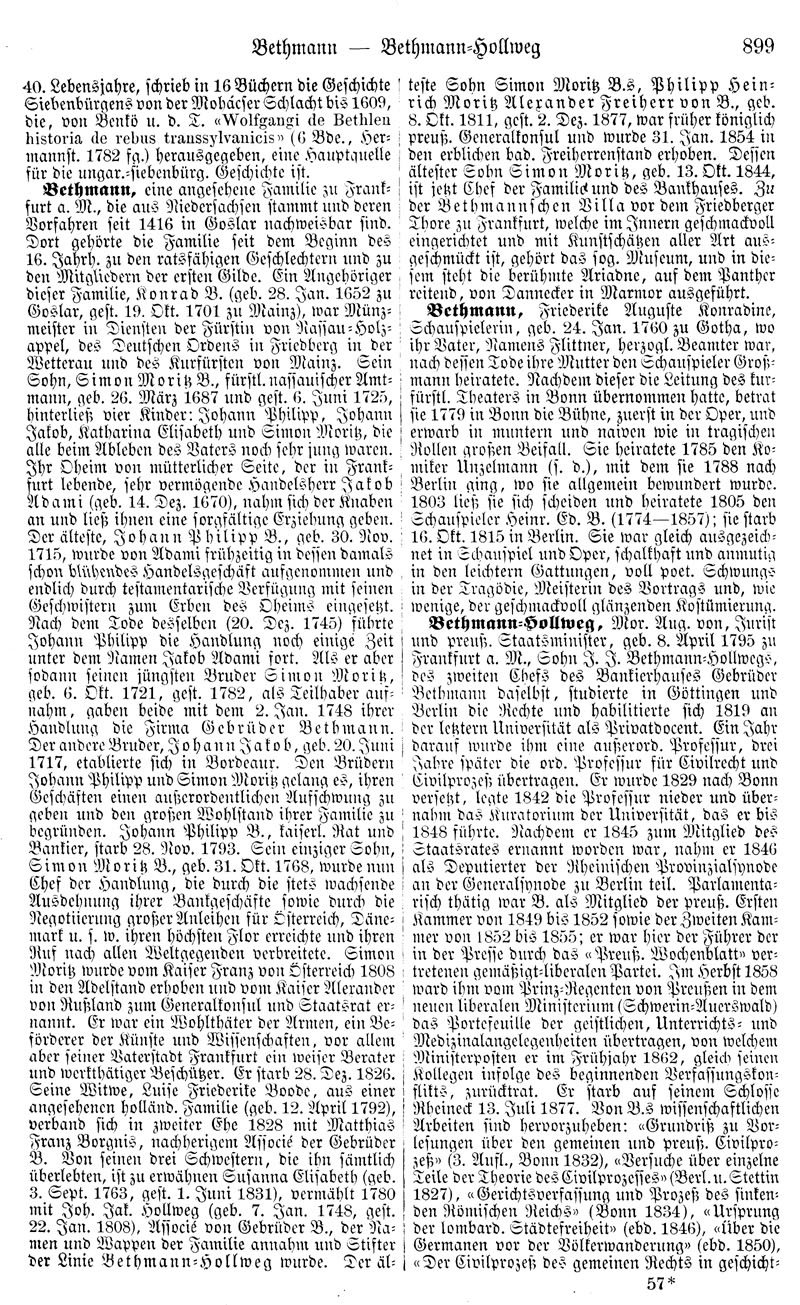
- Brockhaus' Konversationslexikon, volume 2, page 899
- Meyers Großes Konversations-Lexikon 1905, volume 2
- Map segment illustrating Nassau territories until 1800
- French map from 1681 featuring Aschaffenburg
- Information on Carl Ludwig Caesar von Bethmann and his lineage
- ABN AMRO Private Banking timeline detailing the history and merger of the Bethmann bank
- Die Bank, die Goethes Reisen finanzierte by Claudia Wanner, Handelsblatt, published 27 January 2005
- Images of Bethmann park and the Chinese gardens