CDC 1604
| Industry | Computer hardware |
|---|---|
| Founded | April 1, 1957 |
| Founder | Seymour Cray |
| Headquarters | Minneapolis , United States |
| Products | CDC 1604, CDC 924, CDC 160 |
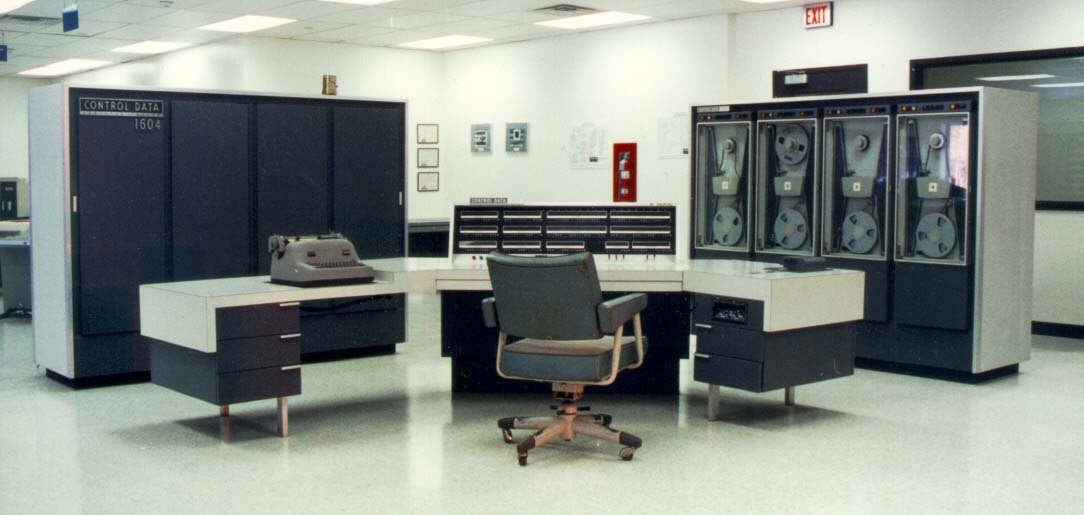
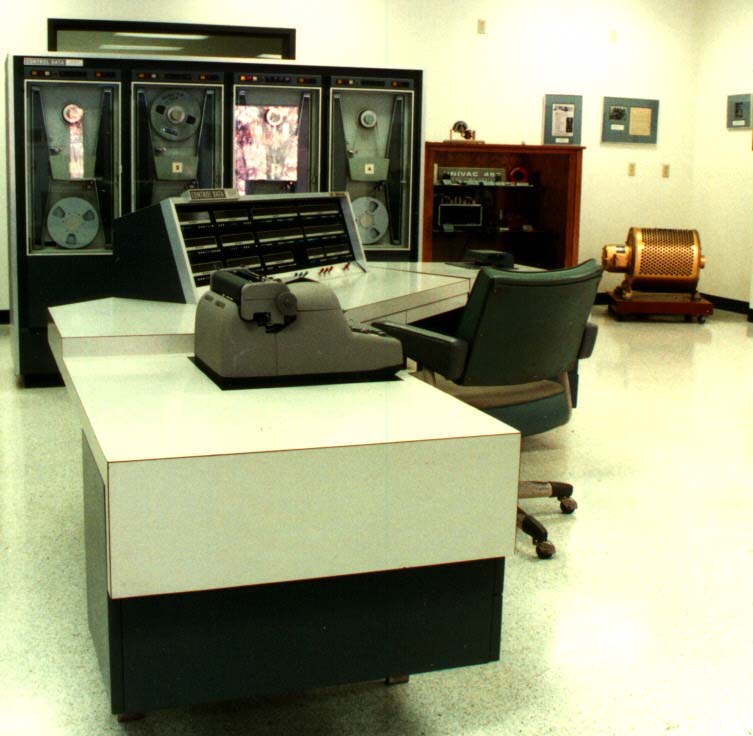
The CDC 1604 is a transistor-based 48-bit computer developed by Seymour Cray and his team at Control Data Corporation (CDC), acknowledged as one of the earliest commercially viable transistorized machines. The model number "1604" is said to reflect the original design objectives of accommodating 16K words of memory and four tape drives.
Shortly thereafter, a reduced 24-bit version named the CDC 924 was created and supplied to NASA.
The initial CDC 1604 system was delivered in January 1960 to the U.S. Navy Post Graduate School, where it was utilized for JOVIAL programming supporting key Fleet Operations Control Centers, mainly for weather forecasting in locations such as Hawaii, London, and Norfolk, Virginia. By 1964, production had exceeded 50 units. Its successor, the CDC 3600, introduced additional operation codes while preserving significant backward compatibility.
During the Cuban Missile Crisis, one CDC 1604 was stationed at the Pentagon’s Defense Atomic Support Agency to simulate possible Soviet missile attacks.
Furthermore, the CDC 160, a 12-bit minicomputer from the same series, often functioned as an input/output processor within CDC 1604 systems. The standalone CDC 160-A is regarded as one of the pioneering minicomputers.
Architecture
| CDC 1604 registers | ||||||||||||||||||||||||||||||||||||||||||||||||||||||||||||||||||||||||||||||
| ||||||||||||||||||||||||||||||||||||||||||||||||||||||||||||||||||||||||||||||
The CDC 1604 is equipped with a magnetic core memory of 32K words, each being 48 bits wide, split into two banks of 16K words. These banks operate out of phase by 3.2 microseconds with a total cycle time of 6.4 microseconds, resulting in an average access latency of approximately 4.8 microseconds. Its processing speed reaches about 100,000 instructions per second.
Each word contains two instructions of 24 bits each, arranged in a format consisting of six bits for the operation code, three bits specifying either an index register or branch condition, and fifteen bits allocated for either memory addressing or shift count.
Within the central processing unit are several registers: a 48-bit accumulator (A), a matching auxiliary arithmetic register (Q) also at 48 bits, a program counter (P) with a width of 15 bits, and six index registers numbered one through six, each holding 15 bits. The Q register commonly works in tandem with A to create a double-length register utilized for multiplication, division, logical functions, and temporary data storage.
Data representation internally employs ones' complement arithmetic. The floating-point numbers are formatted with one bit for sign, eleven biased exponent bits, followed by thirty-six bits for the significand.
An interesting feature is that the three highest-order bits of the accumulator are converted into analog signals routed through an audio amplifier on the console panel. This design allows the machine to produce sound alerts or musical notes to assist with debugging or provide operator notifications.
Uses and applications
In 1960, one of the pioneering text-mining tools, Masquerade, was created for Marathon Oil located in Findlay, Ohio. This system utilized syntactic patterns to conceal words and phrases to facilitate search functions. By 1969, the Fleet Operations Control Center, Pacific (FOCCPAC in Hawaii) implemented an Automated Control Environment (ACE), employing a cluster of five CDC 160A computers to oversee a multitasking network comprising four CDC 1604 machines.
The Minuteman I marked the United States' initial deployment of a solid-fuel ICBM system, incorporating two distinct ground station architectures. The streamlined single silo model housed dual redundant CDC 1604 computer systems equipped with magnetic tape drives, which calculated guidance and targeting data in advance and transferred this information into the missile prior to launch. Replicas of these ICBM ground stations along with CDC 1604 computers are exhibited at the Octave Chanute Aerospace Museum in Illinois.
The third iteration of the PLATO educational platform operated on a CDC 1604-C model.
For programming the CDC 1604, JOVIAL served as the main language, whereas octal notation was employed for shared services on the CDC 160A. The NAVCOSSACT unit at the Washington Navy Yard offered systems support and training.
Additionally, the CDC 1604 played a role in digital art production, contributing to creations by artists such as Sam Schmitt and Stockton Gaines.
Similar machines
The architecture of the CDC 1604 inspired the Soviet nuclear weapons laboratory’s BESM-6 computer, which debuted in 1968. Although it aimed for partial software compatibility with the CDC 1604, the BESM-6 operated at speeds approximately ten times faster and included extra registers.
The 924
The CDC 924 is a 24-bit machine engineered to interface with "any input-output devices capable of communicating with the 160 and/or 1604 computer." It featured six independent channels that permitted three simultaneous input processes alongside three concurrent output operations.
Consistent with several CDC processors, it employed ones' complement arithmetic.
Its notable characteristics comprised a set of 64 instructions, six index registers (with register "7" reserved for indirect addressing), an execute instruction that supported single-instruction subroutines, and robust Storage Search instructions that improved processing efficiency.