CTA-Arsenal
| Company type | Racing automobile project |
|---|---|
| Industry | Automotive |
| Founded | 1945 |
| Founder | Centre for the Study of Automobile and Cycle Technology (CTA) |
| Defunct | 1949 |
| Fate | Project discontinued after racing failures |
| Headquarters | Châtillon , France |
Area served | France |
Key people | Raymond Sommer, Albert Lory, Marcel Paul |
| Products | Single-seater racing automobile |
| Owner | Centre for the Study of Automobile and Cycle Technology (CTA) |
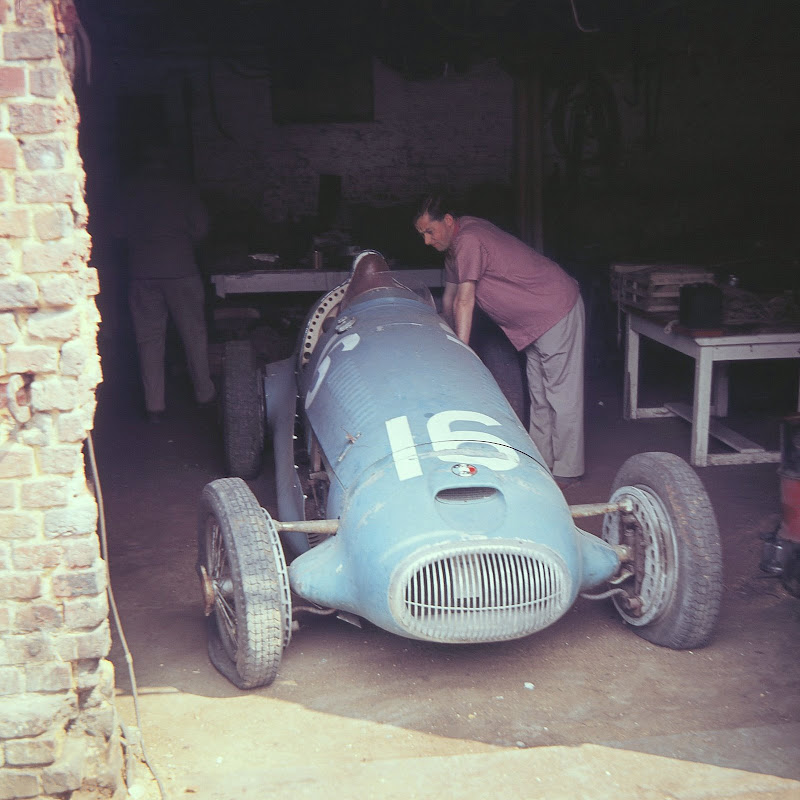
The CTA-Arsenal was a French single-seater racing automobile created by the Centre for the Study of Automobile and Cycle Technology (CTA), presently known as UTAC, and constructed by Arsenal located in Châtillon. Production was limited to just two examples. Conceived as France's official contender against Alfa Romeo in the racing arena, the initiative was discontinued after the vehicle repeatedly failed to complete its competitions.
Origins
In 1945, Raymond Sommer, victor of the Le Mans 24 Hour Race in 1932 and 1933, approached engineers at CTA with a proposal to develop a French racing car. He obtained financial backing from the government through industry minister Marcel Paul to advance the project.
Albert Lory, notable for his engineering contributions to Delage during the 1920s, took charge of the development but concentrated exclusively on the engine design. He openly criticized the chassis and suspension systems, which were widely regarded as the car’s principal weaknesses.
The CTA-Arsenal made its first appearance at the postponed 1947 French Grand Prix held in Lyon, but a transmission malfunction prevented it from starting. In 1948, two vehicles were prepared for the French Grand Prix at Rheims, yet both withdrew prior to the race, which was ultimately won by an Alfa Romeo. The final competitive outing occurred in 1949 before the project was abandoned. Following this, Lory accepted a position as research director at Renault.
Technical
Lory designed a powerful 1,482 cc V8 engine equipped with four overhead camshafts and twin Roots-type superchargers. Initially rated at 215 hp at 6,000 rpm, its output was enhanced to 275 hp at 8,000 rpm by 1948. Despite this impressive powerplant, it was mated to a transmission system that proved unreliable.
The chassis featured independent suspension using longitudinal torsion bars at the front and lateral torsion bars at the rear, incorporating "silent blocks" to allow vertical wheel movement. This configuration resulted in suboptimal handling characteristics on the road. The braking system employed hydraulically actuated drum brakes, while Rudge-Whitworth spoked wheels were fitted.
See also
External links
- CTA-Arsenal at 8W (English)
- Report on the 2010 Monaco Historic Grand Prix at ultimatecarpage.com
- Photo of the CTA-Arsenal at the 2010 Monaco Historic Grand Prix at ultimatecarpage.com (English)
- CTA-Arsenal at diccionario.motorgiga.com (Spanish)
- CTA-Arsenal engine test on YouTube
- 1962 photo of unrestored CTA-Arsenal