
California Central Railway
| Company type | Subsidiary |
|---|---|
| Industry | Railroad |
| Founded | April 23, 1887 |
| Defunct | November 7, 1889 |
| Fate | Merged into Southern California Railway Company |
| Headquarters | San Bernardino , United States |
Key people | George O. Manchester (President) |
| Products | Rail transport services |
| Parent | Atchison, Topeka and Santa Fe Railway (from June 30, 1888) |
The California Central Railway was established on April 23, 1887, with its main office located in San Bernardino, California. The company was led by President George O. Manchester.
At its height, the railway managed a network spanning of track, utilizing 14 steam engines, 14 passenger coaches, and 83 freight wagons. Its operations commenced on May 20, 1887, and continued until November 7, 1889. By the end of 1888, specifically December 31, the railway's worth was appraised at $12.9 million.
On November 7, 1889, the California Central Railway merged with the California Southern Railroad and the Redondo Beach Railway, forming the Southern California Railway Company. Prior to this consolidation, since June 30, 1888, it had functioned as a subsidiary of the Atchison, Topeka and Santa Fe Railway.
Original 1887 lines
The primary routes linked San Bernardino to Los Angeles at La Grande Station, Oceanside to Los Angeles, and High Grove to Orange. Additionally, it operated a segment within Riverside County between Perris and San Jacinto from May 1887 until May 1, 1888. The company also constructed a line stretching from Port Ballona (present-day Playa del Rey) on Santa Monica Bay to Redondo Junction near Boyle Heights in Los Angeles, which opened in September 1887. Redondo Junction later became an essential maintenance center for the railway's rolling stock.
Redondo Beach Railway
Formed in April 1888 and under the control of Henry E. Huntington, the Redondo Beach Railway began service on September 1, 1888. Although California Central Railway operated the route running from Redondo Beach to Inglewood Depot, ownership remained separate. This line played a significant role in promoting tourism by providing access to the newly inaugurated Hotel Redondo in 1890 and included stops at Burwell and Port Ballona. From Inglewood, trains proceeded to downtown Los Angeles utilizing California Central’s tracks through Redondo Junction. The company was incorporated into Southern California Railway on November 7, 1889. Passenger numbers dropped following the launch of the Redondo and Hermosa Beach Railroad streetcar line in 1902.
- Several important rail lines were acquired or controlled by California Central Railway
Riverside, Santa Ana and Los Angeles Railway
This railway was incorporated on September 29, 1885. California Central completed its route from Santa Ana to Los Angeles on August 12, 1888. Furthermore, a separate section measuring between High Grove and Orange was finalized on September 15, 1887. These developments significantly increased California Central’s presence within Southern California’s rail sector.
San Bernardino and San Diego Railway
Incorporated on November 20, 1886, this railway began operations in San Diego County. To fund construction efforts, it issued $4 million in stock. A Victorian-style station was erected in 1887 at what is now the location of San Diego Union Station. Key figures involved included George H. Bonebrake, A. W. Francisco, and M. L. Wicks. The California Central Railway later expanded upon this infrastructure, completing a rail stretch of approximately 35 miles from Santa Ana to San Juan (currently San Clemente) by November 30, 1887. An additional segment of about 15 miles from San Juan to Fallbrook Junction was finished by August 12, 1888. Initially chartered to link Anaheim with San Juan Capistrano, Oceanside, and San Diego, this corridor continues to serve as an integral part of today’s Pacific Surfliner route.
San Bernardino & Los Angeles Railway
Established on November 22, 1886, the San Bernardino & Los Angeles Railway developed a vital rail connection extending from San Bernardino to Duarte. This 38-mile stretch was finalized by the California Central Railway on May 31, 1887. At Duarte, it linked with the Los Angeles and San Gabriel Valley Railroad, which had already obtained rights of way heading eastward. Key stations along this route included Claremont and North Pomona, around which communities such as Rialto and North Cucamonga emerged. This corridor later served as part of the Santa Fe Southwest Chief route until 1994.
Los Angeles and San Gabriel Valley Railroad
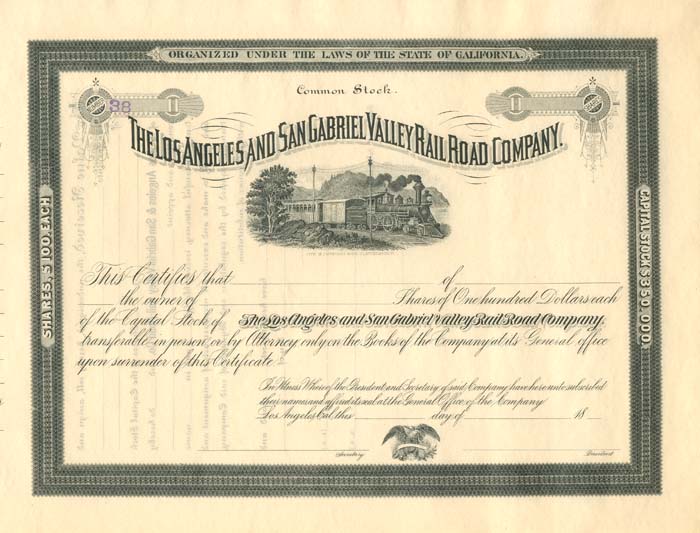
Incorporated on September 5, 1883, the Los Angeles and San Gabriel Valley Railroad celebrated the inauguration of its rail line on September 16, 1885. The track extended from downtown Los Angeles to Lamanda Park in East Pasadena, traversing the Arroyo Seco and passing just north of Garvanza in Highland Park. On May 20, 1887, this railroad was acquired by California Central Railway, which then linked it to the Duarte line, establishing an uninterrupted rail corridor from San Bernardino to downtown Los Angeles through the San Gabriel Valley. Stations along this expanded route included Azusa, Monrovia, Pasadena, and Rancho Santa Anita. The line’s integration with the San Bernardino & Los Angeles Railway facilitated services such as the Southwest Chief, bolstering its regional reach and commercial significance.
San Bernardino Valley Railway
The San Bernardino Valley Railway was formed on January 12, 1887, initiating construction from San Bernardino toward Lugonia (currently Redlands). By December 31, 1887, California Central Railway had completed the 13-mile segment connecting San Bernardino to Mentone. This development further enhanced regional rail infrastructure, promoting economic growth and reinforcing the company’s strategic foothold within Southern California’s railway sector.
San Diego Central Railroad
Incorporated on November 8, 1886, the San Diego Central Railroad constructed a 21-mile rail segment within San Diego County running from Escondido junction to Escondido. Although chartered to extend from San Diego Bay northward through Poway, Escondido, and Oceanside, only the Escondido to Oceanside section was ultimately built by California Central Railway. Service commenced in 1887.
Los Angeles and Santa Monica Railroad
Formed on January 6, 1886, the Los Angeles and Santa Monica Railroad intended to establish a connection between downtown Los Angeles and a terminal on Santa Monica Bay. While construction had not started prior to acquisition, California Central Railway obtained its right of way land. The completed line spanned 18.03 miles and opened on September 7, 1887. It included stops at Ballona Junction, Hyde Park, Inglewood, and Port Ballona. The trip departed Los Angeles at 9:15 a.m., with return service leaving Port Ballona at 4 p.m., lasting approximately one hour each way.
San Jacinto Railway
Incorporated on March 7, 1887 in Riverside County, the San Jacinto Railway was acquired by California Central Railway before any building began. The company secured necessary rights of way for its route. Construction commenced in 1887 on the branch line from Perris to San Jacinto. Operations started on May 20, 1888, marked by the arrival of the first train at Winchester.
Santa Fe
Although prominent figures such as Jay Gould and Collis Potter Huntington opposed it, the Santa Fe Railway successfully extended its line to Los Angeles by May 1887. During the initial 18 months, Santa Fe operated under a costly arrangement, utilizing tracks owned by the Southern Pacific Railroad between Colton and Los Angeles.
On May 20, 1887, the Los Angeles and San Gabriel Valley Railroad was acquired by the California Central Railway, which was a subsidiary of the Atchison, Topeka and Santa Fe Railway. This acquisition linked the railroads at Mud Springs, thereby establishing a continuous route from Chicago to Los Angeles through the San Gabriel Valley. The Santa Fe line continued to serve this corridor until the 1994 Northridge earthquake damaged a critical bridge in Arcadia.
Los Angeles Metro Rail
The right-of-way originally belonging to the Los Angeles and San Gabriel Valley Railroad has been adapted for use by the Los Angeles Metro Rail light rail network. Construction of the Gold Line commenced in the late 1990s along this corridor, with service beginning in 2003.
Expansion efforts resumed in 2013 with Phase 2A of the Gold Line Foothill Extension, which stretches through the San Gabriel Valley and Pomona Valley to reach Azusa. This extension incorporates historic stations such as the 1926-built Monrovia Santa Fe Depot and the site of the Azusa Depot, opening in 2016. Phase 2B further extends the line from Pomona Valley into the San Bernardino Valley.
In June 1887, the California Southern Railroad was consolidated into the California Central Railway Company. Following a downturn in the land boom, a merger occurred in 1889 combining California Southern Railroad, California Central Railway, and Redondo Beach Railway into the Southern California Railway Company. At that time, maintenance facilities were relocated to San Bernardino while administrative headquarters were established in Los Angeles.
See also
- List of California railroads
- History of Trains in Pasadena
- History of rail transportation in California
- Cajon Pass
- Colton Crossing
- Southern Transcon
- Union Station (Los Angeles)
- Rancho Santa Anita Depot
- Pacific Electric's Red Cars connecting with these rail lines
- Santa Fe 3751
- David B. Jones Special
- Redondo Junction train wreck
References
External links
- Reading
- Psrm.org: History of California Southern Railway
- "The Los Angeles and San Gabriel Valley Railroad." by Hoyt, Franklyn., Pacific Historical Review 20 (August 1951): 227-239
- Californiagenealogy.org: Railroads in San Bernardino County, California
- Abandonedrails.com: The Second District of AT&SF Abandoned Rail Lines
- monroviacc.com: Monrovia at 125—“Trees, Trains, Troubles, and Triumphs,” by Steve Baker
- Archive.org: Pomona Valley History with Biographies of Key Figures; Historic Record Company, Los Angeles, Calif. 1920
- LA Magazine CityDig: "Monrovia's 1887 Real Estate Bubble" by Glen Creason; February 12, 2014
- Images
- Articles with short description
- Predecessors of the Atchison, Topeka and Santa Fe Railway
- Defunct California railroads
- History of Los Angeles County, California
- History of Orange County, California
- History of Riverside County, California
- History of San Bernardino County, California
- History of San Diego County, California
- Companies based in San Bernardino County, California
- American companies established in 1887
- Railway companies established in 1887
- Railway companies disestablished in 1889
- 1887 establishments in California
- 1889 disestablishments in California
- 19th century in Los Angeles
- American companies disestablished in 1889
- 4
- Companies of the United States by year of establishment