
Chicago, Rock Island and Pacific Railroad
| Company type | Railroad |
|---|---|
| Industry | Rail transport |
| Predecessor | Rock Island and La Salle Railroad Company, Chicago and Rock Island Railroad, Mississippi and Missouri Railroad Company |
| Founded | 1847-02-27 |
| Defunct | 1980-03-31 |
| Fate | Liquidation |
| Headquarters | Chicago , United States |
Area served | Arkansas, Colorado, Illinois, Iowa, Kansas, Louisiana, Minnesota, Missouri, Nebraska, New Mexico, Oklahoma, South Dakota, Texas, Tennessee |
Key people | Ransom Reed Cable (President 1883–1902), John Dew Farrington (President 1948–1955), John W. Ingram (CEO 1975) |
| Products | Freight and passenger rail transport |
The original Chicago, Rock Island and Pacific Railroad (commonly referred to as CRI&P RW, the Rock Island Line, or simply The Rock) was a prominent Class I railroad in the United States. By the year 1970, it managed 7,183 miles of mainline track across 10,669 miles of total track, transporting 20,557 million ton-miles of freight revenue and covering 118 million passenger miles.
Formation
The company’s beginnings are linked to the Rock Island and La Salle Railroad Company, which was chartered in Illinois on February 27, 1847. In 1851, it was renamed the Chicago and Rock Island Railroad. Construction commenced in Chicago in October of that year and by February 1854, the line had reached the Mississippi River at Rock Island, establishing the first rail connection between Chicago and the river.
To facilitate westward expansion, the founders created the Mississippi and Missouri Railroad Company (M&M) in Iowa in 1853 to connect Davenport with Council Bluffs. The inaugural train in Iowa operated between Davenport and Muscatine in 1855. A significant milestone was achieved in April 1856 with the completion of the Mississippi River bridge linking Rock Island and Davenport.
An important legal case arose after a steamboat collided with this bridge in 1857; Abraham Lincoln represented the railroad's interests, advocating for infrastructure development over navigational objections.
In 1866, C&RI absorbed M&M to form the Chicago, Rock Island and Pacific Railroad Company. Under leaders such as President Ransom Reed Cable (1883–1902), the railroad expanded through both new construction and acquisitions. The company retired its final steam locomotive in 1953.
Service Area
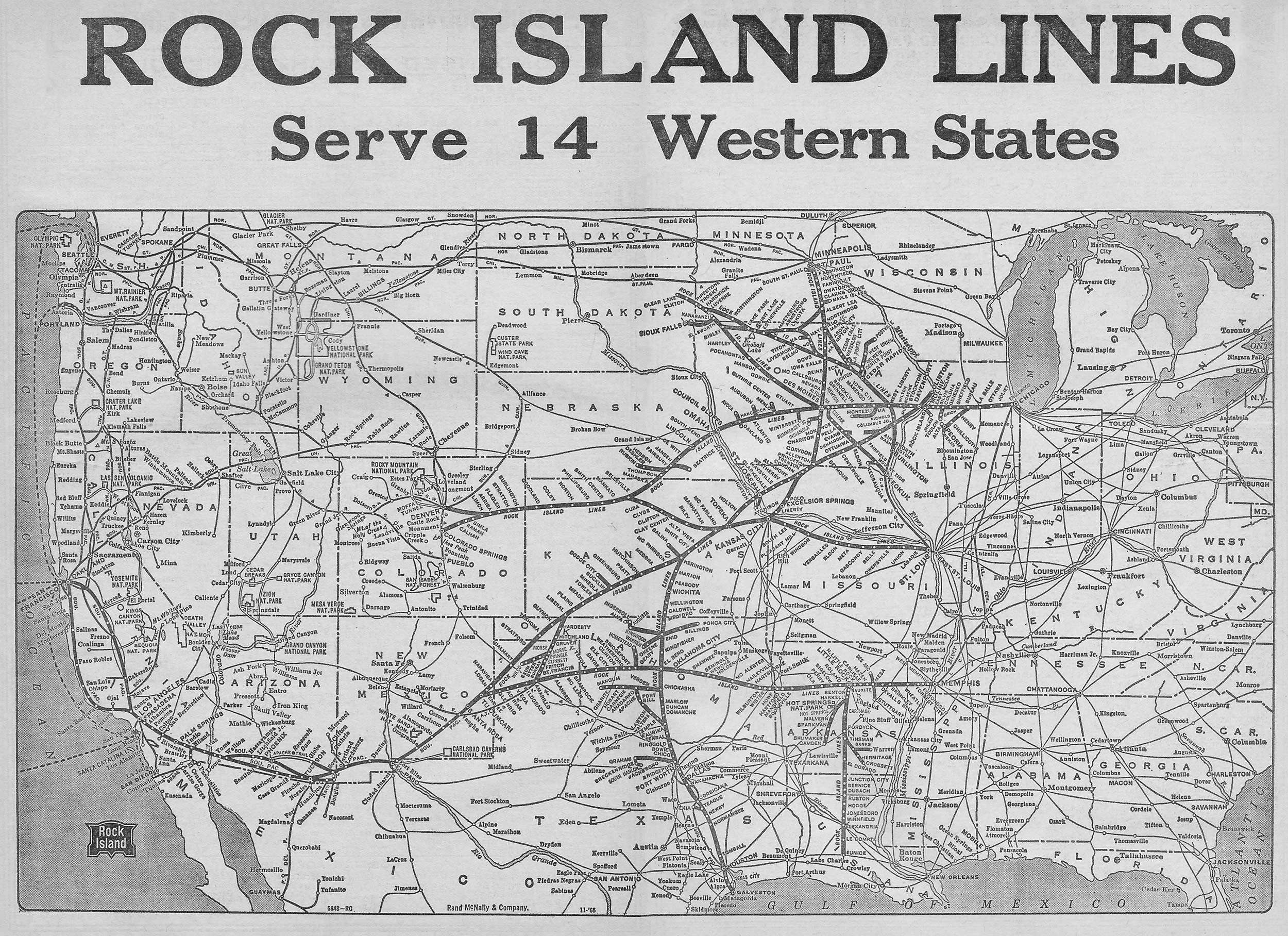
The Rock Island network extended across Arkansas, Colorado, Illinois, Iowa, Kansas, Louisiana, Minnesota, Missouri, Nebraska, New Mexico, Oklahoma, South Dakota, and Texas. Its eastern endpoint was Chicago, stretching westward to Denver, Colorado and Santa Rosa, New Mexico; southward reaching Galveston, Texas and Eunice, Louisiana; northward up to Minneapolis, Minnesota; and eastward to Memphis, Tennessee. Major routes included Minneapolis to Kansas City, Missouri via Des Moines; St. Louis to Santa Rosa through Kansas City; Herington to Galveston passing Fort Worth and Dallas; and Santa Rosa to Memphis. The most heavily trafficked segments were between Chicago–Rock Island and Rock Island–Muscatine.
Intercity Passenger Operations
Rock Island offered extensive passenger services on routes such as Chicago-Los Angeles, Chicago-Denver, Memphis-Little Rock-Oklahoma City-Tucumcari, and Minneapolis-Dallas. In 1937, it launched six lightweight diesel-powered Rocket streamliners. From 1902 until 1968, it co-operated the Golden State Limited (Chicago–Los Angeles) alongside Southern Pacific. Following Southern Pacific’s withdrawal of its planned trainset for the Golden Rocket, the service was relaunched as the streamlined Golden State in 1948. This train maintained first-class amenities until its final journey in 1968.
On the Chicago-Denver corridor, competing with Chicago, Burlington and Quincy Railroad’s Zephyrs, Rock Island ran the Rocky Mountain Rocket, which divided at Limon, Colorado. It received streamlined equipment in 1948 but was gradually shortened starting in 1966 before being renamed the Quad Cities Rocket in 1970.
Other significant Rocket trains included the Corn Belt Rocket (Chicago–Des Moines–Omaha), Twin Star Rocket (Minneapolis–Houston), Zephyr Rocket (Minneapolis–St. Louis), and Choctaw Rocket (Memphis–Amarillo).
By the time Amtrak was established in 1971, Rock Island operated only two intrastate Illinois trains: the Peoria Rocket and the Quad Cities Rocket. Due to high entrance fees calculated from its 1970 passenger mileage figures, Rock Island chose not to join Amtrak and continued running these services with state subsidies until Illinois ended funding in 1978, which brought an end to its intercity passenger operations.
Chicago commuter operations
The Rock Island provided comprehensive commuter rail service in the Chicago area, running from LaSalle Street Station to Joliet with an additional branch extending to Blue Island. Early operations utilized Pacific-type steam engines alongside "Capone" light-heavyweight coaches dating back to the late 1920s. The transition to diesel power introduced EMD FP7s, ALCO RS-3s, Fairbanks-Morse locomotives, and air-conditioned Pullman cars by 1949. Efforts to modernize the fleet in the 1960s included the acquisition of secondhand Aerotrains and bilevel passenger cars powered by locomotives equipped with head-end power.
During the 1970s, neglect in upkeep resulted in deteriorated track conditions and aging equipment. Financial aid from Illinois’ Regional Transportation Authority in 1976 enabled the procurement of new Budd bilevel cars and EMD F40PH locomotives by 1978. Following Rock Island’s closure in 1980, Chicago and North Western briefly assumed commuter operations until the RTA took direct control in 1981. Today, this service operates under Metra’s Rock Island District.
Challenges to Rock Island’s longevity
Under John Dew Farrington’s presidency (1948–1955), Rock Island reached its zenith but subsequently encountered stagnant revenues coupled with rising expenses. Its service territory largely overlapped with rivals such as Chicago, Burlington and Quincy Railroad, which operated longer routes, limiting expansion opportunities. The mechanization of agriculture diminished local grain shipments, intensifying competition for western-bound freight at Omaha.
Attempts to grow through mergers with regional railroads like Chicago & North Western or Milwaukee Road were unsuccessful. In 1964, Rock Island pursued a merger with Union Pacific (UP) aiming to establish a major Chicago-to-West Coast rail network.
The Union Pacific-Rock Island merger proceedings
After a decade-long review by the Interstate Commerce Commission (ICC), Administrative Law Judge Nathan Klitenic endorsed a plan dividing Rock Island’s assets: most lines would be absorbed by UP; the Kansas City-Tucumcari route assigned to Southern Pacific; Memphis-Amarillo line transferred to Santa Fe; and the Denver-Kansas City corridor offered to Rio Grande.
During these negotiations, Rock Island reduced maintenance and passenger services to conserve funds but declined UP’s proposal to reroute interchange traffic from Denver to Omaha. By 1974, worsening infrastructure rendered Rock Island unattractive; UP ultimately abandoned merger plans due to financial burdens and restrictive ICC conditions.
Klitenic’s ambitious restructuring concept was ahead of its era; comparable consolidations only materialized decades later through megamergers forming BNSF and modern Union Pacific as dominant western carriers.
Rock Island’s final survival effort
Renamed "The Rock" in 1975 under new CEO John W. Ingram—a former FRA official—the railroad pursued operational efficiencies and secured FRA-backed rebuilding loans but filed for bankruptcy again on March 17, 1975. Receiver William M. Gibbons concentrated on grain traffic, channeling Midwest agricultural products toward Galveston port.
Investments included acquiring new powder blue-and-white locomotives, initiating track rehabilitation programs to address years of deferred maintenance, and launching a marketing campaign highlighting "The Rock." Despite approaching profitability in the late 1970s amid economic difficulties, competing railroads lobbied against FRA loans fearing renewed competition.
Labor tensions escalated when the Brotherhood of Railway and Airline Clerks (BRAC) initiated a strike in August 1979 demanding back pay. Although management continued limited operations—handling roughly 30% of prestrike freight volume—the ICC declared a transportation emergency under directives from the Carter administration due to concerns over grain shipments.
Consequently, the ICC authorized Kansas City Terminal Railway (KCT) to assume operations. On January 24, 1980, bankruptcy judge Frank J. McGarr ordered the railroad’s closure and liquidation; Ingram resigned as president while Gibbons oversaw asset disposition.
Final freight services ended on March 31, 1980, with equipment assembled for sale.
Legacy
Following the dissolution of Rock Island, its properties were either sold off or dismantled. Under the leadership of William M. Gibbons, more than $500 million was generated through asset liquidation, enabling the full repayment of creditors at their original value plus accrued interest—thus confirming investor Henry Crown’s earlier advocacy for liquidation.
Various railroads took over different portions of the network: the Chessie System leased the Blue Island to Bureau Junction segment; Chicago & North Western acquired the Twin Cities to Kansas City route; Cotton Belt assumed control of the Tucumcari to St. Louis line; Oklahoma, Kansas & Texas Railroad purchased the Herington to Fort Worth section; and Iowa Interstate Railroad obtained the Peoria-Bureau Junction to Omaha stretch.
After liquidation, the remaining corporate structure was renamed Chicago Pacific Corporation and shifted focus toward consumer goods, acquiring companies such as Hoover before being absorbed by Maytag in 1988.
Union Pacific ultimately gained ownership of more former Rock Island tracks than initially intended in the unsuccessful merger bid, with the exception of the Chicago to Omaha mainline, which is now operated by Iowa Interstate Railroad.
The railroad's legacy extends into popular culture, inspiring the well-known song "Rock Island Line" and influencing the television series Petticoat Junction.
The former Rock Island Line Workshop located in Silvis, Illinois—once the largest maintenance facility for the railroad—is presently under the stewardship of Railroading Heritage of Midwest America (RRHMA), a nonprofit organization committed to preserving historic rolling stock and creating a museum.
Reestablishment
In 2017, a new enterprise claiming rights to the Chicago, Rock Island and Pacific name commenced operations as a shortline holding company providing railroad management services. This company acquired the Mississippi Delta Railroad in early 2019 but does not possess any original historic locomotives or track infrastructure.
Company officers
Prominent presidents throughout the company's history include:
- James W. Grant (1850–1851)
- John Bloomfield Jervis (1851–1854)
- Henry Farnam (1854–1863)
- Charles W. Durant (1863–1866)
- John F. Tracy (1866–1877)
- Hugh Riddle (1877–1883)
- Ransom Reed Cable (1883–1898)
- Warren G. Purdy (1898–1901)
- William Bateman Leeds (1901–1904)
- Benjamin L. Winchell (1904–1909)
- Henry U. Mudge (1909–1915)
- Jacob McGavock Dickinson (receiver trustee during bankruptcy, 1915–1917)
- James E. Gorman (1917–1933)
- Joseph B. Fleming and others, receiver trustees during bankruptcy (1933–1947)
- John Dow Farrington (1948–1955)
- Downing B. Jenks (1956–1961)
- R. Ellis Johnson (1961–1964)
- Jervis Langdon Jr. (1965–1970)
- William J. Dixon (1970–1974)
- John W. Ingram (1974–1980)
- William M. Gibbons (receiver trustee during bankruptcy, 1975–1984)
See also
- Chicago, Rock Island and Gulf Railway
- El Comedor
- Grand Excursion
- Iowa Interstate Railroad
- Joseph E. Sheffield
- LaSalle Street Station
- RailsWest Railroad Museum
- Rock Island Rockets
Further reading
External links
- Rock Island System map, 1966
- The Rock Island Line
- The Rock Island In Arkansas
- Rock Island System Map, 1885
- Encyclopedia of Oklahoma History and Culture - Chicago, Rock Island, and Pacific Railroad
- Oklahoma Digital Maps: Digital Collections of Oklahoma and Indian Territory
- Chicago, Rock Island & Pacific Railroad LLC
- Guide to Oral Opinion of Hon. Smith McPherson in the Case of the United States vs. Chicago, Rock Island, and Pacific Railway Company 1908 at the University of Chicago Special Collections Research Center
- Wheels of Progress, 1950
- Articles with short description
- Chicago, Rock Island and Pacific Railroad
- Defunct companies based in Chicago
- Former Class I railroads in the United States
- Defunct Arkansas railroads
- Defunct Colorado railroads
- Defunct Illinois railroads
- Defunct Iowa railroads
- Defunct Kansas railroads
- Defunct Louisiana railroads
- Defunct Minnesota railroads
- Defunct Missouri railroads
- Defunct Nebraska railroads
- Defunct New Mexico railroads
- Defunct Oklahoma railroads
- Defunct South Dakota railroads
- Defunct Tennessee railroads
- Defunct Texas railroads
- Railroads in the Chicago metropolitan area
- Standard-gauge railways in the United States
- Rock Island, Illinois
- Railway companies established in 1866
- Railway companies disestablished in 1880
- Railway companies established in 1947
- Railway companies disestablished in 1980
- 1866 establishments in the United States
- American companies established in 1947
- American companies established in 1866
- American companies disestablished in 1880
- 4
- Companies of the United States by year of establishment