
DC100
| Company type | Storage medium format |
|---|---|
| Industry | Computer storage |
| Founded | 1976 |
| Founder | Hewlett-Packard, 3M |
| Products | Tape cartridge format |
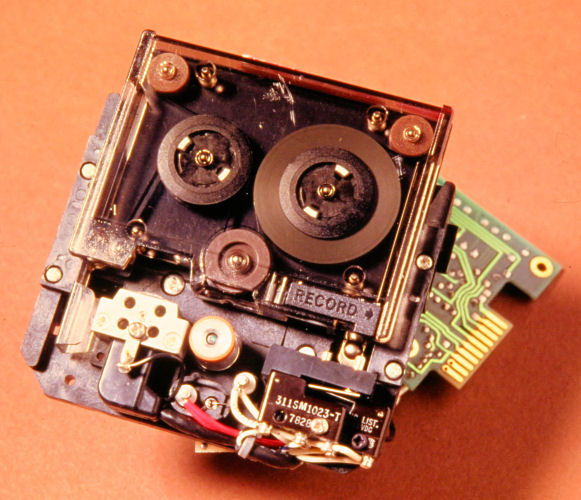
DC100 (also referred to as DC100A) represents a tape cartridge format jointly developed by Hewlett-Packard and 3M, launched in mid-1976 as a storage medium for the HP 9820 programmable calculator. This cartridge was essentially a compact adaptation of 3M's DC300 tape cartridge and served as an early iteration of the QIC Mini Cartridge. While 3M was the sole provider of DC100 tapes, the tape drives were manufactured both by 3M and several other companies.
History
Throughout the late 1970s and into the early 1980s, the DC100 format found use in various HP desktop calculators and computer systems, including models such as the 9815, 9825, 9845, HP Series 80, and the HP 2640 terminal line. Tape transport mechanisms were produced by manufacturers including 3M, North Atlantic Qantex, Instrumentation Technology Corporation, and Beehive International.
Although initially adopted within HP product lines, the DC100 format saw limited acceptance outside HP approximately four years post-release. Nevertheless, in 1981, Computer Automation's LSI-2 minicomputers incorporated DC100 compatibility through Telegenix's TDCA-100 tape transport. Later, in 1984, Irwin Magnetic Systems introduced the Irwin 210 tape backup device which supported DC100 tapes.
Digital Equipment Corporation created a variant known as the DC150 cartridge—an enhanced capacity version of DC100—utilized in DEC's DECtape II drives. Subsequently, HP developed the DC200 cartridge based on the DC100 design but employed narrower tape to boost storage capacity.
Specifications
| Attribute | DC100(A) | DC300 |
|---|---|---|
| Launch year | 1976 | 1972 |
| Raw capacity | 2.6 MB | 2.9 MB |
| Formatted capacity[lower-alpha 1] | 560 KB | 2.5 MB |
| Data transfer rate | 48 Kbit/s | 48 Kbit/s |
| Tape length | 140 feet (43 m) | 300 feet (91 m) |
| Tape width | 0.15 inches (0.38 cm) | 0.25 inches (0.64 cm) |
| Cartridge dimensions (3M-produced) |
4 by 3 by 4 inches (10.2 cm × 7.6 cm × 10.2 cm) | 4 by 10 by 7 inches (10 cm × 25 cm × 18 cm) |
| Number of tracks | 2 | 4 |
| Recording density (ftpi) | 3200 | 3200 |
| Coercivity (Oersted) | 310 | 310 |
- Additional Details
- Innovations by 3M
- Precision in base plate flatness and guide-post alignment ensured stable tape movement and prevented signal loss.
- The surface finish of guide-posts was optimized to balance wear resistance with reduced stiction, minimizing speed fluctuations.
- Internal lubrication combined with a plastic drive belt inside the cartridge was essential for dependable performance.
- Enhancements introduced by HP over the original design
- Substituted lubricant-reliant belt-roller friction with robust axles and Teflon-infused plastic rollers, removing the need for lubrication.
- Elevated minimum tape tension at the read/write head while decreasing the torque required to rotate the drive puck.
- Incorporated optical sensors to detect cartridge insertion and write protection status, improving operational reliability and user convenience.
External links
- Photograph of DC100 drive at HP9825.com
Cite error: <ref> tags exist for a group named "lower-alpha", but no corresponding <references group="lower-alpha"/> tag was found