
Dbx (noise reduction)
| Company type | Private |
|---|---|
| Industry | Audio technology, Noise reduction |
| Founded | 1971 |
| Founder | David E. Blackmer |
Area served | North America and other regions (for dbx-TV) |
Key people | David E. Blackmer (founder) |
| Products | Noise suppression techniques (dbx Type I, Type II, dbx-TV), Dynamic Noise Reduction (DNR) technologies |
Template:Lowercase title
Template:Expand Russian

dbx refers to a collection of noise suppression techniques created by the namesake company. The most widely recognized variants are dbx Type I and Type II, primarily designed for analog tape recording, with occasional use on vinyl LPs. Another distinct variation, called dbx-TV, forms part of the MTS standard, delivering stereo audio to TV broadcasts in North America and selected other regions. Additionally, dbx, Inc. contributed to the development of Dynamic Noise Reduction (DNR) technologies.
History

The initial dbx Type I and Type II systems utilized a method known as "linear decibel companding", which compresses audio signals during recording and expands them upon playback. This approach was pioneered by David E. Blackmer at dbx, Inc. in 1971.
In 1982, a compact dbx Type II decoder integrated circuit was developed for portable and automotive audio applications. Despite its innovation, only a limited number of products incorporated this chip, including select Panasonic portable cassette players and Sanyo car audio units. To enable compatibility with players lacking built-in dbx decoders, dbx introduced the PPA-1 Silencer, an external decoder usable with devices such as the Sony Walkman. Another variant of this chip also featured a noise reduction decoder compatible with Dolby B, termed dbx Type B noise reduction; this became feasible after expiration of Dolby's patent rights (though not its trademark).
There have also been software-based implementations created.
Tape hiss
Magnetic tape recording relies on tiny particles capable of retaining magnetic charges to capture audio signals. The particle size and tape transport speed determine the highest frequency that can be recorded. For high-quality sound reproduction, reel-to-reel audio tape recording commonly uses tape speeds of 15 or 7.5 inches per second (38 or 19 cm/s), which consumes more tape length per recording duration. Lower quality recordings may employ slower speeds such as 3.75 or even 1.875 ips, allowing extended recording time but increasing high-frequency noise presence.
The cassette tape format prioritized portability over sound fidelity, operating at 1.875 ips (4.75 cm/s) to maximize recording duration on smaller tapes compared to open-reel formats. This slower speed caused pronounced tape hiss. Coupled with narrow tape width—which restricts the dynamic range—the hiss often masked higher frequency details in recordings, especially those at low volume levels.
In the 1970s, advancements introduced new magnetic tape formulations like "chrome" and "metal," featuring smaller particles that shifted tape hiss toward higher frequencies. Concurrently, noise reduction methods such as dbx and Dolby sought to mitigate tape noise electronically while using standard media types.
Companding

The dbx Type I and Type II systems represent forms of "companding noise reduction." These methods operate by initially compressing the signal's dynamic range to fit within the limitations of tape recording. This process, known as dynamic range compression, reduces the volume of loud sounds while boosting softer ones, resulting in a more uniform overall loudness. Upon playback, the dynamic range is expanded equivalently, restoring quiet sounds to their original low levels and louder sounds to their higher levels. This dual process of compression followed by expansion is what gives rise to the term companding. Beyond noise reduction applications, companding proves beneficial when a recording medium’s dynamic capacity is insufficient; for example, a cassette tape may only accommodate about 40 decibels of dynamic range before saturation occurs, whereas an original source such as a live concert might span 70 decibels. Applying a 2:1 companding ratio compresses this to approximately 35 decibels, allowing it to be recorded without distortion.
The effectiveness of this approach in reducing noise stems from the nature of tape hiss, which appears as a steady low-level background sound. Without compression, this hiss can be as loud as quieter parts of the audio signal, effectively masking them. Compressing the signal prior to recording raises the volume of these soft sounds above the noise floor, enhancing the signal-to-noise ratio.
During playback, both the signal and tape hiss are expanded together, increasing their volumes simultaneously. Nevertheless, the relative proportion between signal and noise remains nearly constant throughout this cycle, preserving an improved signal-to-noise ratio. Consequently, although tape hiss becomes louder during quieter passages after expansion, the recording’s audio level remains sufficiently higher to render the hiss far less intrusive.
Pre-emphasis
Tape hiss primarily affects higher frequency ranges. Therefore, signals dominated by low frequencies often do not require extensive noise reduction measures. In such cases, applying a low-pass filter to attenuate higher frequencies can substantially diminish hiss.
Consider an audio passage containing both loud and soft segments. During recording with companding, these segments are compressed so their levels are closer together; this prevents saturation during loud parts and raises quieter sections above tape hiss. On playback, louder segments experience minimal attenuation, leaving tape hiss at its natural volume. Softer segments, however, are reduced back to their original level by expansion, which concurrently lowers the volume of tape hiss.
This fluctuation in hiss volume during playback is known as "breathing," named for its resemblance to the sound of someone breathing into a microphone. While this effect is less noticeable when high-frequency content overlays the hiss, it becomes more apparent with predominantly low-frequency signals.
To mitigate breathing artifacts, dbx employs pronounced high-frequency "pre-emphasis" on the input signal before compression. This process boosts high-frequency components so that the compressor reduces gain more selectively, minimizing audible noise modulation. Despite this pre-emphasis technique, noise modulation may still be perceptible when using media with inherently high noise levels—such as standard cassette tapes.
dbx I and II
The dbx Type I system is designed for use with professional-grade recording media that offer a signal-to-noise ratio (S/N), prior to noise reduction, of at least 60 dB and a -3 dB frequency response spanning from 30 Hz to 15 kHz. This system depends on the recording medium maintaining a relatively linear response in terms of both volume and frequency.
Conversely, dbx Type II targets noisier media characterized by lower S/N ratios and a more limited frequency response. Within the control signal pathway, the Type II process attenuates both high and low frequencies to reduce sensitivity to frequency response inaccuracies. Because this roll-off occurs solely in the control path, it does not influence the audible output. Additionally, the dbx Type-II "disc" mode found on consumer dbx decoders introduces an extra 1–3 dB low-frequency roll-off affecting both audio and control paths. This feature safeguards against audible mistracking caused by record warping and low-frequency rumble.
Both Type I and Type II systems employ 2:1 companding, delivering identical noise reduction levels and dynamic range enhancements. Although they achieve comparable results, the two types are mutually incompatible.
dbx versus Dolby
Both dbx and the Dolby noise-reduction system utilize companding techniques to manage noise; however, they differ significantly in their approach to frequency response during companding. dbx applies a uniform frequency pre-emphasis across the spectrum, whereas Dolby implements four distinct pre-emphasis amplifiers, each tailored to specific frequency bands. Given that tape hiss predominantly affects high frequencies, Dolby applies considerably stronger pre-emphasis at these higher frequencies compared to lower ones. As a result, low-level signals at low frequencies may undergo minimal or no companding, while signals at high frequencies of equivalent volume receive substantial pre-emphasis before compression.
This segmented pre-emphasis strategy enables Dolby to apply less overall compression than dbx’s consistent 2:1 ratio. For example, Dolby might avoid compressing low-frequency signals such as speech entirely. In contrast, dbx continues to compand these signals, causing tape hiss to be re-expanded during playback and varying dynamically with volume changes.
Limited market adoption of dbx
Despite offering enhanced dynamic range and reduced noise for cassette tapes, dbx noise reduction failed to gain broad consumer acceptance. One major issue was that recordings compressed with dbx sounded unacceptable when played on equipment lacking dbx decoding capability. At the time of dbx’s introduction, Dolby B was already widely established. Although Dolby also employed companding, its compression and expansion levels were mild enough that Dolby-encoded tapes remained listenable on non-Dolby players.
- In professional contexts, dbx Type I found significant use, especially within "semi-pro" formats such as half-inch 8-track and one-inch 16-track tape systems.
- Tascam integrated dbx Type II into their Portastudio series of four-track cassette recorders, which became popular among home recording enthusiasts.
- A notable advantage of both dbx Type I and II over Dolby noise reduction was their lack of requirement for calibration with the tape deck’s output level—a process that could lead to improper tracking and muffled high frequencies in Dolby B and C systems.
- However, due to its aggressive compression and pronounced high-frequency pre-emphasis, tapes encoded with dbx were nearly unplayable on non-dbx devices. Playback without decoding resulted in harsh sound quality and significant dynamic inconsistencies with fluctuating audio levels.
Although the dbx Type-II noise reduction was eventually implemented within a dedicated LSI chip, the necessity for extremely precise voltage-controlled amplifiers (VCAs) and Root Mean Square (RMS) signal analysis kept production costs high. This complexity discouraged manufacturers from incorporating dbx chips into their products.
dbx applied to vinyl phonograph records
The dbx noise reduction system was also implemented on vinyl records, which were marketed under the name dbx disc.[1] Although some sources suggest the earliest releases date back to 1971/1973Template:Fix/category[citation needed], the highest volume of releases occurred between 1977 and 1978Template:Fix/category[citation needed] and continued until approximately 1982.[2] According to Billboard in August 1981, the number of dbx-encoded album releases was projected to near 200.[3] Discogs lists about 1100 such albums.[2] When used on LPs, the dbx Type-II system significantly minimized the audibility of dust and scratches, reducing them to faint pops or clicks—often imperceptible—and entirely removed record surface noise. Theoretically, dbx encoded LPs offered a dynamic range reaching up to 90 dB.[4] Moreover, dbx LPs were pressed exclusively from original master tapes without using any copies and utilized heavy, virgin vinyl for production. Most of these records were issued in limited runs and commanded premium prices.
dbx integration with professional reel-to-reel tape recorders and other commercial audio applications
The dbx K9 noise reduction module was engineered to be compatible with the professional Dolby-A series A-361 frames, which were widely adopted in professional reel-to-reel recording studios at that time.
Its full model number is K9-22—a playful reference contrasting dogs and cats. The K9-22 card matches pin configurations and physical dimensions of the Dolby module commonly referred to as Cat. 22 (with K9 pronounced as "canine").
The dbx 192 represented a refined design tailored specifically for the Nagra IV-Stereo recorder. Featuring a single push-button to toggle encoding and decoding during recording or playback, it was seamlessly integrated into the Nagra’s internal signal chain and powered directly from the recorder’s power supply.
dbx technology in television broadcasting
While sharing some characteristics with Type I and Type II systems, dbx-TV noise reduction differs fundamentally and was developed in the early 1980s by Mark Davis (then affiliated with dbx, now part of Dolby Labs).
dbx-TV technology forms a component of multichannel television sound (MTS), which is the U.S. standard for stereo analog television broadcasting. Initially, all MTS decoding equipment required royalty payments—first to dbx, Inc., then to THAT Corporation, which was spun off from dbx in 1989 and acquired MTS patents in 1994. These patents expired globally in 2004.[5]
dbx in motion picture production
The dbx noise reduction system, which offers noise attenuation exceeding 20 dB, was implemented during the re-recording process of the 1979 film Apocalypse Now. In contrast, Dolby's A-type noise reduction, delivering only 10-12 dB of noise suppression, was applied exclusively during the final mastering phase for the film’s 70mm soundtrack prints.
An adapted variant of dbx found application in the Colortek stereo film technology. Furthermore, dbx Type-II noise reduction played a vital role in MCA’s Sensurround Special Effects System, specifically within the Model-II and Model-III versions, where it was utilized on the optical audio track as a fundamental component. The Sensurround+Plus system by MCA, featured on the film Zoot Suit, incorporated dbx Type-II alongside a 4-track magnetic sound format on 35mm film prints. This combination enabled the movie to deliver a stereo soundtrack characterized by an extensive dynamic range and minimal noise interference.
dbx in program distribution via NPR’s Public Radio Satellite System
The initial generation of the Public Radio Satellite System (PRSS), launched in 1979 and employed by the American National Public Radio for satellite transmission of network programming to affiliate stations, operated as a single channel per carrier (SCPC) system with approximately 40 dB of analog signal-to-noise ratio. To enhance the system’s dynamic range, dbx modules configured with a 3:1 compression ratio were utilized. While generally effective, these modules introduced distortion exceeding 10 percent total harmonic distortion (THD) at certain low frequencies. Additionally, inconsistencies in how dbx modules tracked compressed audio resulted in expanded audio that did not perfectly replicate the original compressed signal from uplink. Nevertheless, employing dbx contributed to NPR’s reputation for superior audio fidelity on its satellite network, attracting commercial broadcasters who relied on NPR to uplink high-quality music programs and concerts during the analog era. Many of these challenges were addressed when PRSS upgraded to its second-generation system in 1994—the Satellite Operations Support System (SOSS)—which transitioned to digital feed transmission.
See also
- Dolby noise reduction system
- CX noise reduction system
- High Com noise reduction system
- UC noise reduction system
Further reading
- Manual of Analogue Sound Restoration Techniques, authored by Peter Copeland, published by The British Library Sound Archive (www.bl.uk) in London, UK, February 2009 (originally September 2008), edited by Gert Redlich and accessible via Deutsches Hifi-Museum, Wiesbaden, Germany. See Chapter 9: Reciprocal noise reduction. Note: While this resource reflects a predominantly British viewpoint, it remains highly informative.
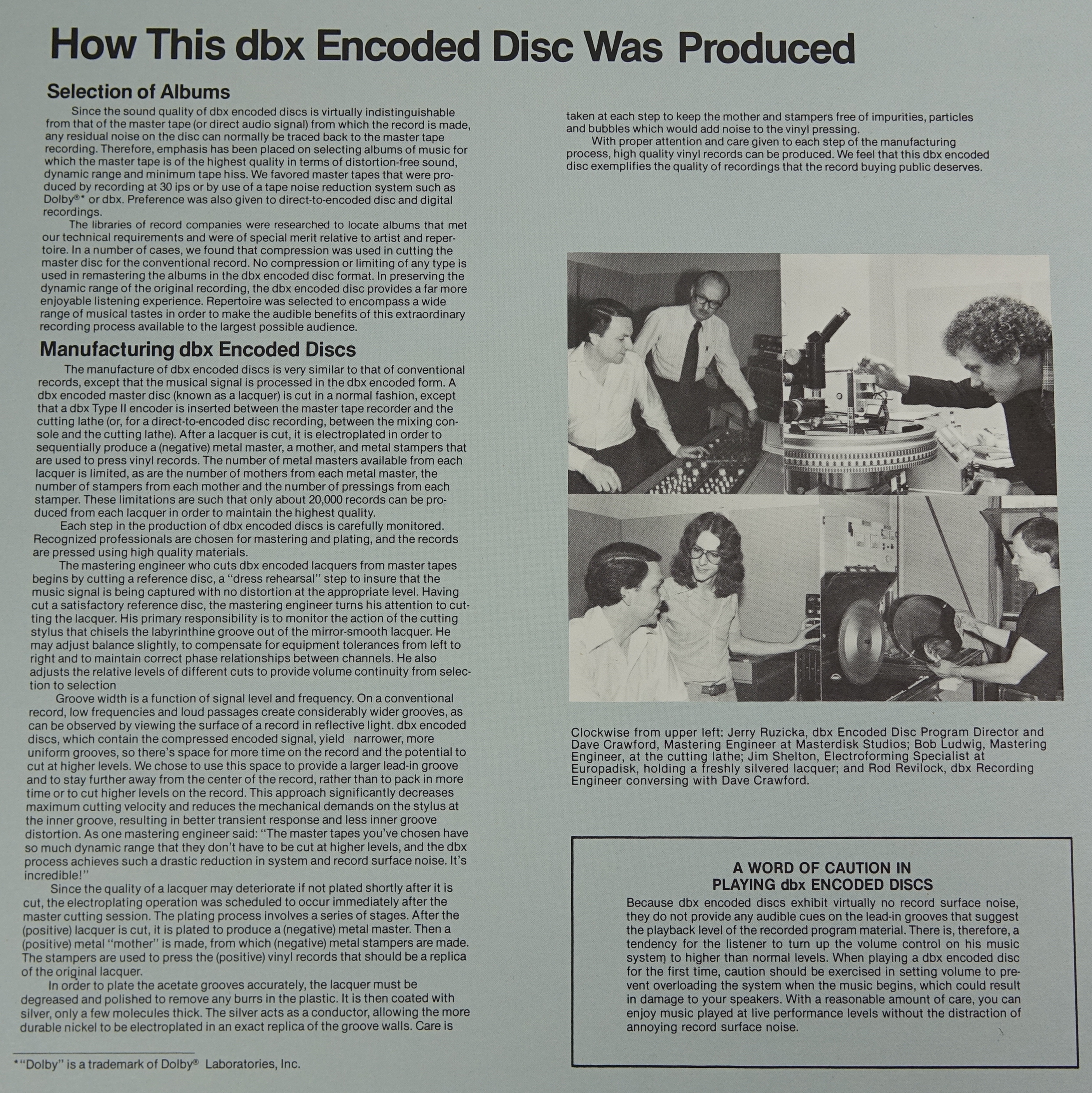
- How This dbx Encoded Disc Was Produced - Card A [URL: http://static1.1.sqspcdn.com/static/f/676027/27117374/1466541757913/DBX+Disc+Card+A.jpg], accessed November 5, 2017, with an archived version available.
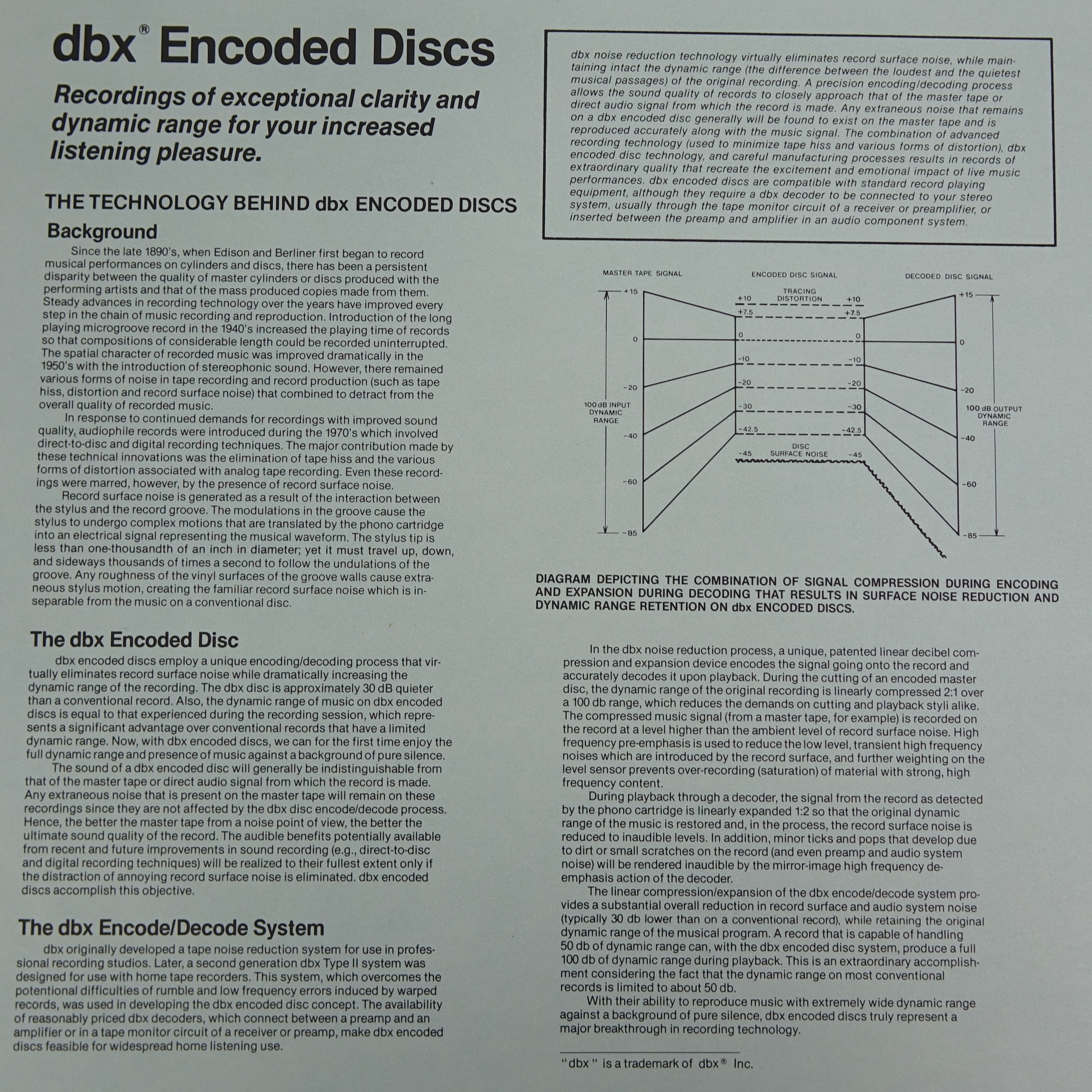
- dbx Encoded Disc - Card B [URL: http://static1.1.sqspcdn.com/static/f/676027/27117398/1466542009840/DBX+Disc+card+B.jpg], accessed November 5, 2017, with archived access. This document explains that dbx encoded discs utilize a proprietary encoding and decoding method to nearly eliminate surface noise on records while significantly expanding the dynamic range. These discs achieve approximately 30 dB lower noise levels compared to standard records. The dynamic range preserved matches that of the original recording session, providing a substantial improvement over traditional vinyl limitations. Consequently, dbx encoded discs allow listeners to experience music with full dynamic presence against a silent background. The playback quality closely resembles the master tape or direct audio source from which the record was produced. Any noise present on the master tape remains unaffected by the dbx process; therefore, superior master tape quality directly correlates with enhanced final sound fidelity. Recent and future advances in recording technology—such as direct-to-disc and digital methods—can only reach their full potential if surface noise distractions are removed, which dbx encoded discs successfully accomplish.
- Archived link to dbx Type III noise reduction product information: https://web.archive.org/web/20210523094543/https://dbxpro.com/en/products/2031
- Archived link to dbx Type V noise reduction product details: https://web.archive.org/web/20201029203213/https://dbxpro.com/en/products/ieq15
External links
- Audio Invest's page dedicated to dbx
- Vintage dbx: Celebrating the iconic sound
- Retro HiFi: DBX Disc – Possibly the finest audio experience yet undiscovered
- ↑ Cite error: Invalid
<ref>tag; no text was provided for refs nameddbx_disc - ↑ 2.0 2.1 Cite error: Invalid
<ref>tag; no text was provided for refs namedDiscog_dbx-disc - ↑ Cite error: Invalid
<ref>tag; no text was provided for refs namedBillboard_1981 - ↑ Cite error: Invalid
<ref>tag; no text was provided for refs namedAudioinvest - ↑ dbx-TV Timeline (THAT Corporation) Archived 2011-07-16 at the Wayback Machine