
Delahaye
| Company type | Private |
|---|---|
| Industry | Automotive |
| Founded | January 1, 1894 in Tours, France |
| Founder | Émile Delahaye |
| Defunct | 1954 |
| Fate | Merged with Hotchkiss; production terminated by Brandt |
| Headquarters | Paris , France |
Area served | France, French colonies, international (exports) |
Key people | Émile Delahaye (founder), George Morane, Leon Desmarais, Charles Weiffenbach, Amédée Varlet |
| Products | Automobiles, trucks, utility vehicles, buses, fire engines |
Number of employees | 200+ (laid off in 1953) |
| Parent | Brandt (after acquisition) |
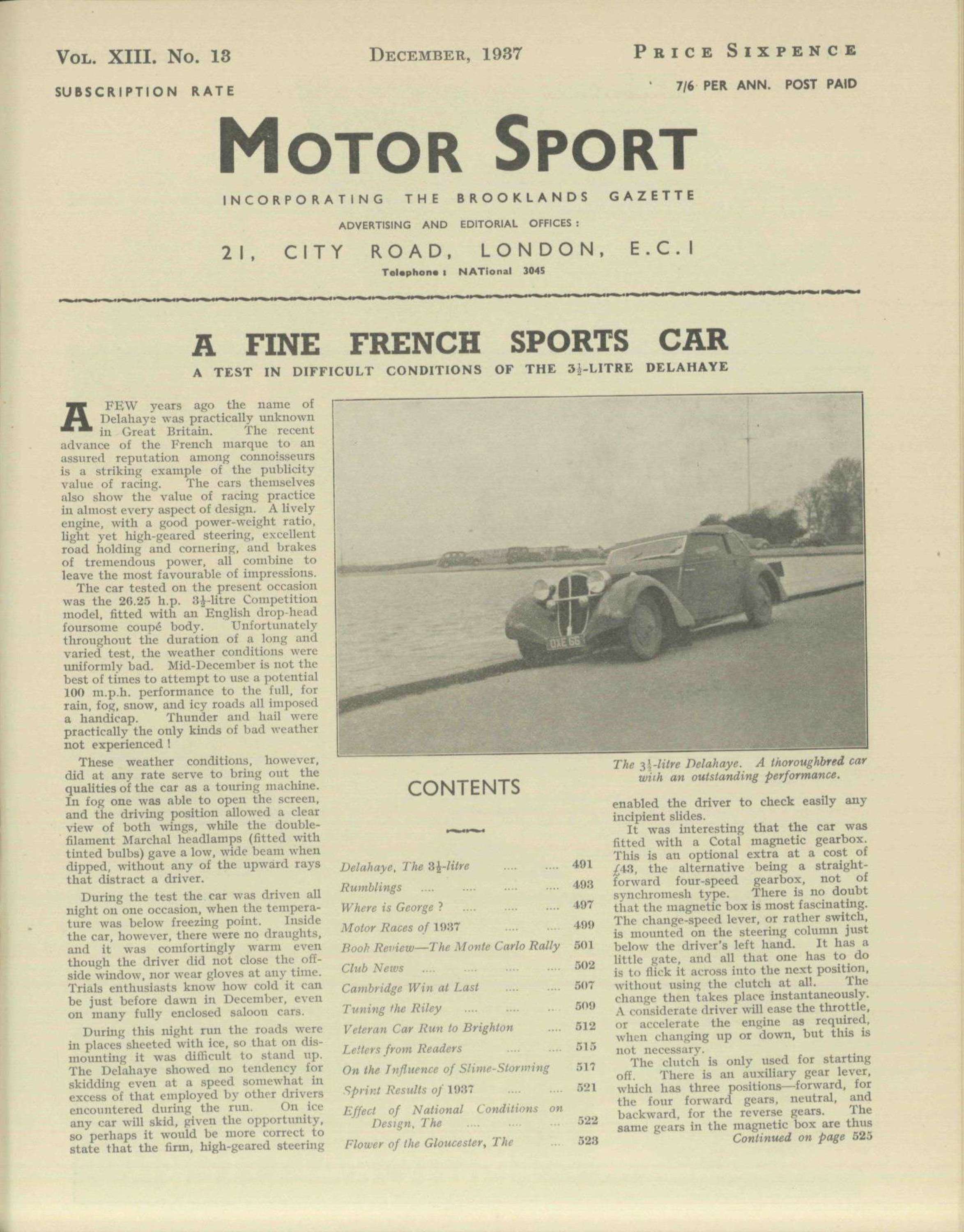
Delahaye was a family-operated car manufacturer established in 1894 by Émile Delahaye in Tours, France. In 1898, following incorporation with his brothers-in-law George Morane and Leon Desmarais as partners, production shifted to Paris. The firm specialized in producing limited-edition luxury automobiles with custom coachbuilt bodies, along with trucks, utility vehicles, buses, and fire engines. Early on, Delahaye introduced several pioneering technical advancements. The creation of a racing division in 1932 elevated the brand’s profile during the 1930s through models such as the record-breaking Type 138, the Type 135 and its short-wheelbase sports-racing version 135CS, as well as the V12-powered racing cars Type 145 and 155. Despite notable motorsport achievements, World War II imposed significant challenges. In 1954, Delahaye merged with rival Hotchkiss; both companies were subsequently acquired by Brandt, which terminated automotive production and closed Delahaye alongside Delage.
Early development
Émile Delahaye, an engineer by training, began creating belt-driven automobiles in 1894 while overseeing operations at the Brethon Foundry in Tours. To continue his automotive pursuits, he purchased the foundry and participated in early motor races including the 1896 Paris–Marseille–Paris and 1897 Paris–Dieppe events.
In 1898, the company was incorporated with investors George Morane—who had driven one of Delahaye’s cars in competition—and Leon Desmarais. Manufacturing was relocated to Paris into a former hydraulic plant owned by the Morane family. Charles Weiffenbach took on the role of operations manager. Early models comprised the 1.4-litre single-cylinder Type 0 and twin-cylinder Types 1 and 2; these vehicles featured bicycle-style tiller steering, rear-mounted water-cooled engines, automatic valves, surface carburetors, trembler coil ignition systems, and belt-and-chain drives offering three forward speeds.
Following Émile Delahaye’s retirement in 1901, Morane and Desmarais assumed control of the company; Weiffenbach became head of operations in 1906. After Delahaye’s death in 1905, the company withdrew from racing activities and redirected its efforts under Weiffenbach toward manufacturing practical chassis for commercial trucks and fire apparatus commissioned by government agencies.
By 1904, production had reached roughly 850 vehicles. The introduction of four-cylinder engines occurred in 1903, while shaft-driven transmissions were implemented starting in 1907. Chief engineer Amédée Varlet was instrumental in developing a V6 engine featured in the 1911 Type 44 model and also designed the large Titan marine engine that powered the speedboat La Dubonnet, which briefly held a water speed record.
Licensing agreements and partnerships
In 1907, German firm Protos commenced licensed manufacture of Delahaye automobiles. Two years later, H. M. Hobson began importing Delahaye vehicles into Britain. The American manufacturer White copied Delahaye designs without authorization; efforts to seek reparations were disrupted by World War I. By the conclusion of the war, truck production had become Delahaye’s primary revenue source.
Seeking to improve profitability after World War I, Delahaye entered a tripartite agreement in 1927 with FAR Tractor Company, Chenard & Walcker, and Rosengart to implement limited assembly-line manufacturing techniques. However, due to an overly broad product lineup lacking effective standardization, this collaboration quickly dissolved by 1931 amid falling sales figures. It is reported that Weiffenbach consulted competitor Ettore Bugatti for advice on reviving Delahaye’s fortunes. In 1932, majority shareholder Madame Leon Desmarais instructed Weiffenbach to develop a more refined and sportier chassis range aimed at affluent younger buyers. Amédée Varlet established a new design department and racing division, appointing Jean François as assistant designer and chief engineer. This strategic shift yielded immediate success with the Type 134 model, followed by the record-setting Type 138 and the renowned Type 135.
Return to racing
In 1934, Delahaye established eighteen class records at Montlhéry with its aerodynamic 18 Sport model. The firm unveiled the 134N, a 12cv vehicle equipped with a 2.15-litre four-cylinder engine, alongside the 18cv Type 138, which featured a 3.2-litre six-cylinder engine—both engines adapted from truck designs. Triumph in the 1935 Alpine Trial inspired the creation of the sporty Type 135 "Coupe des Alpes." By the end of 1935, Delahaye had secured victories in eighteen minor French sports competitions and multiple hill climbs, including a fifth-place finish at the Le Mans endurance race. In 1936, four Type 135-based vehicles participated in the Ulster TT, achieving second place behind Bugatti, while also earning notable results at the Belgian 24 Hours. Capitalizing on this racing momentum, Delahaye acquired the automaker Delage in 1935.
Funding from American heiress Lucy O'Reilly Schell supported the development of short-wheelbase "Competition Court" Type 135 cars with a 2.70-metre wheelbase, tailored for rallying and racing purposes; she purchased twelve of these cars for her amateur racing team, Ecurie Bleue.
In 1937, drivers René Le Bègue and Julio Quinlin captured victory at the Monte Carlo Rally behind the wheel of a Delahaye; that same year, Delahaye secured both first and second places at Le Mans. To compete against German state-sponsored teams such as Mercedes-Benz and Auto Union, Delahaye introduced the Type 145, featuring an intricate -litre V12 engine. Known as the "Million Franc Delahaye" following its success in the Million Franc Race, driver René Dreyfus averaged speeds exceeding at Montlhéry in 1937, earning a government award. Dreyfus further demonstrated the Type 145’s fuel economy by winning at Pau in 1938, outperforming more powerful rivals.
These achievements, combined with national pride, maintained interest in Delahaye until the onset of the German occupation of France during World War II. In early 1940, Renault produced approximately one hundred Type 134N and Type 168 chassis fitted with military bodies under contract for the French army. Although civilian automobile manufacturing was officially halted in June 1939, limited production persisted to supply German forces until at least 1942.
In 1951, a French military crew including Captain Monnier and Colonel Henri Debrus triumphed in the inaugural Algiers-Cape Town Rally driving a Delahaye pickup.
Post-war decline
Following World War II, luxury car manufacturers in France confronted an economic downturn. The five-year reconstruction plan led by General Pons emphasized exports and levied substantial taxes on luxury goods, particularly vehicles with engines exceeding . In 1947, exports constituted 88% of Delahaye’s output, primarily destined for French colonies across Asia and Africa. With just 573 units produced in 1948—dwarfed by market leader Citroën’s production of 34,164—Delahaye’s manufacturing volume was unsustainable.
The postwar Delahaye lineup received an internal redesign from industrial designer Philippe Charbonneaux. Production recommenced in 1946 for the outdated pre-war Type 135 and Type 148L models to generate revenue while awaiting readiness of newer models such as the Type 175 and its derivatives. Although initially conceived in 1938, delays caused by wartime disruptions and the death of its designer postponed the Type 175’s introduction until 1948.
Despite having a licensing agreement, suspension issues plagued the Type 175, compelling Delahaye to repurchase affected vehicles to avoid legal disputes. The ensuing negative publicity resulted in weak sales for the Type 175, as well as for models 178 and 180; these failed to recover development expenses and were discontinued by mid-1951.
Until early 1951, steady orders from the French military for Delahaye’s light reconnaissance vehicles (VLR) helped sustain company operations. Additionally, modest but consistent demand for their truck models contributed to financial stability.
At the 1949 Paris Motor Show, Delahaye unveiled the one-ton light truck Type 171 powered by a 3.5-litre six-cylinder overhead-valve engine later utilized in luxury Type 235 cars. The Type 171 spawned multiple body variants—including ambulance and nine-passenger "familiale" versions—designed for French African colonies due to their large wheels and high ground clearance; exports also included Brazil. By 1952, production reached thirty units per month.
Delahaye’s last new model was the Jeep-style two-litre Delahaye VLR (Véhicule Léger de Reconnaissance Delahaye), introduced in 1951. The French army initially preferred it over American Jeeps. In 1953 alone, Delahaye manufactured 1,847 VLRs along with 537 specialized military vehicles; only thirty-six passenger cars bearing the Delahaye or Delage names were registered that year.
The Type 235 debuted in 1953 as an upgraded version of the Type 135 featuring hydraulic brakes and a triple Solex carburetor-equipped 3.6-litre engine producing . Only eighty-four units were produced.
Meanwhile, rival manufacturer Hotchkiss obtained a license from Kaiser-Willys Motors to produce Willys MB 'Jeep' vehicles domestically. The simpler and less costly Hotchkiss Jeep gained preference within the French army, resulting in cancellation of Delahaye’s VLR contract. In August 1953, over two hundred employees were laid off at Delahaye. Due to shared financial difficulties, merger discussions between Hotchkiss and Delahaye culminated on March 19, 1954 when company presidents Pierre Peigney (Delahaye) and Paul Richard (Hotchkiss) signed an agreement. Less than three months later, on June 9, shareholders approved Hotchkiss’s acquisition of Delahaye; subsequently, Hotchkiss ended production of Delahaye automobiles. By late 1954, after brief sales under the Hotchkiss-Delahaye brand name for trucks, Brandt acquired the merged company. By 1956, all three marques—Delahaye, Delage, and Hotchkiss—had been discontinued.
Ownership and management
From its establishment until its closure on December 31, 1954, Delahaye operated as a privately held, family-run enterprise.
Emile Delahaye, initially proprietor of a foundry and machine workshop, constructed his inaugural automobile in 1894. By 1898, escalating demand necessitated enlargement and capital infusion. Delahaye formed an equal partnership with his brothers-in-law, the coppersmiths Leon Desmarais and George Morane, relocating production to their Paris-based factory. Due to health complications, Delahaye retired in 1901, transferring his shares to the partners; Desmarais gained majority ownership. The Desmarais and Morane families preserved family control until Hotchkiss acquired the company in 1954, with Delahaye holding a minority interest. The board comprised shareholders alongside Charles Weiffenbach serving as CEO.
Until 1901, Emile Delahaye fulfilled roles as president, engineer, and administrator. In 1898, he appointed Charles Weiffenbach as managerial assistant and Amédée Varlet as design engineer—both mechanical engineers who devoted their careers to the firm. Weiffenbach ascended to operations manager by 1906, while Varlet spearheaded technical engineering and manufacturing advancements. In 1932, Jean François joined as chief design engineer; Varlet then assumed leadership of the drawing office and racing division.
Pierre Peigney, a family member by relation, held the presidential title nominally; however, Weiffenbach effectively managed the company independently. He oversaw operations through the 1954 merger with rival Hotchkiss. Both firms lacked sufficient resources to sustain independence and were incorporated into the Brandt group. Following late 1954, Delahaye ceased operations.
Distinguished models
- – 1895–1901
- Delahaye 44 – 1911–1914 – pioneering production V6 engine
- Delahaye 134 – 1933–1940
- Delahaye 135 – 1935–1954
- Delahaye 138
- Delahaye 148
- Delahaye 168 – 1938–1940
- Delahaye 175 – 1948–1951
- Delahaye 178
- Delahaye 180
- Delahaye 235 – 1951–1954
- Delahaye VLR – 1951–1954
Bibliography
- Lua error in Module:Citation/CS1/Configuration at line 2123: attempt to index field '?' (a nil value).
External links
- Pages with script errors
- Articles with short description
- Car manufacturers of France
- Vehicle manufacturing companies established in 1894
- Vehicle manufacturing companies disestablished in 1954
- Defunct motor vehicle manufacturers of France
- French racecar constructors
- Delahaye vehicles
- 1894 establishments in France
- Organizations based in Tours, France
- Motor vehicle manufacturers based in Paris
- Luxury motor vehicle manufacturers
- 1954 disestablishments in France
- Companies based in Centre-Val de Loire
- Sports car manufacturers
- Truck manufacturers of France