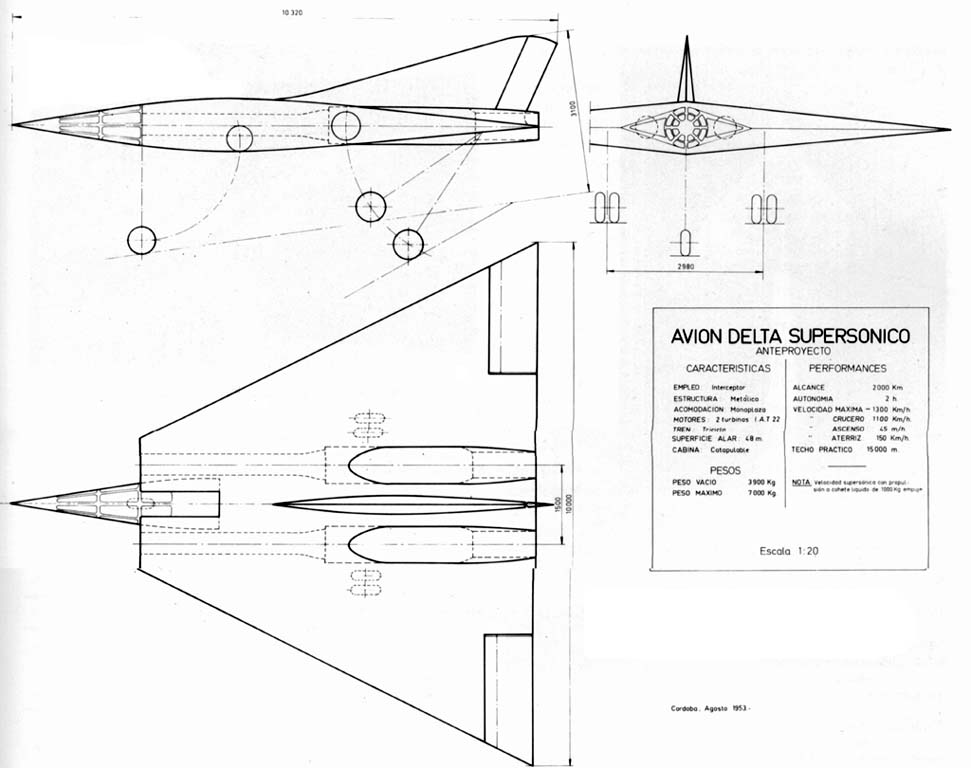
FMA I.Ae. 37
| Industry | Aerospace |
|---|---|
| Founded | 1952 |
| Defunct | 1960 |
| Fate | Project terminated |
| Products | Jet fighter prototype |
The FMA I.Ae. 37 was an Argentine jet fighter prototype conceived during the 1950s. It never achieved flight and the project was terminated in 1960.
Development
Reimar Horten began designing the I.Ae. 37 around 1952 after previous flying wing initiatives were discontinued. The aircraft incorporated a single-engine delta wing flying wing configuration, with engine air intakes positioned on either side of the nose. Testing with wind tunnels and scale models commenced in 1953, followed by the maiden flight of a full-scale glider on 1 October 1954. The pilot operated in a prone position, observing through a transparent nose section. Encouraged by favorable flight characteristics, construction of a powered prototype started in 1955, utilizing a readily accessible but relatively low-thrust Rolls-Royce Derwent V engine. In 1956, the glider’s cockpit was redesigned to adopt a conventional seating arrangement.
The program later diverged into two paths: the existing aircraft was repurposed as a subsonic trainer, while plans were made for the I.Ae. 48, a more advanced fighter featuring twin podded engines intended to reach speeds up to Mach 2.2. Both developments were discontinued in 1960 due to financial limitations, shortly before the I.Ae. 37 was set to make its initial flight.
See also
Bibliography
- .
- .
- I.Ae 37
- I.Ae. 37 schematic
- .
- .