
Fairchild Semiconductor
| Company type | Public (formerly) |
|---|---|
| Industry | Semiconductor technology |
| Founded | 1957 |
| Founder | Traitorous Eight |
| Fate | Acquired by ON Semiconductor in September 2016 |
| Headquarters | San Jose, California , United States |
Area served | Worldwide |
Key people | Mark Thompson (Chairman and CEO), Mark S. Frey (Executive Vice President and CFO) |
| Products | Integrated circuits, signal processing devices, motor control solutions, field-effect transistors |
| Revenue | US$1.37 billion (2015) |
| US$6.3 million (2015) | |
| −US$15.1 million (2015) | |
Number of employees | 6,379 (2015) |
Fairchild Semiconductor International, Inc. was a prominent American company specializing in semiconductor technology, with its headquarters located in San Jose, California. Established in 1957 as a branch of Fairchild Camera and Instrument by the group famously known as the "traitorous eight" who departed from Shockley Semiconductor Laboratory, it played a pioneering role in the production of transistors and integrated circuits. Following its acquisition by Schlumberger in 1979 and subsequent purchase by National Semiconductor in 1987, Fairchild was re-established as an independent entity in 1997. Later, in September 2016, it became part of ON Semiconductor.
Fairchild maintained several facilities across the United States, including sites in San Jose, California, San Rafael, California, South Portland, Maine, West Jordan, Utah, and Mountaintop, Pennsylvania. Its international presence extended through subsidiaries and manufacturing plants located in regions such as Australia, Singapore, Bucheon, South Korea, Penang, Malaysia, Suzhou, China, and Cebu City, Philippines.
Before being acquired, the company’s leadership team featured Chairman and CEO Mark Thompson along with Executive Vice President and CFO Mark S. Frey. Fairchild’s product range concentrated on integrated circuits, signal processing devices, motor control solutions, and field-effect transistors that served a variety of sectors including semiconductors, computer networking, lighting systems, and circuit protection.
In 2015, Fairchild reported revenues amounting to US$1.37 billion with an operating profit of US$6.3 million; however, it recorded a net loss of US$15.1 million. The firm employed roughly 6,379 personnel worldwide. Its business strategy prioritized continuous innovation within semiconductor technologies to sustain its market position amid fierce industry competition.
The company’s strategic management and expansion through acquisitions contributed significantly to its competitive edge and established influence throughout the global semiconductor market prior to its merger into ON Semiconductor’s organizational framework.
1950s
In 1955, William Shockley founded the Shockley Semiconductor Laboratory in Mountain View, California, backed financially by Beckman Instruments. His objective was to develop an enhanced "4-layer diode" transistor. Despite efforts to recruit former Bell Labs colleagues, Shockley ended up hiring top graduates from engineering programs. His ineffective leadership caused dissatisfaction among several key staff members known as the traitorous eight: Julius Blank, Victor Grinich, Jean Hoerni, Eugene Kleiner, Jay Last, Gordon Moore, Robert Noyce, and Sheldon Roberts. In pursuit of funding for their own enterprise, they collaborated with Sherman Fairchild’s firm, Fairchild Camera and Instrument, leading to the creation of Fairchild Semiconductor in 1957 which focused on manufacturing silicon transistors at a time when germanium was still prevalent.
Sherman Fairchild acknowledged Noyce’s foresight regarding silicon semiconductors as instrumental in forming this division. Noyce highlighted silicon’s affordability as a raw material and anticipated the rise of disposable electronic devices powered by cost-effective components.
The company’s first significant product was the 2N697 silicon mesa transistor developed in 1958 by Moore; this component was successfully sold to IBM for use in the B-70 bomber’s computer system and to Autonetics for guidance technology in Minuteman missiles. Simultaneously, Hoerni introduced the planar process which transformed transistor fabrication by enhancing cost efficiency, performance reliability, and production scalability—making previous methods obsolete and leading to widespread licensing of Fairchild’s innovations across the industry.
By 1960, Fairchild had created the first silicon integrated circuit containing four transistors on a single chip—an advancement that surpassed earlier germanium-based designs such as Texas Instruments’ Jack Kilby patent. The company experienced rapid growth from just 12 employees to 12,000 while generating annual revenues reaching $130 million.
1960s
Robert Noyce of Fairchild and Jack Kilby of Texas Instruments independently created the integrated circuit (IC) utilizing bipolar technology. In 1960, Noyce introduced the planar integrated circuit, which became the industry's preferred choice due to its thin-film interconnections, surpassing Texas Instruments' wire-connected approach. This advancement was made possible by Jean Hoerni's planar process, which drew inspiration from Mohamed Atalla's surface passivation technique developed at Bell Labs.
During the early 1960s, Fairchild’s research and development team investigated the MOSFET (metal–oxide–semiconductor field-effect transistor), originally invented by Atalla and Dawon Kahng at Bell Labs in 1959 but initially overlooked there. Fairchild began commercial production of MOS devices in 1964, creating MOS integrated circuits that broadened their product lineup.
In 1963, Fairchild recruited Robert Widlar to engineer analog operational amplifiers (op-amps), leading to innovative products such as the μA702 and μA709 that secured Fairchild’s leadership in the analog IC sector. The μA741, introduced in 1968 by David Fullagar, became the most widely used IC op amp in history.
By 1965, Fairchild’s manufacturing capabilities had positioned it as virtually the only profitable semiconductor producer in the U.S., dominating sectors including diode–transistor logic (DTL), operational amplifiers, and custom circuits for mainframe computers. That same year, Fairchild inaugurated a semiconductor assembly facility on the Navajo Nation in Shiprock, New Mexico, employing over a thousand workers, predominantly Navajo women. Despite initial success, this plant ceased operations in 1975 due to labor disputes and economic difficulties.
Fairchild encountered challenges with digital ICs; its early "micrologic" resistor–transistor logic (RTL) series suffered from limited noise immunity and was ultimately replaced by more reliable DTL technology. By the mid-1960s, semiconductor sales represented two-thirds of Fairchild’s total revenue, ranking it second after Texas Instruments and ahead of Motorola.
Nevertheless, internal management problems surfaced. Leadership of the semiconductor division in California was handled by New York-based executives who rarely visited. President John Carter directed profits into unprofitable acquisitions, causing dissatisfaction among semiconductor managers such as Charles E. Sporck and Pierre Lamond. Sporck departed in 1967 to join National Semiconductor along with several colleagues.
In 1967, Fairchild experienced its first financial loss since 1958 and suffered a steep drop in stock value. The board mandated divestment from unprofitable ventures; Carter resigned. Meanwhile, Texas Instruments’ transistor–transistor logic (TTL) technology overtook Fairchild’s DTL offerings.
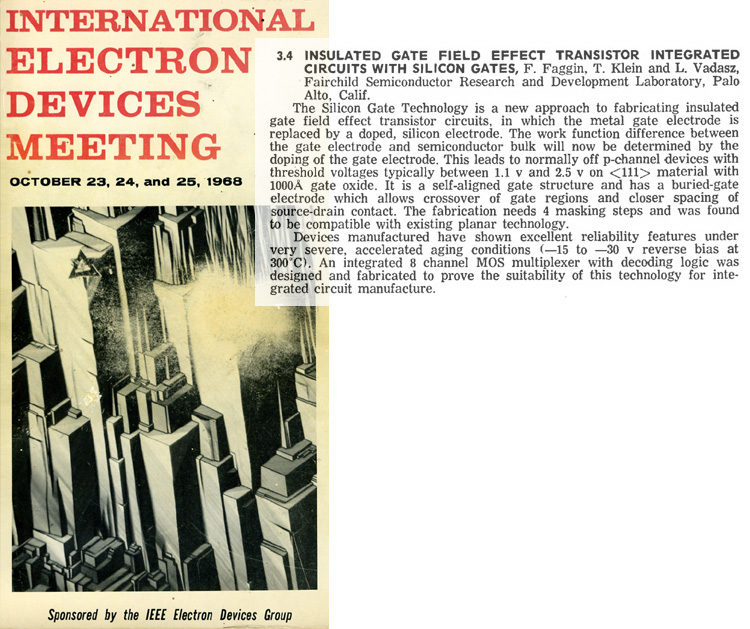
Although Noyce was a natural candidate to succeed Carter as CEO, Sherman Fairchild influenced the board to appoint Richard Hodgson instead. After Hodgson’s short tenure, a management committee led by Noyce assumed control; however, Sherman Fairchild sought alternative leadership options. This led to Noyce and Gordon Moore departing in 1968 to establish Intel alongside key executives Andrew Grove and Leslie L. Vadász. They brought with them MOS Silicon Gate Technology (SGT), developed at Fairchild by Federico Faggin—who later joined Intel to design the first microprocessors using SGT.
Sherman Fairchild hired Lester Hogan from Motorola to overhaul management, recruiting numerous Motorola executives to replace existing staff. This transition demoralized employees and accelerated departures that contributed to Silicon Valley’s expansion through new startups.
The exit of founding "Fairchildren," including Noyce and Moore—the company’s principal innovators—represented a major loss of talent. Fairchild promoted itself as the originator of Silicon Valley’s technological ecosystem; notably, the term "Silicon Valley USA" was popularized in 1971 by Don Hoefler.
This decade captured pivotal transformations in Fairchild’s business strategy, leadership struggles, key technological achievements, and its evolving role within the semiconductor industry landscape.
1970s
Fairchild encountered legal disputes related to recruiting employees from Motorola, but a 1973 judicial decision sided with Fairchild, citing Motorola's subpar performance. In 1974, Lester Hogan was removed from his role as president but continued serving as vice chairman.
In 1973, Fairchild became the pioneer in commercializing the charge-coupled device (CCD), a technology initially developed at Bell Labs. Despite this breakthrough, the company was severely affected by the recession and oil crisis between 1973 and 1975. Fairchild Imaging, a successor entity, still manufactures digital image sensors today.
Following Intel's introduction of the 8008 microprocessor, Fairchild introduced the F8 8-bit microprocessor, which dominated CPU sales worldwide in 1977. The company also launched the Video Entertainment System in 1976 (later renamed Channel F), marking the first video game console to utilize ROM cartridges and powered by the F8 processor. While it enjoyed early success, it eventually lost market dominance to Atari's 2600.
By the end of the decade, Fairchild redirected its efforts toward specialized markets such as rugged integrated circuits for military and aerospace uses and isoplanar ECL products designed for high-performance computing applications like Cray supercomputers. Operating at a financial loss, the firm heavily depended on income from patent licensing.
In 1979, Schlumberger Limited, an oilfield services corporation, acquired Fairchild Camera and Instrument for $425 million amid the impending expiration of many of Fairchild’s crucial patents.
1980s
In 1980, under Schlumberger’s ownership, Fairchild Research established the Fairchild Laboratory for Artificial Intelligence Research (FLAIR). By 1985, this entity evolved into Schlumberger Palo Alto Research (SPAR).
Fairchild created the Clipper architecture, a 32-bit RISC-like computer design, releasing the C100 chip in 1986. This technology was subsequently sold to its primary client, Intergraph.
Schlumberger divested Fairchild to National Semiconductor in 1987 for $200 million; however, this sale did not include Fairchild’s Test Division—which produced automated test equipment (ATE)—nor Schlumberger Palo Alto Research.
During the early part of the decade, Fairchild faced litigation concerning contamination from industrial solvents in San Jose, California. The resolution resulted in a superfund cleanup site that was completed by 1998.
1990s
In 1997, Fairchild Semiconductor reemerged as an independent entity headquartered in South Portland, Maine, with Kirk Pond appointed as CEO.
On March 11 of that year, National Semiconductor sold Fairchild to its management team backed by Sterling LLC—a Citicorp Venture Capital affiliate—for $550 million. This deal primarily involved the Standard Products division previously separated under Gil Amelio.
Later that year, on November 27, Fairchild announced its $120 million purchase of Raytheon’s semiconductor business, with the acquisition finalized on December 31.
In December 1998, Fairchild expanded further by acquiring Samsung’s power division—specializing in power MOSFETs and IGBTs—for $450 million; this transaction closed in April 1999 and reinforced Fairchild’s role as a significant supplier to Samsung.
Fairchild Semiconductor returned to public trading in August 1999 on the New York Stock Exchange under the ticker symbol FCS. Its manufacturing facilities in South Portland and Mountaintop continue operating among the longest-standing semiconductor production sites worldwide.
2000s
On March 19, 2001, Fairchild Semiconductor finalized the purchase of the discrete power division from Intersil Corporation for roughly $338 million in cash. This acquisition elevated Fairchild to become the world's second-largest supplier of power MOSFETs, holding a 20% stake in the $3 billion market, which had expanded by 40% the year before.
Fairchild further expanded on September 6, 2001, by acquiring Impala Linear Corporation for approximately $6 million in a combination of stock and cash. This deal bolstered Fairchild's capabilities in analog power management semiconductors tailored for portable electronics like laptops, MP3 players, mobile phones, and PDAs.
On January 9, 2004, CEO Kirk Pond was appointed as a Director of the Federal Reserve Bank of Boston for a three-year tenure.
Mark Thompson was appointed CEO and joined the board on April 13, 2005. Prior to this, he had served as Executive Vice President of Manufacturing and Technology at Fairchild.
Kirk Pond stepped down as Chairman on March 15, 2006, though he continued serving on the board. Mark Thompson took over the Chairman role while remaining CEO.
On September 1, 2007, Anadigics acquired Fairchild’s RF design group located in Tyngsboro, Massachusetts for $2.4 million.
2010s
In April 2011, Fairchild expanded its portfolio by acquiring TranSiC, a Swedish firm specializing in silicon carbide power transistor technology.
Following speculation about a potential sale, ON Semiconductor proposed a $2.4 billion offer ($20 per share) to purchase Fairchild on November 18, 2015.
Fairchild shifted its corporate headquarters from San Jose to Sunnyvale, California on April 10, 2016.
The acquisition was completed by ON Semiconductor on September 19, 2016, finalizing the $2.4 billion cash transaction.
Later that year, the merged company shut down Fairchild’s manufacturing facility in West Jordan, Utah.
Landmark status
On May 8, 1991, the State Historic Preservation Office recognized the location of the first commercially viable integrated circuit invention as California historical landmark #1000. The commemorative plaque states: "At this site in 1959, Dr. Robert Noyce of Fairchild Semiconductor Corporation developed the first integrated circuit suitable for commercial production. Utilizing 'planar' technology, Noyce’s breakthrough combined an entire electronic circuit onto a compact silicon chip, transforming Silicon Valley’s semiconductor industry and influencing global electronics markets."
Alumni
- Gil Amelio
- Julius Blank
- Lee Boysel
- Ron Brachman
- Wilfred Corrigan
- Alan L. Davis
- Richard O. Duda
- James M. Early
- Kirk Ennis
- Federico Faggin
- Jack Gifford
- Victor Grinich
- Andrew Grove
- Peter E. Hart
- Jean Hoerni
- Lester Hogan
- Eugene Kleiner
- Pierre Lamond
- Hector Levesque
- Richard F. Lyon
- Gordon Moore
- Robert Noyce
- Stav Prodromou
- Chih-Tang Sah
- Jerry Sanders
- Ed Turney
- Leslie L. Vadász
- Frank Wanlass
- Bob Widlar
- Andrew Witkin
- Don Valentine
Fairchildren companies
- National Semiconductor
- Rheem semiconductor
- Signetics
- Amelco - Teledyne Semiconductor
- Raytheon Semiconductor
- HP Associates
- Siliconix
- Stewart-Warner Microcircuits
- General Micro-electronics
- Union Carbide Electronics
- Philco Ford Micro-Electronics
- American Micro-Systems
- Cal-Dak
- Electronic Arrays
- Intersil
- Cermetek
- Monsanto Electronics
- Avantek
- Lab-go
- Integrated Systems Technology
- Nortec
- Kinetic Technology
- Intel
- Computer Micro-Technology
- Qualidyne
- Electro Nuclear Labs
- Advanced Memory Systems
- Lithic Systems
- Communications Transistor Corp
- Monolithic Memories
- Cartesian
- Advanced LSI Systems
- Signetics Memory Systems
- Advanced Micro Devices
- Four-Phase Systems
- Precision Monolithics
- Litronix
- Integrated Electronics
- Varadyne
- International Computer Models
- Cal-Tex
- Exar Corporation
- Micro Power
- Intersil Memory
- Standard Microsystems
- Antex
- International Microcircuits
- LSI Systems
- Nitron
- Frontier Electronics
- Interdesign
- Light Emitting Devices
- IC Transducers
- Opto Ray
- Optical Diodes
- Data General
- Synertek
See also
External links
- Fairchild Imaging
- IT Corporate Histories Collection – Detailed history of Fairchild Semiconductor at the Computer History Museum
- Buying Tomatoes at the Birthplace of Silicon Valley: A look into the original Fairchild location and Shockley Laboratory
- Silicon Gate Technology created at Fairchild in 1968 by F. Faggin and colleagues
- Articles with short description
- Defunct semiconductor companies of the United States
- Manufacturing companies based in San Jose, California
- Technology companies based in the San Francisco Bay Area
- Computer companies established in 1957
- Electronics companies established in 1957
- 1957 establishments in California
- Economy of Cumberland County, Maine
- South Portland, Maine
- Superfund sites in California
- Companies formerly listed on the New York Stock Exchange
- Companies formerly listed on the Nasdaq
- American companies established in 1957
- 1999 initial public offerings
- 2016 mergers and acquisitions
- Defunct computer companies of the United States
- Defunct computer hardware companies
- 5
- Companies of the United States by year of establishment