
Ferdinand Ferber
Louis Ferdinand Ferber | |
|---|---|
| Born | Error: Invalid birth date for calculating age Lyon, France |
| Died | 22 September 1909 (aged 47) |
| Occupation(s) | Army officer, aviation pioneer |
| Known for | Early advocacy for the Wright Brothers; development of early aircraft and gliders |
Louis Ferdinand Ferber (8 February 1862 – 22 September 1909) served as a French Army officer who played a notable role in the advancement of aviation during the early 20th century. While his own aircraft experiments met with limited success, his early advocacy for the Wright Brothers greatly influenced the evolution of European aviation.
Early life
Ferber was born in Lyon in 1862 and pursued studies at the Ecole Polytechnique before entering military service. By 1897, he had become an instructor at the School of Applied Artillery in Fontainbleau. It was there that he first encountered the work of Otto Lilienthal through an article published in the Illustrierte Zeitung.
Initial efforts
In August 1898, Ferber constructed his first full-scale unmanned glider, which featured a lozenge-shaped wing approximately wide. This glider failed to achieve flight when launched from a tower on his family estate in Rue, Switzerland. A subsequent smaller model was tested as a kite, towed behind a horse, but also did not succeed.
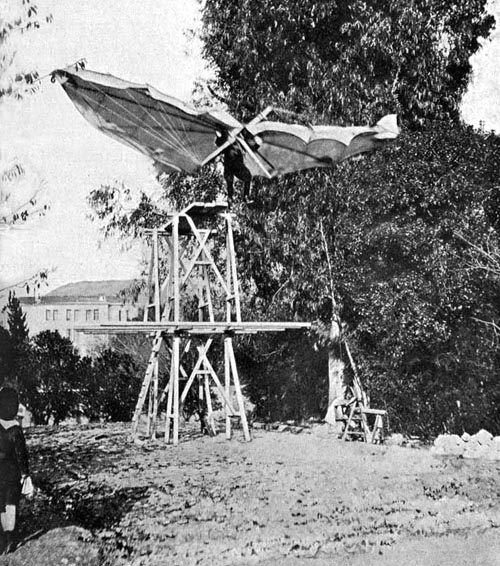
After his transfer to Nice in 1901 to command the 17th Alpine Battery, Ferber built a third glider inspired by Lilienthal’s designs—his first attempt to carry a pilot. Due to inadequate wing surface area, he proceeded to develop a larger fourth glider.
Engagement with Chanute
Ferber discovered Octave Chanute’s aeronautical research through a Revue Scientifique article dated 1 June 1901. He initiated correspondence with Chanute and obtained Wilbur Wright's December 1901 paper titled "Some Aeronautical Experiments," which motivated Ferber’s fifth aircraft, modeled after the Wrights’ 1901 glider.
This biplane incorporated a forward elevator similar to that of the Wright glider but omitted key features such as ribbed aerofoil wings and lateral control through wing warping. Despite its rudimentary construction—using bamboo frames loosely covered with fabric—Ferber’s test flights showed promise. He documented these experiments under the pseudonym "de Rue" in the February 1903 edition of l'Aérophile.
Although Ferber did not attend Chanute’s April 1903 lecture at the Aero Club de France, he wrote to founder Ernest Archdeacon advocating for a prize to encourage glider flight in Europe, aiming to prevent aviation achievements from remaining solely American ("il ne faut pas laisser l'aéroplane s'achever en Amérique"). Archdeacon supported this proposal and published portions of Ferber’s letter in La Locomotion and L'Aerophile.
Further developments
Ferber constructed an aircraft resembling his 1902 glider but added two triangular rudders mounted on the rear outboard interplane struts. Known as the Type V-bis, this model was powered by a 6 hp (4 kW) Buchet engine driving coaxial propellers. Between September 1903 and October 1904, he conducted multiple flight attempts and erected a tall lattice tower equipped with a counterbalanced revolving arm designed to suspend the aircraft. Ferber described these efforts as "completely useless," yet acknowledged they attracted public attention to aviation.
In April 1904, Ferber supported Ernest Archdeacon during Wright-inspired glider trials at Berck-sur-Mer. Shortly thereafter, Charles Renard, commander of the French Army balloon school at Chalais-Meudon, invited Ferber to join the institution—a position he accepted in May 1904. During this period, he developed the Type VI aircraft featuring a rear-mounted horizontal stabilizer and dihedral wings intended to enhance lateral stability.
In June 1905, Ferber proposed purchasing one of the Wright Brothers’ machines; although declined, their October 1905 response detailed recent flights, making Ferber the first European informed about their progress.
Following Renard's death in April 1905, Ferber's relationship with Chalais-Meudon officials deteriorated. In June 1906, he requested three years' leave to join the Antoinette company; this was approved in August along with permission to continue experimental work at Chalais-Meudon. That year he built the Type VIII aeroplane powered by a 24 hp Antoinette engine. After being destroyed by a storm in November, it was rebuilt as Type IX and successfully tested in July 1908 near Paris at Issy-les-Moulineaux.
In 1908, Ferber co-founded the Ligue Nationale Aérienne alongside physiologist René Quinton. Quinton—who belonged to a Parisian literary circle known as the "Forty-five"—was inspired by Ferber’s aviation contributions and established a prize of 10,000 francs for the first individual able to sustain flight for five minutes with the engine off while descending no more than 50 meters. By May 1909, the Ligue had inaugurated a flying school at Port-Aviation (Juvisy Airfield) in Viry-Châtillon, appointing Ferber as chief instructor.
Death
Captain Ferber lost his life on 22 September 1909 during an aviation event in Boulogne when one wing of his Voisin biplane collided with the ground while executing a low-altitude turn. He became the third individual to perish in an airplane accident, following Thomas Selfridge and Eugène Lefebvre.
His final resting place is at the Cemetery of Loyasse in Lyon.
In June 1910, the French Minister of War declared that a newly commissioned Zodiac dirigible would bear the name Capitaine Ferber. Additionally, a commemorative monolith topped with a bronze flying eagle was installed at Boulogne in his honor.
Gaston Combebiac highlighted Ferber's impact on both mathematics and aeronautics, proposing that the Quaternion Association acknowledge him for applying vector calculus to physical problems.
Aircraft
- Ferber I (1899) A monoplane hang-glider influenced by the work of Otto Lilienthal.
- Ferber II
- Ferber III
- Ferber IV (1901) Another monoplane hang-glider modeled after Lilienthal’s designs.
- Ferber V (1902) A two-bay biplane glider equipped with a forward elevator; it was later upgraded with triangular rudders and reconstructed with a 6 hp Buchet engine, receiving the new designation V-bis.
- Ferber VI (1904) Two-bay biplane glider featuring an extended rear horizontal stabilizer combined with a forward elevator.
- Ferber VII
- Ferber VIII
- Ferber IX
Quotes
"L'ascension est une fleur qui naît de la vitesse" ("Lift is a flower born from velocity"). "Concevoir une machine volante n'est rien; Fabriquer est peu; L'essayer est tout" ("Designing a flying machine is insignificant; building one matters little; testing is everything"). This sentiment was later echoed by Igor Sikorsky in his memoirs, underscoring the critical importance of experimentation in aviation progress.
Books
- 1904 : F. Ferber : Les progrès de l'aviation par le vol plané, published in Revue d'Artillerie, March 1904
- 1908: F. Ferber : L'Aviation — ses Débuts — son Développement, available via Internet Archive.
References
- Fred E. Culick & Spencer Dunmore (2001) On Great White Wings: The Wright Brothers and the Race for Flight, Toronto: McArthur & Company Publishing, p. 107.
- C. H. Gibbs-Smith (2003) Aviation: An Historical Survey, London: NMSI
- 1938 : I. Sikorsky : The Story of the Winged-S, Dodd-Mead, New York.
External links
- Pages with script errors
- Articles with short description
- Age error
- Articles with hCards
- No local image but image on Wikidata
- 1862 births
- 1909 deaths
- Aircraft designers
- Aviators killed in aviation accidents or incidents in France
- Knights of the Legion of Honour
- Defunct aircraft manufacturers of France
- French aviators
- Victims of aviation accidents or incidents in 1909