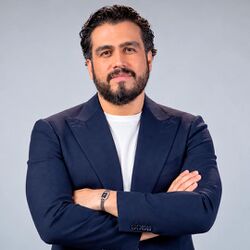
Horacio Pagani
Horacio Raul Pagani (Casilda, November 10, 1955) is an Argentine entrepreneur with Italian citizenship, founder and chief designer of Pagani Automobili.
Biography
Horacio Pagani was born on 10 November 1955 in Casilda, Santa Fe Province, in the heart of the Pampas in Argentina.[1] His family has Italian origins; his great-grandfather was originally from Appiano Gentile and moved to Argentina at the end of the 19th century, settling in the city of Casilda (about 400 kilometres from Buenos Aires) where he opened a bakery. His son Pietro and Pietro’s children Adelmo, Juan Carlos, and Mario (Horacio’s father) continued the family business, the “Panadería Pagani,” which at Horacio’s birth was the most renowned bakery in the city.
From the 1960s, Horacio nurtured an interest in automobiles through reading magazines such as Automundo, which introduced him to European—and especially Italian—car manufacturers. During middle school, he began crafting scale models out of balsa wood and experimenting with various materials like steel and aluminium sheets, plastic, and fiberglass. He applied these skills to motorcycle restoration, building his first mini-motorbike and even a buggy based on the chassis and engine of an old Renault Dauphine.
After middle school, in 1974 he enrolled at the University of La Plata (south of Buenos Aires) to study Industrial Design, and in 1975 he began studying Mechanical Engineering at the University of Rosario. He left university and returned to Casilda, where he opened a workshop on the outskirts of town.
In the 1970s, Argentina’s population became increasingly interested in Formula 2, and Horacio—together with some friends—decided to build an F2 single-seater to compete in the official championship. The project was very complex and took two years but allowed him to develop and deepen his technical automotive knowledge, from suspension kinematics to aerodynamics. Horacio enlisted Renault I.K.A. to sponsor an engine for the car; after numerous requests, he secured a meeting with Renault I.K.A.’s racing sponsorship committee and presented his vehicle. The single-seater gained the company’s interest, and they agreed to supply two engines.
In 1979, the single-seater competed in the F2 championship, driven by Agustín Beamonte, the previous year’s champion. That same year, Horacio met Oreste Berta and Juan Manuel Fangio, connections that would help him grow professionally. In 1982, Horacio moved to Italy with Cristina Pérez, whom he would soon marry.[2] He initially accepted humble jobs until engineer Alfieri invited him to take a position at Lamborghini, where he started as a third-level worker in the experimental body shop.[3]
In a short time, he participated in increasingly important projects, including the Lamborghini LM, Countach, and Jalpa. In 1985, at Horacio’s initiative, the company created the Composites Division, and he was promoted to head of that department. This new responsibility allowed him to expand his knowledge of advanced composite materials such as carbon fiber and Kevlar. He was tasked with designing the Countach 25th Anniversary, which met with great success. Horacio began proposing the creation of a car entirely made of composite material, but Lamborghini declined. Consequently, Horacio decided to strike out on his own, renting an industrial warehouse in Sant'Agata Bolognese and founding Horacio Pagani Composite Research to continue his research on new materials after factory hours. Despite operating in an experimental technology field, Horacio intensified his studies and analyses on carbon fiber coupled with resin and paint chemistry. After a year of experiments, he delivered some carbon fiber components for the Lamborghini Diablo to Lamborghini’s factory.
Lamborghini’s rejection of composite materials convinced Horacio to found Modena Design S.p.A.; after purchasing land in the La Graziosa industrial area of San Cesario sul Panaro, he began constructing what would become his first facility. In the Modena Design warehouse, starting in 1993, Pagani began developing Project C8 with the intention of presenting it to the public under the name Fangio F1, in honor of his friend. However, Juan Manuel Fangio passed away in July 1995, so Horacio decided to name the car Zonda—after a scorching wind in the Argentine Andes—when it was launched in 1998 and unveiled the following year at the Geneva Auto Show. Pagani’s production has focused on supercars, introducing the Huayra model in 2011 and Utopia in 2022. In 2023, Pagani celebrated 25 years of operation.[4]
Notes
- ↑ Who is Horacio Pagani, on Virgilio Motori, 15 May 2019
- ↑ QN Motori, Pagani «Me, my friend Fangio and the dream cars», on motori.quotidiano.net, 8 January 2020
- ↑ QN Motori, Pagani «Me, my friend Fangio and the dream cars», on motori.quotidiano.net, 8 January 2020
- ↑ Pagani Automobili celebrates its 25 years in Modena - Mondo Motori - Ansa.it, on Agenzia ANSA, 8 June 2023
Bibliography
- Pagani Hypercars d'Autore, edited by Daniele Buzzonetti, Artioli Editore 1899 ISBN 9788877921871