
IBM 303X
| Company type | Product line |
|---|---|
| Industry | Computer hardware |
| Founded | March 25, 1977 |
| Defunct | February 5, 1985 |
| Products | Mainframe computers (IBM 3031, 3032, 3033) |
The IBM 303X series represents a now-obsolete range of mainframe computers, with the initial unit, the IBM 3033 Processor, launched on March 25, 1977.
Subsequently, two more models—the 3031 and 3032—were revealed on October 6, 1977. The entire 303X lineup was officially discontinued on February 5, 1985.
Features
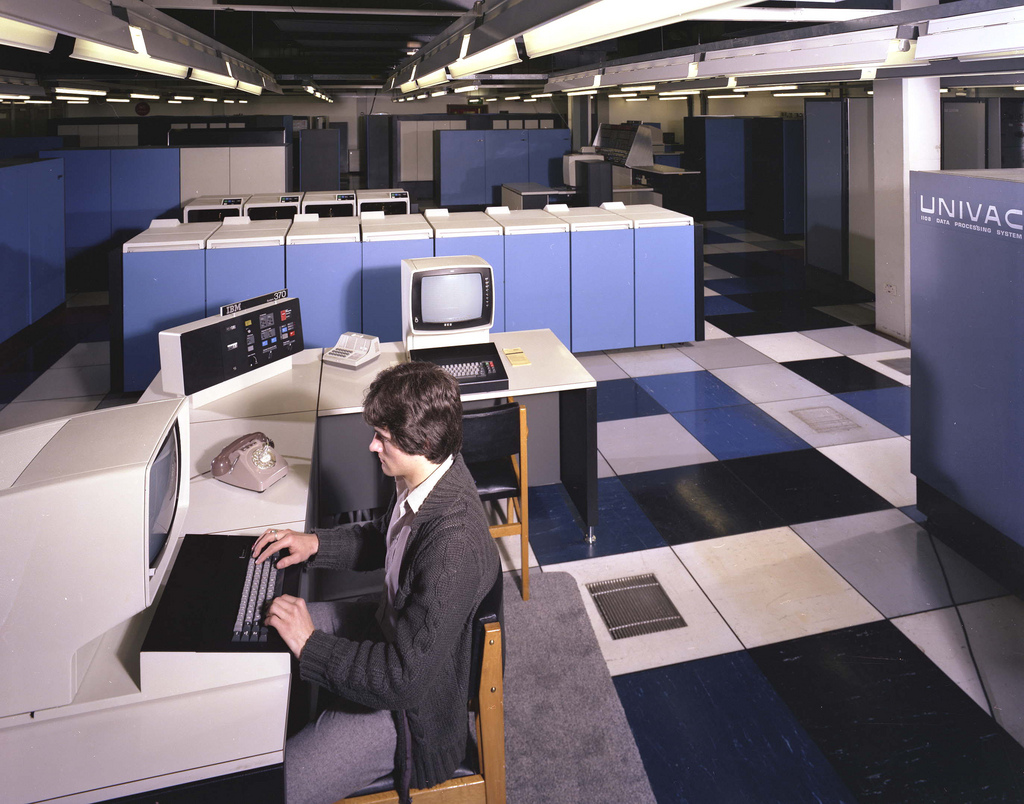
These processors incorporate instruction pipelining, enabling multiple instructions to be fetched ahead during processing. The memory architecture utilizes four-way interleaving, which enhances data throughput compared to non-interleaved configurations. Each system is paired with the IBM 3036 Dual-display console, featuring two operator stations outfitted with service processors, 3277 display terminals, and dual floppy drives—one dedicated to recording hardware faults and the other for microcode storage. Among the two service processors, one functions as the primary controller while the other serves as a standby, automatically taking over if necessary. This service processor design closely mirrors that employed in the IBM System/370 Model 158.
Compared to a System/370 mainframe with equivalent memory size and channel capacity, these systems require less than half the floor area because the channels are integrated directly into the mainframe chassis. Each unit is equipped with dedicated I/O processors known as Channel Directors, which operate similarly to System/370 Model 158 CPUs running specialized microcode for channel management. Each Director manages six channels—typically configured as one byte multiplexor channel alongside five block multiplexor channels. Cooling methods differ: the 3031 uses air cooling, whereas the 3032 and 3033 rely on water cooling. All models operate on a 400 Hz power supply; the 3031 contains an internal motor generator (model 3017), while the others depend on an external power source.
The debut of the 3033 also marked the introduction of updated operating system variants: MVS/System Extensions (MVS/SE) and VM/System Extensions (VM/SE).
303X as successor to System/370
Beginning in 1977, IBM marketed these new systems emphasizing:
- Their compatibility within the System/370 family.
- Descriptions such as "System/370 Compatible - 303(1/2/3)".
- The designation "System/370 3033 Processor."
Competing compatibles
During this era, plug compatible manufacturers (PCMs) offered IBM-compatible alternatives. Notably, Amdahl produced fully air-cooled mainframes, contrasting IBM’s water-cooled designs and thereby lowering infrastructure expenses. For instance, out of the eighteen ES/9000 models introduced in 1990, ten were air-cooled while eight required water cooling.
Introduced to challenge Amdahl’s offerings, the 3033 nearly doubled its predecessor's performance at just a 12% increase in price. This enhanced cost-to-performance ratio led to substantial demand and order backlogs that unintentionally advantaged Amdahl by postponing IBM deliveries into the following year.
In October 1977, Computerworld reported that Itel unveiled its air-cooled AS/6 shortly after IBM’s announcement, aiming for concurrent availability with the IBM 3032.
Additionally, Magnuson Computer Systems manufactured the M80 System/370-compatible model from 1975 through 1980.
IBM 3031
The IBM 3031 operates with a machine cycle time of 115 nanoseconds and includes a high-speed buffer storage (cache) of 32 KB. Its main memory ranges from 2 to 6 MB in increments of one megabyte. It is equipped with a single Channel Director managing one byte multiplexor channel and five block multiplexor channels. An optional channel-to-channel adapter (CTCA) can be added. Upon release, leasing a basic configuration with 2 MB of memory (excluding peripherals) cost $27,497 per month. Supported operating systems encompass MVS, OS/VS1 SVS, VM/370, ACP, TSS/370, and uniquely for this model within the series, DOS/VS.
Models
The 3031 series comprises 15 different models, each distinguished by the size of their primary memory.[1]
IBM 3032
The IBM 3032 operates with a machine cycle time of 80 ns and is equipped with a 32 KB cache. Main memory configurations include options of 2, 4, or 6 MB. It is equipped with one Channel Director as standard, with the possibility to add a second. Typically, each Channel Director controls one byte multiplexer channel alongside five block multiplexer channels. An optional Data Streaming capability boosts the performance of the first block multiplexer channel on each Director to 3 MB/s. Additionally, a CTCA unit can be installed. At its initial release, the monthly leasing cost for a base system without peripherals was $43,740. This model supports operating systems such as MVS, OS/VS1 SVS, VM/370, ACP, and TSS/370.[2]
Models
Four variants of the 3032 are offered, distinguished by their main storage capacities.[1]
IBM 3033
The IBM 3033 features an improved machine cycle time of 58 ns and doubles the cache to 64 KB. Its original main memory options included 4, 6, or 8 MB, which were later extended to support up to 16 MB on select versions. Two Channel Directors come standard; an optional third Director can be added that supports up to four channels due to architectural limitations. This third Director may be configured either with four block multiplexers or a combination of one byte and three block multiplexers. The Data Streaming feature was also incorporated to enhance throughput to 3 MB/s on the first block multiplexer channel per Director. There is an option for two CTCA units as well. Upon release, the monthly lease for a minimal setup without peripherals was priced at $70,400. Supported operating systems include MVS, OS/VS1 SVS, VM/370, and ACP.[3]
Subsequent models included the slower 3033-N introduced in November 1979 and the even more simplified 3033-S launched in November 1980; both featured streamlined configurations with only a single Channel Director. These variants were phased out by 1985 along with other members of the 303X family.
The 3033 was also available in attached-processor (AP) and multiprocessor (MP) dyadic setups:
- The AP configuration paired one 3033 with a single 3042 processor. Early versions of the 3042 lacked channels and depended on the 3033 for input/output operations; later iterations incorporated Channel Directors allowing system partitioning for maintenance without interrupting operations.
- The MP arrangement connected two 3033 processors together while maintaining similar partitioning capabilities.
Both AP and MP systems included two IBM 3036 consoles.
Models
There were a total of 29 models within the IBM 3033 lineup.[1][4]
Photos
See also
Further reading
- — Chapter 8 (pp. 223–240) discusses details about the IBM 3033.
- ↑ 1.0 1.1 1.2 Cite error: Invalid
<ref>tag; no text was provided for refs namedFT2 - ↑ Cite error: Invalid
<ref>tag; no text was provided for refs namedPP3032 - ↑ Cite error: Invalid
<ref>tag; no text was provided for refs namedPP3033 - ↑ Lua error in Module:Citation/CS1/Configuration at line 2123: attempt to index field '?' (a nil value).