IBM Personal Computer
| Company type | Product |
|---|---|
| Industry | Computer hardware |
| Founded | August 12, 1981 |
| Founder | William C. Lowe, Philip Don Estridge |
| Headquarters | Boca Raton , United States |
| Products | Personal computers |
IBM Personal Computer (Model 5150)
The IBM Personal Computer, designated model 5150 and frequently referred to as the IBM PC, was introduced on August 12, 1981, marking IBM's initial foray into the microcomputer arena. This system was created under the leadership of William C. Lowe and Philip Don Estridge at IBM’s Boca Raton, Florida facility, laying the groundwork for what became the widely recognized IBM PC compatible ecosystem.
Built around the Intel 8088 processor utilizing x86 architecture, the IBM PC adopted an open architecture approach that fostered third-party hardware and software innovation. Its modular design allowed for ongoing enhancements through expansion cards and applications, which contributed to its widespread acceptance in both commercial and consumer sectors.
The IBM PC played a pivotal role in shaping the personal computing landscape by establishing a dominant design standard throughout the 1980s. Its primary competitors outside this compatibility framework were Apple’s Macintosh series and consumer-oriented computers from Commodore and Atari. Many contemporary personal computers, including Intel-based Macs manufactured from 2006 to 2022, owe their architectural heritage to this original IBM model.
History
Prior to the 1980s, IBM was chiefly recognized for its business computing solutions. Nevertheless, its position in the expanding minicomputer market lagged behind rivals, while other companies capitalized substantially on the burgeoning microcomputer segment. At that time, personal computing was largely led by Tandy, Commodore, and Apple, with product prices typically in the several hundred-dollar range. The microcomputer market had grown considerably, reaching $15 billion in revenue by 1979 and expected to expand at an annual rate exceeding 40% during the early 1980s. Competitors such as Hewlett-Packard, Texas Instruments, and Data General had also entered this domain, with some IBM clientele already purchasing Apple devices.
Speculation about IBM developing a personal computer surfaced in 1980, including rumors of a compact version of the IBM System/370 and talks of collaboration with Matsushita (Panasonic), which ultimately did not materialize. Public perception remained doubtful due to IBM’s reputation for slow-moving bureaucracy focused on large-scale, costly business machines. New product development cycles typically spanned four to five years. An industry expert famously likened IBM launching a personal computer to "teaching an elephant to tap dance."
Although IBM had introduced microcomputers such as the IBM 5100 in 1975, these models targeted corporate customers and carried price tags up to $20,000. To compete effectively in the home computer market segment, IBM needed to offer more affordable alternatives.
In 1979, Ron Mion—IBM’s Senior Business Trends Advisor for entry-level systems—recommended that the company take an aggressive stance toward the emerging microcomputer market to counter rivals like Apple and Tandy encroaching on small business customers. His strategy emphasized three main shifts:
- a) Lowering production expenses by utilizing standard off-the-shelf components such as disk drives and keyboards to manufacture competitively priced microcomputers;
- b) Employing a cost-effective third-party operating system to foster a wide range of applications—he suggested Digital Research’s CP/M alongside Microsoft’s MS-DOS;
- c) Distributing and servicing microcomputers through independent resellers rather than relying on IBM’s traditional high-cost sales channels.
Despite reaching senior executives, Mion’s proposal was declined in favor of preserving IBM’s conventional approach where all components were internally developed and maintained.
After Tandy reported shipments exceeding 100,000 TRS-80 units in 1980—representing approximately $50 million in sales—IBM revisited Mion’s concept. President John Opel assigned William C. Lowe and Philip Don Estridge to head a newly formed Entry Level Systems division based in Boca Raton. Market research revealed dealers preferred selling IBM products only if designs incorporated standard parts permitting local repairs instead of expensive returns to IBM facilities. Time constraints also motivated adoption of third-party components.
At one point in 1980, Atari proposed serving as an original equipment manufacturer for an IBM microcomputer—a potential solution to accelerate product development—but this idea was rejected. Instead, Lowe suggested creating an autonomous internal team that would depart from traditional IBM procedures in order to deliver a design within twelve months and produce a prototype within thirty days. Although the initial prototype underperformed, it was accompanied by a comprehensive business plan advocating an open architecture based on non-proprietary parts and software marketed through retail outlets—contradicting typical IBM practices. The plan forecasted sales of 220,000 units over three years, exceeding IBM's entire existing installed base.
This proposal persuaded the Corporate Management Committee to launch "Project Chess" as a dedicated business unit with full funding and authority to expedite development. By year-end 1980, the team had grown to 150 members, while over 500 employees expressed interest in joining on a single day.
Design process
The development of the IBM PC was carried out under a veil of strict confidentiality, with other divisions within IBM kept uninformed about the initiative.
Multiple central processing units were assessed, such as the Texas Instruments TMS9900, Motorola 68000, and Intel 8088. While the Motorola 68000 featured advanced 32-bit registers and a 24-bit address bus capable of addressing up to 16MB of memory, it was not yet ready for production. The IBM 801 RISC processor was also evaluated but ultimately dismissed because the project required the use of commercially available components. The TMS9900’s 16-bit addressing was less capable compared to the Intel 8088’s 20-bit address space, which allowed for addressing up to 1MB of memory.
IBM chose the Intel 8088, a variant of the 8086 architecture, primarily due to Intel’s more favorable pricing and reliable supply chain. The 8088’s 8-bit external data bus contributed to lowering overall system expenses. Its architecture was compatible with existing software such as BASIC, simplifying software adaptation. IBM’s prior experience with the Intel 8085 in the System/23 Datamaster also influenced this decision. The PC’s expansion slots and keyboard design drew heavily from the Datamaster, with the keyboard evolving into what became known as the Model F shipped alongside the PC.
The motherboard incorporating the 8088 processor was engineered within a span of 40 days. A functional prototype was completed in approximately four months and showcased in January 1981. By April of that year, the design was finalized and transitioned to manufacturing. Assembly took place at IBM’s Boca Raton facility, utilizing parts sourced both internally and from external suppliers; monitors were procured from IBM Japan, while Epson produced the printers. Due to reliance on externally sourced components, IBM secured only a limited number of patents related to innovations such as color monitor bytecoding and keyboard interfaces—patents that were never actively enforced.
A significant number of designers involved were computer enthusiasts and Apple II users, which shaped IBM’s decision to adopt an open architecture and openly share technical specifications to foster a robust ecosystem of compatible software and hardware expansions.
IBM deliberately avoided vertical integration when feasible—for example, opting to license Microsoft BASIC instead of developing its own mainframe BASIC variant—capitalizing on Microsoft’s broader market presence and expertise.
Debut
After one year of development, the IBM PC officially launched on August 12, 1981. Initial pricing started at $1,565 for a configuration including 16 KB of RAM, a Color Graphics Adapter, keyboard, and no disk drives—positioned competitively against comparable products in the market. For comparison, IBM's earlier Datamaster system had a price tag around $10,000.
Marketing efforts featured advertisements licensed from Charlie Chaplin's iconic "The Little Tramp" character, portrayed by Billy Scudder.
This marked IBM’s first computer sold through retail outlets rather than direct sales channels. To capitalize on retail distribution expertise, IBM partnered with ComputerLand and Sears as principal sales venues. ComputerLand operated over 190 stores nationwide, while Sears was establishing dedicated in-store computer centers.
The reception was overwhelmingly positive; industry analysts forecasted multi-billion dollar sales within just a few years. The PC rapidly became a dominant topic within the industry, generating an influx of orders that exceeded dealer expectations—some customers even prepaid without guaranteed delivery dates. By the time of launch, "PC" had already begun entering common usage as a term widely recognized by consumers.
Success
IBM's sales performance far surpassed initial projections, reaching up to 800% beyond expectations, with monthly shipments hitting 40,000 units. The company estimated that home users represented between 50% and 70% of retail buyers. In 1983, IBM moved over 750,000 units, while competitors such as Hewlett-Packard, Xerox, and Digital Equipment Corporation (DEC) faced difficulties; DEC managed to sell only 69,000 machines despite having influenced IBM's entry into the PC market.
The software ecosystem expanded swiftly, positioning IBM PCs as the dominant platform for microcomputer software development. Within a year of the PC’s launch, there were 753 software titles available—quadruple the number offered for the Macintosh at a comparable stage. Hardware support also grew rapidly, with approximately 30 to 40 companies competing in the market for memory expansion cards within twelve months.
By 1984, IBM's personal computer revenue had climbed to $4 billion—more than twice that of Apple. Research conducted in 1983 revealed that two-thirds of large enterprises standardizing on a single computer selected IBM PCs, whereas only 9% opted for Apple systems. A survey from 1985 indicated that among American firms using personal computers, 56% utilized IBM PCs compared to just 16% who used Apple products.
Shortly after the PC’s debut, rumors about compatible clones began circulating; the first legally produced clone—the MPC 1600 by Columbia Data Products—was introduced in June 1982, less than a year following the original IBM PC’s release.
Ultimately, IBM divested its PC division to Lenovo in 2004.
Hardware
To reduce expenses and speed up development timelines, the IBM PC hardware was constructed entirely from readily available components sourced from external manufacturers instead of proprietary IBM parts.
The system features a broad and shallow steel case designed to accommodate a CRT monitor on top. Its plastic front panel includes slots for one or two disk drives. At the back, there is a power connector with an on/off switch, ports for keyboard and cassette connections, and removable metal covers allowing access for expansion card installation.
Internally, the motherboard contains the central processing unit (CPU), integrated RAM modules, sockets for additional memory expansion, and slots for expansion cards.
The IBM PC was engineered with considerable expandability and upgrade options. The standard factory setup comprised:
| CPU | Intel 8088 running at 4.77 MHz |
|---|---|
| RAM | Minimum of 16 KB or 64 KB (expandable up to 640 KB) |
| Video | Either IBM Monochrome Display Adapter or IBM Color Graphics Adapter |
| Display | Options included IBM 5151 monochrome monitor, IBM 5153 color monitor, or a composite-input television set |
| Input | IBM Model F keyboard with 83 keys and five-pin connector |
| Sound | Single-channel programmable-frequency square wave output via integrated speaker |
| Storage | Support for up to two internal 5.25-inch single- or double-sided full-height floppy drives Cassette tape recorder port included No hard drive option available at launch |
| Expansion | Five 62-pin ISA slots connected to an 8-bit CPU I/O bus Optional IBM 5161 Expansion Chassis providing eight additional I/O slots (seven usable) |
| Communication | Optional serial and parallel interface ports |
Motherboard
At the heart of the PC lies a single, expansive circuit board called the motherboard, which integrates the processor, built-in memory (RAM), expansion connectors, keyboard and cassette interfaces, as well as peripheral ICs that control various system components.
Among these peripheral integrated circuits are the Intel 8259 PIC, an Intel 8237 DMA controller, and an Intel 8253 PIT. The PIT is responsible for generating clock pulses and managing dynamic memory refresh cycles.
CPU and RAM
The central processing unit is an Intel 8088, a cost-effective variant of the Intel 8086 featuring a 16-bit internal architecture but utilizing an 8-bit external data bus. It operates at a clock speed of 4.77 MHz; subsequent clones increased this frequency but occasionally compromised compatibility with original software. The system’s fundamental clock runs at 14.31818 MHz, which is divided to produce both the CPU frequency and the NTSC color carrier signal.
The motherboard provides a socket for an optional auxiliary processor, the Intel 8087 math coprocessor, designed to accelerate floating-point calculations.
Initial memory configurations included soldered DRAM chips offering either 16 KB or, in later models, 64 KB of onboard RAM. IBM and third-party manufacturers produced upgrades allowing additional memory modules to be installed in three socketed banks, as well as expansion via ISA cards.
Early motherboards identified as "16KB-64KB" supported up to 64 KB of onboard RAM without sockets, whereas later "64KB-256KB" models could accommodate up to 256 KB onboard. Expansion cards allowed conventional memory to reach up to 640 KB, with optional expanded memory accessible through expensive third-party solutions late in the product’s lifecycle—primarily utilized by software capable of leveraging the Upper Memory Area. Consequently, the typical maximum RAM configuration was generally capped at 640 KB.
ROM BIOS
The BIOS firmware of the IBM PC is stored on an 8 KB chip mounted on the motherboard. It contains essential bootstrap routines and fundamental functions such as video output control, keyboard input processing, disk drive access, interrupt management, and memory diagnostics. IBM released three BIOS versions throughout the PC’s production period (dated 04/24/81, 10/19/81, and 10/27/82—the latter introducing hard disk boot support) and provided an upgrade kit for users.
Display
IBM offered two distinct graphics adapter options: the MDA and the CGA. The MDA delivered high-resolution monochrome text display but lacked graphic capabilities, while CGA supported both medium- and low-resolution color graphics alongside text modes.
CGA was synchronized with the NTSC television scan frequency, allowing composite video output compatible with standard TVs or composite monitors, in addition to TTL output for RGBI monitors operating on NTSC timing. To complement CGA, IBM introduced the 5153 color monitor in March 1983. The MDA required a proprietary 5151 monochrome monitor due to its elevated scan rate and also incorporated a built-in printer port.
Both adapters could function simultaneously to support mixed-mode graphics and text environments—applications such as AutoCAD and Lotus 1-2-3 took advantage of this by using a CGA display for graphics alongside a monochrome monitor for textual menus. This versatility encouraged a thriving aftermarket for graphics cards, including popular options like the Hercules Graphics Card.
Initially, both hardware and software of the PC supported an 8-bit ASCII variant known as code page 437.
Storage
The two front bays were designed to accommodate one or two 5.25″ floppy disk drives, each capable of storing 160 KB on a single side, resulting in a total capacity of 320 KB per disk. These drives required connection through a controller card installed in an expansion slot and interfaced via a single ribbon cable featuring two edge connectors. The IBM floppy controller card also provided an external 37-pin D-sub connector intended for an external disk drive; however, IBM did not release such a drive until 1986.
In contrast to many home computers of the era, the IBM PC included a port for a cassette data recorder, although this interface was seldom utilized for software distribution because floppy drives had become standard. This cassette port was eliminated in the later XT model.
At the time of release, IBM did not offer a hard disk drive option. Incorporating one was problematic due to the PC’s limited power supply capacity, the motherboard’s lack of BIOS expansion ROM support required by hard drive controllers, and the absence of hard disk support in both PC DOS and BIOS. Following the introduction of the XT, IBM revised the 5150 design to incorporate most necessary features except for an enhanced power supply. Hard drives became practical with the IBM 5161 Expansion Unit, which supplied dedicated power and included a hard disk.
Although official hard drive support was initially missing, third-party manufacturers provided early hard drives that connected through the floppy controller. Using these devices necessitated modified versions of PC DOS to manage larger storage volumes.
Human interface
The primary user interface on the original PC was its built-in keyboard port designed for the included Model F keyboard. Originally engineered for the IBM Datamaster, the Model F outperformed most home computer keyboards available at that time in terms of key quantity, reliability, and ergonomic design. Unlike many contemporaneous keyboards that featured chiclet or low-quality mechanical keys, IBM’s keyboard delivered tactile feedback, robust build quality, and adjustable tilt feet for improved comfort. It earned widespread acclaim as a significant selling feature and was regarded as "the best keyboard available on any microcomputer."
At launch, IBM also supplied a Game Control Adapter equipped with a 15-pin connector supporting up to two joysticks featuring analog axes and buttons. Early PCs preceded graphical user interfaces and mouse input devices.
Communications
Initial connectivity options consisted of serial and parallel ports. IBM provided a serial interface card based on an 8250 UART, with BIOS capabilities supporting up to two serial ports. For Centronics-compatible parallel printers, IBM offered two alternatives: the IBM Printer Adapter and the integrated IBM Monochrome Display and Printer Adapter (MDA).
Expansion
Expansion capabilities were pivotal to the commercial success of the IBM PC. By publishing comprehensive system bus and memory map specifications at launch, IBM encouraged a thriving ecosystem of third-party hardware and software developers.
The motherboard included five 62-pin card edge connectors connected directly to the CPU’s I/O lines; these were labeled "I/O slots" by IBM and later became known as the ISA bus. Each slot corresponded with a metal panel on the rear chassis, allowing expansion cards with matching brackets to be securely fastened, ensuring reliable external port connections.
Expansion cards greatly extended the PC’s functionality by adding:
- Enhanced graphics capabilities
- Audio support
- Mouse input
- Increased memory capacity
- Joystick interfaces
- Additional serial or parallel ports
- Networking solutions
- Interfaces for specialized industrial or scientific equipment
Within several years, a broad array of expansion hardware emerged, aligning closely with IBM’s open architecture approach.
5161 Expansion Unit
Although the original PC offered some expandability, it was constrained by the absence of internal hard drive support and a limited number of expansion slots—only five—that were quickly occupied by vital cards such as those for graphics, memory, parallel, and serial connections.
IBM resolved these shortcomings with the introduction of the XT model, which featured additional expansion slots and support for internal hard drives. Alongside this, IBM launched the 5161 Expansion Unit compatible with both the original PC and the XT. This unit connected through a dedicated cable and expansion card, providing an extra enclosure equipped with more expansion slots and a hard drive, thereby enhancing the system’s overall functionality.
Software
IBM’s initial strategy involved backing multiple operating systems: CP/M-86, UCSD p-System, and their proprietary IBM PC DOS, which was derived from 86-DOS developed by Seattle Computer Products and supplied by Microsoft. Despite this, IBM anticipated that PC DOS would become the predominant choice in the marketplace. The CP/M-86 OS was delayed for six months post-launch and experienced limited sales upon availability; similarly, the p-System faced postponements. As a result, PC DOS rapidly established itself as the dominant operating system for IBM PCs, maintaining this position for over ten years while Microsoft marketed a variant known as MS-DOS.
The PC came equipped with BASIC stored in ROM across four 8 KB chips, enabling use of the cassette tape interface. However, since PC DOS lacked support for this interface, its utilization remained confined to BASIC.
The initial release of PC DOS version 1.00 supported only 160 KB single-sided double-density floppy disks. Nine months later, version 1.1 expanded compatibility to include both 160 KB SSDD and 320 KB double-sided double-density (DSDD) floppies. Further enhancements in March 1983 introduced support for larger nine-sector per track formats of 180 KB and 360 KB.
Third-party software development grew swiftly, and within a year, the IBM PC platform offered a diverse array of applications spanning multiple categories.
Reception
The IBM PC garnered widespread acclaim from critics. Even prior to its market debut, its technical specifications impressed reviewers; following release, commendations covered nearly every design element when compared to competing systems and recognized its introduction of innovative features.
Reviewers praised the PC’s superior build quality—particularly its keyboard—IBM’s open architecture which fostered third-party hardware and software innovation, comprehensive and timely documentation, high-quality video display capabilities, and reliance on standardized components sourced from reputable suppliers. Its pricing was also viewed as highly competitive relative to the value it delivered compared to other machines available at that time.
Two years after launch, Byte magazine attributed the PC’s success to attributes such as an 80-column display, open design architecture, and a high-quality keyboard—features that competitors had yet to match:
In 1984, Creative Computing awarded the IBM PC the title of best desktop computer within the $2,000 to $4,000 price bracket, highlighting its extensive hardware/software ecosystem, robust manufacturer support, and strong resale value.
Many IBM PCs remained functional well past their prime years; notably, as late as June 2006—more than twenty years after introduction—the IBM PC and XT models continued in use at most U.S. National Weather Service upper-air observation stations for radiosonde data processing.
As a foundational device in shaping the personal computer industry, the original IBM PC has become a sought-after collector’s item with market prices ranging between $50 and $500 as of 2007.
Model line
Throughout the 1980s, IBM offered a range of computers under the "Personal Computer" or "PC" designation. This branding was later revived in the 1990s and early 2000s with the IBM PC Series. The original lineup was replaced in 1987 by the IBM PS/2, which introduced new hardware standards that were incompatible with earlier IBM PC-compatible systems. The IBM PC Series later reverted to using ISA standard hardware before being succeeded by the IBM NetVista line, and eventually by ThinkCentre models starting in 2003. In 2005, IBM transferred its Personal Systems Group to Lenovo.
| Model name | Model # | Released | Discontinued | Processor | Key Features |
|---|---|---|---|---|---|
| PC | 5150 | August 1981 | April 1987 | 8088 | Offered with floppy disk or cassette storage; initially sold without floppy drives or monitor at $1,565, with optional internal floppy drives available. |
| XT | 5160 | March 1983 | April 1987 | 8088 | First IBM PC model to include an internal hard drive as a standard feature. |
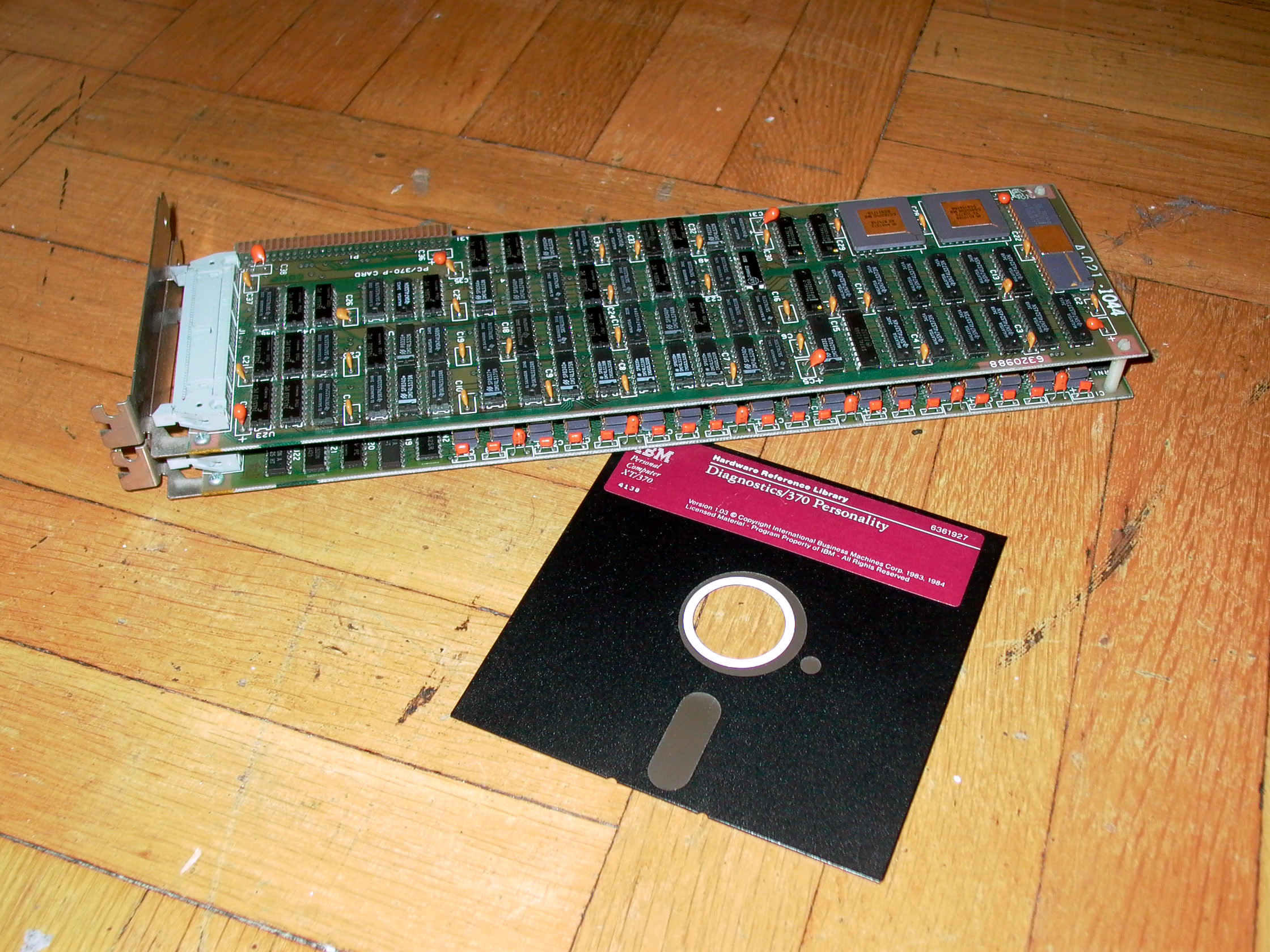
| XT/370 | 5160 | October 1983 | April 1987 | 8088 | Model 5160 equipped with XT/370 Option Kit and 3277 Emulation Adapter. |
| 3270 PC | 5271 | October 1983 | April 1987 | 8088 | Features 3270 terminal emulation and a keyboard with 20 function keys. |
| PCjr | 4860 | November 1983 | March 1985 | 8088 | Home computer relying on floppy disks and ROM cartridges; included an infrared wireless keyboard. |
| Portable | 5155 | February 1984 | April 1986 | 8088 | Portable system utilizing floppy disk storage. |
| AT | 5170 | August 1984 | April 1987 | 80286 | Enhanced processor speed with expanded RAM up to 16 MB, faster system bus (initially 6 MHz, later upgraded to 8 MHz), jumperless configuration, and integrated real-time clock. |
| AT/370 | 5170 | October 1984 | April 1987 | 80286 | 5170 model equipped with AT/370 Option Kit and 3277 Emulation Adapter. |
| 3270 AT | 5281 | June 1985 | April 1987 | 80286 | Incorporates 3270 terminal emulation capabilities. |
| Convertible | 5140 | April 1986 | August 1989 | 80C88 | Laptop-style portable featuring microfloppy disk drives. |
| XT 286 | 5162 | September 1986 | April 1987 | 80286 | Includes a slower hard drive but zero wait-state memory on the motherboard; outperforms some AT models despite a lower clock frequency. |
All IBM PC models offer baseline software compatibility, although programs sensitive to timing may experience issues on processors with higher speeds.
Clones
IBM made much of its IBM PC documentation publicly available, which allowed other manufacturers to create compatible hardware and software products. However, the BIOS remained proprietary. Since the IBM PC was built using widely available hardware components and its operation was well documented, producing compatible machines largely depended on developing a BIOS ROM that could function equivalently.
Direct copying of the BIOS was prohibited under copyright law, but companies such as Compaq, Phoenix Software Associates, American Megatrends, and Award employed clean-room reverse engineering techniques. They developed their own BIOS implementations that were compatible with IBM PCs, enabling them to manufacture systems capable of running identical software and utilizing the same expansion cards as IBM PCs or license their BIOS technology to other vendors.
These computers, commonly referred to as IBM compatibles or "clones," quickly gained significant market acceptance. Clone manufacturers also introduced hardware enhancements, including faster processors like the NEC V20, which could execute software designed for the original 8088 at clock speeds up to 10 MHz.
The clone industry grew rapidly, eventually becoming synonymous not only with IBM but also representing a set of de facto standards established by various producers.
Sources
- Referenced materials
Additional resources
- IBM SCAMP Video
- Detailed IBM 5150 Data at minuszerodegrees.net
- Collection of IBM PC 5150 System Disks and ROMs
- Definition of IBM PC from IT Dictionary
- Historical and Technical Overview of IBM PC
- Reflecting on the IBM PC's 25-Year Impact
- CNN Coverage: IBM PC Celebrates 25 Years
- IBM-5150 and Vintage Computer Collection at oldcomputermuseum.com
- Visuals and Details on the IBM PC
- November 1982 IBM PC Promotional Brochure
- Image Depicting XT/370 Cards with Dual 68000 CPUs
- IBM PC Internals Fundamentals Training Notes (PDF)