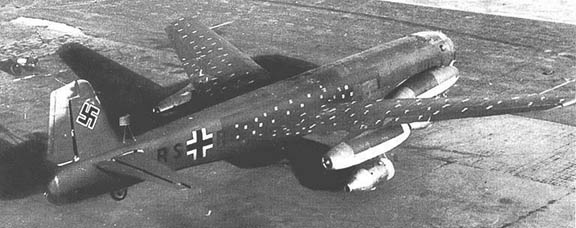
Junkers Ju 287
| Company type | Tactical jet bomber (prototype) |
|---|---|
| Industry | Aerospace |
| Founded | 1944 |
| Founder | Dr. Hans Wocke (designer) |
| Headquarters | Dessau , Nazi Germany |
| Products | Jet-powered bomber aircraft |
The Junkers Ju 287 was a tactical jet bomber with multiple engines, developed in Nazi Germany during 1944. It was distinguished by its innovative forward-swept wing design, and its first two prototypes were among the rare jet aircraft to utilize fixed landing gear.
Development
The Ju 287 was conceived to equip the Luftwaffe with a bomber capable of outrunning enemy fighters. The forward-swept wing concept, introduced by designer Dr. Hans Wocke, aimed to enhance lift at low speeds, addressing the challenges faced by early turbojet engines during takeoff and landing phases. This wing arrangement also permitted a sizable central weapons bay aligned with the aircraft’s center of gravity, as the main wing spar was positioned aft of the bomb bay. Prior to assembling the Ju 287, a modified He 177 A-3 served as a testbed for this bomb bay configuration.[1]
The initial pair of prototypes (Ju 287 V1 and V2, designated Ju 288 V201 and Ju 288 V202 for security reasons) evaluated the forward-swept wing and high subsonic flight capabilities respectively. Their construction incorporated parts from existing aircraft: fuselages from He 177 A-3s, tails from Ju 188G-2s, and landing gear sourced from B-24 Liberators, all fixed to minimize weight and mechanical complexity. The fixed undercarriage was necessary because the wing’s structural design could not accommodate wheel wells without undermining the rigidity critical to the forward sweep. Later iterations intended to implement retractable landing gear housed within the fuselage sides.[2]
Initially, the Ju 287 was designed to be powered by four Heinkel-Hirth HeS 011 engines; however, delays in their development led to a switch to BMW 003 engines. The V1 prototype was equipped with four Jumo 004 engines—two mounted beneath the wings and two integrated into the fuselage. The V2 planned for six engines arranged in clusters combining Jumo 004s and BMW 003s, alongside structural changes such as inward-angled main gear struts and repositioned stabilizers.[1]
Later prototypes (V3 and V4) featured six BMW 003 engines grouped in triple clusters under each wing and introduced a redesigned fuselage and tail section intended for the production Ju 287A-1 model, which also incorporated a pressurized cockpit derived from the Junkers Ju 288. The V5 and V6 variants added tail armament, complete operational systems, and ejection seats. The proposed Ju 287B-1 variant was designed to carry six Jumo 004 engines arranged similarly.[1]
Flight testing commenced on 8 August 1944 under pilot Siegfried Holzbaur, demonstrating excellent handling characteristics but revealing some wing flexing issues typical of forward-swept designs. Testing suggested that moving engine mass forward beneath the wings would mitigate this flexing; this adjustment was implemented in subsequent prototypes.[2] Components for the V2 were completed and sent for assembly. The Ju 287 V1 completed seventeen flights without significant problems but experienced minor reliability issues with its turbojets and HWK 109-501 RATO boosters.[3]
Although initial tests focused on low-speed performance, the V1 achieved speeds up to 660 km/h during dives. After September 1944, testing shifted to the Luftwaffe’s primary test facility at Rechlin for airflow analysis using tuft methods. Despite encouraging outcomes, development was halted alongside the Heinkel He 343 project to prioritize production of the Volksjäger emergency fighter program. Unexpectedly, in March 1945, the Ministry of Aviation issued an order to commence mass production of the Ju 287 bomber at a rate of one hundred units per month.[1][4]
Postwar progress
In April 1945, the Red Army seized control of the Junkers facility located in Dessau. At that juncture, the Ju 287 V2 was nearly finished, pending engine installation, while the V3 was approximately 80 to 90 percent complete and the V4 was about 60 percent built. The Luftwaffe personnel destroyed both the V1 and V2 prototypes at Brandis to avoid their capture by Allied forces. Wocke and his engineering team were relocated to the Soviet Union, where components from the V2—most notably its wings—were utilized in constructing the EF 131 prototype, which took flight on 23 May 1947. By that time, however, jet propulsion technology had already advanced beyond the capabilities of the Ju 287. A larger evolution of the design, designated EF 140, was developed and flown as a prototype in 1949 but was soon discontinued.
Variants
Information sourced from: Junkers Ju 287: The World's First Swept-Wing Jet Aircraft
- Ju 287 V1 (also known as Ju 288 V201)
- The initial prototype serving as a technology demonstrator featuring fixed landing gear; fuselage derived from He 177A-5, tail section from Ju 188G-2; powered by four Jumo 004B engines.
- Ju 287 V2 (also referenced as Ju 288 V202)
- The second prototype with modifications including removal of the tail wheel, horizontal stabilizer lowered by one foot, and inward main gear struts; originally intended to have four BMW 003 engines plus two Jumo 004Bs, later altered to two underwing pods each housing three BMW 003 engines. The airframe was nearly complete when development ceased in late 1944; it never achieved flight.
- Ju 287 V3
- The third prototype and planned model for Ju 287A-1 production; featured a fuselage based on the Ju 288 with a fully glazed and pressurized cockpit accommodating three crew members; equipped with retractable landing gear and lacking armament; powered by six BMW 003 engines arranged in two clusters of three beneath the wings. Completion status at war’s end was roughly between 80 and 90 percent.
- Ju 287 V4
- The fourth prototype was about 60 percent finished prior to the Dessau factory’s capture by Allied forces.
- Ju 287 V5 & V6
- Armed variants incorporating ejection seats and an FHL 131/Z turret armed with two MG 131 machine guns.
- Ju 287 A-1
- Production variant powered by six BMW 003 engines arranged in two triple-engine pods under the wings; outfitted with operational systems and an FHL 131/Z turret carrying two MG 131 machine guns; did not include ejection seats.
- Ju 287 B-1
- Production version utilizing six Jumo 004 engines in a similar triple-cluster configuration under the wings; featured an FHL 131/Z turret and larger nose wheels; lacked ejection seats.
- EF 125
- A proposed concept powered by two turbojets—either Junkers Jumo 012 or BMW 018—mounted beneath the wings.
- EF 131
- Prototype closely resembling the production Ju 287 but equipped with two triple clusters of RD-10 engines under each wing.
Bibliography
- Ford, Roger. Germany's Secret Weapons of World War II. London: Amber Books, 2013. .
- Green, William. Warplanes of the Third Reich. New York: Doubleday, 1970. .
- Hitchcock, Thomas H. Junkers 287 (Monogram Close-Up 1). Acton, Massachusetts: Monogram Aviation Publications, 1974. .
- Jack, Uwe W. Junkers Ju 287 and EF 131: Luftwaffe Six-engine Long-range Aircraft with Forward Swept Wings. N.p.: Jack Aerospace Publishing, second edition, 2021