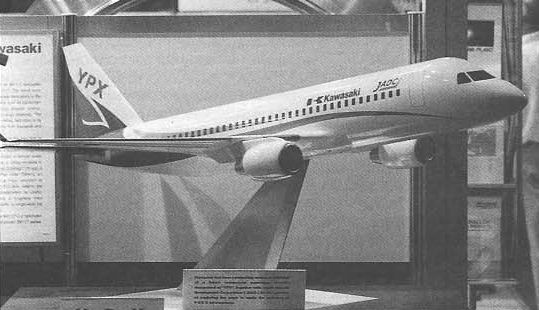
Kawasaki YPX
| Industry | Aerospace |
|---|---|
| Headquarters | Japan |
| Parent | Kawasaki Heavy Industries |
The Kawasaki YPX represented a proposed twinjet airliner concept developed by Japan's Kawasaki Aerospace Company. This design was derived from the Kawasaki P-1 platform, which was originally created for the Japan Maritime Self-Defense Force, but featured a configuration with two engines instead of the original four.
As of 2024, no advancements have been reported.
Design and development
The YPX was intended to accommodate between 100 and 150 passengers, positioning itself as a competitor to smaller short-range jets such as the Boeing 737 and the Airbus A320 family. At the time development ceased, the choice of engines remained unresolved, with initial plans aiming for service entry around 2015. However, no prototype aircraft was ever constructed.
Kawasaki targeted a fuel consumption reduction of approximately 15% relative to the Boeing 737.
According to specifications published in 2007, the base YPX-11 variant would offer seating for 113 passengers across two classes. The YPX-10 was designed for 93 seats, while the YPX-12 could hold up to 137 passengers; an all-economy configuration could increase capacity to roughly 150. Each model shared a standard operational range of 4,260 km (2,300 nautical miles), with extended-range versions of the YPX-10 and YPX-11 capable of reaching up to 5,930 km (3,200 nautical miles).
The aircraft’s cabin was designed with five seats abreast in economy class, featuring an elliptical fuselage cross-section to enhance aerodynamic efficiency. Economy seating measured 46 cm (18 in) in width, complemented by an aisle width of 51 cm (20 in).
In 2012, Kawasaki Heavy Industries together with Japan’s Ministry of Defense acknowledged that adapting a passenger airliner heavily based on the P-1 would face limited commercial viability and necessitate significant redesign efforts. While twin-engine configurations are standard in this category for reasons of cost-effectiveness and fuel economy, the P-1’s prototype utilized four domestically manufactured turbofan engines as required by the Maritime Self-Defense Force, implying substantial modifications would be needed. By March 2013, Kawasaki publicly stated that there were "no concrete moves" toward converting the P-1 into a commercial passenger aircraft.