
Lun-class ekranoplan
| Company type | Military ground effect vehicle |
|---|---|
| Industry | Military / Naval |
| Founded | 1975 |
| Founder | Rostislav Alexeyev |
| Defunct | Late 1990s (retired from service) |
| Headquarters | Kaspiysk (location of main unit) , Soviet Union / Russia |
Area served | Caspian Sea |
Key people | Rostislav Alexeyev (designer) |
| Products | Lun-class ekranoplan (Project 903) |
Number of employees | 15 (crew: 6 officers, 9 enlisted) |
Lun-class ekranoplan
The Lun-class ekranoplan (Soviet designation: Project 903) represents the sole ground effect vehicle (GEV) ever to be actively deployed as a combat vessel, serving within the Caspian Flotilla. Conceived by Rostislav Alexeyev in 1975, this unique craft was operated by the Soviet Navy and subsequently by the Russian Navy from 1987 until the late 1990s.
Unlike conventional aircraft, seaplanes, hovercraft, or hydrofoils, ekranoplans such as the Lun generate lift by exploiting the ground effect produced when flying just a few metres above water. This phenomenon enhances wing efficiency by significantly reducing drag due to diminished wingtip vortices caused by proximity to the surface. Consequently, the Lun glides at an altitude of approximately 4 metres above the waterline. Due to this operational principle, international maritime authorities classify such vehicles as ships rather than aircraft.
The Lun measures 73.8 metres in length with a wingspan of 44 metres and stands 19.2 metres tall. It has an unloaded weight of 286 tonnes and a draught of 2.5 metres. Propulsion is provided by eight Kuznetsov NK-87 turbofan engines, each delivering 127.4 kilonewtons of thrust, enabling speeds up to 297 knots and a range near 1,000 nautical miles. The vessel can carry up to 100 tonnes of payload and operates with a crew complement consisting of six officers and nine enlisted personnel.
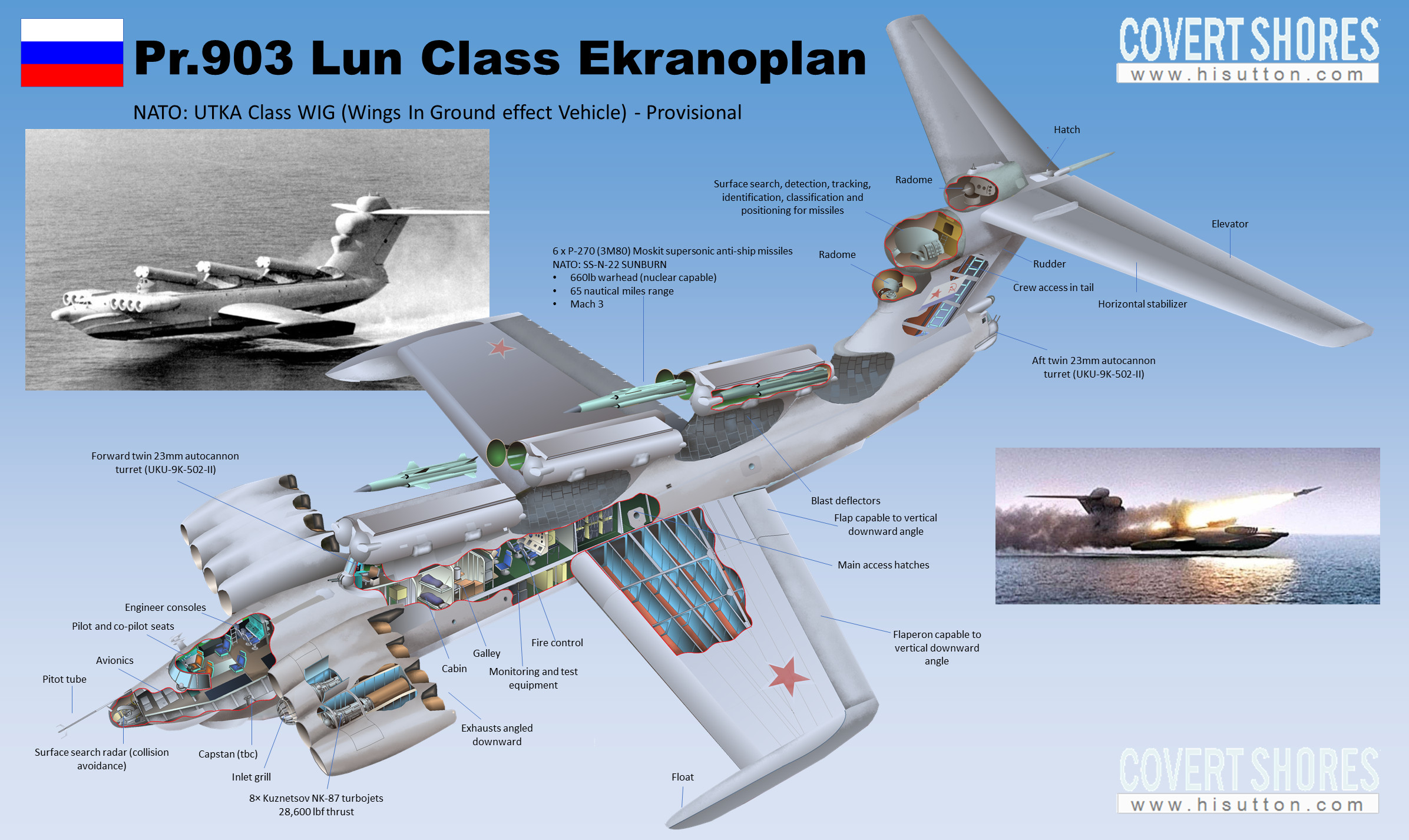
Armament includes six fixed-elevation launchers for P-270 Moskit anti-ship missiles and two twin-mounted 23 mm PI-23 turrets. The Lun is equipped with Puluchas search radar systems for target acquisition and situational awareness.
The vessel’s name derives from the Russian term for the harrier bird, reflecting its distinctive low-altitude flight characteristics over water surfaces.
Design and development
The Lun-class ekranoplan was created as an evolution of the experimental KM ekranoplan, often referred to as the "Caspian Sea Monster".
This model was equipped with eight Kuznetsov NK-87 turbofan engines, each delivering 127.4 kN (28,600 lbf) of thrust, and these were installed on forward-positioned canards. Its hull was designed as a flying boat, featuring a prominent deflecting plate underneath that acted as a "step" to assist during takeoff.[1] The maximum cruising velocity reached 550 kilometres per hour (340 mph).[2]
Designed primarily for anti-surface warfare, the Lun carried six P-270 Moskit (Mosquito) guided missile launchers arranged in pairs along the dorsal side of its fuselage. Advanced targeting systems were installed both at the front and rear of the craft to enhance missile guidance.[3]
Only one completed unit of this class, designated MD-160, was commissioned into service with the Soviet Navy's Caspian Flotilla in 1987. It remained active until its retirement in the late 1990s, after which it was left idle at a naval base in Kaspiysk on the Caspian Sea until 2020.[2][4][5]
A second Lun-class ekranoplan was partially constructed during the late 1980s. During its build, plans shifted to convert it into a mobile field hospital capable of rapid deployment to various maritime or coastal zones, earning it the name Spasatel ("Rescuer"). However, following the dissolution of the Soviet Union in 1991 and the subsequent cessation of military funding, work on this vessel ceased.[6]Cite error: The opening <ref> tag is malformed or has a bad name As of 2021, this unfinished Spasatel remains stored near the Volga river within an old industrial facility located in Nizhny Novgorod, Russia.[7]
Despite its innovative design, the Lun had notable limitations. Its short wingspan required it to operate extremely close to water—approximately 1.5–3.0 m (5–10 ft) above the surface—to maintain ground effect flight, making it incapable of flying in anything beyond calm sea conditions. Additionally, since it relied exclusively on ground effect for lift, it lacked the capability to ascend to higher altitudes for cruising. These factors severely restricted its operational deployment to areas with tranquil waters.[8]
Museum ship
Template:Maplink On 31 July 2020, the fully assembled MD-160 Lun-class ekranoplan was moved out from the naval facility in Kaspiysk with plans to eventually exhibit it publicly in Derbent, Dagestan. It was intended to be part of the forthcoming Patriot Park, a combined museum and theme park showcasing Soviet and Russian military hardware.[9][5]Cite error: The opening <ref> tag is malformed or has a bad name The relocation utilized rubber pontoons, three tugboats, and two escort vessels, covering an estimated distance of 100 km (62 miles) if completed.[9] Nevertheless, the ekranoplan ran aground just offshore on a sandy beach before reaching its destination.
Efforts to dislodge the massive craft were unsuccessful, leading to its secure mooring in the surf zone. Meanwhile, strategies were developed for continuing its transfer to Patriot Park. During this period, the distinctive vehicle drew significant interest from media representatives, casual observers, and unauthorized "urban explorers", even prior to the park's establishment.[9][10] Reports from August 2020 indicated that prolonged exposure to surf conditions was causing water ingress into the hull.[11] Relocating the ekranoplan beyond the surf zone onto dry land would reduce the risk of further hull deterioration due to intensified wave action during storms.
By December 2020, a successful extraction operation had pulled the ekranoplan out of the water nose-first, leaving its tail approximately 20–30 m (65–100 ft) from the shoreline as confirmed by satellite imagery.[12] The vessel was subsequently towed fully ashore on 30 December 2021.Cite error: The opening <ref> tag is malformed or has a bad name Unfortunately, during towing and beach haul-out, damage occurred to the wing sponsons and fuselage of MD-160.Cite error: The opening <ref> tag is malformed or has a bad name
Russian sources reported in December 2024 that restoration work on MD-160 had commenced.Cite error: The opening <ref> tag is malformed or has a bad name By September 2025, restoration efforts were underway focusing on both exterior surfaces and portions of the interior. The goal was to reinstate its original appearance and prepare it for display as a museum piece.Cite error: The opening <ref> tag is malformed or has a bad name This project also included partial repairs addressing damage sustained by the vehicle’s flaps during transport from Kaspiysk. By mid-October 2025, repainting was largely finished, with MD-160 coated in a grey livery.Cite error: The opening <ref> tag is malformed or has a bad nameCite error: The opening <ref> tag is malformed or has a bad name The ekranoplan is set to serve as the centerpiece exhibit at the new Derbent Patriot Park, situated within a developing tourist area along the Caspian Sea coast just south of the city.
Previous Operators
Image Gallery
-
Illustration depicting a Lun-class ekranoplan in flight.
-
Lun-class ekranoplan at Kaspiysk, Russia, captured in 2010.
-
MD-160 being dragged ashore before the establishment of Derbent Patriot Park and its later refurbishment.
-
Museum exhibit featuring a scale model of a Lun-class ekranoplan.


Technical Specifications
Associated developments
References
- ↑ Cite error: Invalid
<ref>tag; no text was provided for refs namedFlying Magazine - ↑ 2.0 2.1 Cite error: Invalid
<ref>tag; no text was provided for refs namedBusiness Insider - ↑ Cite error: Invalid
<ref>tag; no text was provided for refs namedHollebone2012 - ↑ Cite error: Invalid
<ref>tag; no text was provided for refs namedFerguson2013 - ↑ 5.0 5.1 Cite error: Invalid
<ref>tag; no text was provided for refs namedCenciotti2020 - ↑ Cite error: Invalid
<ref>tag; no text was provided for refs namedYunBliault2009 - ↑ Satellite view of uncompleted Lun-class ekranoplan in Nizhny Novgorod, Russia Archived 22 March 2023 at the Wayback Machine via Google Maps. Retrieved 25 July 2021.
- ↑ Lua error in Module:Citation/CS1/Configuration at line 2123: attempt to index field '?' (a nil value).
- ↑ 9.0 9.1 9.2 Cite error: Invalid
<ref>tag; no text was provided for refs namedcnnRos - ↑ Cite error: Invalid
<ref>tag; no text was provided for refs namedurbanEx - ↑ Cite error: Invalid
<ref>tag; no text was provided for refs namedforbes - ↑ Cite error: Invalid
<ref>tag; no text was provided for refs namedyandex
External links

- Short clip showing the 2020 towing operation on YouTube (duration: 1m0s)
- Aerial drone footage of Lun stranded near the shoreline on YouTube (2m5s, no audio)
- Satellite imagery following the successful beaching of Lun via Yandex Maps
- Article from Wired featuring a photo gallery (optimized for slower or limited internet connections)
- Extensive photographic collection of Lun (recommended for faster connections) with Russian captions, or mirrored images including translated descriptions
- Preliminary cutaway illustration of the Lun-class ekranoplan hosted on hisutton.com dedicated ekranoplan/WIG page
Lua error in Module:Coordinates at line 489: attempt to index field 'wikibase' (a nil value).
- Pages with reference errors
- Pages with broken file links
- Pages with script errors
- Webarchive template wayback links
- Pages using gadget WikiMiniAtlas
- Articles with short description
- Commons category link is defined as the pagename
- Ekranoplans
- Tandem-wing aircraft
- Alekseyev Central Hydrofoil Design Bureau aircraft
- Three-surface aircraft
- Eight-engined jet aircraft
- T-tail aircraft