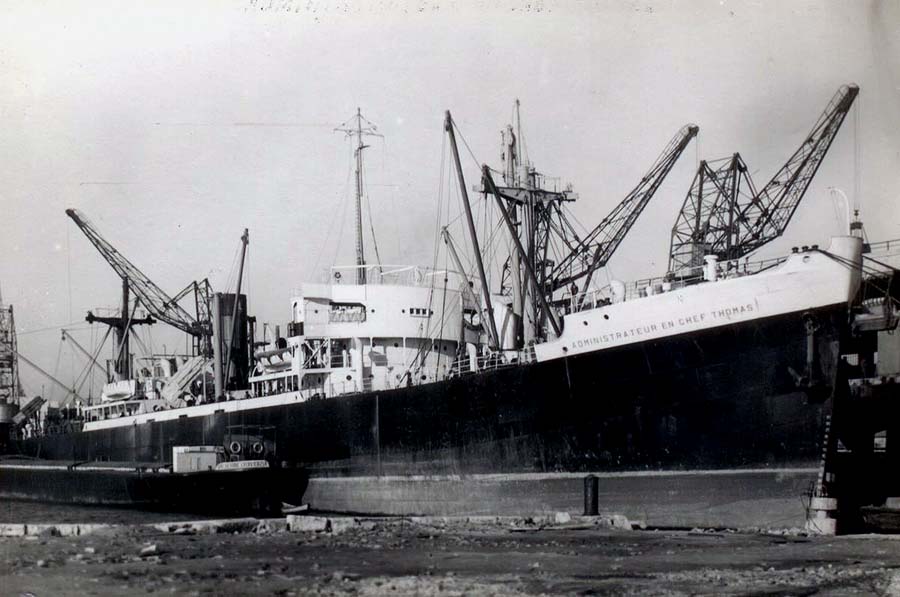
MV Santagata
| Industry | Shipping |
|---|---|
| Founded | 8 March 1943 |
| Founder | Sir W G Armstrong, Whitworth & Co (Shipbuilders) Ltd |
| Fate | Wrecked on Goodwin Sands, 24 November 1950 |
| Headquarters | Newcastle upon Tyne (builder) , United Kingdom |
| Products | Cargo shipping services |
Santagata Cargo Vessel Overview
Santagata was a cargo vessel with a gross register tonnage of 7,049, constructed in 1943 by Sir W G Armstrong, Whitworth & Co (Shipbuilders) Ltd, located in Newcastle upon Tyne, United Kingdom. Originally launched under the name Empire Farmer, the ship was commissioned by the Ministry of War Transport (MoWT). In 1945, ownership transferred to the French Government, which renamed her Administrateur en Chef Thomas. Subsequently, in 1949 she was acquired by an Italian company and received the name Santagata. The vessel met its demise later that same year when it was wrecked on the Goodwin Sands.
Construction and Specifications
Built by Sir W G Armstrong, Whitworth & Co (Shipbuilders) Ltd, the ship was launched on 8 March 1943 and completed by May of the same year. It measured 430 feet 9 inches in length with a beam of 56 feet 2 inches and a draught of 26 feet 9 inches. The depth of the hull was recorded at 35 feet 2 inches. Powered initially by a triple-expansion steam engine delivering 2,500 horsepower, propulsion was provided via a single screw propeller capable of reaching speeds up to 11 knots. In 1949, the vessel’s propulsion system was updated to a diesel engine. When named Santagata, the crew complement numbered 32.
Ownership and Service History
Throughout her operational life, this cargo ship underwent several changes in ownership and registry. From 1943 to 1945, she was owned by the Ministry of War Transport and registered in Newcastle upon Tyne under United Kingdom Official Number 119166 with code letters BFDC. During this period, Lyle Shipping Co Ltd managed her operations. Following her sale to the French Government in 1945, she sailed under the French flag registered at Le Havre with code letters FPPJ, operated by Compagnie Générale Transatlantique until 1948. A brief tenure under Compagnie des Transports Atlantiques followed before her acquisition by Achille Lauro & Co in Italy from 1949 until her loss in 1950. During this final phase, she was registered in Naples.
Final Fate
The ship’s service concluded on 24 November 1950 when she was wrecked on the Goodwin Sands, marking the end of her maritime career.
Description
Constructed in 1944 by Sir W G Armstrong, Whitworth & Co (Shipbuilders) Ltd located in Newcastle upon Tyne, Northumberland, the vessel was assigned yard number 3 during its production.[1]
The ship measured 430 feet 9 inches (131.29 m) in length and had a beam spanning 56 feet 2 inches (17.12 m). Its depth reached 35 feet 2 inches (10.72 m), with a draught of 26 feet 9 inches (8.15 m). The vessel was registered with a gross tonnage of Template:GRT, a net tonnage of Template:NRT,[2] and a deadweight tonnage of 10,499.[3]
Originally, propulsion was provided by a 2,500 horsepower (1,900 kW) triple expansion steam engine,[3] featuring cylinders measuring 24½ inches (62 cm), 39 inches (99 cm), and 70 inches (180 cm) in diameter, each with a stroke of 48 inches (120 cm). This engine was manufactured by the North East Marine Engine Co. (1938) Ltd, based in Newcastle upon Tyne.[2] Power was transmitted to a single screw propeller.[3] The engine enabled the ship to reach speeds up to 11 knots (20 km/h).[4]
History
Launched on 8 March 1943 and finalized by May of the same year,[1] the ship was designated with the Code Letters BFDC and the United Kingdom Official Number 169166. Its home port was Newcastle upon Tyne, and operational control was under Lyle Shipping Co Ltd.[2]
The vessel’s inaugural journey commenced as part of Convoy FN1037, which departed from Southend-on-Sea, Essex on 2 June 1943 and reached Methil, Fife on 4 June.[5] She joined this convoy from the River Tyne on 3 June.[6] Subsequently, she became part of Convoy EN.238 departing Methil on the same day and arriving at Loch Ewe on 6 June.[7] Later, she sailed with Convoy KMS19G from the River Clyde on 25 June, passing Gibraltar on 6 July,[8] which then transitioned to Convoy KMS 19 arriving at Malta on 22 July during Operation Husky. On this voyage, she carried the Convoy Commodore.[9] Following that, she joined Convoy KMS19T leaving Malta on 23 July and reaching Tripoli, Libya the next day.[10] Departing Tripoli on 26 July as part of Convoy MKS19Y, she arrived at Gibraltar on 31 July,[11] but disembarked at Bizerta, French Algeria on 1 August. On 30 August, she left Bizerta to join Convoy MKS23,[6] which had sailed from Alexandria, Egypt on 25 August and arrived at Gibraltar on 3 September.[12] She exited this convoy at Skikda (formerly Philippeville) the following day.[6]
Departing Philippeville on 16 September, she joined Convoy UGS16,[6] which had set off from Hampton Roads, United States on 27 August and reached Malta on 24 September.[13] She then led Convoy TSS6,[14] departing Malta on 22 September. Records indicate her next departure was from Salerno, Italy on 5 October, arriving at Malta two days later.[6] During this passage, she transported several Royal Marines destined for HMS Phoenicia.[15] The following day, she sailed for Tripoli, Libya, arriving there on 9 October.[6] On 20 October she joined Convoy TX5, arriving at Alexandria five days later.[16] Continuing onward to Port Said, Egypt, she arrived there the next day. On 6 November she left Port Said and returned to Alexandria by the following day.[6] She embarked with Convoy MKS31 on 13 November but detached at Augusta, Italy to join Convoy AH9A departing on 19 November and reaching Bari, Italy two days later.[17][18] Convoy MKS31 proceeded to Gibraltar by 23 November.[17] Afterwards, she voyaged to Brindisi, Italy,[6] leaving there on 28 November with Convoy HA10 which arrived at Augusta two days later.[19] Empire Farmer departed Augusta on 2 December joining Convoy GUS23,[6] which had left Port Said on 27 November and arrived at Hampton Roads on Christmas Day.[20] She exited this convoy at Gibraltar on 8 December. On 19 December she sailed from Gibraltar to join Convoy OS61 that reached Freetown, Sierra Leone by month-end.[6]
On 2 January 1944 Empire Farmer left Freetown as part of Convoy STL9 bound for Lagos, Nigeria where she arrived six days later. She then proceeded to Calabar, Nigeria arriving there two days after departing Lagos. Returning to Lagos by late January, she sailed for Takoradi in the Gold Coast shortly thereafter. On 1 February she joined Convoy LTS9,[6] which had departed Lagos at the end of January and docked at Freetown by early February.[21] Subsequently joining Convoy SL149 departing Freetown on 11 February,[22] this convoy merged with MKS40 at sea by late February,[23] arriving in Liverpool by early March.[23] Empire Farmer detached from this convoy to call at Loch Ewe before joining Convoys WN558A and FS1386 en route back to Southend by mid-March.[6]
From Southend starting mid-June until late July, Empire Farmer operated within convoys traveling between the Seine Bay area. Departing Seine Bay with Convoy FTM44,[24] she reached Southend before diverting to Portsmouth where she left the convoy. The following day she sailed from The Solent joining Convoy EBC33,[6][25] arriving in Cardiff by late July. Mid-August saw her move to Belfast Lough before joining Convoy ON249 departing Liverpool for New York in early September.[6][26]
Leaving New York mid-September for Hampton Roads,[6], Empire Farmer joined Convoy UGS54 sailing towards Port Said by early October,[27] but left this convoy upon arrival at Augusta. The next day she joined Convoy VN69 reaching Naples soon after. Later that month she sailed from Naples to Gibraltar arriving in early November.[6] Onward movements included sailing with Convoy GC95 from Gibraltar to Casablanca,[28], followed by joining convoy GUS57 returning to Hampton Roads by late November.[29][6]
Mid-December found her departing Hampton Roads for Cristóbal in Panama where she arrived just before Christmas. From Balboa in Panama, she set sail late December bound for Iquique in Chile arriving at New Year’s Day of 1945.[6]
In early January Empire Farmer returned from Iquique to Balboa before moving onwards to Cristóbal. From there she embarked with Convoy ZG116 reaching Guantanamo Bay later that month. She then proceeded with Convoy GN183 back to Hampton Roads by month’s end before joining UGS73 bound for Gibraltar in February. After arrival there mid-February, she continued to Port Said by early March and subsequently sailed for Suez followed by Aden later that month. By late March she had reached Diego-Suarez in Mozambique; mid-April saw her depart for Majunga in Madagascar before heading onward to Durban in South Africa later that month. Early May found her sailing for Colombo in Ceylon where she arrived late May; late June saw her move onwards to Cochin in India arriving shortly thereafter.[6]
Departing Cochin in early July for Durban where she stayed briefly before setting course for Buenos Aires reaching mid-August. Ten days later she traveled onward to Rosario in Argentina returning again to Buenos Aires before sailing early September for Montevideo in Uruguay. By mid-September Empire Farmer visited Cape Verde Islands before heading toward London arriving during October.[6]
She left London mid-November heading for Hull where arrival occurred the following day.[6]
On 15 November 1945 ownership transferred to the French Government who renamed her Administrateur en Chef Thomas, commemorating Thomas Prudent who died after being wounded attempting escape following arrest by the Gestapo due to his involvement in the St. Nazaire Raid of March 1942.[30] Her port of registry changed to Le Havre with Code Letters FPPJ assigned,[31] managed under Compagnie Générale Transatlantique (CGT).[4]
Beginning CGT service with a maiden voyage from Le Havre to New York in December, subsequent routes included visits to Nantes, Marseille and various African ports. In July 1947 a collision occurred with tanker SS Wyoming Valley at New Orleans causing damage; later that year another collision took place with USS LCT-932 near Bassens resulting in stern leakage. In August 1948 ownership passed to Compagnie des Transports Atlantiques based in Le Havre.[3]
In October 1949 sale transferred vessel to Achille Lauro & Co of Naples who renamed her Santagata.[3] A re-engining took place in 1950 installing a Burmeister and Wain six-cylinder four-stroke diesel engine originally built in 1940.[4]
On Christmas Eve of that year while voyaging from Casablanca toward Leith, Santagata grounded upon Goodwin Sands approximately three nautical miles northeast of South Goodwin Lightship breaking apart into two sections and declared a total loss.[1][4][3] All thirty-two crew members were rescued by Walmer Lifeboat; however its bowman suffered collapse and died as they reached the stranded ship.[32][33]
References
- ↑ 1.0 1.1 1.2 Cite error: Invalid
<ref>tag; no text was provided for refs namedShips - ↑ 2.0 2.1 2.2 Cite error: Invalid
<ref>tag; no text was provided for refs namedFarmer42 - ↑ 3.0 3.1 3.2 3.3 3.4 3.5 Cite error: Invalid
<ref>tag; no text was provided for refs namedFrench - ↑ 4.0 4.1 4.2 4.3 Cite error: Invalid
<ref>tag; no text was provided for refs namedTyne - ↑ Cite error: Invalid
<ref>tag; no text was provided for refs namedFN1037 - ↑ 6.00 6.01 6.02 6.03 6.04 6.05 6.06 6.07 6.08 6.09 6.10 6.11 6.12 6.13 6.14 6.15 6.16 6.17 6.18 6.19 6.20 Cite error: Invalid
<ref>tag; no text was provided for refs namedPort - ↑ Cite error: Invalid
<ref>tag; no text was provided for refs namedEN238 - ↑ Cite error: Invalid
<ref>tag; no text was provided for refs namedKMS19G - ↑ Cite error: Invalid
<ref>tag; no text was provided for refs namedKMS19 - ↑ Cite error: Invalid
<ref>tag; no text was provided for refs namedKMS19T - ↑ Cite error: Invalid
<ref>tag; no text was provided for refs namedMKS19Y - ↑ Cite error: Invalid
<ref>tag; no text was provided for refs namedMKS23 - ↑ Cite error: Invalid
<ref>tag; no text was provided for refs namedUGS16 - ↑ Cite error: Invalid
<ref>tag; no text was provided for refs namedTSS6 - ↑ Cite error: Invalid
<ref>tag; no text was provided for refs namedBBC - ↑ Cite error: Invalid
<ref>tag; no text was provided for refs namedTX5 - ↑ 17.0 17.1 Cite error: Invalid
<ref>tag; no text was provided for refs namedMKS31 - ↑ Cite error: Invalid
<ref>tag; no text was provided for refs namedAH9A - ↑ Cite error: Invalid
<ref>tag; no text was provided for refs namedHA10 - ↑ Cite error: Invalid
<ref>tag; no text was provided for refs namedGUS23 - ↑ Cite error: Invalid
<ref>tag; no text was provided for refs namedLTS9 - ↑ Cite error: Invalid
<ref>tag; no text was provided for refs namedSL149 - ↑ 23.0 23.1 Cite error: Invalid
<ref>tag; no text was provided for refs namedSL149MK - ↑ Cite error: Invalid
<ref>tag; no text was provided for refs namedFTM44 - ↑ Cite error: Invalid
<ref>tag; no text was provided for refs namedFBC33 - ↑ Cite error: Invalid
<ref>tag; no text was provided for refs namedON249 - ↑ Cite error: Invalid
<ref>tag; no text was provided for refs namedUGS54 - ↑ Cite error: Invalid
<ref>tag; no text was provided for refs namedGC95 - ↑ Cite error: Invalid
<ref>tag; no text was provided for refs namedGUS57 - ↑ Cite error: Invalid
<ref>tag; no text was provided for refs namedNantes - ↑ Cite error: Invalid
<ref>tag; no text was provided for refs namedAdministrateur45 - ↑ Cite error: Invalid
<ref>tag; no text was provided for refs namedStM - ↑ Cite error: Invalid
<ref>tag; no text was provided for refs namedTimes271250