
Omaha and Council Bluffs Railway and Bridge Company
| Company type | Private |
|---|---|
| Industry | Streetcar / Electric railway |
| Predecessor | Omaha Horse Railway Company, Omaha Cable Tramway Company |
| Founded | 1886 |
| Defunct | 1955 |
| Fate | Merged into Omaha Traction Company |
| Headquarters | Omaha , United States |
Area served | Omaha, Nebraska and Council Bluffs, Iowa |
Key people | George F. Wright (Secretary), Samuel D. Mercer (founder of predecessor) |
| Products | Streetcar services |
The Omaha and Council Bluffs Railway and Bridge Company (O&CB), established in 1886, linked Omaha, Nebraska and Council Bluffs, Iowa by means of a bridge spanning the Missouri River. Holding exclusive rights to operate streetcar services in both municipalities, O&CB was among the pioneering electric street railway enterprises and remained one of the final streetcar operators in the United States until it discontinued service in 1955.
Background
Originating from the Omaha Horse Railway Company, which was founded in 1867, O&CB's electric streetcar operations began with the formation of the 1887 Omaha Motor Railway. This entity resulted from merging the Omaha Horse Railway and the Omaha Cable Tramway Company under the leadership of Samuel D. Mercer.[1]
George F. Wright, who initiated the Council Bluffs Street Railway in 1868, collaborated with prominent Omaha business figures Frank Murphy and Guy C. Barton, as well as Council Bluffs executives John T. Stewart and Thomas J. Evans, to establish O&CB in 1886.[2] Key investors included Chicago’s Marshall Field, Nebraska Senator Joseph Millard, and representatives from American Smelting Company.[3]
By June 1895, all horse-drawn streetcar lines had been completely replaced.[1]
Douglas Street Bridge
In 1887, O&CB obtained congressional authorization to build a dual-purpose bridge accommodating both wagons and railway traffic across the Missouri River.[4] This authorization led to the creation of the Douglas Street Bridge—later renamed the Ak-Sar-Ben Bridge—which officially opened on October 30, 1888.[5]
Operations
Following the bridge’s completion, O&CB extended its streetcar network throughout Omaha and neighboring suburbs such as South Omaha, Benson, Dundee, and Florence. In 1888, George F. Wright assumed the role of Secretary as the company launched the first electric street railway line in either Iowa or Nebraska. In preparation for Omaha’s Trans-Mississippi Exposition in 1898, O&CB invested $100,000 in new rolling stock and infrastructure enhancements, including expanding its power plant located at 20th and Nicholas Streets.
By 1902, O&CB had consolidated all electric railway operations within Omaha under its control. That same year, a syndicate based in New York City purchased the company for $4 million, acquiring full ownership of its shares. Subsequently, the Omaha and Council Bluffs Street Railway Company acquired O&CB in 1902, obtaining a lease on municipal tracks valid for one hundred years and absorbing local franchises such as the Omaha Street Railway Company and Council Bluffs Street Railway Company.
Eventually, local financier Gurdon Wattles took ownership of O&CB and merged it with rival lines to form the Omaha Traction Company; although O&CB ceased functioning independently, its name continued to be recognized. During World War II, women were trained as streetcar operators to replace men who had enlisted in military service; these female employees received equal pay.
In the late 1940s, the DePorres Club organized a boycott targeting O&CB due to its segregationist policies and inadequate transit service to Omaha's Near North Side neighborhood—an action that preceded the Montgomery bus boycott by four years.
The Omaha and Council Bluffs Street Railway Company Car Barn at South 10th Street and Pierce Street served as Omaha’s final operational car barn before O&CB ended service on March 4, 1955. This facility was later repurposed by the United States Postal Service and is planned for restoration.
A Sub-Station building still exists in Council Bluffs, Iowa. In Omaha, several historic streetcars have been preserved: one mounted on freight car trucks at South 11th Street and Leavenworth Street; another housed within the Durham Western Heritage Museum; plus a streetcar body converted into a cabin near Bellevue, Nebraska.
See also
External links
- Vintage images of the Omaha & Council Bluffs Street Railway Company
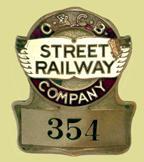
- Photograph depicting the O&CB badge
- Picture of the O&CB bridge
- ↑ 1.0 1.1 Cite error: Invalid
<ref>tag; no text was provided for refs namedLarsen, L.H. 2007 p 151 - ↑ "Omaha's First Century: Installment VI," Omaha World-Herald.
- ↑ Cite error: Invalid
<ref>tag; no text was provided for refs namedSeilegman Syndicate Deal - ↑ United States Army Corps of Engineers. (1888) Annual Report of the Chief of Engineers to the Secretary of War for the Year. p 309.
- ↑ "Ak-Sar-Ben Bridge", Omaha Public Library.
- History of Omaha, Nebraska
- Defunct companies based in Omaha, Nebraska
- Railway companies established in 1886
- Tram, urban railway and trolley companies
- Railway companies disestablished in 1955
- Defunct Iowa railroads
- Streetcars in Omaha, Nebraska
- American companies disestablished in 1955
- American companies established in 1886
- Companies of the United States by year of establishment