
Pakistan International Airlines Flight 8303
| Industry | Aviation |
|---|---|
| Founded | 1946 |
| Headquarters | Karachi , Pakistan |
| Products | Passenger air transport |
On 22 May 2020, Pakistan International Airlines Flight 8303, operating a domestic route from Lahore to Karachi, crashed while on final approach to Jinnah International Airport. Of the 99 individuals aboard, 97 lost their lives, along with one person on the ground. The aircraft, an Airbus A320-214, was carrying 91 passengers and 8 crew members. During its approach, the plane was unstable due to excessive speed and altitude, resulting in a belly landing approximately midway along the runway before attempting a go-around.
The subsequent go-around maneuver led to both engines failing as a consequence of damage sustained during the belly landing. The aircraft was unable to regain sufficient airspeed and crashed into buildings within Model Colony. All crew members and the majority of passengers perished; additionally, a ground fatality occurred ten days later due to burn injuries.
Pakistan's Aircraft Accident Investigation Board concluded that the accident stemmed from poor crew resource management and failure to adhere to standard operating procedures. The flight crew ignored air traffic control directives, which caused an unstable approach and disengagement of the autopilot. The first officer initiated the go-around without proper communication or following established procedures. The aircraft made multiple impacts with the runway, inflicting severe damage on engines and electrical systems. With both engines compromised, the plane lacked the necessary altitude for a safe landing, culminating in a crash roughly 1.5 kilometers from the runway threshold.
Aircraft
The aircraft involved was an Airbus A320-214, manufactured by Airbus Industrie in 2004 and registered as AP-BLD with manufacturer serial number 2274. It was equipped with two CFM International CFM56-5B4 engines; the left engine had been installed in February 2019 and the right engine in May 2019. Before the accident, the airplane had accumulated 47,124 airframe hours and completed 25,866 flight cycles, including 18,632 hours and 8,353 cycles operated by Pakistan International Airlines (PIA). Routine maintenance was last performed on 21 March 2020, while a comprehensive inspection on 19 October 2019 revealed no faults in the engines, landing gear, or avionics systems. The aircraft was grounded from 22 March until 6 May due to COVID-19 restrictions but resumed flights with six trips starting from 7 May. At the time of the crash, it held valid certificates for airworthiness and maintenance review.
Crew and passengers
| Nationality | Passengers | Crew | Total |
|---|---|---|---|
| Pakistan | 90 | 8 | 98 |
| United States | 1 | 0 | 1 |
| Total | 91 | 8 | 99 |
Captain Sajjad Gul, aged 58, served as flight commander with a total of 17,252 flying hours, including 4,783 hours on the Airbus A320. He joined PIA in 1996 and was regarded as one of its most seasoned pilots. The first officer was Usman Azam, aged 33, who had accumulated 2,291 flight hours with 1,504 on the A320 and began working for PIA in 2010. Six flight attendants were also present onboard.
Among the passengers were 91 individuals comprising 51 males, 31 females, and 9 children; one passenger held American nationality. Distinguished travelers included Pakistani model and actress Zara Abid as well as Bank of Punjab CEO Zafar Masud. The manifest also included five officers from the Pakistan Army and one from the Pakistan Air Force. Many aboard were returning home to observe Eid al-Fitr after travel disruptions caused by COVID-19 restrictions in Pakistan.
Jinnah International Airport
Jinnah International Airport is equipped with two runways: 07L/25R and the longer 07R/25L, which spans . The approach procedure for Runway 25L initiates at the Nawabshah VOR, positioned approximately northeast of the airport. Aircraft proceed to the MAKLI waypoint, located from the runway threshold, then execute a right turn toward the SABEN waypoint, situated from the threshold. Crossing SABEN must occur at or below to capture the 3° glideslope; exceeding this altitude requires entering a holding pattern for altitude reduction.
Airbus A320 flight control unit
The flight control unit (FCU) of the Airbus A320, positioned on the cockpit glareshield, serves as the primary interface enabling pilots to manage flight computers, autopilot systems, autothrust, and adjust flight parameters. It features four rotary knobs for airspeed, altitude, heading, and vertical speed, each capable of being pushed or pulled to activate different autopilot modes.
Engaging a selected mode involves pulling a knob outward after setting a value, which maintains that parameter until pilots alter it. Conversely, pushing a knob inward activates managed mode, where autopilot adheres to the flight management system’s (FMS) programmed route—for instance, controlling heading to follow the FMS track.
When the altitude knob is pushed in with a target altitude below the current level, descent mode (DES mode) is triggered. This mode follows the FMS descent profile and modulates descent rate to safely reach the designated altitude.
Selected mode also supports open descent mode, where autothrust reduces engine thrust to idle and autopilot adjusts pitch to keep selected speed; however, this mode is prohibited during final approach.
First approach
Flight "Pakistan 8303" departed from Allama Iqbal International Airport in Lahore at 13:05:30 with First Officer Azam as pilot flying and Captain Gul as pilot monitoring. The aircraft climbed to cruising altitude of . At 13:24, contact was established with Karachi area control and clearance was granted for an instrument landing system (ILS) approach to Runway 25L. After passing Nawabshah at 14:15:38, ATC authorized descent to , directing the flight toward MAKLI. The crew activated DES mode at this altitude. At 14:18:36, the descent rate increased following a change in selected altitude to .
Approaching MAKLI at 14:23:16, the crew erroneously tuned their radios to 126.5 MHz instead of the instructed 125.5 MHz, resulting in missed ATC transmissions. Contact was restored only after responding on the third call with Karachi Approach.
At 14:25:54, Karachi Approach cleared descent to for continuation of the ILS approach; however, the aircraft remained above . At 14:30:22, localizer capture (LOC) mode engaged automatically at , measured from runway threshold. This engagement altered the flight path from a longer holding pattern to a more direct course, shortening track distance from to . Despite this adjustment, the FMS did not update accordingly, causing an excessive descent rate that compromised safe glideslope interception. ATC noted that altitude was too high and questioned crew comfort with descent; Captain Gul acknowledged despite recognizing risk.[1] Gul then urgently directed Azam to disengage hold function; Azam complied but did not inform ATC.
At 14:30:44, an open descent mode targeting was initiated even though such use is prohibited during approach. Speed brakes were deployed and airspeed set to , exceeding maximum limits below .[2] Karachi Tower alerted Karachi Approach regarding high altitude; Approach planned an orbit but continued monitoring.
Landing gear was lowered at 14:31:34 without verbal confirmation, increasing drag and causing a sharp nose-down pitch and high descent rate (~). Despite ATC offering an orbit maneuver, crew declined expressing confidence in completing what was an unstable approach.[3]
At 14:32:25, ATC issued two instructions for a left turn heading 180; both were disregarded as crew asserted they were established on ILS 25L despite being above assigned altitudes (~). The aircraft passed through at , pitching sharply nose-down with airspeed surpassing limits leading to overspeed warnings following flap extension. Autopilot disconnected without crew response.
Ground proximity warnings ("sink rate," "pull up") began at 14:32:52. First Officer Azam applied nose-up inputs reducing descent rate and pitch angle while retracting landing gear and speed brakes without informing Captain Gul. ATC cleared landing on Runway 25L.
Flaps were extended beyond safe airspeeds triggering further overspeed alerts. At , landing gear warning sounded indicating gear not down despite prior retraction command; Captain Gul canceled overspeed warnings but gear warnings continued alongside multiple GPWS alerts ("too low terrain," "sink rate," "pull up").
At 14:34:16, aircraft crossed Runway 25L threshold at an altitude of , traveling at , suppressing GPWS alerts below . Reverse thrust was selected but failed to engage as aircraft remained airborne.[3]
Landing and go-around
At 14:34:28, the aircraft executed a belly landing roughly along Runway 25L, with its engines, positioned beneath the wings, making contact with the runway surface. Inspection revealed that the left engine was the first to scrape the ground, followed shortly by the right engine. Two seconds following this, maximum braking was engaged despite the landing gear remaining retracted. Captain Gul applied full forward pressure on his sidestick while First Officer Azam countered with about two-thirds backward input, resulting in a net pitch angle of approximately 4° nose-down during deceleration. Vibrations in the engines intensified, activating an engine two fire warning, the master caution indicator, and an ECAM alert. Concurrently, engine two’s AC generator ceased functioning, leaving electrical power dependent solely on engine one.
Fourteen seconds after initial contact with the runway, First Officer Azam urged Captain Gul to "Take off sir, take off!" Within two seconds, both thrust levers were advanced to takeoff/go-around (TOGA) power. While engine one responded by accelerating to TOGA thrust, engine two failed to increase beyond idle due to damage sustained by its engine control unit from runway contact. The aircraft became airborne again at 14:34:45 despite significant engine impairment. At this point, dual sidestick inputs stopped and Captain Gul remained as pilot flying. As the aircraft climbed through , a "too low, gear" warning was triggered. Although the gear lever was moved down and then back up, the landing gear did not extend. The crew promptly declared a go-around to Karachi Approach control.
By 14:35:10, climbing through , both engines’ N1 fan speeds reached 94%, with engine two finally achieving TOGA power. However, damage to both engines’ gearboxes resulted in oil level reductions of 75% on engine one and 67% on engine two, causing low oil pressure warnings for each engine. The flight crew contacted Karachi Approach requesting clearance for another ILS approach to Runway 25L; clearance was granted for a left turn heading 110 and climb to 3,000 feet as they prepared for a second landing attempt.
Second approach attempt and crash
At 14:36, engine one lost power entirely and shut down during flight. Despite engine two operating near maximum thrust, First Officer Azam instructed a reduction of its power to idle, which led to both engines failing to provide sufficient thrust. The failure of engine one’s generator caused a complete electrical outage onboard that disabled both the digital flight data recorder (DFDR) and cockpit voice recorder (CVR). The aircraft’s ram air turbine (RAT) deployed automatically to supply emergency electrical power.
With engine one inoperative and engine two at idle, airspeed deteriorated rapidly. Multiple stall warnings sounded as the crew realized that engine two was still running and increased its N1 speed from 40% up to 76%. Following RAT deployment, CVR recording resumed but the DFDR remained offline. Azam instructed Captain Gul to maintain airspeed above 140 knots—the minimum speed required for RAT-generated power. However, at 14:38:46, engine two experienced a compressor stall and subsequently ceased producing thrust altogether; repeated stall warnings followed. Gul expressed concern about increasing speed without available engine thrust.
Descending through approximately 1,500 feet altitude, Azam notified air traffic control that both engines had failed but declined to confirm a belly landing. After verifying that the landing gear was extended, Azam prepared cabin crew for impact as the aircraft passed through 700 feet altitude. At 14:39:46, Gul issued three mayday calls before Azam successfully transmitted the final mayday message identifying Pakistan 8303 to ATC. The airplane turned left while continuing to lose altitude amid active stall warnings and crashed into buildings located about 4,410 feet from the runway threshold at 14:40:18.
The aircraft initially struck a mobile tower before colliding with a street; most debris settled there while portions remained embedded within structures. A post-impact fire erupted, damaging or destroying multiple houses in the vicinity.
Immediate response and rescue efforts
An emergency of the highest level was declared at the airport, with local firefighting and rescue units arriving within ten minutes. Access to the crash location was complicated by narrow streets and alleys. According to the ISPR, the media branch of the Pakistani military, special forces from the Pakistan Army and Pakistan Rangers secured the perimeter. Video evidence showed rescue personnel maneuvering through debris to reach the wreckage. Several residences suffered damage or were destroyed, with reports varying between five and 25 homes impacted. The official investigation concluded that multiple houses were damaged due to both the crash impact and subsequent fires.
The Sindh Health Minister declared an emergency status for hospitals in Karachi. Prime Minister Imran Khan alongside the Pakistan Air Force chief of staff deployed all possible resources to assist at the site. Victims, both injured and deceased, were transported to Civil Hospital, Dar-ul-Sehat Hospital, and the Jinnah Postgraduate Medical Centre. Medical facilities faced significant pressure amid the ongoing COVID-19 crisis.
Victims
Pakistani authorities confirmed a total of 97 deaths aboard the aircraft, including Zara Abid and five officers from the Pakistani Army. Two passengers survived and were admitted in stable condition. On the ground, eight residents of Model Colony sustained injuries—primarily women and children—as the crash occurred during Friday prayers when most men were attending a nearby mosque. The Edhi Foundation reported that 25 to 30 individuals were hospitalized mainly due to burn injuries. Ten days later, a 13-year-old girl who had been injured on-site succumbed to her burns.
DNA analysis identified the majority of victims; within three weeks, Karachi University’s Forensic Laboratory and Punjab Forensic Science Agency confirmed identities for 95 individuals, leaving two bodies unidentified. The Edhi Foundation reported that approximately 19 bodies were removed from its morgue without proper identification procedures. Some families raised concerns over delays and questioned the accuracy of DNA testing performed by officials.
Investigation
Pakistan's Aircraft Accident Investigation Board (AAIB) led the inquiry, with Airbus supporting France’s Bureau of Enquiry and Analysis for Civil Aviation Safety (BEA). An Airbus team comprising 11 members visited the crash site on 26 May. The aircraft’s DFDR and CVR were retrieved and sent to France for detailed examination by BEA experts.
Flight operations
During the flight, crew members neglected several safety protocols. The CVR revealed that during cruising altitude, pilots engaged in casual discussions about COVID-19, breaching sterile cockpit regulations applicable below 10,000 feet. The essential approach briefing was never completed. This distraction resulted in failures to announce changes in flight mode annunciators and temporary loss of radio communication.
The AAIB identified numerous lapses in situational awareness and crew resource management (CRM) during descent. The crew overlooked two alerts indicating a holding pattern at SABEN—one displayed on navigation instruments and another on the multi-function control unit—leading to miscalculations in their track distance. Overconfidence and complacency hindered proper communication or cross-verification of aircraft position.
Standard operating procedures (SOPs) were disregarded; notably, an open descent mode was activated during final approach, which is prohibited. Despite air traffic control (ATC) recommendations to hold position, the crew proceeded with an unstable approach without adequately assessing altitude or alternative options. When autopilot disengaged due to excessive nose-down pitch, crew members failed to announce master caution alerts or assert control authority. They also neglected to initiate a terrain avoidance maneuver after GPWS warnings activated, demonstrating poor situational awareness.
After First Officer Azam retracted landing gear and speed brakes without informing Captain Gul—who insisted on continuing with landing—neither pilot acknowledged multiple master caution alerts nor complied with ATC instructions to circle. No callouts regarding aircraft position were made during this unstabilized approach, violating SOPs. Gul assumed control without communication, reflecting inadequate CRM.
During touchdown, full reverse thrust was applied while still airborne, contrary to SOPs. Subsequently, a go-around was initiated after 18 seconds on ground—a maneuver prohibited once reverse thrust is engaged. The AAIB judged this as deficient airmanship. Following this attempt, the crew failed to properly discuss gear-up landing or plan a second approach and mistakenly reduced power on the functioning engine instead of the malfunctioning one, further indicating diminished situational awareness.
Flight crew performance
The investigation uncovered significant concerns regarding the flight crew's qualifications and conduct. Captain Gul consistently exceeded flying hours, logging 33% more than the average PIA A320 captain between 2017 and 2019, which prompted a formal warning from the Pakistan Civil Aviation Authority (PCAA) for surpassing duty limits. In 2014, he was denied a supervisory position on ATR aircraft due to inadequate technical expertise. Review of his flight records before the crash revealed repeated instances of high-speed, unstable approaches, frequent GPWS alerts, and an absence of go-around maneuvers. An aviation psychologist characterized him as assertive but possessing below-average cognitive ability, limited mechanical understanding, and poor stress resilience. Initially, PIA’s psychiatric panel rejected Gul’s application for cadet pilot training; however, following a legal challenge, alternate psychiatric evaluations deemed him fit for duty.
First Officer Azam also exhibited performance shortcomings. During his initial ATR simulator assessments in 2014, he received multiple "satisfactory with briefing" evaluations and was placed under close supervision by a PCAA inspector, which delayed his advancement to A320 first officer until 2016.
The AAIB determined that the crew neglected to adhere to standard operating procedures and demonstrated ineffective crew resource management. Captain Gul’s history of unstable approaches was identified as a contributing factor in the crash.
Given that the accident took place during Ramadan, the AAIB investigated whether fasting influenced crew performance. Fasting can disrupt circadian rhythms, hydration levels, and blood glucose balance; PCAA regulations prohibit pilots from flying while fasting. Simulator experiments indicated that dehydration impairs spatial awareness and flight control, while hypoglycemia leads to significant deviations in flight parameters. The crew likely observed fasting during the flight, as they declined offered snacks. The AAIB concluded that fasting probably compromised their decision-making abilities but could not precisely measure its overall effect. Additionally, PIA’s manuals did not provide explicit guidelines concerning pilot fasting.
Role of ATC
At the time of the incident, Flight 8303 maintained communication with Karachi Approach ATC. The flight crew disregarded several ATC commands instructing them to circle and descend. The AAIB highlighted that ATC failed to notify the pilots about the aircraft landing gear status; although the airport controller requested Karachi Approach to verify the gear position, no such confirmation was received. Both the crew’s non-compliance with ATC directives and inadequate communication between ATC and the flight were deemed primary contributors to the accident.
PIA operations and PCAA oversight
The AAIB examined PIA’s flight data analysis (FDA) programs designed to monitor flight recordings for risk detection and to support a safety management system (SMS). A PCAA audit revealed critical shortcomings: under 5% of flights underwent FDA review, including only six of Captain Gul’s last 289 flights. From June to September 2019, the European Aviation Safety Agency (EASA) evaluated PIA’s SMS as deficient due to incomplete safety data software implementation, unresolved safety reports, lack of training enforcement, and insufficient safety performance metrics—issues remaining unaddressed at the time of the crash.
Furthermore, the AAIB criticized PCAA’s regulatory oversight as ineffective for failing to ensure timely enhancements in PIA’s FDA program. The monitoring framework did not identify inadequate crew resource management (CRM) training at PIA, as demonstrated by substandard CRM practices during this flight.
Concluding report and suggestions
On 25 February 2024, the AAIB published its conclusive report pinpointing the main causes as follows:
- Damage to both engines due to gear-up landing, resulting in oil leakage and engine failure during the attempted go-around
- Failure to comply with standard operating procedures (SOPs) and ignoring air traffic control (ATC) directives
- Insufficient communication between ATC and flight crew about the landing gear status following touchdown
Additional contributing elements included:
- Poor implementation of Flight Data Analysis (FDA) and weak regulatory supervision
- Lack of explicit rules prohibiting flight operations while fasting
- Deficient application of Crew Resource Management (CRM) during the flight
The AAIB put forward five recommendations directed at PIA and seven aimed at the Pakistan Civil Aviation Authority (PCAA). These focused on integrating an effective Flight Operational Quality Assurance (FOQA) program within PIA’s Safety Management System (SMS), revising the CRM program, enforcing adherence to SOPs, and strengthening regulations and oversight regarding fasting protocols during flight operations.
Aftermath
Following the accident, President Arif Alvi and Prime Minister Imran Khan conveyed their sympathies. Numerous dignitaries and global leaders also expressed their sorrow over the incident. The government declared compensation amounts of (₨ 10 lakh, approximately US$6,250) for the families of those who lost their lives and (₨ 5 lakh, about US$3,125) for survivors.
Pilot licensing controversy and operational bans
On 24 June 2020, Pakistan’s aviation minister Ghulam Sarwar Khan disclosed that out of 860 pilots, 262 possessed counterfeit licenses allegedly acquired through proxy examinations. PIA responded by grounding 150 out of its 434 pilots due to these fraudulent credentials. Later updates revealed fewer suspensions: 48 licenses were suspended and seven pilots dismissed. By September, 50 licenses were permanently revoked while 32 were suspended for one year. The licenses of the crew involved in the crash were confirmed valid.
On 30 June, due to safety shortcomings and inadequate safety management systems, PIA faced a six-month ban from operating flights into the European Union and the United Kingdom. On 9 July, the United States also prohibited PIA flights citing concerns over pilot qualifications. The EU extended its ban multiple times because of insufficient safety audits, ultimately imposing an indefinite suspension in April 2021.
On 29 November 2024, after PIA successfully passed a safety audit and the Pakistan Civil Aviation Authority demonstrated adequate regulatory oversight, the European Union Aviation Safety Agency (EASA) lifted its ban. Subsequently, in July 2025, the UK Department for Transport declared Pakistan compliant with international aviation security standards and revoked all restrictions on PIA and other Pakistani carriers.
See also
- List of accidents and incidents involving commercial aircraft
- List of accidents and incidents involving the Airbus A320 family
- Pacific Western Airlines Flight 314 (1978) – Incident involving a go-around following reverse thrust activation
- Malév Flight 262 (2000) — Incident involving a go-around after a belly landing
Works cited
External links
- Final report — Issued by Pakistan’s Aircraft Accident Investigation Board
- Preliminary report — Provided by Pakistan’s Aircraft Accident Investigation Board
- Press releases — From Pakistan International Airlines
- Flight data and details — Via Flightradar24
- Compilation of videos showing immediate aftermath including CCTV footage — Hosted on YouTube
- Accident summary — From Aviation Safety Network
- Accident report – Published by The Aviation Herald
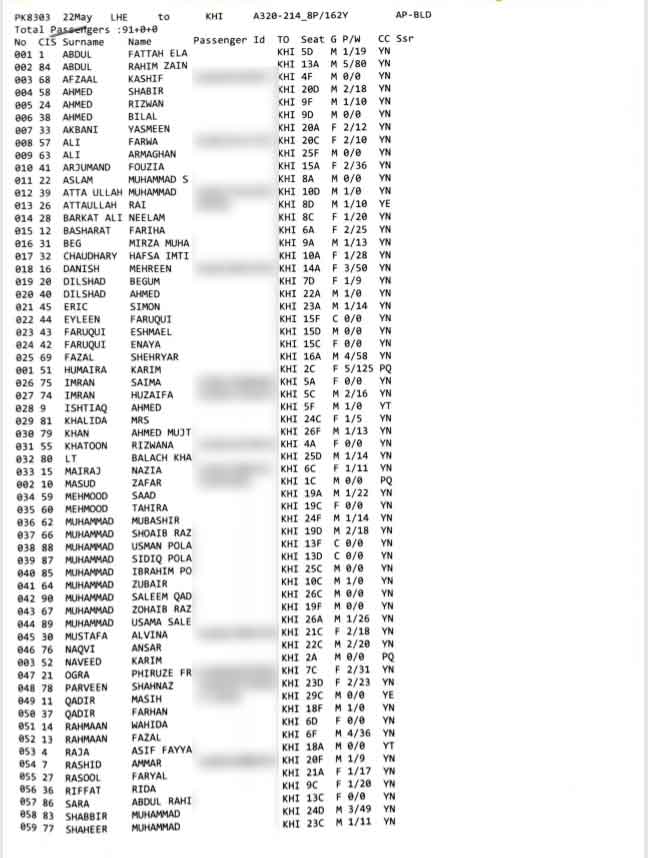
- Passenger manifest (1–59) – Provided to The News International
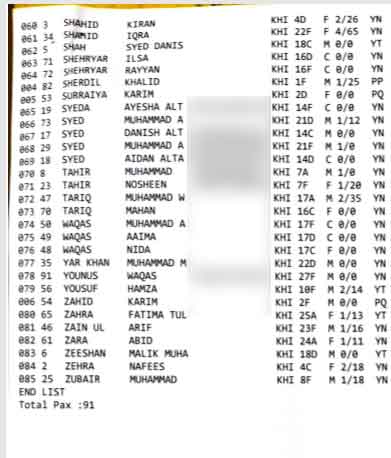
- Passenger manifest (60–91) – Provided to The News International
- Articles with short description
- 2020 disasters in Pakistan
- 2020 in Sindh
- 2020s in Karachi
- Accidents and incidents involving the Airbus A320
- Aviation accidents and incidents in 2020
- Aviation accidents and incidents in Pakistan
- Disasters in Sindh
- May 2020 in Pakistan
- Pakistan International Airlines accidents and incidents
- Airliner accidents and incidents caused by stalls
- Airliner accidents and incidents caused by pilot error
- Airliner accidents and incidents involving belly landings
- Airliner accidents and incidents caused by engine failure
- Filmed deaths during aviation accidents and incidents
- Filmed deaths in Pakistan
- Ramadan
- Pages with reference errors
- Pages with script errors