Red Rock Corridor
| Company type | Joint powers board |
|---|---|
| Industry | Public transportation |
| Founded | 1998 |
| Headquarters | Saint Paul , United States |
Area served | Southeastern suburbs of the Twin Cities metropolitan region |
Key people | 11 members and ex-officio delegates from Goodhue County, Red Wing, Prairie Island Indian Community, Canadian Pacific Railway |
| Products | Bus rapid transit planning and coordination |
| Website | redrockcorridor |
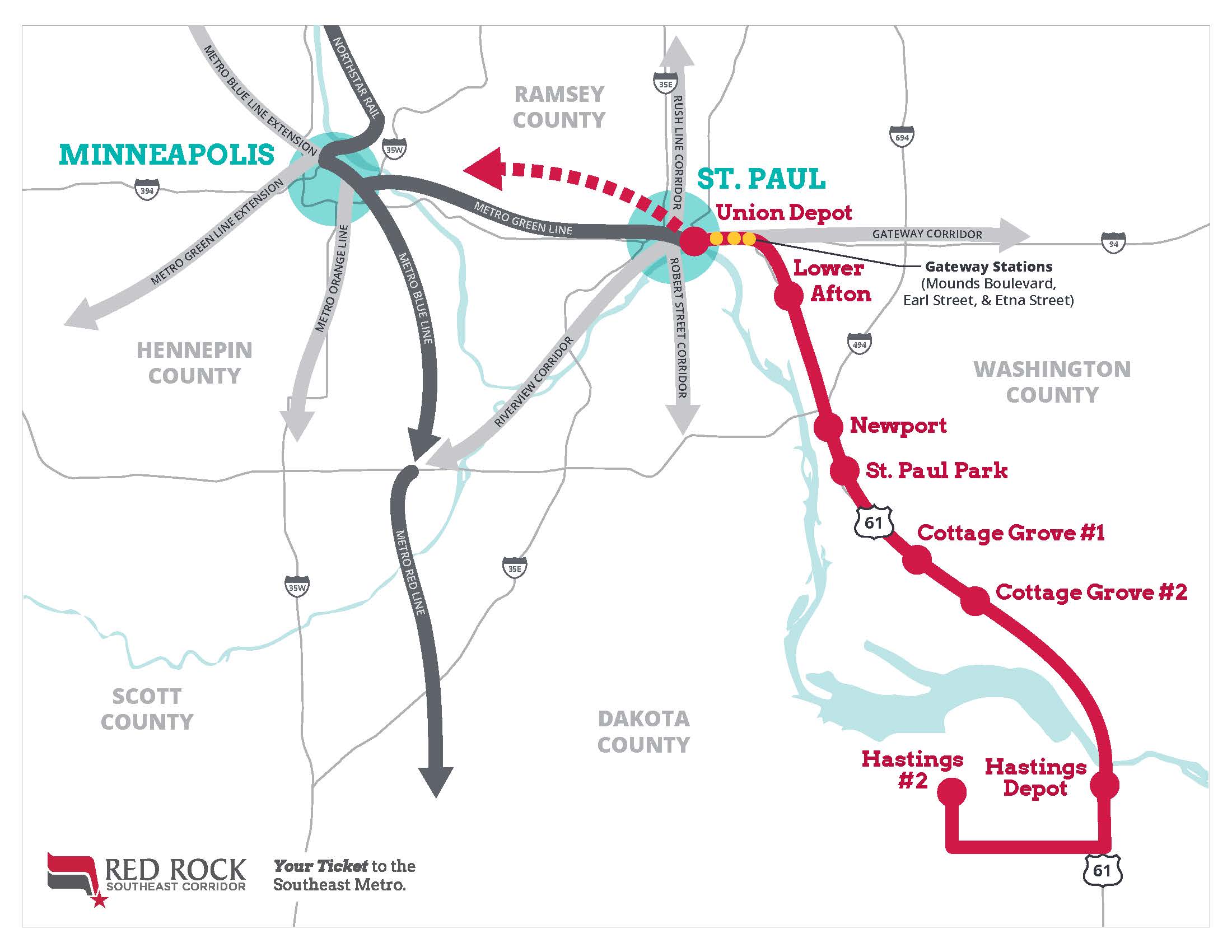
The Red Rock Corridor is a planned bus rapid transit line designed to link the southeastern suburbs of the Twin Cities metropolitan region with downtown Saint Paul and Minneapolis. Beginning in Hastings, this corridor is set to include stops in Cottage Grove, Newport, and Saint Paul, with its endpoint at Saint Paul's Union Depot. From this hub, passengers will have access to express and local bus routes as well as the Metro Green Line, which connects Minneapolis, the airport, and the Mall of America.
Serving as the primary thoroughfare for the corridor, Highway 61 accommodates rail, truck, and automobile traffic. The population in the southeast metro area is expected to increase by approximately 100,000 residents by 2030, while employment opportunities will largely remain centered in Minneapolis and Saint Paul. According to projections by the Minnesota Department of Transportation, Highway 61 will experience substantial congestion during peak commuting hours by 2030.
Formed in 1998, the Red Rock Corridor Commission operates as a joint powers board representing counties and municipalities along the transit corridor. Its membership consists of 11 individuals along with ex-officio delegates from Goodhue County, Red Wing, Prairie Island Indian Community, and Canadian Pacific Railway.
Although initially favoring commuter rail for transit service, the commission adopted a phased expansion approach in 2007 aimed at cultivating transit ridership. By 2014, bus rapid transit emerged as the preferred option following an updated Alternatives Analysis. In 2016, the commission approved an implementation strategy emphasizing phased BRT rollout combined with immediate enhancements to local bus services. This plan received formal adoption on October 26, 2016.