
Seneca Glass Company
| Company type | Private |
|---|---|
| Industry | Glass manufacturing |
| Founded | 1891 in Fostoria, Ohio, United States |
| Founder | Otto Jaeger, Michael Dinger, George Truog, August Boehler, Leopold Sigwart |
| Headquarters | Morgantown , United States |
Area served | United States |
Key people | Otto Jaeger (first president), Leopold Sigwart (president after 1896) |
| Products | Blown tumblers, hand-crafted lead crystal stemware, dining glassware, Driftwood Casual collection |
Number of employees | 250 (1969) |
Seneca Glass Company was established in 1891 in Fostoria, Ohio and shifted its operations to Morgantown, West Virginia in 1896. It grew to become the foremost American manufacturer of blown tumblers and gained acclaim for its superior hand-crafted lead crystal stemware and dining glassware. Its distinguished customers included notable personalities such as Eleanor Roosevelt and Lyndon B. Johnson, along with prestigious retailers like Marshall Field and Company, Neiman Marcus, and Tiffany's.
The company took ownership of its first facility in Fostoria on January 1, 1892; this plant was previously operated by the Fostoria Glass Company. Otto Jaeger, a former executive at Fostoria Glass and one of Seneca’s founders, assumed the role of its inaugural president. The early leadership and many skilled artisans were German glassmakers who also held stakes in the enterprise. In 1911, Seneca broadened its production by opening a second factory in Morgantown dedicated to manufacturing more basic glass items.
During the 1950s, Seneca introduced the Driftwood Casual collection aimed at the expanding informal tableware segment, maintaining this line for nearly thirty years despite a general decline in demand for formal glass products. By 1969, the firm employed roughly 250 people and achieved revenues near $2 million. In 1982, new ownership took control and renamed the business Seneca Crystal Incorporated; nonetheless, it filed for bankruptcy the following year. The original Morgantown Seneca Glass building now serves as a historic landmark hosting retail outlets and office spaces.
Glassmaking
The process of glassmaking starts with a mixture predominantly composed of sand (silica), which is melted at temperatures around 1700°C. Other ingredients such as soda ash, potash, and either lead oxide or lime are incorporated into the batch. The molten material is then formed by blowing or pressing it into molds before undergoing gradual cooling (annealing) to prevent fragility. Seneca Glass Company employed European glassmaking methods brought by its German founders, producing lead flint glass recognized for its brilliance compared to standard lime-based soda–lime glass.
Throughout its operation, the company utilized technology typical of the 19th century. Glassblowers gathered molten glass using hollow pipes, shaping it by inflating with air, manipulating tools, or employing molds. A rim glazer refined edges using flame jets. Annealing took place in a lehr—a lengthy conveyor oven—lasting nearly two hours at Seneca’s Morgantown facility. Workers, often women, packed the finished products which sometimes had been cut, etched, engraved, or decorated with gold or silver trim fused through reheating.
In the late nineteenth century, furnace capacity at glass plants was commonly measured by counting ceramic pots used to melt batches inside furnaces. Fuel costs were a major expense; while wood and coal were traditional sources of energy, natural gas increasingly became preferred due to its cleaner burn, stable heat output, improved temperature control, and quicker melting times—factors that enhanced operational efficiency.
Ohio glass industry
During the 1870s, Ohio’s glass manufacturing was primarily concentrated in the eastern part of the state, notably in coal-abundant Belmont County. The town of Bellaire, nicknamed "Glass City" from 1870 until 1885, was a significant production center. In early 1886, natural gas discoveries near Findlay in northwest Ohio prompted local authorities to offer incentives such as inexpensive natural gas, free land parcels, and cash bonuses to attract manufacturers—especially glass producers.[1] This initiative resulted in over 70 glass factories operating in northwest Ohio by the early 1900s.[2]
Fostoria, strategically located with multiple railroad connections and close to natural gas pipelines, emerged as a prominent glassmaking hub. From 1887 through 1920, it hosted thirteen different glass companies at various intervals.[3][4] This surge helped elevate Ohio’s standing in national glass manufacturing value from fourth place in 1880 to second by 1890.[5]
Nonetheless, by 1891 dwindling natural gas supplies combined with overexpansion created difficulties within the industry.[6] The Fostoria Glass Company, an important entity founded during the gas boom period, relocated to West Virginia near abundant coal sources late that year. Approximately sixty employees transferred with the company while others lost their jobs.[7][8]
German artisans
During the 1880s, expert glassmakers from the Black Forest area of Germany and Switzerland moved to Cumberland, Maryland to join local glass manufacturing facilities. With ambitions to launch their own business, they established a company in 1891 to purchase the soon-to-be-vacated Fostoria Glass Company factory. The group chose Otto Jaeger—an accomplished glass etcher and former manager at Fostoria—as their leader. The German investors acquired the plant and equipment for $20,000 (value in 1891).
Although the company was based in Fostoria, Ohio, it was officially incorporated in West Virginia on December 4, 1891. The founding members included Jaeger, Michael Dinger from Wheeling (Jaeger's brother-in-law), and several investors from Cumberland: George Truog, August Boehler, and Leopold Sigwart. Jaeger brought experience from his time at Wheeling's Hobbs, Brockunier and Company. Contrary to popular misconception, the Seneca Glass Company facility was situated in Hancock County, Ohio—not Seneca County—just west of the county line. The company took its name from the Seneca Native American tribe.
This well-planned acquisition combined with leadership by seasoned entrepreneurs established a strong foundation for growth in glass manufacturing, capitalizing on expert craftsmanship and a robust corporate framework to expand market presence.
Founding
Otto Jaeger gathered a talented team for the Seneca Glass Company, recruiting many workers from the Fostoria Glass Company who continued their work at the same South Vine Street location. Jaeger, along with investor-glass specialists from Cumberland—Truog, Boehler, Sigwart, and Edward and Joseph A. Kammerer—formed the principal leadership group. Jaeger assumed the role of president; Edward Kammerer became vice president and general manager; Truog served as secretary. The board primarily consisted of skilled glassworkers rather than financiers or affluent businessmen. Within a few months, Truog departed to launch Maryland Glass Etching Works and was succeeded by Frank B. Bannister as secretary; W. H. Bannister took on treasurer duties.
Operations in Fostoria
Production of lead glassware commenced on December 29, 1891—prior to the official departure of Fostoria Glass from the factory—with an experienced workforce ensuring smooth operations. By 1892, Seneca Glass promoted itself as a "manufacturer of fine lead blown table and bar goods" featuring "fire finished edges," emphasizing "Fine Lead Stemware." The original 1887 Fostoria plant was sizable for its era with a 12-pot furnace; Seneca Glass’s site spanned 2.5 acres adjacent to two rail lines and included a siding connected to the Baltimore and Ohio Railroad (B&O).
Though occasional interruptions occurred due to insufficient gas pressure—the furnace’s fuel source—production levels and sales supported plans for expansion. By May 1892, Seneca intended to install an additional furnace to boost capacity to 38 pots, positioning it as the largest U.S. factory focused solely on tumbler production. Approximately 200 highly skilled employees were engaged and well compensated due to the handcrafted nature of their work.
Seneca Glass survived the economic downturn of the Panic of 1893 and maintained operations despite difficulties such as an October 1894 gas shortage that temporarily halted both Seneca Glass and Fostoria Shade and Lamp Company production. By 1895, workforce numbers surpassed 230. While expansion was under consideration, management also weighed relocating due to rising coal expenses after converting from natural gas to coal gas for furnace fuel.
Leadership Transition
Production came to a standstill in late 1895 when the non-union employees initiated a strike over working conditions, spanning from December 13 until January 17, 1896. During this interruption, a consortium of investors led by Leopold Sigwart removed Otto Jaeger from the presidency. Jaeger’s opposition resulted in Sigwart changing the lock on the president’s office door. Edward Kammerer resigned as plant manager in protest and was succeeded by his brother Joseph. Subsequently, Sigwart assumed the role of president.
By March 1896, Jaeger endeavored to launch a rival enterprise in Fostoria. A trade magazine advertisement from that month identified "L. Sigwart" as president and "F.B. Bannister" as superintendent. The same publication highlighted the company’s vigorous expansion under new leadership and noted it ranked first nationally in blown tumbler production. By summer, the factory was operating at full capacity to satisfy demand, including manufacturing tumblers etched with an image of Ohio Governor and 1896 presidential candidate William McKinley—a product anticipated to be highly popular.
Relocation of Facility
In the summer of 1896, the firm announced plans to move its operations to Morgantown, West Virginia due to difficulties with fuel supply—specifically, inconsistent natural gas availability and expensive coal prices. Morgantown presented several strategic benefits: enhanced transportation options through a new Monongahela River lock and Baltimore & Ohio Railroad connection; plentiful coal reserves alongside recently discovered oil and gas deposits; and access to high-quality sand from local sources vital for glass manufacturing. Additional incentives included complimentary land, affordable gas rates, and a $20,000 financial grant.
Although Otto Jaeger initiated a legal challenge delaying the transfer, a settlement reached in November removed obstacles for relocation. The former Fostoria glass factory remained unused until 1905 when it became home to the Seneca Wire and Manufacturing Company. This move aligned with the company’s strategy to reduce production costs and improve logistics, thereby strengthening its position within the glass industry.
Establishment
Constructed between 1896 and 1897 on Beechhurst Avenue with riverfront access to the Monongahela River and connectivity to the Baltimore & Ohio Railroad, the Morgantown glassworks featured a 14-pot furnace alongside dedicated blowing, lehr, packing, warehousing, and smaller decoration rooms. The furnace and blowing area were primarily brick-built with a substantial smokestack; the lehr room measured roughly 60 by 60 feet. The plant underwent expansions during the 1920s and again in 1947.
Operations commenced in January 1897 with a workforce of approximately 250 employees—comprising 150 men, 50 boys, and 50 girls—including around 100 skilled artisans. The company focused on producing hand-blown lead (crystal) tableware. Typical weekly output was about three railcar loads of glassware, with advertisements claiming daily production of 3,000 dozen tumblers. By 1898, employee numbers remained steady at around 250.
Further Developments
In January 1899, Seneca Glass Company experienced leadership changes: Leopold Sigwart resigned as president while Frank W. Bannister stepped down as manager. August Boehler assumed the presidency; "Andrew" Kammerer became vice president; F. B. Bannister took on the secretary role; and W. H. Bannister was appointed treasurer. The Bannister family soon departed to establish Morgantown Glass Works. By January 1900, Leopold Sigwart had joined the board of directors; Charles F. Boehler served as secretary; Frank Caples as treasurer.
By 1901, Seneca Glass was described as thriving due to low fuel expenses and favorable shipping conditions while independently competing against a tumbler trust. A fire in 1902 caused $50,000 in damages and halted production for some 350 workers; restoration included constructing a two-story addition designed by architect Elmer F. Jacobs.
Between June and September 1904, monthly production records were broken under Charles Boehler’s leadership. Advertising efforts shifted toward promoting fine lead blown bar and table glassware—including tumblers, stemware, and etching—rather than focusing exclusively on tumblers. In 1905, a new West Virginia charter was issued; principal shareholders were Leopold and Otto Sigwart, August Boehler, and J. A. Kammerer who collectively held more than half of the company’s shares.
Toward the end of 1910, Seneca Glass switched its fuel source from natural gas to coal as part of operational adjustments aimed at improving efficiency.
Plant B
The Seneca Glass Company broadened its operations by acquiring a second site known as "Plant B," located in Star City, West Virginia, approximately 2 miles from Morgantown. This facility, formerly owned by the Romana Glass Company, commenced production between late 1911 and early 1912, employing a workforce ranging from 80 to 150 individuals. Plant B primarily focused on producing hand-blown tumblers, generally undecorated, crafted from soda–lime glass—a more economical substitute for the lead glass used at the Morgantown plant. The facility operated with two small tank furnaces, which, despite their higher installation expenses, provided enhanced efficiency. Otto Sigwart initially oversaw Plant B's management until 1914, when his son Charles assumed leadership.
Operations at Plant B were halted in September 1918 due to diminished demand following World War I. Although discussions about selling the plant took place in early 1920, it instead resumed activity in July of that year with a staff of 75 workers. In 1929, Charles F. Boehler, serving as secretary–treasurer, announced another reopening after a year-long closure, reinstating employment for between 75 and 100 personnel. The plant continued functioning until its final shutdown in 1931.
Family business
Throughout its existence, Seneca Glass Company remained under tight control of its founders and their descendants, preserving a stable leadership framework. Joseph Anthony "Andy" Kammerer, one of the original backers, became president around the period of 1917 to 1920 and held this position until his passing in 1941. By 1927, company management consisted of J.A. Kammerer as president and general manager; Leopold Sigwart as vice president and factory manager; and Charles F. Boehler responsible for secretary, treasurer, sales, and purchasing duties. Sigwart died in 1937.
Following Kammerer's death, Charles F. Boehler was elected both president and treasurer but died in 1945. Subsequently, leadership transitioned to Harry G. Kammerer, son of J.A. Kammerer, who was later succeeded by his stepson John W. Weimer—initially general manager—who had become president by 1974.
Other family members also held significant executive positions: James Sigwart served as vice president until his death in 1950, while Louis W. Stenger acted as secretary–treasurer for over four decades until his death in 1959. By that year, the company’s principal officers were all descendants of the founding families—Kammerer as president, Sigwart as vice president, and Stenger as secretary–treasurer—demonstrating the firm’s enduring family-oriented governance.
Harry G. Kammerer maintained the roles of president and treasurer into the early 1970s, highlighting the company’s commitment to sustained leadership continuity within its founding lineage.
Products
In its formative years, Seneca Glass Company stood as the largest American manufacturer of blown tumblers, specializing in etched designs tailored for advertising purposes. During World War I, the firm temporarily shifted production to watch crystals to compensate for import shortages. It earned a reputation for premium tableware quality; by 1932 retailers such as Bloomingdale's advertised its "Hand–Blown Crystal Glass." By 1961, prominent clients included Marshall Field and Company, Neiman Marcus, Sheraton’s Palace Hotel in San Francisco, the Ritz Carlton Boston, and Tiffany & Co.. Distinguished buyers included Eleanor Roosevelt and Liberia’s head of state. In 1962, Lady Bird Johnson selected Seneca’s Epicure pattern for personal use—a choice that enhanced the company's visibility. By 1969, annual sales neared $2 million.
Seneca ventured into casual dining glassware and secured a patent in 1953 for an ornamental design created by Louis W. Stenger. That same year marked the introduction of the Driftwood Casual dinnerware line aimed at informal dining consumers—a strategic response to declining demand for formal dinnerware sets. This popular collection was produced continuously for three decades. Regional advertisements emphasized its attractiveness and diverse color options such as amber, peacock blue, moss green, among others. Throughout the 1970s, Seneca launched additional casual patterns including Fashionable and Cascade, though none achieved the commercial success of Driftwood. A company statement from 1971 underscored an emphasis on "casual–looking glassware" and "colored stemware" as key drivers for business expansion. Positive financial results at the end of that year forecasted an optimistic outlook for 1972.
Demise
In testimony before the U.S. House Committee on Ways and Means in 1968, J. Raymond Price represented fourteen handcrafted glass manufacturers and noted a reduction from thirty-nine firms in 1950 due to inability to compete with low-cost foreign producers.
The decade of the 1970s introduced escalating labor wages and fuel prices amid multiple U.S. economic recessions (1969–70; 1973–75; 1980; and 1981–82), which severely undermined profitability within the glass industry. Industry executives identified foreign competition and elevated energy costs as significant challenges; however, Seneca Glass Company's decline was primarily attributed to diminishing consumer interest in fine glassware products.
In 1982 Seneca’s manufacturing facility was sold to new investors who established Seneca Crystal Incorporated; nevertheless, by August 1983 this entity shuttered operations and declared bankruptcy—signaling the conclusion of Seneca Glass Company amid evolving market conditions and economic pressures.
Legacy
Seneca Glass Company's products are celebrated internationally for their craftsmanship and have been retailed through prestigious American outlets. From a business standpoint, its nearly ninety-year use of nineteenth-century production techniques is remarkable. The original Morgantown factory building—now called the Seneca Center—still stands as of 2023 and accommodates offices, dining establishments, and specialty retail stores. This structure was listed on the National Register of Historic Places in 1985.
Otto Jaeger—the company's first president who was later ousted—founded Bonita Art Glass Company in Wheeling in 1901; it employed about one hundred workers specializing in decorating china and glassware. Other notable industry figures include W.H. Bannister, F.B. Bannister, Leopold Sigwart, and Frank Caples who incorporated Morgantown Glass Works in 1899 before it was acquired by Economy Tumbler Company in 1903. George Truog—a former shareholder at Seneca—established Maryland Glass Etching Works in Cumberland; his residence is also listed on the National Register of Historic Places.
Footnotes
Citations
- ↑ Cite error: Invalid
<ref>tag; no text was provided for refs namedOhioBoom - ↑ Cite error: Invalid
<ref>tag; no text was provided for refs namedPaquette28 - ↑ Cite error: Invalid
<ref>tag; no text was provided for refs namedFOGAhomepage - ↑ Cite error: Invalid
<ref>tag; no text was provided for refs namedFOGAlist - ↑ Cite error: Invalid
<ref>tag; no text was provided for refs namedCensus315 - ↑ Cite error: Invalid
<ref>tag; no text was provided for refs namedSkrabec55 - ↑ Cite error: Invalid
<ref>tag; no text was provided for refs namedPaquette179-183 - ↑ Cite error: Invalid
<ref>tag; no text was provided for refs namedPaquette214
References
- Bredehoft, Neila M.; Bredehoft, Thomas H. (1997). Hobbs, Brockunier and Co., Glass: Identification and Value Guide. Collector Books.
- Callahan, James Morton (1926). History of the Making of Morgantown, West Virginia: a Type Study in Trans-Appalachian Local History. West Virginia University Studies in History.
- Page, Bob; Frederiksen, Dale (1995). Seneca Glass Company, 1891-1983: A Stemware Identification Guide. Page-Frederiksen Pub. Co.: Replacements [distributor].
- Paquette, Jack K. (2002). Blowpipes: Northwest Ohio Glassmaking in the Gas Boom of the 1880s. Xlibris Corp.
External links
- Seneca Glass – Collection featuring Seneca Glass Company artifacts at The Museum of American Glass
- Seneca Glass – Historical Glass Museum newsletter highlighting Driftwood Casual line colors
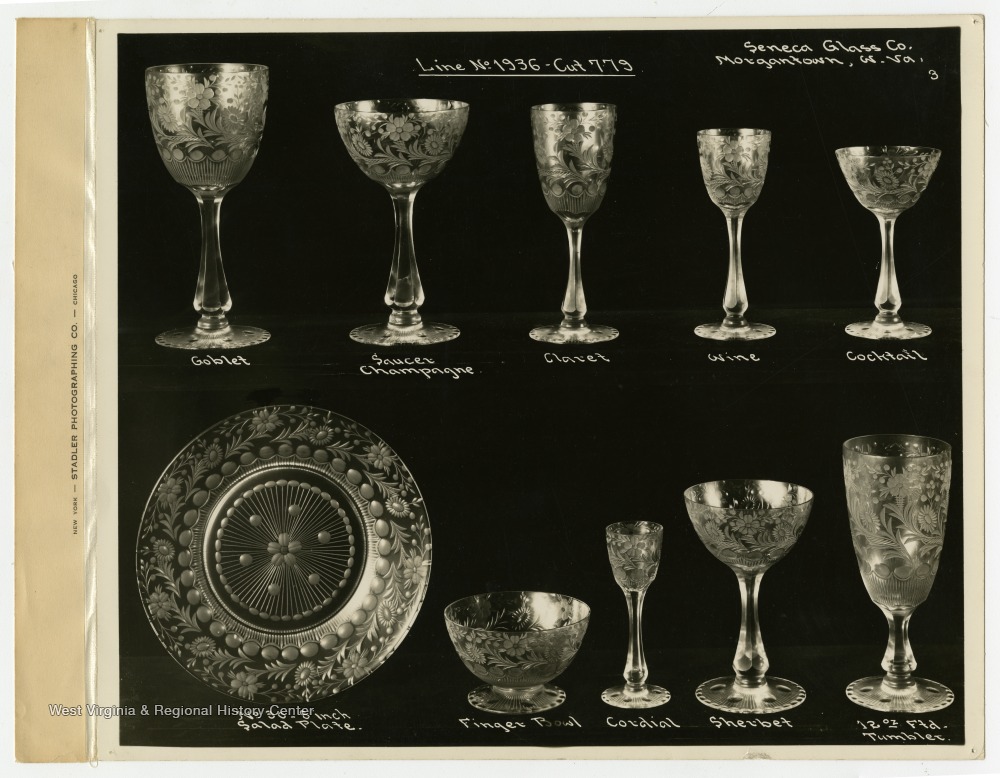
- Seneca etched ware – Archive image from West Virginia & Regional History Center
- Seneca Glass Company page – Resource provided by Fostoria Ohio Glass Association
- Seneca Glass plant in Morgantown – Documentation held by West Virginia University & Regional History Center
- Glassmaking companies of the United States
- Defunct glassmaking companies
- Fostoria, Ohio
- Morgantown, West Virginia
- Manufacturing companies based in West Virginia
- American companies established in 1891
- Manufacturing companies established in 1891
- 1887 establishments in Ohio
- Defunct manufacturing companies based in West Virginia
- Companies of the United States by year of establishment