Sukhoi Shkval
| Industry | Aerospace, Defense |
|---|---|
| Founded | 1939 |
| Founder | Pavel Sukhoi |
| Headquarters | Moscow , Soviet Union |
The Sukhoi Shkval (Russian: Сухой Шквал, lit. 'Dry Squall') represented a Soviet initiative to develop a tailsitter-style interceptor aircraft.
History
In 1960, Rolan Martirossov, then a young engineer, led a small team of ten to develop an innovative single-seat tailsitter interceptor. Initially, the group received authorization to pursue the project during their off-hours. This endeavor was designated as Shkval-1, with Martirossov appointed as Chief Designer.
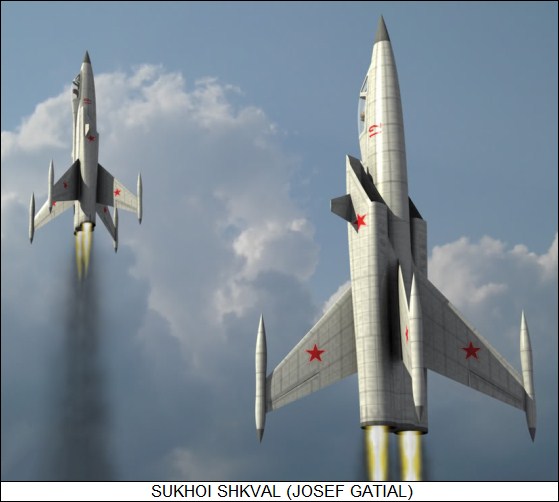
During this period, the Yakovlev Design Bureau was advancing the Yak-36, while across Britain, the Hawker Siddeley Group was progressing on the Hawker Siddeley Harrier. Both aircraft featured traditional landing gear. Contrastingly, the Shkval was conceived to take off and land vertically on its Empennage, akin to the American Lockheed XFV-1. This configuration allowed it to operate within a much smaller footprint.
Following conceptual development and successful wind tunnel experiments conducted at the Central Aerohydrodynamic Institute, the team under Pavel Sukhoi secured formal endorsement for the project. This authorization provided governmental financing and access to specialized experimental infrastructure. A partial mockup of the aircraft was subsequently constructed.
In August 1963, a review panel from the Ministry of Aviation Industry evaluated the project. Although there were intense debates, the panel acknowledged the accomplishments of the design team. Nevertheless, since the team could not fully address all inquiries posed by the commission, approval for prototype fabrication was withheld. Furthermore, shifting military strategies under Nikita Khrushchev, which prioritized missile technology over manned aircraft, led to a significant reduction in funding for new military aviation projects.
Design
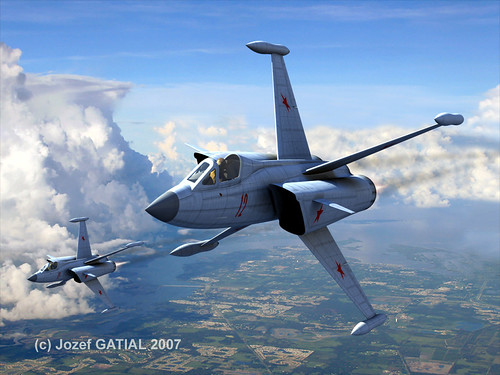
The Sukhoi Shkval was conceived as a twin-engine interceptor featuring integrated radar, a pair of built-in aircraft guns, and side-by-side afterburning engines.
Two variations were tested in a wind tunnel, differing solely in their air intake shapes and canard placements. The initial model incorporated D-shaped air intakes similar to those found on the Su-15, with canards located ahead of the cockpit extending toward the radome. The alternate design utilized rectangular ramp air intakes akin to the MiG-25, positioning the canards along the upper outer edge of these inlets. Ultimately, the latter design was selected.
The fuselage of Shkval resembled that of the Su-15 but lacked landing gear, wings, vertical fin, and airbrakes. Four wings were affixed at the fuselage corners arranged in a reclined X pattern, reminiscent of the fictional X-wing fighter from Star Wars. Cylindrical pods were attached at each wingtip. The lower sections of these pods housed shock absorbers for takeoff and landing operations, while the remainder served as kerosene fuel tanks, as did the fuselage and wings. These pods were externally outfitted with guide plates to extend the wingspan. Each wing incorporated a single control surface functioning simultaneously as an aileron and rudder.
To enable vertical landing capability, the entire ejection seat assembly, including the thrust lever and side-stick controller, was mounted on a pivot within the cockpit. This arrangement ensured that the pilot's relative position to these controls remained constant regardless of cockpit rotation. The swivel mechanism enhanced pilot visibility of the ground or landing area through a transparent panel integrated into the cockpit floor. The cockpit section for Sukhoi Shkval was constructed with this ground window and swivel seat/control configuration, which underwent multiple successful demonstrations and tests. Additionally, plans included a two-axle trailer designed for transporting and erecting the Sukhoi Shkval.
See also
- Convair XFY Pogo
- Lockheed XFV
- Rockwell XFV-12
- Heinkel Lerche
- Ryan X-13 Vertijet
- Focke-Wulf Triebflügel
References
- Yefim Gordon, Sergey Komissarov Unflown Wings Soviet/Russian unrealised aircraft projects 1925–2010 Ian Allan Publishing Pages 444–446
- Yefim Gordon, Sergey Komissarov OKB Sukhoi A History of the Design Bureau and its Aircraft Ian Allan Publishing Pages 515–518
- Tony Buttler, Yefim Gordon Soviet Secret Projects Fighters Since 1945