
Supermarine Spitfire (late Merlin-powered variants)
| Company type | Military aircraft series |
|---|---|
| Industry | Aviation |
| Predecessor | Spitfire Mk Vb |
| Founder | Supermarine |
| Successor | Griffon-engine Spitfire variants |
| Headquarters | Southampton , United Kingdom |
Area served | Royal Air Force, Allied air forces |
Key people | Rolls-Royce engineers (Merlin engine development) |
| Products | Fighter aircraft powered by two-stage Merlin engines (Spitfire Mk VI, VII, VIII, IX, XI, XVI) |
| Parent | Supermarine |

The British Supermarine Spitfire encountered significant challenges by mid-1942. The introduction of the powerful Focke-Wulf Fw 190 in late 1941 presented difficulties for Royal Air Force fighter units equipped with the then-current Spitfire Mk Vb.[1] Rolls-Royce engineers were simultaneously developing an enhanced Rolls-Royce Merlin engine featuring a two-stage supercharger. Combining this upgraded Merlin with the Spitfire Mk Vc airframe in a temporary solution enabled RAF pilots to effectively counter the Fw 190.
In parallel, Supermarine was advancing work on a strengthened Spitfire airframe incorporating multiple improvements, tailored to accommodate the Merlin 60 and 70 series engines.[2] This updated structure eventually served as the foundation for the Rolls-Royce Griffon-powered Spitfires. This article focuses on Spitfire models powered by two-stage Merlin engine variants and also covers some conceptual and experimental designs. Griffon-engine variants are detailed separately in the corresponding article.
Wing configurations
From the Mk VIII onwards, most Spitfires utilized one of three principal wing types: C, D, or E.
C type
Referred to as the "universal wing," this design became standard on most Spitfires produced from mid-1942 onward. The wing's configuration was modified to streamline manufacturing processes and support various armament layouts: Type A (eight .303 machine guns, four per wing), Type B (four .303 machine guns, two per wing, plus two 20mm Hispano cannons, one per wing), or four 20 mm Hispano cannons.[3]
The undercarriage attachments were redesigned with doors featuring a bowed cross-section to allow landing gear legs to sit lower within their wells, eliminating the upper-wing blisters above wheel wells and pivot points. The landing gear legs were reinforced and angled forward by 2 inches (5.08 cm), enhancing ground stability and reducing the risk of nose-overs.[3] During production of the Mk VIII and Mk IX, a new undercarriage leg incorporating external v-shaped "scissor-links" at the front was introduced, resulting in minor modifications to the undercarriage bay and leg fairings.[4] Since night-fighter duties were discontinued for this model, retractable landing lights were omitted.[3]
The Hispano Mk II cannons used belt-fed ammunition from box magazines holding 120 rounds per gun (the Chattellerault system). The fairings over the cannon barrels were shortened, often accompanied by a small rubber cover over the outer cannon port. New upper wing gun-bay doors featured "teardrop"-shaped blisters to accommodate cannon feed motors; lower wings no longer had heating vents outside the gun bays. Early Spitfire Mk IXs retained bay doors first seen on VCs with large blisters for two Hispano feed motors; subsequent models adopted smaller, more streamlined blisters.[3] To fit the belt-feed mechanism for the cannons, inner machine gun bays were relocated outward between ribs 13 and 14.[3]
Starting with HF Mk VIIs, several Spitfires incorporated additional integral fuel tanks of 13 gallons capacity within wing leading edges between the root and inboard cannon bay.[5] Although earlier Spitfires had been adapted to carry bomb racks capable of mounting 250 lb (110 kg) bombs, those specifically modified for fighter-bomber operations under Modification 1209 were introduced within the RAF Second Tactical Air Force. The initial deployment of Mk IXs in this role began in June 1944.[6]
D Type
Designed specifically for photo-reconnaissance Spitfires, such as the PR Mk X and XI, these models were unarmed. The wings featured distinctive D-shaped leading edges ahead of the main spar, which were repurposed to serve as built-in fuel tanks, each holding 66 gallons. To prevent damage from fuel expansion caused by high temperatures, pressure relief valves equipped with small external vent pipes were installed near the wingtips.
E Type
This wing was structurally the same as the C type but with notable modifications. The outer machine gun ports were removed; although the outer gun bays remained, their access panels no longer contained ports for empty cartridge cases or deflectors. This wing design supported a four-cannon armament, with the inner bays capable of housing heavy machine guns. Consequently, there were two armament configurations available:
- Either 2 × .50 cal Browning M2 machine guns loaded with 250 rounds per gun in the inner bays, paired with 2 × 20 mm Hispano Mk II cannons carrying 120 rounds each in the outer bays
- Or 4 × 20 mm Hispano cannons with 120 rounds per gun
The removal of .303 machine guns from the outer wings was due to their ineffectiveness against heavily armored targets. These outer guns had always been less efficient because their distance from the aircraft's centerline complicated harmonization, and wing flex during turns caused the bullets to scatter more widely. The 20 mm Hispano cannons were positioned further outboard, while the .50 caliber Browning M2/AN guns loaded with 250 rounds each were installed in the inner gun bays. The initial trial fit (modification 1029) occurred on BS118 in November 1943; by mid-March 1944, Spitfires from 485 (NZ), 222, and 349 Squadrons were among the first to receive this upgrade. Early on, these armed Spitfires were called Spitfire LF.IX .5, though the official introduction of the E suffix did not happen until early 1945. This armament became standard for all Mk IX and XVI Spitfires operated by the 2nd Tactical Air Force as fighters and fighter-bombers shortly after D-Day. It demonstrated superior effectiveness in both aerial combat and ground attack roles.
A number of Spitfires had their elliptical "pointed" wingtips replaced by shorter, squared-off fairings. This alteration slightly boosted top speed at low altitudes and improved roll responsiveness. While many "LF" Spitfires (such as the LF.IX) featured these clipped wings, some retained the original shape. The defining characteristic of "LF" variants was the installation of low-altitude versions of the Rolls-Royce Merlin engine.
Mark numbers, type numbers
Mark numbers did not always follow a strict chronological sequence; for example, the Mk IX was introduced as an interim solution before production of Mks VII and VIII commenced. Some aircraft initially built as one mark or variant were later converted to another; several early Mk Vbs originated from modified Mk Ibs, and initial Mk IXs were conversions of Mk Vcs—sometimes carried out by Rolls-Royce at their Hucknall facility.
Until late 1942, RAF designations used Roman numerals for mark numbers. Between 1943 and 1948, new aircraft received Arabic numeral marks while older models kept Roman numerals. From 1948 onward, only Arabic numerals were employed. This article follows the convention of using Roman numerals for Marks I through XVI and Arabic numerals for Marks 17 through 24. Additionally, "type numbers" (e.g., type 361) refer to Supermarine’s internal design drawing numbers.
Characteristics of late Merlin-equipped Spitfires
The introduction of the Merlin 61/63/66 and 70 series engines, featuring a two-stage, two-speed supercharger with an intercooler, prompted several notable alterations to the original airframe. These changes were implemented across all aircraft utilizing these powerplants. Due to the extended length of the Merlin 61, the nose section ahead of the engine and fuel tank bulkhead was extended by 7 inches (17.8 cm). Positioned behind the engine on the supercharger casing was an intercooler. Additionally, a small rectangular air intake for a "Heywood" air compressor was installed on the upper starboard side of the engine cowling.
The carburettor air intake design on early to mid-production Spitfire IXs differed from that of single-stage engine variants; it was shorter but featured a broader opening. Starting in 1943, an "Aero-Vee" tropical filter housed within a long, streamlined fairing was introduced for the carburettor intake. This became standard equipment on all Mk VIIs, VIIIs, PR Mk Xs, Mk XVIs, most late-production Mk IXs, and many PR Mk XIs.
A new four-bladed Rotol propeller measuring 10 ft 9 in (3.27 m) in diameter was installed, enclosed by a pointed spinner. The exhaust system was updated to feature six "fishtail" stacks on each side. Beneath the nose, the previous three-piece cowling was replaced by a single-piece design. The oil tank was no longer integrated into the cowling structure. Early Mk IXs were equipped with a teardrop-shaped blister accommodating a Coffman engine starter on the lower starboard cowling behind the propeller; this starter utilized shotgun-like cartridges to initiate engine rotation and had been first employed on earlier Spitfire variants. Most two-stage Merlin-powered Spitfires transitioned to an improved electric starter system, resulting in the blister becoming rare after late 1942.
Standard fitting included the Type C wing; however, some mid-production and most late production Spitfire Mk IXs, along with all Mk XVI models, featured the Type E wing. While Mk IXs converted from Mk Vcs retained large teardrop fairings on their upper surfaces, most Mk VIIs, VIIIs, IXs, and XVIs had smaller, more streamlined teardrop blisters covering the Hispano feed motors compared to those on the Mk Vc. According to A.P 1565J P & L (Spitfire IX, XI and XVI Pilot's Notes), early production Mk IXs used red-painted undercarriage indicator rods protruding through the wing tops when landing gear was deployed; these rods supplemented an electric visual indicator located on the instrument panel. These rods appeared on all Mk VIIs and VIIIs as well. A light indicating tailwheel position was installed just below the main visual indicator on the instrument panel. Furthermore, early Mk IXs and all Mk VIIs and VIIIs featured an undercarriage warning horn that sounded if throttling back occurred with retracted landing gear—this safety device originated from pre-war incidents where aircraft landed gear-up.
The intercooler's requirement for cooling led to modifications in radiator arrangements: the starboard wing radiator was halved in size to accommodate an intercooler radiator alongside it. On the port wing, a new radiator fairing housed both a square oil cooler and half of the radiator unit. At low engine speeds, one radiator section sufficed for cooling; a thermostatic switch deactivated the starboard radiator section until additional cooling was necessary during higher power demands.
Additional structural updates included adopting flush riveting for fuselage panels starting mid-1943 and replacing the rectangular rear-view mirror with a streamlined round version featuring a bullet-shaped fairing. New production Mk IXs also omitted the small teardrop identification light formerly positioned behind the radio mast.
While early Mk IX conversions from Mk Vcs retained smaller elevator horn mass-balances, most transitioned to larger versions with straightened leading edges. Many Mk VIIs, VIIIs, and mid- to late-production Mk IXs and XVIs were fitted with an enlarged rudder identifiable by its pointed tip.
All Mk VII and Mk VIII Spitfires incorporated several key revisions: The internal framework was reinforced and redesigned. Wing ailerons were shortened by approximately 8.5 inches (216 mm) beyond their outer hinges due to concerns over structural failures during steep high-speed dives attributed initially to aileron flutter; subsequent investigations revealed longitudinal instability caused by improper loading affecting center of gravity limits.
Fuel capacity increased notably: main fuselage tanks held 47 gallons (213.7 L) in the upper tank and 49 gallons (222.7 L) in the lower tank. Combined with wing tanks, total internal fuel reached 122 gallons (554.6 L), nearly 50% more than previous Spitfire versions carrying 85 gallons (386.4 L). Additionally, each wing's leading edge between root and inner gun bay contained a 13-gallon (64 L) fuel tank.
For the first time in Spitfire history, main undercarriage legs were equipped with forward-facing torque links. Leg doors were slightly concave to allow landing gear to retract deeper into wheel wells without causing bulges in upper wing skinning traditionally required for wheel clearance. Wheels were upgraded to reinforced Dunlop AH10019 "four-spoke" types replacing earlier five-spoke patterns used since initial models. This improved undercarriage appeared on some mid- to late-production Mk IXs and all Mk XVIs as well. A retractable Dunlop 2184 tailwheel covered by small doors when stowed was also standard on PR Mk Xs and most PR Mk XIs.
Mk VII (type 351)

Similar to the Mk VI, the Mk VII was designed as a high-altitude, pressurised model, equipped with either the Merlin 64 (F. Mk. VII) or Merlin 71 (H.F. Mk. VII) engines, both featuring two-stage, two-speed superchargers.[7][nb 1] The cockpit pressurisation system resembled that of the Mk VI but incorporated some distinct modifications. Additional airframe alterations have been detailed above. The pressurisation compressor, produced by Marshall, was installed on the right side of the engine and drew air through an extended intake situated beneath the starboard exhaust stubs. An automatic valve regulated pressure differentials up to +2 lb./sq.in., which built up during ascent and was sustained at altitudes of 28,000 ft and higher.[9]
The Type C wings were fitted with lengthened, "pointed" wingtips, extending the wingspan to 40 ft 2 in (12.2 m). However, as the anticipated threat from high-altitude bombers did not arise, many Mk VIIs eventually reverted to conventional rounded wingtips.
Early versions of the Mk VII featured a detachable canopy fastened by four pilot-operated catches. Later models adopted a "Lobelle"-style sliding hood that moved backward for opening, similar to non-pressurised Spitfire variants. This represented a significant enhancement over the clampdown cockpit design used in the Mk VI. The canopy was double-glazed and sealed against the fuselage using rubber tubing to maintain proper pressurisation. Its rails were more robust compared to standard Spitfire designs.[9][10]

Supermarine manufactured a total of 140 Mk VIIs.[11] Most were powered by either the Merlin 64 (F. Mk. VII) or Merlin 71 (H.F Mk. VII) engines; the latter incorporated a Bendix-Stromberg "anti-g" carburettor.[12] The HF variant demonstrated outstanding high-altitude capabilities with a service ceiling reaching 45,100 feet (13,700 m). French ace Pierre Clostermann recounts in his memoir The Big Show an incident where a Mk VII Strato Spitfire from 602 Squadron successfully intercepted a long-range reconnaissance Messerschmitt Bf 109G-6/R3 at approximately 40,000 feet (12,000 m) over the British Home Fleet base at Scapa Flow in early 1944.
Mk VIII (type 360)

The Mk VIII was essentially a modification of the Mk VII, omitting the pressurised cabin, and was designed to be the primary production Spitfire model. However, once the interim Mk IX demonstrated sufficient capability against the German Focke-Wulf Fw 190, production at the Castle Bromwich shadow factory focused exclusively on the Mk IX; consequently, all Mk VIII units were manufactured by Supermarine. Besides the absence of pressurisation, the Mk VIII differed only slightly from the Mk VII, notably featuring a redesigned fin and a pointed rudder.
While some early versions were equipped with extended wingtips, most aircraft retained the standard wing design. Jeffrey Quill, Supermarine’s Chief Test Pilot, stated that when asked about his preferred Spitfire mark from a flying perspective, he usually named "the Mark VIII with standard wingtips." He expressed a strong dislike for the extended wingtips, noting they offered no practical advantage for the Mk VIII and instead diminished aileron responsiveness and roll rate. New Zealand ace Alan Peart reported that extended wingtips caused structural issues on Mk VII Spitfires operating in Burma, leading to their replacement with standard wings. The Mk VIII came in three sub-variants tailored for different operational altitudes: low altitude (LF Mk VIII) powered by the Merlin 66 engine, medium altitude (F Mk VIII) with the Merlin 63, and high altitude (HF Mk VIII) driven by the Merlin 70 engine.[12]

The F Mk VIII could reach a maximum speed of 408 mph (657 km/h) at 25,000 ft (with the LF Mk VIII achieving 404 mph at 21,000 ft (6,400 m) and the HF Mk VIII reaching 416 mph (669 km/h) at 26,500 ft). Its operational ceiling was 43,000 ft (41,500 ft for LF and 44,000 ft (13,000 m) for HF variants). Fuel capacity was increased by 11 gallons in the main tanks to total 96 gallons; combined with wing tanks, this allowed a maximum range of approximately 660 mi (1,060 km) on internal fuel alone and up to 1,180 miles (1,900 km) when fitted with a full internal load plus a 90-gallon drop tank. The design accommodated a single "slipper" drop tank with capacities of 30, 90, or 170 gallons. With a 170-gallon tank installed, range extended beyond 1,500 mi (2,400 km). When equipped with either a 90 or 175-gallon tank, flight was limited to straight and level cruising after takeoff.[13] Additionally, it could carry an external bomb load up to 1,000 pounds (one 500 lb (230 kg) bomb on the center rack plus two 250 lb (110 kg) bombs under each wing).
One specific Mk VIII aircraft, JF299, served as a testbed for a redesigned rear fuselage featuring a "tear-drop canopy" aimed at improving pilot visibility. This modification addressed a critical vulnerability where many pilots were shot down due to enemies exploiting blind spots behind the aircraft. Testing confirmed significant enhancements in all-around visibility with this new canopy design; after several refinements, it became standard on subsequent Spitfire models.[14]
This model primarily operated abroad within the Mediterranean theatre alongside the Desert Air Force and USAAF units; it also saw service in the South West Pacific Area with both Royal Australian Air Force and RAF squadrons and in the South-East Asian theatre under RAF command. Following the Mk IX and Mk V variants, the Mk VIII ranked as the third most produced operational Spitfire type with a total of 1,658 units constructed.[15]
Mk IX (type 361)

At the start of 1942, the clear dominance of the Focke-Wulf Fw 190 over the Spitfire Mk Vb created urgent demand to produce Spitfires powered by the new two-stage supercharged Merlin 61 engine. In September 1941, the Spitfire Mk III prototype N3297 was altered by Rolls-Royce at their Hucknall facility to accommodate a Merlin 60 engine, originally developed for the Wellington Mk VI high-altitude bomber.
Jeffrey Quill described the resulting performance boost as a "quantum leap" compared to the Mk Vb, prompting modification of another Spitfire airframe, R6700, to fit this advanced powerplant. Although development on the Mk VII and VIII models was ongoing, their production would require over a year, while an immediate response to the Fw 190 was critical. Consequently, the Air Ministry resolved to convert existing Mk Vc airframes to house the more powerful engine. Many early Mk IXs were thus modified Mk Vcs lacking later refinements. These conversions could be recognized by their Type C wings featuring prominent double blisters over the inner cannon bays and an identification light positioned on the fuselage spine behind the radio mast. Additionally, their elevator horns were smaller than those on most later Mk IXs, which had larger horn balances.[16][17] The inaugural Mk IX was a converted Mk Vc AB505, evaluated by the Air Fighting Development Unit (AFDU) in April 1942.[nb 2] The evaluation report stated:
The Spitfire IX's performance surpasses that of the Spitfire V significantly, particularly above 20,000 feet altitude. At level flight, it is notably faster and climbs exceptionally well. It can easily ascend to 38,000 feet and can be coaxed above 40,000 feet through staged climbs utilizing speed buildup and slight zooms. Its agility matches that of a Spitfire V up to 30,000 feet and is substantially superior above this height. At 38,000 feet, it achieves a true speed of 368 mph while retaining excellent maneuverability for combat.[19]
Despite lacking aerodynamic enhancements and structural reinforcements or modified control surfaces found on the Mk VII and VIII variants, the Mk IX demonstrated itself as an effective adversary against the Focke-Wulf Fw 190.[20]

In September 1942, RAF Northolt established a "High Altitude Flight" unit to counteract threats posed by high-flying Junkers Ju 86 R bombers. Two Spitfire Mk IXs converted from Vcs were stripped of armor plating, .303 Browning machine guns, and additional equipment before being repainted in lightweight PRU blue livery. One such aircraft successfully intercepted a Ju 86R at an altitude exceeding 40,000 feet (12,000 m).
Supermarine ceased production of the Mk IX in June 1943; thereafter manufacturing continued solely at Castle Bromwich. Throughout production, numerous significant and minor improvements were introduced incrementally to the Mk IX series; some of these enhancements were also applied across other Spitfire models.
Early in 1943, the Merlin 61 engine was replaced by Merlin variants 63 and 63A.[21] These engines delivered increased power due to technical improvements and operated within limits of +18 lbf/(sq in) manifold pressure and up to 3,000 rpm for five-minute combat durations. During late 1943, production shifted away from Merlin 63-powered F Mk IXs in favor of Merlin 66-powered LF Mk IXs.[22] Initial batches of Spitfire Mk IX experienced vapour lock issues within fuel lines caused by fuel evaporation when parked under direct sunlight exposure. To address this problem, gun-cameras were relocated from port wing roots to starboard wing roots; in their place a fuel cooler was installed featuring a small circular air intake. This cooling system was also incorporated into early PR Mk XI models.[23]
The LF Mk IX variant—often called Spitfire Mk IXb—was produced concurrently with Merlin 63-powered versions initially and entered operational service in March 1943 with Biggin Hill Wing comprising 611 and 341 (Free French) Squadrons. This variant became by far the most widely manufactured among all Spitfire Mk IX types with over four thousand units completed. The Merlin 66 engine generated a maximum output of 1,720 hp (1,280 kW) at an altitude of approximately 5,750 feet (1,750 m), delivering a top speed for the LF Mk IX around 404 mph (650 km/h) at 21,000 feet (6,400 m).[24] This engine featured a Bendix-Stromberg injection carburettor replacing earlier S.U float carburettors.[21]
The HF Mk IX model utilized a specialized high-altitude Merlin 70 engine and entered service during springtime of 1944. Serial number records indicate that HF Mk IX production was limited as priority focused on low- and medium-altitude versions[nb 3] The Merlin 70 delivered up to 1,710 hp (1,280 kW) at 11,000 feet (3,400 m), enabling maximum speeds near 405 mph (652 km/h) at 25,400 feet (7,700 m) with an all-up weight around 7,320 pounds ([convert: unknown unit]).[26]

In early 1944 also saw introduction of an advanced Mark II Gyro gunsight. This sight computed precise deflection angles required for accurate target leading during aerial engagements significantly enhancing RAF gunnery effectiveness—doubling hit probabilities—and played a crucial role in securing Allied air dominance.[27]
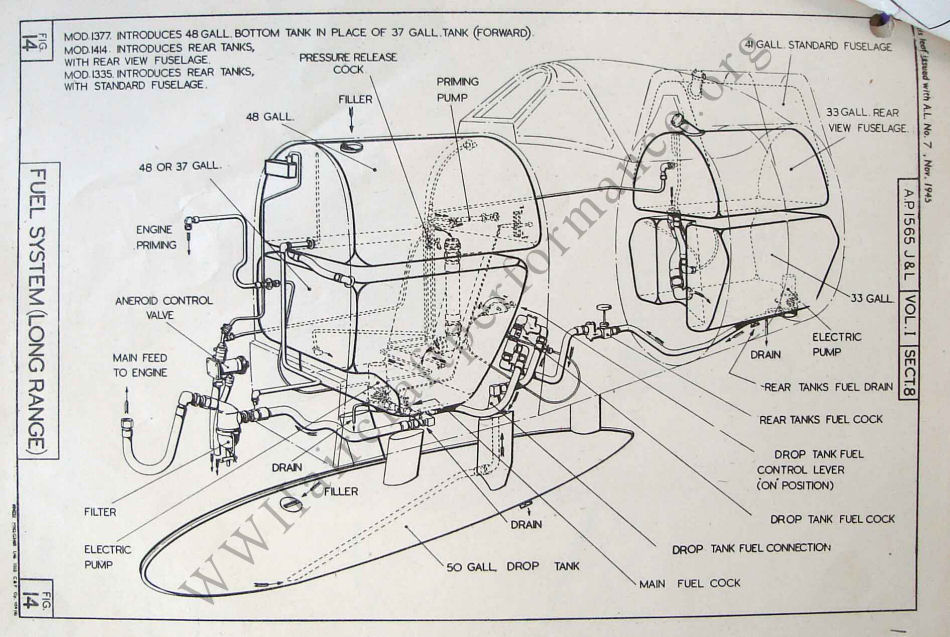
The main internal fuel capacity comprised an upper tank holding forty-eight gallons and a lower tank containing thirty-seven gallons totaling eighty-five gallons internally. Additionally jettisonable "slipper tanks" with capacities of thirty, forty-five or ninety gallons could be mounted beneath the center-section.[28] Alternatively a cylindrical fifty-gallon drop tank adapted from those used on long-range Hawker Typhoon fighters could be carried on fuselage bomb racks common to most Second Tactical Air Force-operated Mk IXs. To extend operational range further some late-production models incorporated supplementary internal self-sealing fuel tanks located in rear fuselage; upper tank held forty-one gallons while lower contained thirty-four gallons capacity allowing ferry ranges exceeding 1,200 miles (1,900 km), though these tanks compromised stability necessitating only straight flight or gentle maneuvers at low altitudes as per pilot guidelines which also recommended avoiding instrument flight whenever feasible.[29][30]
Later production variants of the Mk IX shared with contemporaneous Mk XVI models featured redesigned upper engine cowling exhibiting a pronounced bulge along its top surface; this modification accommodated altered intercoolers fitted on Packard-built Merlin engines such as Merlin 266 which integrated header tanks.
The cut-down rear fuselage combined with bubble canopy design—initially tested on a Spitfire Mk VIII—was incorporated into very late series of Mk IXs resulting in increased forward lower fuselage tank capacity raised to forty-seven gallons while rear tanks reduced to sixty-six gallons.[31] These rare examples often had "clipped" wings and predominantly served postwar within South African Air Force operations both domestically and during deployment in Korea throughout the early1950s.
During early1945 some Spitfires designated IXe and XVIe flown by No.74 Squadron RAF were equipped with single RP-3 rockets mounted under each wing believed to be unique among RAF Spitfire units employing rockets operationally during World War II.[32]
PR Mk IX (type 374) and FR Mk IX
Before the dedicated Merlin 61-powered PR Spitfire (the Mk XI) was developed, at least three Mk IX aircraft (BS338, BS339, and BS473) were taken from the production line and modified to house two vertical cameras in the rear fuselage. The initial example was delivered to 541 Squadron at RAF Benson on 30 November 1942. Following this, an additional 15 Mk IXs underwent conversion to PR Mk IXs (factory code type 374) at the Vickers-Armstrong facility located at Worthy Down. These modifications included the installation of camera systems, a wrap-around PR style windscreen, and an enlarged oil tank beneath the nose. All weaponry was removed, and the aircraft received a PRU Blue paint scheme. Unlike other variants, these models did not feature "wet wing" fuel tanks, relying instead on drop tanks to extend their operational range. Among their most notable missions were reconnaissance flights supporting Operation Chastise, the 617 "Dambusters" Squadron assault on the Ruhr dams. A PR Mk IX captured images of the dams one day prior to the raid and also photographed the Moehne Dam following the attack.
The FR IX variant consisted of standard armed Mk IXs outfitted with a single oblique camera mounted on the port side. These aircraft were employed for low-level "Dicing" reconnaissance missions, providing tactical support to ground forces. 16 Squadron, part of the 2nd TAF, operated several FR Mk IXs painted in a pale "Camoutint" Pink that offered effective camouflage beneath cloud cover, using them to photograph the Arnhem region before and during Operation Market Garden. Another operator of FR Mk IXs was 318 (Polish) "City of Gdańsk" Fighter-Reconnaissance Squadron, which was active in the Mediterranean theatre. Certain Spitfires within the MJ- and MK- serial blocks sent to Forward Repair Units (FRU) were converted into a distinct FR Mk IXc variant featuring streamlined blisters on both sides of the fuselage; these were exclusively assigned to No. 414 Squadron RCAF as replacements for their TAC-R Mustangs. A similar modification was applied to F Mk XIVe Spitfires, creating FR Mk XIVe versions used solely by No. 430 Squadron RCAF.
T Mk IX and TR 9 (type 509)

While there were wartime adaptations of the Spitfire into two-seat trainers—including a unique modification of a Mk Vc by RAF No. 261 Squadron and a Soviet-converted Mk IX—the primary development of two-seat Spitfire trainers occurred postwar. In 1946, a Mk VIII (MT818) served as Vickers’ first trainer demonstrator, followed by the export of ten Spitfire T Mk IX aircraft to India in 1948. Later in 1951, six TR 9 trainers were converted from standard Mk IXs specifically to train pilots for the Irish Air Corps (IAC) Seafire units. These trainers facilitated transition training that included live gunnery exercises, as they retained two .303 Browning machine guns—one mounted in each outer wing bay. The majority of TR 9s eventually transferred to Baldonnel’s ground technical training school, where they functioned as instructional airframes for Air Corps aircraft engineer education. Four of these Irish Air Corps Spitfires have survived; two entered the warbird community during the 1970s and beyond.
A total of 5,656 Mk IX Spitfires were produced—561 constructed by Supermarine and 5,095 manufactured at Castle Bromwich. Production ceased in April 1945, and combined with the Mk XVI, this "compromise" variant became the most widely produced Spitfire model overall.
PR Mk X and PR Mk XI (types 387, 365, and 370)

During the initial development of Merlin 60-powered Spitfires, photo-reconnaissance (PR) versions were planned for both the Mk VII and VIII models. On 21 April 1942, an order was placed for 70 aircraft provisionally called PR Mk VIII. These planes were designed on the updated Mk VIII airframe and intended to be equipped with Merlin 61 engines, assigned serial numbers LV643–681 and LV726–756. However, aircraft with these serials were ultimately produced as Merlin 66 LF Mk VIIIs.
A shift in policy led to the pressurized PR variant of the Mk VII being rebranded as the PR Mk X (type 387). This model entered production following the PR Mk XI and combined the Mk VII airframe with PR Mk XI wings and camera systems. It featured the pressurized cockpit of the Mk VII with a Lobelle sliding canopy and retained a fighter-style windscreen that included bullet-proof glass. The cockpit pressurization system’s slim air intake was positioned beneath the starboard cowling’s exhaust stacks. Performance closely matched that of the PR XI; however, its pressurized cockpit allowed pilots to remain at altitudes exceeding 40,000 ft longer without experiencing the severe physiological strain common in unpressurized cabins. Sixteen PR Mk X aircraft were manufactured between April and May 1944, with the first operational sortie flown on 11 May. These aircraft saw limited deployment within 541 Squadron and 542 Squadron for high-altitude reconnaissance missions. Insights gained from this variant contributed to the development and production of the pressurized PR Mk XIX.
The PR Mk XI (type 365 standard, type 370 tropicalized) incorporated elements from the Mk VII, VIII, and IX designs. It was notably the first PR Spitfire to offer dual vertically mounted F52 cameras with 36-inch focal length lenses installed in the fuselage behind the cockpit. Various camera configurations could be tailored to mission requirements; for instance, the X Type setup included two vertically mounted F24 cameras with 14-inch lenses plus an oblique F24 camera with an 8-inch lens mounted above and facing port side. Tactical reconnaissance versions of the PR Mk XI also carried an additional vertically oriented camera housed in a fairing beneath each wing.
Physically, the Mk XI featured a deeper nose fairing to accommodate a larger 14.5-gallon oil tank and utilized an unarmored wrap-around PRU windscreen. Booster pumps servicing the wing tanks were enclosed within teardrop-shaped fairings under each wing. Retractable tailwheels became standard equipment, and most production models incorporated a larger pointed rudder design. Of the total produced, 260 Mk XIs were powered by Merlin 61, 63, or 63A engines, while another 211 utilized high-altitude Merlin 70 engines. All Merlin 70 variants and 198 of those powered by Merlin 60 series engines were fitted with Vokes Aero-Vee dust filters integrated into an extended streamlined carburettor air intake beneath the nose. Additionally, all Merlin 60-powered aircraft carried a fuel cooler located in the port leading edge wing root. Radio equipment comprised either VHF TR.1133 or TR.1143 units equipped with "Rebecca" beam approach technology.
The Mk XI could be fitted with supplementary slipper drop tanks beneath its center section; consistent with the Mk IX, these tanks came in capacities of 30, 45, or 90 gallons. For the Mk XI specifically, an additional option of a 170-gallon tank was available.
Performance-wise, Spitfire PR Mk XIs achieved maximum speeds of 417 mph (671 km/h) at 24,000 ft (7,300 m) altitude and cruised comfortably at 395 mph (636 km/h) at 32,000 ft (9,800 m). Typically operating between these altitudes, they could reach emergency ceilings up to 44,000 ft (13,000 m); however, pilots could only endure such heights briefly in unpressurized cockpits due to severe physiological effects.
Initial production of the PR Mk XI faced delays because development of both Mk VII and VIII series lagged behind schedule. Consequently, it was decided to base Merlin 60-powered PR aircraft on the MK IX airframe instead. Production prospects were further jeopardized by disagreements over RAF photo-reconnaissance strategy: in early 1943, due to delays in new PR Spitfire availability, the Air Ministry proposed converting all PR units to de Havilland Mosquito aircraft. After review, it was determined that Mosquitoes could fulfill approximately 90% of PR missions; thus Spitfire production was considered necessary for only about 10% of units. However, Air Vice Marshal John Slessor, head of Coastal Command, argued that because Spitfires were smaller than Mosquitoes, used half as many Merlin engines, and offered superior speed, maneuverability, and stealth characteristics, their production should be increased rather than curtailed. As a result of his advocacy, Air Staff accelerated PR Mk XI production at the expense of fighter output.
The first PR Mk XIs rolled off production lines in November 1942; from April 1944 onward they were manufactured alongside PR Mk XIXs until December that year when they were phased out in favor of their successor. In total, Supermarine produced 471 units of this variant.
PR Mk XIII
The PR Mk XIII represented an enhanced version of the PR Type G, equipped with a single-stage Merlin engine. Further details can be found in Supermarine Spitfire (early Merlin powered variants).
Mk XVI (type 361)

In almost every aspect, the Mk XVI mirrored the Mk IX, with the primary distinction being its powerplant: the Merlin 266. This engine was essentially a Packard-built variant of the Merlin 66, manufactured under licence in the USA by the Packard Motor Company. The prefix "2" was added to differentiate it from other Merlin engines due to differing manufacturing requirements. All Mk XVI units were produced as Low-Altitude Fighter (LF) models. The LF designation stemmed not from wing length—though many featured clipped wings suited for low altitude—but from an engine specifically tuned for operations at lower altitudes. The majority of Mk XVI aircraft were outfitted with clipped wings and rear fuselage fuel tanks holding a total of 75 gallons.[33] Numerous examples had modified rear fuselages topped with bubble canopies, which reduced the rear tank capacity to 66 gallons.[33]
Due to a slightly taller intercooler and altered accessory arrangement on the Packard-built Merlins, a new upper cowling design with a distinctive bulge was introduced; this feature also appeared on later production Mk IXs.[34]
The typical armament configuration for most Mk XVI aircraft included two 20 mm Hispano II cannons, each supplied with 120 rounds, alongside two .50 caliber Browning machine guns carrying 250 rounds per gun. For ordnance, one 500 lb (227 kg) bomb could be mounted centrally beneath the fuselage, and one 250 lb (114 kg) bomb could be attached under each wing. Some models featured additional rear fuselage fuel tanks supplementing the main tank, enabling range comparable to the Spitfire Mk VIII. However, delays in front-line deployment occurred due to challenges with these licence-produced engines. Castle Bromwich manufactured a total of 1,054 Mk XVI aircraft.[11]
Spitfire Floatplanes (types 355 and 359)

Following Germany's invasion of Norway in April 1940, the RAF explored the feasibility of floatplane fighters for regions lacking immediate airfield access. Consequently, a Spitfire Mk I designated R6722 underwent modifications at the Woolston factory to be fitted with floats derived from the Blackburn Roc. Scale model testing at Farnborough (at one-seventh scale) confirmed the concept's viability but indicated that vertical tail surfaces needed enlargement to counteract the floats' side area. Due to the conclusion of the Norwegian campaign and urgent demand for standard Spitfires, R6772 was reverted to a conventional fighter before any flight testing occurred.[35][36]
With Japan entering the conflict in early 1942, interest in floatplane fighters was renewed. A Spitfire V W3760 was adapted with twin floats measuring 25 ft 7 in (7.8 m) in length, supported by cantilever struts. This variant was powered by a Merlin 45 engine coupled to an eleven-foot three-inch (3.4 m) diameter four-bladed propeller. A Vokes filter was installed on the carburettor air intake and an extended fin beneath the tail was added.[37]
Additional modifications included external lifting points located before and behind the cockpit along with a spin-recovery parachute protected by a rudder balance-horn guard. The floatplane's maiden flight occurred on 12 October 1942 under pilot Jeffrey Quill’s control. Soon thereafter, the Vokes filter was replaced by an Aero-Vee filter similar to those used on later Merlin 61 series engines; this filter featured an extension designed to prevent water ingress. Full armament matching the Mk Vb standard was installed as well. Two further Vb models—EP751 and EP754—were converted by Folland, and all three floatplanes were shipped to Egypt in October 1943. At that time, it was anticipated these aircraft could operate covertly from bases in the Dodecanese Islands to disrupt German supply routes reliant on transport aircraft resupply. However, this plan failed when German forces reinforced by Luftwaffe units seized British-held islands including Kos and Leros. Consequently, no alternative operational role materialized for these floatplane Spitfires; they remained stationed in Egypt operating around the Great Bitter Lake. Performance specifications for this Vb-based floatplane indicated a top speed of 324 mph (521 km/h) at an altitude of 19,500 ft (521 km/h at 5,943 m), a maximum climb rate of 2,450 ft/min at 15,500 ft (12.45 m/s at 4,724 m), and an estimated service ceiling reaching approximately 33,400 ft (10,180 m).[38][nb 4]
In spring of 1944, anticipating potential deployment in the Pacific Theatre, a Spitfire IX identified as MJ892 was converted into a floatplane utilizing components similar to those employed in earlier Mk Vb conversions. Jeffrey Quill remarked:
The Spitfire IX equipped with floats demonstrated speeds exceeding those of standard Hurricanes. Its water handling characteristics were excellent; however, it exhibited a tendency to oscillate laterally ("tramp") or sway ("waddle") at high speeds while airborne.
Shortly after testing commenced, plans for floatplane fighters were abandoned and MJ982 underwent reconversion back into a land-based aircraft.[39]
Five aircraft underwent conversion:
Associated design initiatives
Supermarine 305: Developed according to the F.9/35 specification, which also produced the Boulton Paul Defiant turret fighter and the ultimately dismissed Hawker Hotspur. This model combined the fundamental F.37/34 wing and landing gear—then still recognized as part of the Spitfire framework—with a redesigned fuselage that accommodated a gunner and a remotely operated four-gun turret (initially equipped with .303 Browning machine guns, later replaced by Lewis light machine guns). Additional changes included a cooling system positioned within a chin radiator assembly. The aircraft lacked any forward-firing weapons and featured dive brakes on its wings. Its anticipated maximum speed was 315 mph (507 km/h) at an altitude of 15,000 ft (4,572 m).
Supermarine 312: Created under specification F.37/35 for a cannon-armed fighter, this variant adapted the basic Spitfire Mk I to carry four 20 mm Oerlikon cannons housed in modified wing structures. The radiator and oil cooler were relocated from beneath the wing to a duct beneath the fuselage. This project represented R J Mitchell's final design before his passing in 1937. A separate twin-engine concept meeting the same requirements was also submitted. However, the Ministry declined the 312 since Supermarine's design team was already heavily committed to Spitfire development, preventing work on an alternative wing. Instead, the twin-engined Westland Whirlwind was approved for this specification.
Supermarine 324, 325, and 327: These models were twin-engine fighter designs responding to F.18/37, intended as successors to the Spitfire and Hurricane, utilizing similar construction methods and the elliptical wing characteristic of the Spitfire. All three featured tricycle landing gear with a Merlin engine as standard powerplant and an option for the Bristol Taurus. The 324 and 325 were designed to mount twelve .303 caliber Brownings arranged in groups of six on each outer wing, whereas the 327 replaced this armament with six 20 mm Hispano cannons located near the wing roots. While the 324 and 327 used conventional tractor engine layouts, the 325 employed a pusher configuration. Ultimately, two Hawker designs that evolved into the Hawker Typhoon and Hawker Tornado were chosen. The Type 327 was briefly considered due to its cannon armament but development focus remained on existing projects such as the Whirlwind, Bristol Beaufighter, and Gloster F.9/37.
Griffon engine adaptations
Initial Griffon-powered Spitfire variants were modifications of Mk Vc (early Mk XII) or Mk VIII (late Mk XII and Mk XIV) airframes. Subsequent Griffon-equipped models incorporated redesigned wings, tail assemblies, and undercarriages, marking a significant departure from earlier Spitfire versions. These Griffon-powered variants are detailed in a dedicated article.
Manufacturing
Following extensive damage inflicted by Luftwaffe attacks on the principal Itchen and Woolston facilities in September 1940, all Supermarine Spitfires were produced across multiple "Shadow Factories." By war’s end, production was spread among ten major factories alongside numerous smaller workshops responsible for component manufacture. Further details are available in Supermarine Spitfire. The main Castle Bromwich plant also received support from several shadow factories.
The earliest Mk IX units were conversions from Mk Vcs; however, production of genuine Mk IXs is identified by serial number.
| Variant | Manufacturer | Quantity | Remarks |
|---|---|---|---|
| F VII, H.F VII | Supermarine | 140 | Initial Mk VII introduced September 1942 |
| F VIII, L.F VIII | Supermarine | 1,658 | First Mk VIII flew on 11 November 1942 |
| F IX, H.F IX L.F IX |
Supermarine Castle Bromwich |
5,656 | First true Mk IX BR581 June 1942 |
| PR X | Supermarine | 16 | First Mk X appeared May 1944 |
| PR XI | Supermarine | 471 | Initial Mk XI delivered November 1942 |
| XVI | Castle Bromwich | 1,054 | First Mk XVI produced October 1944 |
See also
Notes
- ↑ Initially, a prototype designated AB450 was converted from a Mk V and powered by a Merlin 61; otherwise, the Merlin 64 and 71 engines were standard.[8]
- ↑ Some very early Mk IXs were modified by Rolls-Royce at Hucknall using extended engine cowlings from Mk Vcs with welded additions at the rear and improvised blisters covering the intercooler mounted on the Merlin 61 supercharger.[18]
- ↑ HF Mk IXs were manufactured under serial prefixes ML, NH, PL, PT, PV, TA, TB, TD and TE; approximately four hundred units were built.[25]
- ↑ Based on figures taken from a trials report of the prototype taken at the Marine Aircraft Experimental Establishment (MAEE) at Helensburgh (near Glasgow) in 1943.
Citations
- ↑ McKinstry 2007, pp. 278–279.
- ↑ Price 1982, p. 171.
- ↑ 3.0 3.1 3.2 3.3 3.4 Cite error: Invalid
<ref>tag; no text was provided for refs namedBarbic 1996, pp.165-167. - ↑ Laird and Matusiak 2009, pp. 39–42.
- ↑ Cite error: Invalid
<ref>tag; no text was provided for refs namedAir Ministry 1943, pp. 16, 27–29. - ↑ Cite error: Invalid
<ref>tag; no text was provided for refs namedShores and Thomas 2008, pp.586, 607. - ↑ Air Ministry 1943, p. 6.
- ↑ Price 2010, p. 204.
- ↑ 9.0 9.1 Air Ministry 1943, p. 13.
- ↑ Laird and Mackenzie, 1997, p. 7.
- ↑ 11.0 11.1 Cite error: Invalid
<ref>tag; no text was provided for refs namedAI187 - ↑ 12.0 12.1 Air Ministry 1943, p.6.
- ↑ Cite error: Invalid
<ref>tag; no text was provided for refs namedAir Ministry 1943, pp. 16, 27-29, para 64. - ↑ Price 2002, pp. 171, 175, 178–179.
- ↑ Cite error: Invalid
<ref>tag; no text was provided for refs namedPrice 2002, p.171 - ↑ Morgan and Shacklady 2000, pp. 307–309.
- ↑ Price 1999, pp. 153–170.
- ↑ Price 1995, p. 12.
- ↑ Delve 2007, p. 80.
- ↑ Price 1995, p. 9.
- ↑ 21.0 21.1 Cite error: Invalid
<ref>tag; no text was provided for refs namedAir Ministry 1946, p.6. - ↑ Morgan and Shacklady 2000, pp. 315–317.
- ↑ Matusiak 2007, pp. 21,38.
- ↑ Morgan and Shacklady 2000, pp.315–316,332.
- ↑ Morgan and Shacklady 2000, pp.359–364,372–376.
- ↑ Price 1999,p.170.
- ↑ Price 2002,pages154–155
- ↑ Cite error: Invalid
<ref>tag; no text was provided for refs namedAir Ministry 1946,p7. - ↑ Air Ministry1946,pages7and23.
- ↑ Fuel System Diagram for Mk IX
- ↑ Cite error: Invalid
<ref>tag; no text was provided for refs namedAir Ministry1946,p7. - ↑ Price1999,p158.
- ↑ 33.0 33.1 Cite error: Invalid
<ref>tag; no text was provided for refs namedAir Ministry 1946, p.7. - ↑ "Packard 266 Installation." Spitfire Performance. Retrieved: 21 August 2011.
- ↑ Price 2002, pp. 193–203.
- ↑ Ford 2004, p. 63.
- ↑ Price 2002, pp. 195, 202.
- ↑ Price 2002, pp. 195, 202.
- ↑ Price 2002, pp. 195, 201.
- ↑ Aeroplane Monthly – April 1975 issue – Personal Album – More Spitfire floatplanes
- ↑ Price 2002, p.195.

Bibliography
- Air Ministry. Pilot's Notes for Spitfire Mark F.VII – Merlin 64 or 71 engine; Mark F.VIII-Merlin 63,66 or 70 engine. Air Publication 1565G & H -P.N. London, UK: Air Ministry, December 1943.
- Air Ministry. Pilot's Notes (3rd edition) for Spitfire IX, XI & XVI; Merlin 61, 63, 66, 70 or 266 Engine. Air Publication 1565J, P & L -PN. London, UK: Air Ministry, September 1946.
- Bachelor, Len J. "Supermarine Spitfire (Griffons) Mks. XIV & XVIII". Aircraft in Profile, Volume 13. Windsor, Berkshire, UK: Profile Publications Ltd., 1973, pp. 265–288. ISBN 0-85383-022-3.
- Bader, Douglas. Fight for the Sky: The Story of the Spitfire and Hurricane. London: Cassell Military Books, 2004. ISBN 0-304-35674-3.
- Barbic, Vlasco. "The Spitfire and its Wing: Article and scale drawings." Scale Aviation Modeller Volume 2, Issue 3, March 1996. Bedford, UK: SAM Publications, DMZee Marketing Ltd.
- Buttler, Tony. British Secret Projects: Fighters and Bombers 1935–1950. Hersham, Surrey, UK: Midland, 2004. ISBN 1-85780-179-2.
- Caygill, Peter.Combat Legend; Spitfire Mks VI-F.24. Ramsbury, Marlbourough, Wiltshire, UK: The Crowood Press Ltd, 2004. ISBN 1-84037-400-4.
- Cooke, Peter. "The Early Griffon Spitfires part 1: Article and scale drawings" Scale Models Magazine Vol. 9, No 109, October 1978. Hemel Hempstead, Hertfordshire, UK.
- Cooke, Peter. "The Early Griffon Spitfires part 2: Article and scale drawings" Scale Models Magazine Vol. 9, No 110, November 1978. Hemel Hempstead, Hertfordshire, UK.
- Dibbs, John and Tony Holmes. Spitfire: Flying Legend. Southampton UK: Osprey Publishing, 1997. ISBN 1-84176-005-6.
- Ford, Daniel. "Spitfires with Sea-Boots: The Floatplane Interlude". Air Enthusiast, No.114, November/December 2004. Stamford, UK: Key Publishing, pp. 61–65.
- Hancock, Ian. The Lives of Ken Wallis: Engineer and Aviator Extraordinaire. Flixton, Bungay, Suffolk, UK: Norfolk & Suffolk Aviation Museum, 2008 (Fourth Edition). ISBN 978-0-9541239-4-9.
- Jackson, Robert. "Spitfire: The History of Britain's Most Famous World War II Fighter." London, UK: Parragon Publishing, 2005. ISBN 0-7525-8770-6.
- Jane, Fred T., ed. "The Supermarine Spitfire." Jane’s Fighting Aircraft of World War II. London: Studio, 1946. ISBN 1-85170-493-0.
- Laird, Malcolm and Steve Mackenzie. Spitfire the ANZACS; The RAF through Colonial Eyes. Wellington, NZ: Ventura Publications, 1997. ISBN 0-9583594-1-5.
- Laird, Malcolm and Wojtek Matusiac. Merlin PR Spitfires in Detail: Classic Warbirds No. 11. Wellington, NZ: Ventura Publications, 2009. ISBN 0-9582296-5-1
- Listemann, Phil H. Allied Wings No.1: Supermarine Spitfire Mk.XII. France: www.raf-in-combat.com, 2007. ISBN 978-2-9526381-4-2.
- McKinstry, Leo. Spitfire: Portrait of a Legend. London: John Murray, 2007. ISBN 0-7195-6874-9.
- Matusiak, Wojtek. "Five to Nine: Evolving the Spitfire — A Detailed Examination of the Modifications (Mythical and Real) That Turned the Mk.V into the Mk.IX." Air Enthusiast, September–October 2001 (Issue 95), pp. 14–31.
- Matusiak, Wojtek. Merlin PR Spitfires; Classic Warbirds No.10. Wellington, New Zealand: Ventura Publications, 2007. ISBN 0-9582296-2-7
- Morgan, Eric B., and Edward Shacklady. Spitfire: The History. London: Key Publishing, 2000. ISBN 0-946219-48-6.
- Palfrey, Brett R., and Christopher Whitehead. Supermarine Spitfire: History of a Legend. Royal Air Force (RAF). Accessed on December 27th, 2006.
- Price, Alfred. Late Marque Spitfire Aces 1942 – 1945. Oxford UK: Osprey Publishing,,1995. ISBN 1-85532-575-6.
- Price Alfred.Spitfire Mark I/II Aces 1939–41. London: Osprey Aerospace,,1996.. ISBN 1-85532-627-2.
- Price Alfred.The Spitfire Story. London:: Weidenfeld Military,,1999 (New edited edition).. ISBN 1-85409-514-5..
- Price Alfred.The Spitfire Story. Enderby Leicester UK:: Siverdale Books,,2002 (Revised second edition)..ISBN 1-85605-702-X..
- Quill Jeffrey.Spitfire:A Test Pilot’s Story. London:: Arrow Books,,1983..ISBN 0 -09 -937020 -4..
- Shores Christopher and Chris Thomas.2nd Tactical Air Force Volume four; Squadrons Camouflage and Markings Weapons and Tactics1943–1945.. Hersham Surrey UK:: Midland Publishing,,2008..ISBN 978 -1 -906537 -01 -2..
- Smallwood Hugh.Spitfire in Blue. London:: Osprey Aerospace,,1996..ISBN 1 -85532 -615 -9..
- Spick Mike.Supermarine Spitfire. New York:: Gallery Books,,1990..ISBN 0 -8317 -1403 -4..
- "Spitfire Simply Superb Part three".Air International, Volume28 Number4 April1985.. Bromley Kent UK..
- Thomas Andrew.Griffon Spitfire Aces Aircraft of the Aces81. London:: Osprey Aerospace,,2008..ISBN 978 -1 -84603 -298 -1..
Videography
External links

- The Spitfire Site Archived 17 August 2020 at the Wayback Machine
- The Spitfire Society
- Alan Le Marinel’s Supermarine Spitfire Resource
- Performance Testing of the Spitfire
- Serial Numbers, Production Contracts, and Histories of Spitfire/Seafire Aircraft
- Warbird Alley: Current Flying Spitfires Information
- K5054 – History of the Supermarine Type 300 Prototype and Production Aircraft
- The Spitfire: Seventy Years Later – Featuring Factory Photographs Archived 25 September 2006 at the Wayback Machine
- Spitfire Mk. VIII and Mk. XVI – Temora Aviation Museum website
- Pages with reference errors
- Pages with script errors
- Articles with short description
- Use dmy dates from November 2017
- Articles with invalid date parameter in template
- Use British English from November 2017
- Pages with broken file links
- Articles containing French-language text
- Convert errors
- Webarchive template wayback links
- Supermarine Spitfire