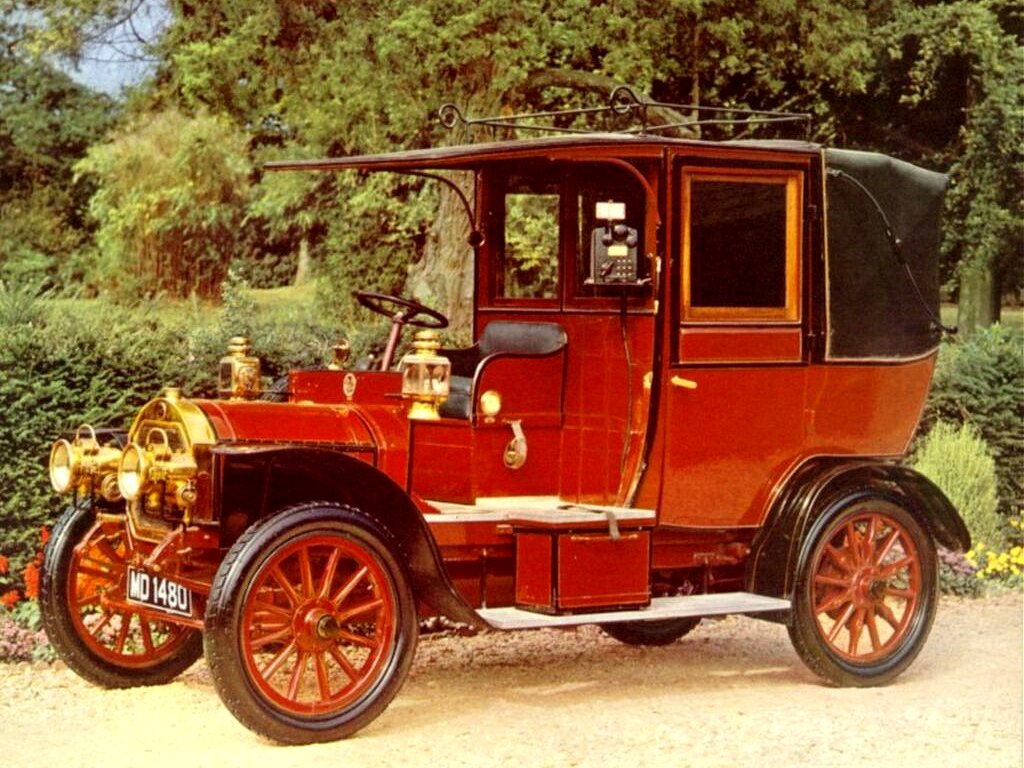
Unic
| Company type | Société anonyme |
|---|---|
| Industry | Automotive |
| Founded | 1905 |
| Founder | Georges Richard |
| Defunct | 1976 (as independent brand) |
| Fate | Acquired by Henri Pigozzi (Simca) in 1952; later part of Fiat and Iveco |
| Headquarters | Puteaux (original headquarters) , France |
Area served | France, Europe |
Key people | Georges Richard (founder), Georges Dubois (leader after 1922), Henri Pigozzi (acquirer) |
| Products | Automobiles, taxis, commercial vehicles, trucks |
| Parent | Simca (from 1952), Fiat (from 1966), Iveco (from 1975) |
Unic was a French automobile manufacturer established in 1905, producing cars until July 1938.[1] Subsequently, the firm redirected its efforts toward commercial vehicles and retained its autonomy until 1952, when Henri Pigozzi acquired it and incorporated Unic as the commercial vehicle branch within the expanding Simca group.
Origins
Following his departure from Richard-Brasier, Georges Richard founded Unic. In 1905, with financial support from entrepreneur Baron Henri de Rothschild, Richard created the "société anonyme des automobiles Unic" headquartered in Puteaux.[2] The company’s mission was to manufacture "unique" automobiles, initially concentrating on lightweight cars and taxis equipped with two- and four-cylinder engines.
For more than thirty years, taxi production remained a core aspect of Unic’s operations. The steady investment from Rothschild proved essential in providing financial security, particularly during the difficult post-war years.
Growth and diversification
Unic began by producing light passenger cars but capitalized on its strong presence in the taxi market to branch out into delivery vehicles and small utility trucks.[3] A notable model was the 1943 cc four-cylinder engine producing 12 CV (9 kW), primarily designed for taxi use. This model enjoyed remarkable success, remaining in production for nearly twenty years and eventually being upgraded to a 2120 cc engine. During World War I, Unic taxis notably contributed to the Marne campaign. Following the war, the company introduced an additional 1847 cc four-cylinder model while continuing its taxi production.
First truck and founder's death
In 1922, Unic introduced its inaugural three-ton truck, the Unic MSC, signaling a strategic pivot towards heavier commercial vehicles. That same year, founder Georges Richard passed away due to injuries sustained in a motor accident near Rouen.[3] Leadership then passed to Georges Dubois, who had been responsible for vehicle testing.
Passenger cars in the 1920s
Throughout the 1920s, Unic offered a 1997 cc sports car model, some of which were equipped with sleeve valve engines.
At the 19th Paris Motor Show held in October 1924, Unic presented three passenger vehicles, all powered by four-cylinder engines. However, larger four-cylinder models such as the 16HP were becoming outdated:
- Unic "Type L1T" 10 CV/HP: four-cylinder 1843 cc; wheelbase
- Unic "Type L3T" 11 CV/HP: four-cylinder 2000 cc; wheelbase
- Unic 16 CV/HP: four-cylinder 3450 cc; wheelbase
By the time of the 22nd Paris Motor Show four years later, only one of two displayed models still featured a four-cylinder engine. This was an updated version of the two-litre car, now named the Unic "Type L9," with a wheelbase of , commonly available as a "Torpedo" or "Berline" (sedan) body style. For the 1929 model year, attention shifted to Unic’s first eight-cylinder automobile: the 14 CV/HP "Type H1," which housed a -litre inline-eight engine on a wheelbase measuring , with a chassis-only price of 55,000 francs.
Passenger vehicles in the 1930s
The 8-cylinder "Type H1" introduced in 1928 underwent continuous enhancements throughout the early 1930s, culminating in the Unic "Type H3" by 1933, which featured a larger 2646 cc engine. Nevertheless, October 1933 marked the final occasion an 8-cylinder passenger car was showcased by Unic at the Paris Motor Show.
Following this, Unic shifted its focus primarily to 4-cylinder models within the 11 CV/HP tax bracket, aligning with the strategy established in the mid-1920s. In 1934, the company launched the "Type U4," powered by a 2-litre side-valve engine and paired with a newly designed 4-speed gearbox. The five-seat "berline" sedan received subtle styling updates between late 1933 and mid-1934, including an elongated rear section and a more aerodynamic front grille. Alongside these passenger vehicles, Unic continued to manufacture sturdy taxis of comparable dimensions during this timeframe.
Final phase of automobile production
In March 1937, Unic introduced its last revision of the four-cylinder passenger car, while at the October 1937 Motor Show, the six-cylinder version was presented with a sleeker body design. By this point, Unic's passenger lineup consisted solely of these two models. The Unic Type U4D featured a four-cylinder 2,150 cc (12CV) overhead valve engine producing 55 hp, built on a conventional chassis with a wheelbase measuring 3160 mm. The six-cylinder Type U6C was equipped with an 85 hp 3,000 cc (17CV) engine combined with an electromagnetic "Cotal" preselector transmission and offered wheelbase options ranging from 3200 mm to 3370 mm.
Unic's passenger cars gained recognition not for cutting-edge technology but for dependable performance and spacious, refined coachwork predominantly crafted by Letourneur et Marchand or their subsidiary Autobineau. However, sales volumes remained modest, reflected in their pricing: at the 1937 Motor Show, the steel-bodied U4D (12CV) was priced at 53,750 francs (with the chassis alone costing 35,500 francs). By comparison, the slightly more powerful Talbot Type T4 "Minor" (13CV) was listed at 42,500 francs (35,000 francs for chassis), while Citroën’s long-wheelbase Traction 11CV Longue was offered at 28,900 francs including bodywork. The market’s preference for more competitively priced alternatives ultimately led to Unic ceasing passenger car production in July 1938.
Afterward, Unic concentrated exclusively on truck manufacturing, eventually becoming one of France’s foremost producers. The company was acquired by Italian automaker Fiat in 1966 and later integrated into Iveco during the consolidation process of 1975.
Post–World War II developments
In 1952, Unic was purchased by Simca, under the leadership of Henri Pigozzi, with the objective of expanding its commercial vehicle output. Vehicles from this period are often referred to as Unic-Simca. In 1956, Unic absorbed the French operations of Swiss truck manufacturer Saurer.
Unic became part of Fiat in 1966. The creation of the holding company Iveco in 1975 brought together various truck and bus brands including Fiat, OM, Lancia, UNIC, and Magirus.
In 1976, Unic-Fiat S.A. was renamed UNIC S.A., and by 1992 Iveco Unic S.A. transitioned to Iveco France S.A.
In 2003, corporate headquarters were moved from Villejuif to Boissy St Léger, where a second facility had been established in 1995.