
Autoblindo Fiat-Ansaldo
| Industry | Military vehicles |
|---|---|
| Founded | 1939 |
| Headquarters | Turin , Italy |
| Products | Armoured cars (Autoblindo 40, 41, 43) |
Overview
The Autoblindo series, comprising the 40, 41, and 43 models (commonly referred to as AB 40, AB 41, and AB 43), were Italian military armoured cars manufactured by the collaboration of Fiat and Ansaldo. These vehicles were predominantly deployed throughout World War II. The majority of these armoured cars featured a turret-mounted 20 mm Breda 35 autocannon, accompanied by a coaxial 8 mm machine gun. Additionally, they were equipped with a rear-facing 8 mm machine gun installed in the hull. The turret design bore resemblance to that used on the Fiat L6/40.
Development
In 1937, the Italian Ministry of War set forth requirements for a new armoured car (autoblindomitragliatrice) intended to meet the needs of colonial police conducting extended patrols and army reconnaissance units within the newly formed armoured divisions.[1] By May 1939, the consortium of Fiat-SPA and Ansaldo-Fossati presented their armoured car design, called Abm 1,[2] coinciding with the opening of Fiat’s new Mirafiori factory near Turin. Two prototypes had been completed: one tailored for military applications and another configured for police use.[1]
Following evaluations by the Army, the vehicle was officially standardized in May 1940, receiving the designation Autoblindo 40, with an initial order placed for 176 units.[1] Prior to adoption, the prototype underwent multiple modifications at the Army's request, including a reworked front hull, recessed headlights protected by armoured covers, enhanced ventilation systems, newly designed cast spoked wheels, and shortened flat mudguards.[2] Deliveries of the first AB 40 models began in March 1941.[3]
Autoblindo 40
Produced in limited quantities during 1940, the Autoblindo 40 was equipped with twin 8 mm machine guns mounted in a turret. Throughout its production run, there emerged a demand for more powerful weaponry, prompting a redesign that resulted in the AB 41. This successor retained the core vehicle design but featured a new turret armed with a 20 mm Breda 20/65 mod.35 autocannon. The majority of the 24 AB 40 units manufactured were subsequently converted into AB 41 models.
Autoblindo 41
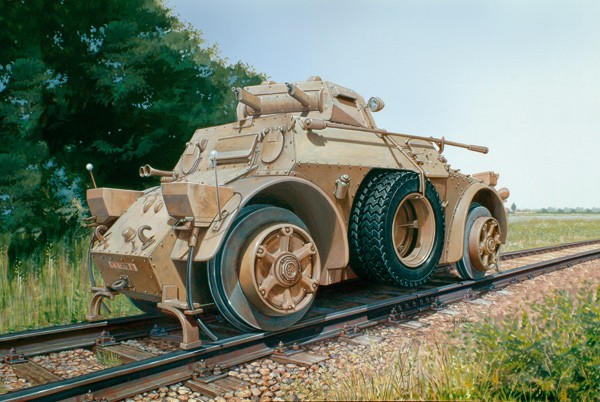
The Autoblindo 41, named after its inaugural production year of 1941, represented an evolution from the machine gun-armed AB 40. Constructed entirely with riveted armor plates, it incorporated a four-wheel drive system alongside four wheel steering, although the latter proved problematic.[4] The spare wheels mounted on its sides were free-spinning, aiding mobility over challenging terrain and enabling traversal over taller obstacles. Additionally, some units were adapted for railway operation by fitting specialized wheels; these modifications included installing sand boxes and rail guards to clear debris from tracks.[5] This variant was designated AB 41 Ferroviaria.
The vehicle featured six forward gears and four reverse gears, with driving stations positioned at both front and rear ends, allowing two crew members to operate it simultaneously. Overall, the AB 40/41 series was well-designed, achieving speeds exceeding 70 km/h (45 mph), offering robust armour protection (with frontal plates up to 15 mm thick), and delivering strong performance on roads and off-road conditions. Nonetheless, certain design shortcomings existed such as limited engine access, an unshielded fuel tank, a single-operator turret, exposed turret traverse mechanisms, and absence of an internal bulkhead separating engine and crew compartments. Despite these issues, the AB 41 earned recognition as an effective armoured car and stood among the top vehicles of its class during that period.[6] Its chassis also served as the foundation for developing the SPA-Viberti AS.42. In total, roughly 550 units were produced.
Autoblindo 43

Italy intended to enhance the AB 41 by equipping it with a 47 mm anti-tank cannon, resulting in the AB 43 model. However, these developments were halted due to the Armistice of Cassibile in September 1943.
Combat history
Throughout World War II, the AB 41 saw service across multiple theaters including North Africa, Yugoslavia, Italy, Hungary, and the Eastern Front. Deployment of the AB 41 was primarily limited to Italian cavalry units, the Italian Africa Police (PAI), and Bersaglieri troops. These vehicles were also integrated into reconnaissance battalions or cavalry groups, each comprising three to four companies. An armoured car company typically included three platoons, each with four armoured cars, plus one vehicle for the company commander and another for the company headquarters, amounting to a total of 42 or 56 AB 41s per battalion. These independent companies demonstrated exceptional effectiveness in roles such as reconnaissance, escort missions, and security operations.[6]

The AB 41 was highly versatile and could be modified swiftly to suit various environments. For desert conditions, sand tires were installed, while for railway use, specialized bogies and additional lighting were fitted. Vehicles adapted for rail travel were mainly employed in anti-partisan patrols throughout the Balkans. Following the Armistice, German forces seized approximately 57 AB 41 units and proceeded to manufacture an additional 120 vehicles.[4] The Germans referred to this model as Panzerspähwagen AB41 201(i).[7]
Users
The following nations and organizations operated the Autoblinda:[8][9]
- File:Flag of Australia (converted).svg Australia
- Template:Flagcountry
- Template:Country data Free France
- File:Flag of France.svg France
- Template:Flagcountry
- File:Flag of Greece (1822-1978).svg Greece
- Template:Country data Kingdom of Italy
- Template:Flagcountry
- Template:Flagicon image Italian partisans
- Template:Flagcountry
- Poland Poland
- Romania Romania (refer to Romanian armored cars during World War II)
- File:Flag of the United Kingdom.svg United Kingdom (limited evaluation use)
- Template:Flagdeco Yugoslavian partisans
- Template:Country data Socialist Federal Republic of Yugoslavia


See also
- AB md. 41, a comparable armored vehicle from Romania
- Fiat-Ansaldo AB 43, exhibited at the Museo Storico della Motorizzazione Militare in Rome, Italy
- Demonstration drive of the AUTOBLINDO ANSALDO AB 43
References
- Notes
- ↑ 1.0 1.1 1.2 Pignato and d'Inzéo, p. 1.
- ↑ 2.0 2.1 Pignato 2004, p. 56.
- ↑ Pignato 2004, p. 55.
- ↑ 4.0 4.1 Cite error: Invalid
<ref>tag; no text was provided for refs namedReferenceA - ↑ An artist's view of an AB 41 Ferroviaria
- ↑ 6.0 6.1 Pignato 2004.
- ↑ Chamberlain, Peter and Hilary Doyle. Encyclopedia of German Tanks of World War Two. Wigston Leicestershire, UK: Silverdale Books, 2004. ISBN 1-84509-012-8. p. 232.
- ↑ Pignato and d'Inzéo, p. 4–5.
- ↑ Lua error in Module:Citation/CS1/Configuration at line 2123: attempt to index field '?' (a nil value).
- Bibliography
- Lua error in Module:Citation/CS1/Configuration at line 2123: attempt to index field '?' (a nil value).
- Lua error in Module:Citation/CS1/Configuration at line 2123: attempt to index field '?' (a nil value).
- Lua error in Module:Citation/CS1/Configuration at line 2123: attempt to index field '?' (a nil value).
External links

- Detailed information on Autoblindo AB 40, AB 41, and AB 43 armored cars at wwiivehicles.com
- Pages with reference errors
- Pages with script errors
- Articles with short description
- Pages with broken file links
- Armoured cars of Italy
- World War II armoured cars
- Military vehicles introduced from 1940 to 1944
- Gio. Ansaldo & C. armored vehicles
- Fiat armored vehicles
- World War II armoured fighting vehicles of Italy