
Bristol M.1
| Company type | Private company |
|---|---|
| Industry | Aerospace |
| Founded | 1910 in Bristol, England |
| Founder | Sir George White |
| Headquarters | Bristol , United Kingdom |
| Products | Aircraft including the Bristol M.1 Monoplane Scout |
Bristol M.1 Monoplane Scout
The Bristol M.1 Monoplane Scout was a British monoplane fighter aircraft developed during the First World War. It remains notable as the sole British monoplane fighter to enter production throughout the conflict.
In mid-1916, Bristol initiated development of a new fighter as a private project, led by aeronautical engineer Frank Barnwell. This design was more unconventional compared to other fighters of the period, such as the Airco DH.5, which featured a biplane layout with backward staggered wings. The M.1 incorporated a streamlined fuselage with a circular cross-section, constructed using traditional wood and fabric methods to simplify manufacturing. The prototype, known as the M.1A, completed its inaugural flight on 14 July 1916, piloted by F.P. Raynham. Testing revealed that the aircraft achieved impressive speeds for its time, outperforming contemporary German Fokker Eindecker and French Morane-Saulnier N monoplanes by approximately 30–50 mph (48–80 km/h).
Despite these advantages, production was limited to just 130 units. This was primarily due to prevailing skepticism within the British War Office and many Royal Flying Corps (RFC) pilots toward monoplanes, which they regarded as less safe and inferior compared to the widely used biplane designs of the era. Furthermore, concerns over the M.1's relatively high landing speed made it unsuitable for operation from the small airfields on the Western Front, leading to its deployment mainly in the Middle East and Balkans regions instead. Among its pilots was Captain Frederick Dudley Travers, DFC of No. 150 Squadron RAF, who achieved several aerial victories flying this model. Notably, in December 1918, Lieutenant Dagoberto Godoy of Chile's Servicio de Aviación Militar completed a historic flight from Santiago to Mendoza, Argentina, marking the first recorded crossing of the Andes mountains by aircraft using this type.
Origins
Throughout the First World War, rapid progress in aircraft technology was pursued by all belligerent nations, each striving to gain superiority over their adversaries. In the summer of 1916, British aeronautical engineer Frank Barnwell, serving as chief designer at the Bristol Aeroplane Company, recognized that the performance of existing fighter planes was insufficient. Consequently, he initiated the design of a new fighter as a private enterprise. For experimental purposes, several Bristol Scout D models were equipped with 110 horsepower (82 kW) Clerget rotary engines and large-diameter propellers. These modifications proved successful, prompting Barnwell to integrate these elements into his developing design.
Aviation historian J.M. Bruce noted that Barnwell’s design shared similarities with a concurrent project by competing British manufacturer Airco, which eventually produced the DH.5. However, the Bristol aircraft was regarded as more innovative and superior in comparison. Barnwell focused considerable effort on creating an aerodynamically efficient aircraft, only compromising where necessary to simplify construction and maintenance. This led him to choose a monoplane layout for the fighter. Bruce described this choice as a "bold conception," particularly since the British War Office had effectively prohibited monoplanes from military use following several accidents.
In July 1916, the initial model of this aircraft, designated Bristol M.1, was unveiled at Bristol’s manufacturing facility. It was essentially a single-seat tractor monoplane fighter. The prototype, known as the M.1A, made its first flight on 14 July 1916 with pilot F.P. Raynham at the controls. Reports from this inaugural flight highlighted the aircraft’s capability for high-speed operation, reaching speeds up to 132 mph.
Test programme
Soon after its first flight, the War Office acquired the prototype for evaluation purposes. By late July 1916, the M.1A had been sent to the Central Flying School (CFS) located in Upavon, Wiltshire, where it underwent official testing. During these trials, the M.1A demonstrated impressive performance metrics, achieving a maximum speed of 128 miles per hour (206 km/h) and climbing to an altitude of 10,000 feet (3,000 m) within 8 minutes and 30 seconds. The aircraft’s stability was positively noted, particularly regarding lateral control, although landing was described as moderately challenging.
Nevertheless, some criticisms emerged from test pilots concerning limited forward and downward visibility, fatigue associated with flying the aircraft for extended periods, and a nose-heavy condition when operated without engine power. The CFS also observed that no attempt had been made to determine the maximum speed at ground level; this was attributed to the propeller being optimized for peak efficiency at altitude. In addition to flight tests, static load assessments were conducted on the prototype in August 1916, during which no structural weaknesses were detected.
Impressed by the prototype’s capabilities, in October 1916 the War Office awarded contract No. 87/A/761 to Bristol for four modified aircraft designated M.1B intended for further evaluation. The original M.1A was also upgraded to this enhanced standard. The M.1B featured several changes including a more conventional cabane structure composed of four straight steel struts arranged in a pyramid shape, a large clear-view cut-out in the starboard wing root to improve landing visibility, and armament consisting of a single .303 inch (7.7 mm) Vickers machine gun mounted on the port wing root. The first M.1B was delivered to the Central Flying School on 15 December 1916.
Rejection and restricted production
During the M.1's development period, the War Office showed minimal urgency or interest in advancing the programme. Bruce observed that the authorities seemed reluctant to promptly reach a conclusion regarding its future. Despite this, the aircraft exhibited outstanding performance in trials, achieving a top speed approximately 30 to 50 mph (48 to 80 km/h) faster than contemporary German Fokker Eindecker and French Morane-Saulnier N monoplanes. Structural evaluations on the ground also confirmed its robust design. Bruce further noted that production models could have been ready before several renowned British fighters of the war, including the Royal Aircraft Factory S.E.5 and Sopwith Camel. Nevertheless, the War Office opted to prolong its decision-making process, favoring extensive testing and operational assessments.
In the end, the Air Ministry declined to deploy the M.1 on the Western Front, primarily citing concerns over its landing speed of 49 mph being too high for limited French airstrips. However, comparative tests involving the M.1A, Airco DH.2, and Royal Aircraft Factory B.E.12 revealed similar landing distances, with the biplanes' landing speeds only about 5 mph slower. Bruce suggested that bias against monoplanes and dissatisfaction with the restricted downward visibility from the cockpit significantly influenced this outcome. Despite such reservations, Bruce reported that word of the M.1's speed and agility quickly reached frontline pilots, generating enthusiastic rumors about the type.
Some historians have proposed that widespread perceptions of monoplanes as unsafe in combat contributed to the M.1's rejection. The Royal Flying Corps (RFC) had implemented a blanket ban on monoplanes following a Bristol-Coanda Monoplane crash in September 1912. Although a 1913 Monoplane Committee later vindicated the design category, deep-seated mistrust persisted among pilots. This skepticism was likely reinforced by unsatisfactory experiences with various Morane-Saulnier monoplanes, particularly the Morane-Saulnier N, which was also criticized for relatively high landing speeds compared to biplanes. At that time, biplanes were generally regarded as structurally stronger since their designs could utilize established principles from bridge engineering and were easier to reinforce than monoplanes.
Nonetheless, on 3 August 1917, the War Office authorized an order for 125 units of the M.1C variant. These models were equipped with a single 110 hp Le Rhône 9J rotary engine and featured one centrally mounted Vickers machine gun positioned directly ahead of the pilot. Among these aircraft, one M.1 registered as G-EAVP was converted into a high-speed experimental platform powered by a Bristol Lucifer three-cylinder radial engine; this modified version was designated as the M.1D.
Design
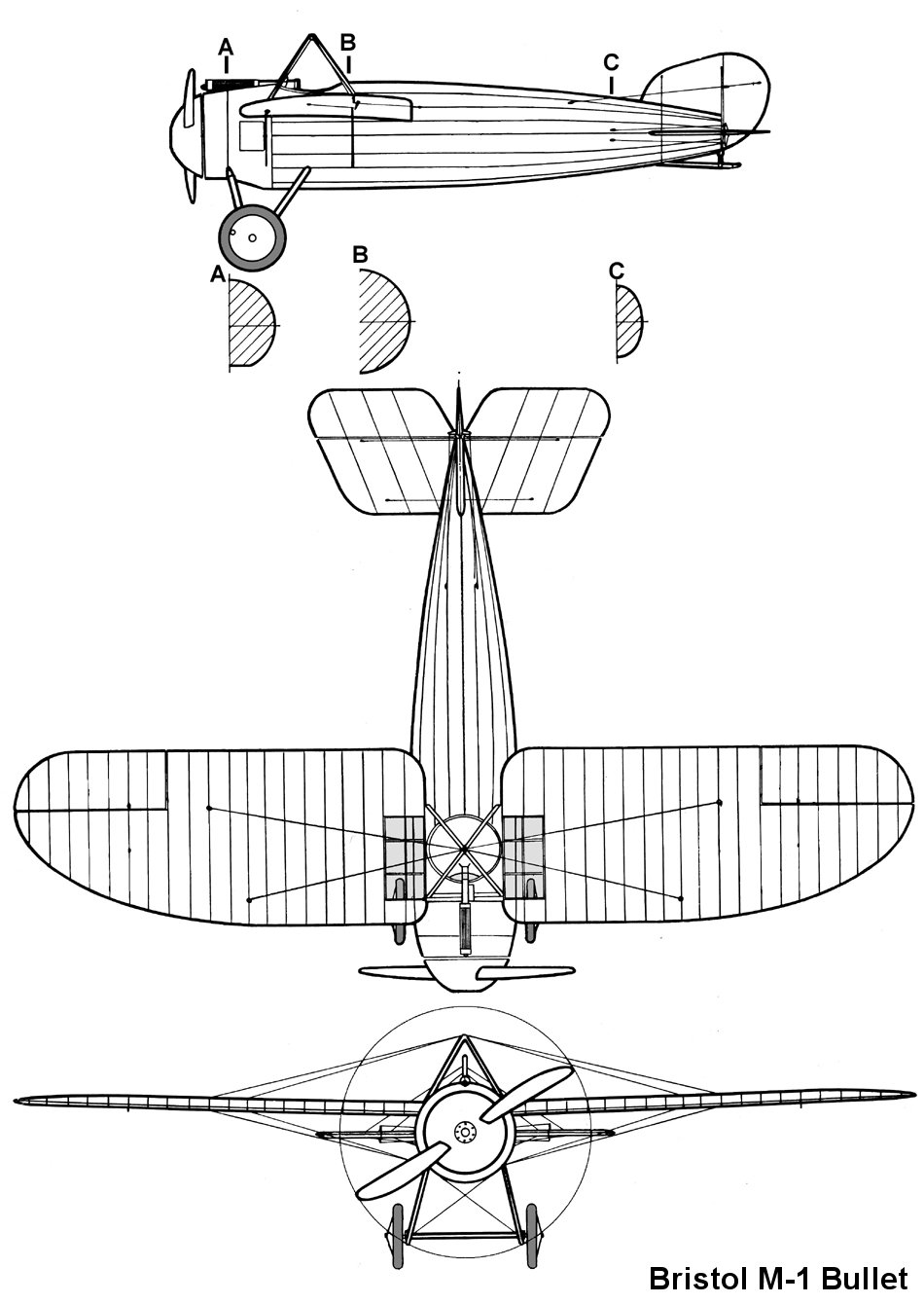
The Bristol M.1 was a single-seat monoplane featuring a tractor configuration. It was equipped with a single Clerget rotary engine that produced up to 110 horsepower (82 kW), which turned a comparatively large twin-bladed propeller. This propeller was fitted with a substantial hemispherical spinner designed to minimize aerodynamic drag. The aircraft's fuselage had a streamlined circular cross-section and utilized traditional wood and fabric construction methods to simplify manufacturing. The entire exterior, covered in fabric and fully faired, contributed to the aircraft being described as one of the most straightforward and aerodynamically clean designs of its era.
The M.1 featured a shoulder-mounted wing attached to the upper longerons of the airframe. Bracing was provided by flying wires extending between the wing and lower fuselage, along with landing wires connected from the wings to a cabane structure composed of two semi-circular steel tube hoops positioned above the pilot’s cockpit. This cabane was shaped to facilitate easier entry and exit for the pilot. The wing tips exhibited a broad semi-elliptical sweep rearwards, resulting in a front spar significantly shorter than the rear spar, with no inter-spar bracing at the forward spar’s end. To enhance downward visibility for the pilot, a large inter-spar cutout was incorporated into the starboard wing root.
Operational history

Approximately 33 M.1Cs were believed to have been dispatched to operational theaters in the Middle East and Balkans during 1917–18, while most of the remaining units served primarily within various British training establishments. The aircraft reportedly gained favor as personal mounts among senior officers of the Royal Flying Corps. A single M.1C was also sent to France in 1917, likely for evaluation purposes only. According to Bruce, official hesitance limited the M.1C’s deployment opportunities, restricting its participation in combat operations.
Official records from No. 111 Squadron RAF indicate that when deployed in Palestine, the M.1 frequently disrupted enemy reconnaissance flights, compelling adversaries to operate at higher altitudes. However, its limited endurance prevented it from effectively escorting long-range reconnaissance missions. The type was extensively employed in ground attack roles against Turkish forces in the region. In hotter climates, the central spinner was often removed to improve engine cooling by allowing better heat dissipation.
Among pilots on the Macedonian front, Captain Frederick Dudley Travers DFC of No. 150 Squadron RAF stood out as the only ace flying the M.1C. Having scored three of his four kills in an SE.5a, Travers achieved five additional victories between 2 and 16 September 1918, likely all while piloting M.1C serial number C4976. One of his confirmed kills was a Fokker D.VII, considered Germany’s premier fighter at that time.
In late 1918, twelve M.1Cs were delivered to Chile as partial payment for two battleships originally built in Britain—Almirante Latorre and Almirante Cochrane—which had been requisitioned by the Royal Navy before completion. One of these fighters, piloted by Lieutenant Dagoberto Godoy, completed a pioneering flight across the Andes mountain range from Santiago to Mendoza and back on 12 December 1918.
After hostilities ceased with the Armistice on 11 November 1918, numerous military surplus M.1s were sold into civilian hands and frequently used for sporting and racing purposes. The sole Lucifer-powered M.1D, painted red and registered G-EAVP, won the handicap prize at the 1922 Aerial Derby under pilot L.L. Carter. In 1923, it received an upgraded Lucifer engine rated at 140 horsepower (104 kW) and entered the Grosvenor Cup race; however, it crashed near Chertsey during approach to Croydon Airport, resulting in pilot Ernest Leslie Foot’s fatality.
Variants
- M.1A
- One prototype equipped with a 110 hp (82 kW) Clerget 9Z rotary engine.
- M.1B
- Four evaluation units powered by a range of engines, including the 110 hp (82 kW) Clerget 9Z, 130 hp (97 kW) Clerget 9B, or the 150 hp (110 kW) Admiralty Rotary A.R.1.
- M.1C
- The main production version, with 125 aircraft built, utilizing 110 hp (82 kW) Le Rhône 9Ja engines.
- M.1D
- A single M.1C airframe converted into a test platform for the 140 hp (100 kW) Bristol Lucifer engine.
Operators
Surviving aircraft

- A single original Bristol M.1 remains preserved at the Harry Butler Memorial in Minlaton, South Australia. This aircraft, formerly RAF C5001, was brought to Australia in 1921 by Captain Harry Butler and operated under the Australian civil registration VH-UQI. It is notable for completing the first over-water flight in the Southern Hemisphere.
- The Royal Air Force Museum Cosford exhibits an airworthy replica identified as C4994.[1]
- The Shuttleworth Collection at Old Warden, UK, maintains and flies a replica M1C registered as C4918 (G-BWJM). Constructed by Northern Aeroplane Workshops and delivered in October 1997, it is powered by an original 110 horsepower (82 kW) Le Rhône rotary engine and regularly participates in summer air displays.[2]
- At the Museo Nacional Aeronáutico y del Espacio in Los Cerrillos, Santiago de Chile, two replicas are part of the collection. One, constructed in the UK by AJD Engineering in 1989 and flown briefly during FIDAE'90, is preserved indoors with part of its fabric covering removed to reveal its frame. The other replica was locally manufactured and carries the RAF serial number C4988—the same monoplane piloted by Dagoberto Godoy during his historic Andes crossing in 1918—and is used for various aviation exhibitions.[3]
Specifications (M.1C)
See also
Citations
- ↑ "Bristol M1C." RAF Museum, Retrieved: 29 March 2017.
- ↑ "Bristol M1C." Archived 15 May 2021 at the Wayback Machine The Shuttleworth Collection, Retrieved: 29 March 2017.
- ↑ "EL BRISTOL M1C Y SUS 101 AÑOS EN CHILE" Archived 28 February 2021 at the Wayback Machine Museo Nacional Aeronáutico y del Espacio de Chile, Retrieved: 2 December 2020.
Bibliography
- Andrews, C.F. The Nieuport 17 (Aircraft in Profile no. 49). Leatherhead, Surrey, UK: Profile Publications Ltd., 1966.
- Barnes, C.H. Bristol Aircraft Since 1910. First edition. London: Putnam, 1964.
- Bruce, J.M. The Aeroplanes of the Royal Flying Corps (Military Wing). London: Putnam, 1982.
- Bruce, J.M. The Bristol M.1 (Aircraft in Profile no. 193). Leatherhead, Surrey, UK: Profile Publications Ltd., 1967.
- Bruce, J.M. War Planes of the First World War: Volume One Fighters. London: Macdonald, 1965.
- Jackson, Robert. The Encyclopedia of Military Aircraft. Paragon, 2002.
- Skaarup, Harold A. Canadian Warbird & War Prize Survivors: A Handbook on Where to Find Them. United States: Writers Press Club, 2000.
Further reading
- Dodson, Aidan. HMS Eagle & the Chilean Connection. The Aviation Historian, 2023, issue 42, pages 36–44.
External links
- Preserved original Bristol M.1 aircraft at Minlaton, South Australia
- RAF Museum collection
- World War I aviation resources
- Duxford legends archive
- Detailed scale drawings of the Bristol M.1 Bullet
Template:Bristol aircraft Lua error in Module:Authority_control at line 159: attempt to index field 'wikibase' (a nil value).