The Buran programme (Russian: Буран, Russian pronunciation:[bʊˈran], meaning "Snowstorm" or "Blizzard"), also referred to as the VKK Space Orbiter programme (Russian: ВКК «Воздушно-Космический Корабль», lit. 'Air and Space Ship'), was a Soviet, and subsequently Russian, initiative focused on developing a reusable spacecraft. Initiated in 1974 at Moscow's Central Aerohydrodynamic Institute, this project officially ceased operations in 1993. Besides denoting the entire Soviet/Russian reusable spacecraft effort, the term Buran specifically identified orbiter 1K, which executed a single uncrewed mission in 1988 and remains the only Soviet reusable spacecraft to have reached orbit. The orbiters of the Buran class were launched using the expendable Energia launch vehicle.
Conceived as a countermeasure to the United States' Space Shuttle program, the Buran programme drew heavily on publicly available information about the American shuttle, resulting in numerous external and functional resemblances between the two designs. Despite its visual similarity to NASA's Space Shuttle orbiter, and its capability to operate as a re-entry spaceplane, Buran's internal systems and operational principles diverged significantly. For instance, Buran's main propulsion during ascent was provided by engines mounted on the Energia rocket rather than by engines carried aboard the orbiter itself. The spacecraft featured smaller thrusters for orbital maneuvers and de-orbit burns, analogous to the Space Shuttle's OMS pods. Unlike NASA’s Space Shuttle, whose inaugural crewed flight occurred in April 1981, Buran completed its sole orbital mission in November 1988 without crew onboard, demonstrating autonomous flight capabilities including fully automated landing procedures.
The Buran project represented the most extensive and costly endeavor in the history of Soviet space exploration.
Background
The origins of the Soviet reusable spacecraft initiative trace back to the late 1950s, coinciding with the dawn of the space era. Although the concept of a reusable Soviet space vehicle dates from this early period, its development was sporadic and lacked consistent organization. Prior to the Buran project, none of the programme’s efforts advanced to an operational phase.
The initial attempt at creating a reusable Soviet spacecraft was the 1954 Burya, a high-altitude prototype that combined elements of a jet aircraft and cruise missile. This vehicle underwent several test flights before being terminated by a directive from the Central Committee. The primary mission envisioned for the Burya was to deliver a nuclear warhead—likely targeting the United States—and subsequently return to its base. Ultimately, the USSR discontinued the Burya programme in favor of prioritizing the development of ICBMs. Following Burya, the next reusable spacecraft concept was embodied in the Zvezda design, which also reached prototype status. Decades later, another project bearing the same name—Zvezda—would serve as a service module for the International Space Station. After Zvezda, there was a pause in reusable spacecraft projects until the emergence of Buran.
The Buran orbital vehicle programme was initiated as a response to the American Space Shuttle program, which generated significant apprehension within Soviet military circles, particularly from Defense Minister Dmitry Ustinov. Boris Chertok, a respected historian of Soviet and Russian space endeavors, provides an account of how this programme originated. According to Chertok, once the U.S. introduced its Space Shuttle system, Soviet military officials grew wary that it might have military applications due to its large payload capacity—several times greater than earlier U.S. launch vehicles. Officially, Buran was intended to transport spacecraft, cosmonauts, and cargo into orbit and safely return them to Earth. Both Chertok and Gleb Lozino-Lozinskiy, General Designer and General Director of NPO Molniya, imply that from its inception, Buran had military objectives; however, the specific military functions or intended uses remain classified.
Similar to its American equivalent, when relocating from landing sites back to its launch facility, the Buran orbiter was carried atop a massive jet aircraft—the Antonov An-225 Mriya transport plane—which was partially designed for this purpose and held the record as the largest aircraft globally with multiple flights. Prior to the availability of the Mriya (which became operational after Buran’s flight), this transportation role was fulfilled by the Myasishchev VM-TAtlant, a modified version of the Soviet Myasishchev M-4Molot (Hammer) bomber (NATO reporting name: Bison).
Initiated in the early 1970s, the Buran programme emerged as a Soviet reaction to the American Space Shuttle initiative. Soviet authorities perceived a strategic threat from the U.S. Shuttle's capabilities, particularly noting its 30-ton payload capacity to orbit and, more critically, its ability to return 15 tons to Earth. They believed these features signaled an intent to deploy substantial experimental laser weaponry in orbit, capable of neutralizing enemy missiles across thousands of kilometers. The Soviets reasoned that such weapons required in-space testing and frequent retrieval for refinement to minimize development time and expenses. Additionally, concerns were raised about the U.S. Shuttle's potential to perform rapid atmospheric descents to deliver nuclear strikes on Moscow.[1][2]
In 1974, the design bureau led by Valentin Glushko, OKB-1 (later known as NPO Energiya), proposed a new series of heavy-lift launch vehicles named RLA (Russian: РЛА, «Ракетные Летательные Аппараты», romanized: Raketnyye Letatel'niye Apparaty, lit. 'Rocket Flying Apparatus'). This concept introduced kerosene and liquid hydrogen fuels combined with liquid oxygen oxidizer—novel technologies for Soviet rocketry—with the shuttle orbiter envisioned as one potential payload.[3] While NPO Molniya, under Gleb Lozino-Lozinskiy, advanced development efforts, the Military-Industrial Commission (VPK) was responsible for gathering comprehensive intelligence on the American Space Shuttle. Supported by the KGB, VPK acquired extensive documentation on U.S. shuttle airframe designs, software tools for design analysis, materials used, flight computers, and propulsion technologies. The KGB targeted numerous university research archives including institutions like Caltech, MIT, Princeton, and Stanford. The open classification status of the U.S. shuttle programme significantly facilitated this intelligence gathering.[4]
By 1975, NPO Energiya had developed two rival orbiter concepts: the MTKVP (Russian: МТКВП, «Многоразовый Транспортный Корабль Вертикальной Посадки», romanized: Mnogorazoviy Transportniy Korabl' Vertikal'noy Posadki, lit. 'Reusable Vertical Landing Transport Ship'), a 34-meter lifting body spaceplane launched atop kerosene-fueled strap-on boosters;[5] and the OS-120 (Russian: ОС-120, «Орбитальный Самолет», romanized: Orbital'niy Samolet, lit. 'Orbital Spaceplane–120 tons'), which closely mirrored the U.S. Space Shuttle design based on intelligence obtained via VPK and KGB operations.[4] The OS-120 featured a delta-wing configuration with three liquid hydrogen engines attached to an external tank and four liquid-fueled boosters; NPO Energiya even contemplated solid rocket boosters to further emulate the U.S. setup.[6]
A middle ground between these designs was reached in January 1976 with NPO Energiya’s OK-92 (Russian: ОК-92, «Орбитальный Корабль», romanized: Orbital'niy Korabl', lit. 'Orbital Ship–92 tons'), a delta-winged orbiter equipped with two Soloviev D-30 turbofan engines enabling independent atmospheric flight. It was launched atop a rocket stack comprising a core stage with three cryogenic engines plus four kerosene-powered boosters each equipped with four engines.[7] Refinements continued through 1978, culminating in a finalized OK-92 configuration by June 1979.[8]
Initially, Soviet engineers hesitated to adopt a spacecraft design so closely resembling that of the U.S. Space Shuttle. Although wind tunnel experiments indicated NASA’s design was aerodynamically optimal,Cite error: The opening <ref> tag is malformed or has a bad name military requirements dictated shape parameters due to its intended role in transporting large payloads into low Earth orbit—a mission profile paralleling Pentagon expectations for the American Shuttle.[9] Despite proposals from Molniya Scientific Production Association for their earlier Spiral project,[10] which had been discontinued thirteen years prior, it was dismissed for lacking resemblance to the U.S. counterpart.
Construction of Buran orbiters commenced in 1980; by 1984, the first full-scale vehicle was unveiled. Suborbital testing began with scale model flights of BOR-5 starting July 1983, followed by five additional test flights of similar models. A dedicated test craft known as OK-GLI or "Buran aerodynamic analogue" was built featuring four jet engines mounted aft. This enabled conventional runway takeoffs followed by engine shutdown at a predetermined point for unpowered glide landings—providing critical data on handling characteristics distinct from the air-drop method used by NASA’s carrier aircraft and test vehicles. The Gromov Flight Research Institute conducted twenty-four OK-GLI test flights before it was retired due to wear. Consideration was given to transporting Buran using pairs of Mil Mi-26 helicopters in tandem lift configurations; however, mock-up trials revealed this approach as hazardous and impractical.[11] Component transport utilized the Myasishchev VM-T aircraft,[12] while ferrying of completed shuttles employed the Antonov An-225 Mriya, renowned as the heaviest airplane ever constructed.[13][14]
Software development for flight and ground tests posed significant challenges. In 1983 estimates suggested thousands of programmers would be needed if assembly language methods persisted; thus assistance was sought from Keldysh Institute of Applied Mathematics. This collaboration led to creation of new high-level "problem-oriented" programming languages: PROL2 for real-time onboard system programming and DIPOL for ground-based testing environments, supported by an integrated development environment called SAPO PROLOGUE.[15] An operating system named Prolog Manager was also developed.[16] These languages evolved beyond Buran’s conclusion; PROL2 advanced into SIPROL,[17] eventually contributing to development of DRAKON, which remains active within Russia’s aerospace sectorTemplate:Fix/category[citation needed]. A declassified CIA report from May 1990 referencing open-source intelligence noted that Buran’s software utilized "the French-developed programming language known as Prolog",[18] likely due to confusion with SAPO PROLOGUE’s name rather than actual use of Prolog itself.
Following the unsuccessful Soyuz 25 mission in 1977, a regulation was implemented requiring every Soviet spaceflight to include at least one cosmonaut with prior space experience. In 1982, it was established that all commanders and their backups for Buran flights would occupy the third seat on a Soyuz mission before participating in Buran missions. Several candidates were considered for the inaugural Buran crew. By 1985, it was determined that at least one crew member would be a test pilot trained at the Gromov Flight Research Institute (commonly referred to as "LII"), with corresponding crew lists prepared. Among these candidates, only two eventually traveled to space: Igor Volk, who flew aboard Soyuz T-12 to the space station Salyut 7, and Anatoli Levchenko, who visited Mir via launch on Soyuz TM-4 and returned with Soyuz TM-3. Both missions lasted approximately one week.[19]
Levchenko passed away from a brain tumor one year after his orbital mission, Bachurin withdrew from the cosmonaut corps due to health issues, Shchukin served as backup for Soyuz TM-4 before dying in an aviation accident, and Stankevičius also died in a plane crash. Meanwhile, Borodai and Zabolotsky did not fly on any Soyuz missions before the termination of the Buran program.
Igor Volk was slated to command the initial manned Buran flight. The Soyuz T-12 mission had two main objectives: primarily, to provide Volk with spaceflight experience; secondly, to achieve the milestone of performing the first female spacewalk.[19] At that time, details regarding the Buran program remained classified. The inclusion of Volk as a crew member raised questions from observers, including those at the British Interplanetary Society's Spaceflight, who wondered why a test pilot occupied a Soyuz seat typically assigned to researchers or international cosmonauts.[20]
Anatoli S. Levchenko’s orbital flight
Anatoli Levchenko was designated as the alternate commander for the inaugural manned Buran mission, and in March 1987, he commenced rigorous preparation for his Soyuz spaceflight. In December of the same year, he occupied the third seat on Soyuz TM-4 en route to Mir, returning approximately a week later aboard Soyuz TM-3. This mission is occasionally referred to as Mir LII-1, a title derived from the shorthand used by the Gromov Flight Research Institute. Following Levchenko’s death the next year, the backup crew for the first Buran flight was once again left without astronauts possessing spaceflight experience. Although the Gromov Flight Research Institute sought to arrange a Soyuz flight for another potential backup commander, this did not come to fruition.
The Baikonur Cosmodrome, located in the Kazakh SSR, was designated as the site for the maintenance, launches, and landings of Buran-class orbiters. Several locations within Baikonur were either modified or newly constructed to support these activities:
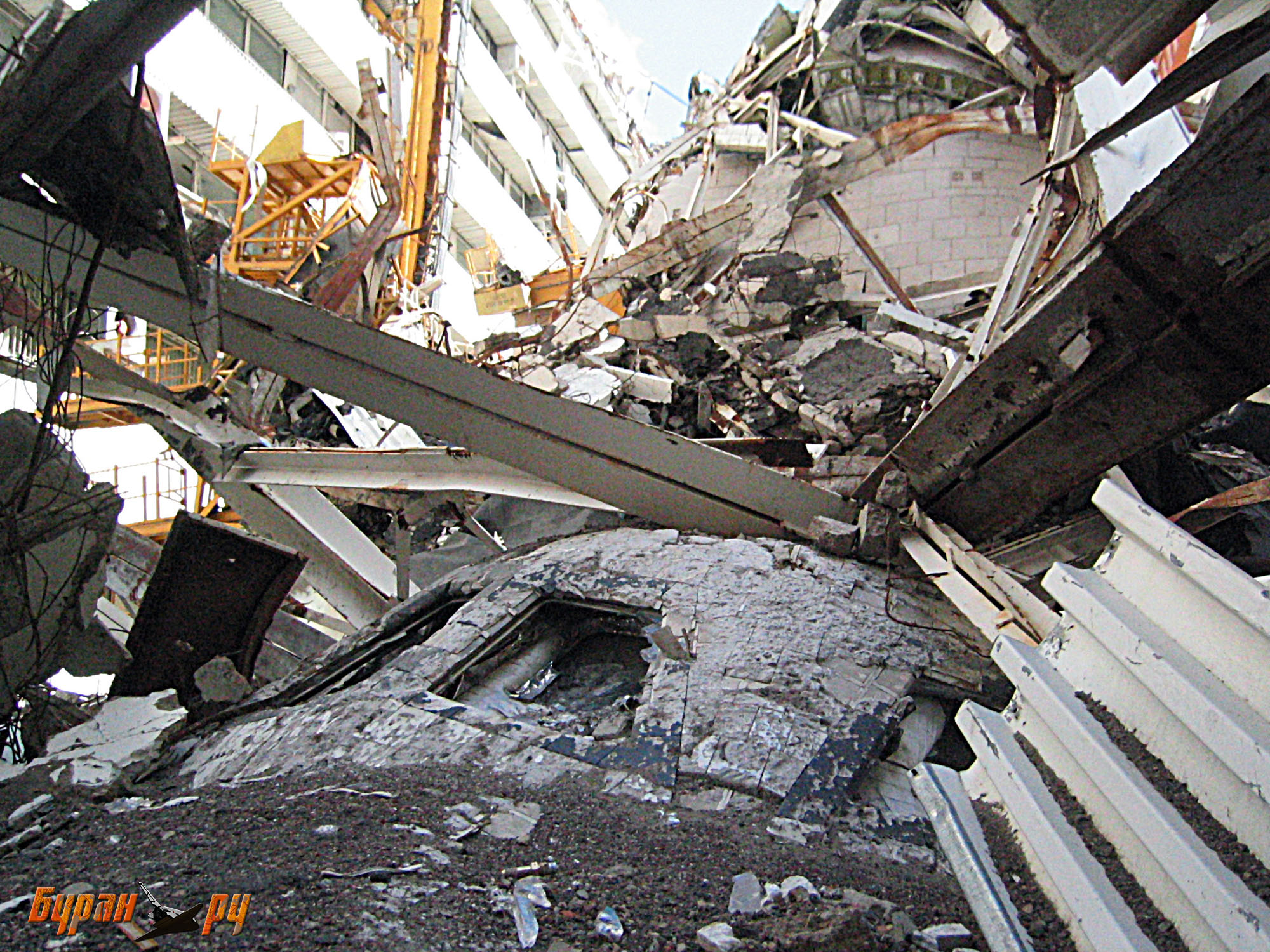
Site 112 – Functioned as the maintenance hub for orbiters and facilitated their integration with Energia launch vehicles, analogous to the role of the VAB at KSC. The primary hangar here, known as MIK RN or MIK 112, was originally constructed for assembling the N1 Moon rocket. After cancellation of the N1 project in 1974, Site 112's infrastructure was converted to serve the Energia-Buran program. This location housed orbiter 1K following the conclusion of the Buran program until it was destroyed when the hangar roof collapsed in 2002.
Site 251 – Designated as the landing site for Buran orbiters and also referred to as Yubileyniy Airfield, fulfilling a role similar to that of the SLF at KSC. It features a single runway labeled 06/24, measuring 4,500 metres (4,900 yd) in length and 84 metres (92 yd) in width, paved with reinforced concrete classified as "Grade 600". Adjacent to this runway stood a specialized mating-demating apparatus, engineered to lift orbiters from their Antonov An-225 Mriya carrier aircraft onto transporters that conveyed them to processing facilities at Site 254. Nearby, a dedicated orbiter landing control center was housed within a multi-story office building. Besides serving its primary function, Yubileyniy Airfield accommodated heavy transport planes carrying components of the Energia-Buran system. After Buran operations ceased, Site 251 fell into disuse but was subsequently reopened as a commercial cargo airport. It now supports both Baikonur operations and passenger or charter flights from Russia under Kazakh administration.
Site 254 – Constructed during the 1980s specifically to service Buran-class orbiters between missions, this facility played a role comparable to that of the OPF at KSC. The complex included a four-bay building with an extensive processing area flanked by multiple floors containing test rooms. Following cancellation of the Buran program, Site 254 was adapted for pre-launch preparations of Soyuz and Progress spacecraft.
Developed in 1984, the aerodynamic test vehicle OK-GLI was designed to evaluate the flight characteristics of the Buran spacecraft. In contrast to the American prototype Template:OV, OK-GLI was equipped with four AL-31turbofan engines, allowing it to operate independently during flight.
After completing several atmospheric test flights with the jet-powered OK-GLI prototype, the first functional orbiter (Buran, orbiter 1K) undertook a single unmanned test mission.[21]
At 03:00 UTC on 15 November 1988, the Buran spacecraft, mounted on the Energia launch vehicle, lifted off from pad 110/37 at Baikonur.[21] Notably, the life support system was omitted for this mission, and no information was shown on the CRT display screens within the Command Compartment.[22]
During its mission, the shuttle completed two revolutions around the Earth, covering approximately 83,707 kilometres (52,013 mi) within a span of three hours and twenty-five minutes (0.14 days).[27] Upon conclusion, it executed an automated touchdown on the designated shuttle runway (Site 251) at Baikonur Cosmodrome.[28]
Before the program was scaled back and ultimately discontinued, the shuttle missions planned for 1989 included:[29]
1991 — The uncrewed maiden flight of Orbiter 2K, lasting approximately 1 to 2 days.
1992 — Orbiter 2K's second uncrewed mission, extending over 7 to 8 days, involving orbital maneuvers and approach procedures toward a space station.
1993 — The second uncrewed mission of Buran (1K), with an anticipated duration between 15 and 20 days.
1994 — The inaugural crewed test flight of Orbiter 3K, projected to last around 24 hours. This orbiter was planned to be outfitted with life-support systems and two ejection seats. The crew was intended to include two cosmonauts, with Igor Volk as commander, supported by a flight engineer.
1994–1995 — Subsequent second through fifth crewed orbital test flights.
In December 1991, the originally planned uncrewed second flight of Orbiter 2K was revised to include:
An uncrewed mission lasting seven to eight days, focusing on orbital maneuvers and approach tests to the space station:
Automated docking with the Mir space station's Kristall module.
Transfer of crew from Mir to the orbiter, followed by testing of onboard systems over a 24-hour period, including operation of the remote manipulator.
Undocking and independent orbital flight.
Docking of the crewed Soyuz TM-101 spacecraft with Orbiter 2K.
Crew transfer from Soyuz to the orbiter and onboard activities for another 24 hours.
Autonomous undocking and landing procedures.
Termination of the Program in 1993
File:Buran family.pngOverview of Buran family vehicles, illustrating test articles and orbiters at various stages of completion.
Following the initial Buran shuttle flight, development was halted due to financial constraints and the evolving political landscape within the Soviet Union. The next two orbiters scheduled for completion in 1990 (Orbiter 2K) and 1992 (Orbiter 3K) remained unfinished, while other prototypes were dismantled (refer to subsequent section).
The initiative aimed to bolster national prestige, conduct scientific research, and achieve technological milestones analogous to those pursued by the U.S. Space Shuttle program. It also intended to support resupply missions for the Mir space station, which launched in 1986 and operated until its decommissioning in 2001. Notably, when Mir eventually received a visit from a spaceplane, it was a Space Shuttle orbiter, not a Buran-class vehicle.
The Buran SO docking module, initially designed for rendezvous with Mir, was later adapted for compatibility with U.S. Space Shuttles during the Shuttle–Mir program.[31]
Launching a Buran vehicle carrying a payload of approximately twenty tons was estimated to cost around 270 million roubles, in contrast to roughly 5.5 million roubles for a Proton rocket launch.[32]
Hangar roof failure at Baikonur
On 12 May 2002, a roof at a hangar within the Baikonur Cosmodrome in Kazakhstan gave way due to structural failure attributed to inadequate upkeep. This incident resulted in the deaths of eight workers and the loss of one of the Buran-class orbiters (specifically the Buran orbiter 1K, which had completed its test flight in 1988), along with a full-scale mock-up of an Energia booster rocket. At that time, external observers were uncertain which orbiter had been destroyed; the BBC reported it as merely "a model" of the orbiter. The collapse took place inside the MIK RN/MIK 112 facility located at Site 112 of Baikonur Cosmodrome, occurring fourteen years after the sole Buran spaceflight. Maintenance work was underway on the roof, and it is believed that the equipment used for this task, combined with heavy rainfall in prior days, contributed to the structural failure.
Inventory of vehicles
The program initially planned for five orbiters, labeled from 1K to 5K (with "K" derived from the Russian word for "craft" or "flying vehicle"), with hull numbers beginning with 1 or 2 (for example, 1.01). Two units were originally commissioned in the 1970s, while an additional three ("second series") were ordered in 1983.
Several test models were produced for experimental and research purposes, designated from 1M to 8M (where "M" stands for "mock-up"), featuring hull numbers starting with zero (e.g., 0.02). The program prefix OK signifies "Orbital Vehicle" in Russian and carries the GRAU index 11F35.
By 1991, two operational orbiters had been delivered to Baikonur, while three others remained under construction at the Tushino Machine-Building Plant (TMZ) near Moscow.
Most of the geographic coordinates listed below indicate locations where orbiter hulls are situated on land; occasionally, viewing these orbiters within specified dates requires utilizing Google Earth's historical imagery function.
Lua error: callParserFunction: function "#coordinates" was not found. Spaceplane not visible; no satellite imagery available
15 November 1988
Constructed in 1986; only orbiter capable of flight. It performed an uncrewed remote-controlled mission involving two orbits and landed amid strong crosswinds and a self-initiated approach maneuver at Yubileiniy Airport near Baikonur.
Lua error: callParserFunction: function "#coordinates" was not found. Spaceplane not visible; shadows present
1988 to 2002
Stored inside MIK building at area 112 alongside an Energia booster mockup and other Energia components; destroyed during a roof collapse on 12 May 2002 that claimed eight lives.
Lua error: callParserFunction: function "#coordinates" was not found. Spaceplane not visible; housed indoors
Since 1995
Frequently misidentified as "Ptichka" or "Burya". Relocated to MZK building in August of 1995. Reportedly owned by Russian-Kazakh company Aelita since approximately 2005.
Displayed from August 2011 onward at Lua error: callParserFunction: function "#coordinates" was not found.; historical imagery recommended
Since August of 2011 to present
Exhibited at MAKS-2011 and subsequent airshows; Zhukovsky International Airport hosts the Gromov Flight Research Institute and has evolved into a prominent open-air aviation museum. Other documented sightings: 15 March 2012: Lua error: callParserFunction: function "#coordinates" was not found., 31 July 2012 & 8 May 2013: Lua error: callParserFunction: function "#coordinates" was not found., 4 June & 29 July 2014: Lua error: callParserFunction: function "#coordinates" was not found., 11 September 2016 through 2020: Lua error: callParserFunction: function "#coordinates" was not found.. As of December 2021, reportedly acquired by Vadim Zadorozhny for restoration and exhibition at UMMC Museum Complex.
|-
|-
|-
|-
|-
|-
|-
|-
|-
|-
|-
|-
|-
|-
|-
|-
|-
|-
|-
|-
|-
|- ! colspan="7" cellspacing="0" cellpadding="2" style="background:#ffdead;" |Test models
|-
|- rowspan="2" | OK-M OK-ML-1 BTS-001 1M 0.01
|- rowspan="2" | Airframe used for vibration and shake testing purposes
|- Outdoor test pad at area 112 in Baikonur Cosmodrome, Kazakhstan
|- [6]
|- Lua error: callParserFunction: function "#coordinates" was not found. Visible from outdoor pad between years 1988 and January 2007; historical imagery useful for viewing.
|- Constructed in year 1982; suffered significant deterioration outdoors.
|- Gagarin Museum located within Baikonur Cosmodrome grounds in Kazakhstan.
|- File:Buran baikonur.jpg Photograph from year 2007.
|- Lua error: callParserFunction: function "#coordinates" was not found. Present there since January 2007.
|- Refurbished in early 2007 and currently exhibited outdoors.
|
|- rowspan="4" | OK-GLI OK-ML-2 BTS-002 2M 0.02
|
|- rowspan="4" | Atmospheric flight test vehicle equipped with two additional jet engines mounted at rear for takeoff assistance.
|
|- Ramenskoye Airport near Moscow.
|
|
|
|
Lua error: callParserFunction: function "#coordinates" was not found. Location confirmed in year 1999; no earlier history available.
|
Built in year 1984 and flown on twenty-five test flights; displayed during MAKS-1999 airshow.
|
|
|
Darling Island within Sydney Harbour, Australia.
|
[7] Image from year 2000 File:Buran Space Shuttle (5449959291).jpg Taken in year 2002.
|
Lua error: callParserFunction: function "#coordinates" was not found. Visible February through September 2000 via historical imagery.
|
Transported there for display during Sydney's Olympic Games in February 2000; housed inside a lightweight structure initially then stored outdoors subsequently until approximately October 2002.
|
|
Manama harbor located in Bahrain.
|
|
Lua error: callParserFunction: function "#coordinates" was not found. Visible July 2004 through year 2007 via history function.
|
Stored outdoors while ownership disputes over the vehicle persisted during this period.
|
|
Technik Museum Speyer located in Germany.
|
File:OK-GLI Technik Museum Speyer 2008 12.JPG Image dated year 2008.
|
Lua error: callParserFunction: function "#coordinates" was not found. Visible since year 2008 indoors; shuttle not visible externally.
|
Acquired from Roscosmos State Corporation following legal resolution; currently displayed indoors.
|
|
|
|}
{-
|- rowspan="3" | OK-KS 3M 0.03
|
|- rowspan="3" | Electrical systems test model.
|
|- Checkout and Test Building (KIS) within RKK Energia Plant located in Korolev, Russia.
|
[8]
|
Lua error: callParserFunction: function "#coordinates" was not found. Present indoors between years 2006 and October 15, 2012; location shows half-scale memorial possibly intended for replacement.
|
Constructed during year 1982; stored inside facility during this period.
|
Grounds surrounding RKK Energia plant.
|
Lua error: callParserFunction: function "#coordinates" was not found. Visible outdoors between October 15, 2012 and June 2017.
|
Moved outside as of mid-October 2012 with plans for permanent exhibition display.
|
Sirius Science Center located in Sochi within Krasnodar Krai region of Russia.
|
File:Буран БТС-003 Сочи 27102018.jpg Image captured during year 2018.
|
Lua error: callParserFunction: function "#coordinates" was not found. On permanent outdoor display since June 2017 until present day.
|
Exhibited permanently outdoors at Sirius Science Center since mid-2017.
|
}
{-
|'OK-MT 4M 0.04
|'Engineering mock-up model.'
|'MZK building at Baikonur Cosmodrome in Kazakhstan.'
|'[9] Photo from year 2014 File:Изделие 0.15.jpg Taken during year 2020.'
|'Lua error: callParserFunction: function "#coordinates" was not found. Vehicle not visible as it is housed indoors.'
|'Constructed in year 1983; relocated to MZK building during August of year 1995.'
|'5M 0.05'
|'Environmental testing components derived from forward fuselage.'
|
|
|'Unknown'
|'From approximately year 1988 onwards.'
|'Destroyed with parts repurposed for use on OK-TVA.'
|'OK-TVI 6M 0.06'
|'Environmental test article.'
|'NIIKhimMash rocket testing site near Moscow.'
|'[10]'
|
|'From around year 1988 onwards.'
|
|'OK-TVA 7M 0.15'
|'Structural testing article.'
|'Gorky Park located in Moscow.'
|'File:Moscow Gorky Park View from Frunzenskaya Embankment 05.jpg Picture dated year 2010.'
|'Lua error: callParserFunction: function "#coordinates" was not found. Visible between years 1995 and July 2014 using historical imagery.'
|'From mid-1995 until July of year 2014.'
|'Served variously as an attraction spot, small restaurant venue, and bicycle storage area within a now-defunct amusement park.'
|'Outside Pavilion No.~20 approximately ~250 meters south of Vostok rocket, located at VDNKh / VVT exhibition center.'
|'File:Buran OK-TVA VDNKh.JPG Image taken during year~2014.'
|'Lua error: callParserFunction: function "#coordinates" was not found. Visible since July~5th~2014 using historical imagery.'
|'Relocated to VDNKh on July~5th~2014 and assembled by July~21st.~Part of ongoing VDNKh refurbishment efforts.'
|'8M 0.08'
|'Components utilized for static thermal and vacuum testing.'
|'Displayed outdoors at Clinical Hospital No.~83 FMBA situated on Orekhovy Boulevard in Moscow.'
|'File:Buran 8M front view.JPG Photograph from April~24th~2011.'
|'Lua error: callParserFunction: function "#coordinates" was not found. On display since April~24th~2011 until present day.'
|
|'Unnamed'
|'Wooden wind tunnel model scaled one-third size.'
|'Ramenskoye Airport near Moscow photographed circa year~2013.'
|'File:It no longer exists. Wind tunnel wooden model 1 3 scale of Buran is at the far corner of Zhukovsky airfield. (11137924623).jpg Image taken during year~2013.'
||Up until approximately year~2013.'
||Has been destroyed sometime after this date; photo credited to Aleksander Makin taken at Zhukovsky International Airport.'
}
Following the Columbia accident, several researchers explored possibilities to reinstate the Buran initiative.[33]
The suspension of U.S. Space Shuttle missions in 2003 sparked discussions about potentially reactivating the Energia booster or Buran orbiter.[34] Nevertheless, by that time, most hardware and vehicles had deteriorated or been reassigned after falling into neglect post-Soviet Union dissolution.
In 2010, the head of Moscow's Central Machine Building Institute announced plans to reassess the Buran project with intentions to develop a comparable crewed spacecraft, aiming for rocket test launches around 2015.Cite error: The opening <ref> tag is malformed or has a bad name Russia continues development on the PPTS, although it discontinued the Kliper program due to differing objectives with European collaborators.Cite error: The opening <ref> tag is malformed or has a bad name
After the 2011 U.S. Space Shuttle retirement, with ongoing requirements for shuttle-type vehicles to finalize International Space Station assembly, some American and Russian experts considered reactivating existing Buran shuttles rather than investing in entirely new designs and enduring lengthy development times.[33][34] These ideas ultimately did not materialize.
Marking the 25th anniversary of Buran’s flight in November 2013, Oleg Ostapenko, then director of Roscosmos, proposed constructing a new heavy-lift rocket for Russia’s space efforts. This vehicle would be capable of delivering approximately 100 tonnes (220,000 lb) to a standard low Earth orbit, leveraging technology derived from the Angara series.[35]
Since the Buran spacecraft was introduced after Template:OV, and given the evident visual resemblance between the two shuttle programs—evoking parallels to the likeness between the Tupolev Tu-144 and Concorde supersonic jets—there has been widespread speculation regarding whether Cold War espionage influenced the Soviet shuttle's design. Despite these outward similarities, significant technical distinctions exist, indicating that if espionage contributed to Buran's creation, it was likely limited to photographic reconnaissance or preliminary airframe concepts. NASA Administrator James C. Fletcher remarked that Buran was based on a NASA design that had been previously discarded.[36] Refer to the § Program development section above for more details.
Distinctive features of Energia-Buran versus NASA's Space Shuttle
In contrast to the Space Shuttle’s boosters, each of Energia’s four boosters was equipped with its own independent guidance, navigation, and control system.[37] These boosters, designated Zenit-2, could operate independently as launch vehicles for smaller payloads than those requiring the full Energia-Buran assembly. While Space Shuttle boosters had individual guidance and control units, all navigation was centralized within the orbiter; thus, their autonomous guidance capabilities were limited mainly to ensuring safe separation from the external tank and orbiter upon fuel depletion.
Energia’s configuration was adaptable, allowing for four, two, or zero boosters depending on payload requirements other than Buran. Fully assembled, it could deliver up to 100 metric tons into orbit.[38] Conversely, the Space Shuttle orbiter was an integral part of its launch system and served as its sole payload.
The four Energia boosters employed liquid propellants (kerosene and oxygen), whereas the Space Shuttle’s two boosters utilized solid propellant.[39]
The liquid-fueled boosters of Energia avoided segmented construction prone to O-ring leaks—the failure mode responsible for the destruction of Template:OV.[40]
Although designed for post-flight recovery,[1]Template:Disputed inline Energia’s four boosters were not retrieved during its two operational launches. In contrast, Space Shuttle boosters were routinely recovered and refurbished.
Buran’s counterpart to the Space Shuttle Orbital Maneuvering System utilized GOX/LOX/Kerosene propellants featuring lower toxicity and enhanced performance (achieving a specific impulse of 362 seconds (3.55 km/s) via a turbopump system)[41] compared to the Shuttle’s pressure-fed monomethylhydrazine/dinitrogen tetroxide OMS engines.
Designed for both crewed and fully autonomous missions—including automated landings—Buran featured robotic flight capabilities from inception. The Space Shuttle later incorporated remote control landing functions on STS-121, eighteen years after Buran’s first flight; however, these were intended solely as emergency measures.[42]
The nose landing gear on Buran was positioned significantly further aft along the fuselage compared to its placement beneath the mid-deck on NASA’s Space Shuttle.[43]
Standard payload capacity for Buran was approximately 30 metric tons per mission, closely matching early Space Shuttle capabilities at around 27.8 metric tons.[44][45]Template:Disputed inline
The orbiter could return up to 20 metric tons from orbit,[46][47] exceeding the Space Shuttle’s approximately 15-ton return capacity.
A drag chute was incorporated into Buran’s design;[48] initially absent on the Space Shuttle but later added through retrofitting.
The lift-to-drag ratio for Buran is reported as approximately 5.6,[49] compared with a subsonic L/D ratio near 4.5 for the Space Shuttle.[50]
Both Buran and Energia were transported horizontally via rail transporter to the launch pad before being erected and fueled onsite.[51][52][53] By contrast, NASA’s Space Shuttle was transported vertically on a crawler-transporter with solid rocket boosters attached while fueling of the external tank occurred at the launch location.[54]
Designed to accommodate up to ten crew members aboard Buran; in comparison, the Space Shuttle carried between five and seven astronauts typically and had a maximum capacity of eight during its largest crewed mission. It could support up to eleven occupants in emergency rescue scenarios such as the unflown STS-400 mission.[55][45][56]
The thermal protection tiles beneath Buran featured a unique layout where all tile gaps ran either parallel or perpendicular to airflow direction during flight,[46] differing from those on NASA’s orbiter.[57]
See also
Lua error in mw.title.lua at line 359: bad argument #2 to 'title.new' (unrecognized namespace name 'Portal').