
Gulf, Colorado and Santa Fe Railway
| Company type | Subsidiary (after 1886) |
|---|---|
| Industry | Railroad |
| Founded | 1873 |
| Defunct | 1965 |
| Fate | Fully absorbed into Atchison, Topeka and Santa Fe Railway |
| Headquarters | Temple, Texas , United States |
Area served | Texas, Oklahoma, Louisiana |
Key people | General Braxton Bragg (first engineer), Bernard Moore Temple (chief engineer), Walter Justin Sherman (chief engineer) |
| Products | Rail transportation |
| Parent | Atchison, Topeka and Santa Fe Railway (from 1886) |
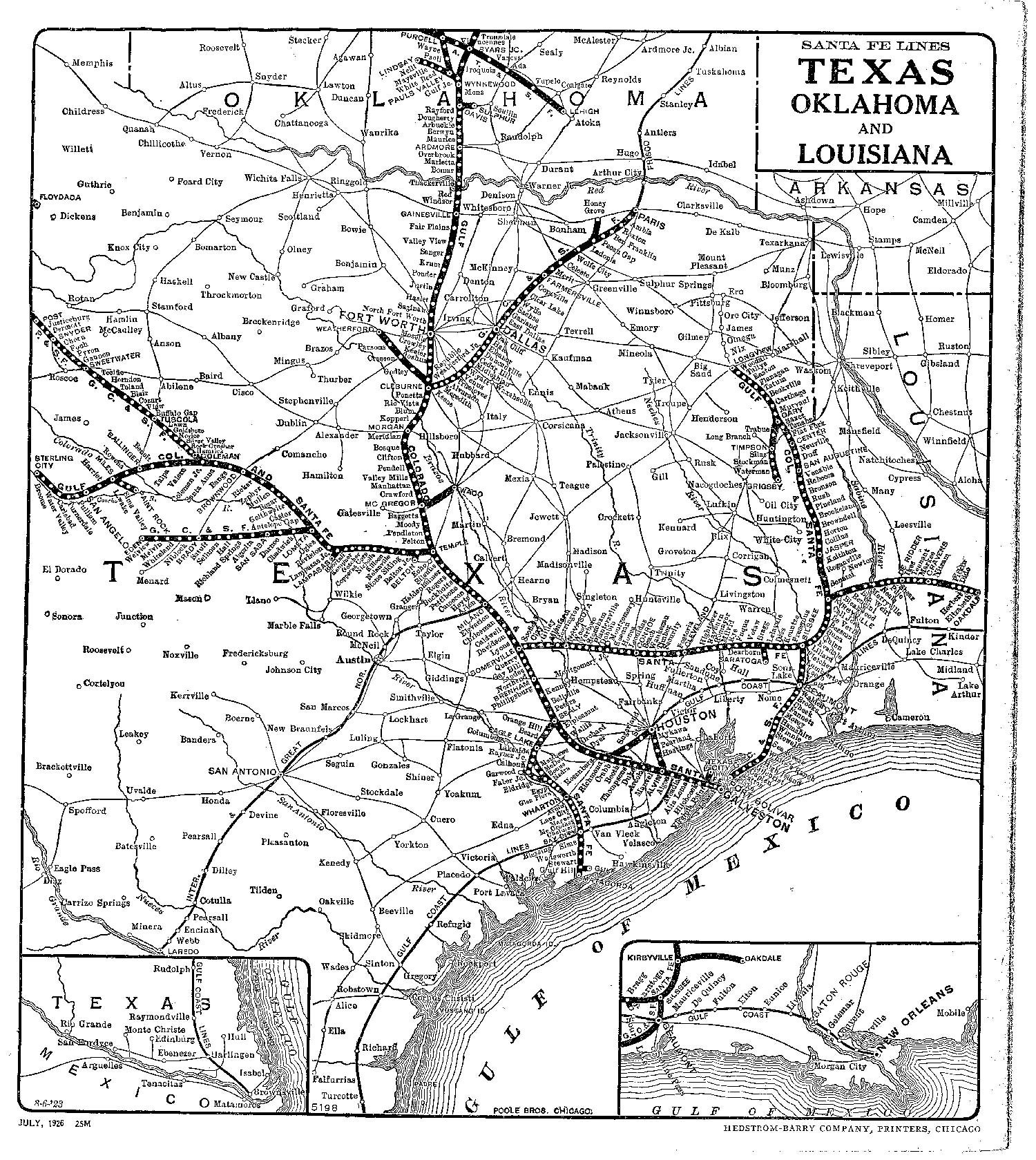
The Gulf, Colorado and Santa Fe Railway (GC&SF) was a Texas-chartered railroad established in 1873 with the goal of constructing a route from Galveston to Santa Fe, New Mexico. By 1886, the railway had completed its line from Galveston to a junction at Temple, Texas, a city founded by the company itself. From Temple, one branch extended northward through Cleburne to reach Dallas and Fort Worth, while another line stretched northwest near Coleman, Texas.
In 1886, ownership of the GC&SF transferred to the Atchison, Topeka and Santa Fe (ATSF), which managed it as a Texas subsidiary in compliance with Article X of the Texas Constitution. Under ATSF’s direction, the GC&SF expanded its network northward through Fort Worth to Purcell, Oklahoma, northeast via Dallas to Paris, Texas, southwest toward San Angelo, and northwest to Sweetwater, where it connected with the Panhandle and Santa Fe Railway, ATSF’s principal subsidiary serving Lubbock and the Texas panhandle. Additional acquisitions extended GC&SF’s reach into East Texas, covering cities such as Beaumont, Longview, Port Bolivar, and even into Oakdale, Louisiana. Following the repeal of Article X, GC&SF was fully absorbed into ATSF in 1965. Presently, portions of the former GC&SF lines operate as part of the BNSF Railway system.
19th century
During 1873, rivalry between Houston and Galveston was intense; the Galveston, Houston & Henderson Railroad (GH&H) was the exclusive rail connection between these cities. Due to frequent quarantines imposed by Houston on Galveston-bound traffic amid yellow fever epidemics, residents of Galveston sought to create their own railroad that would circumvent Houston. The GC&SF was chartered with state land grants amounting to sixteen sections per mile.
Construction commenced in 1875 under General Braxton Bragg, who served as the railroad’s inaugural engineer. Initial efforts concentrated on building a bridge over Galveston Bay and laying track toward Arcola and further inland. By 1877, rails had reached Arcola; however, by 1878 financial troubles necessitated a $250,000 loan from George Sealy and his partners secured against company assets. Unable to repay this debt, GC&SF’s assets were sold in 1879 to Sealy’s consortium, which reorganized operations and resumed extending the line toward Brenham.
Chief engineer Bernard Moore Temple directed surveys and construction deeper into Texas’s interior; recognizing Houston’s strategic value, a spur line was also constructed to serve that city. In 1880, GC&SF introduced what became the nation’s first daily newspaper train service, allowing it to bypass Houston’s quarantine restrictions and strengthen its market presence.
By 1881–82, the railway reached Belton and Lampasas while branches were developed from Alvin to Houston. Financial backing came from counties and municipalities along its path—including substantial investments from Fort Worth—and new towns such as Rosenberg, Sealy, and Temple were established as key division points.
In the mid-1880s, Walter Justin Sherman succeeded Temple as chief engineer amid workforce challenges during construction. The railway garnered interest from prominent railroad tycoons like Jay Gould and ATSF president William Barstow Strong. Facing ongoing fiscal pressures, GC&SF negotiated a strategic stock swap with ATSF in 1886.
This agreement entailed building connections from Fort Worth to Purcell (in Indian Territory) linking with ATSF lines; additional branches were planned toward Paris and Weatherford. By June 1887, trains operated from Kansas City to Galveston under ATSF management following an $8 million stock exchange that finalized GC&SF’s merger.
Although integrated into ATSF’s system, GC&SF remained crucial for linking major Texan cities with Galveston’s port facilities—bolstering ATSF’s competitive position in the region.
In 1897, GC&SF collaborated with entrepreneur Fred Harvey to launch Harvey Houses—railroad hotels and dining establishments—along its routes. This partnership enhanced passenger amenities and strengthened brand recognition for both companies within the railroad industry.
20th century
Following the devastating hurricane of 1900, GC&SF significantly contributed to Galveston's recovery efforts by leasing land in 1904 to facilitate canal construction as part of the city's elevation project. In 1908, GC&SF joined forces with other railroads to create a new causeway that connected Galveston directly to the mainland.
From 1910 to 1911, GC&SF extended its reach by building a 98-mile branch line running from Lometa through San Saba and Brady to Eden. By 1912, AT&SF had announced plans for an eight-story, fire-resistant union depot in Galveston designed to house GC&SF offices. This structure incorporated steel-reinforced concrete and white enameled brick. In 1932, the depot underwent expansion with the addition of an eight-story building and an eleven-story tower, alongside a $35,000 renovation of the original facility. The complex featured a state-of-the-art electric boiler plant that provided heating throughout the entire building.
In 1937, AT&SF acquired control of the Fort Worth & Rio Grande Railway and leased it to GC&SF, thereby establishing a more direct route to Fort Worth and the Edwards Plateau livestock areas, improving upon previous routes that passed through Temple.
After World War II, AT&SF enhanced its freight services by introducing specialized trains such as the 1949 Cotton Special, which transported cotton from West Texas' Lubbock area to the port facilities in Galveston.
During the 1960s, AT&SF engaged in strategic collaborations like its partnership with Duval Corporation to develop a sulfur mining operation at Rustler Springs. To support this venture, AT&SF constructed a 30-mile branch line and pioneered a system for transporting molten sulfur via heated tank cars over a distance exceeding 930 miles to Galveston for shipment by sea. This logistics innovation enabled continuous train movement involving three 66-car trains.
By this era, GC&SF had become closely intertwined with AT&SF’s corporate identity; in 1965, all remaining Gulf division assets were officially transferred to AT&SF, streamlining ownership and operational control.
See also
- Krum, Texas (railroad-founded town)
- Fort Worth and Rio Grande Railway (subsidiary acquired in 1937)
- Nolan River Bridge 303-A of the Gulf, Colorado and Santa Fe Railway (historic railway bridge)
External links
- Galveston County Historical Commission
- Galveston Railroad Museum
- Splinters Online Transcripts
- Handbook of Texas Online
- 1926 map depicting Santa Fe lines across Texas, Oklahoma, and Louisiana including GCSF routes
- Texas Santa Fe History —dedicated site covering Gulf, Colorado and Santa Fe Railway history
- Oklahoma Digital Maps Collection
- Defunct Louisiana railroads
- Defunct Oklahoma railroads
- Defunct Texas railroads
- Former Class I railroads in the United States
- History of Galveston, Texas
- Predecessors of the Atchison, Topeka and Santa Fe Railway
- Railway companies established in 1873
- Railway companies disestablished in 1965
- Transportation in Galveston, Texas
- American companies disestablished in 1965
- American companies established in 1873
- Companies of the United States by year of establishment