
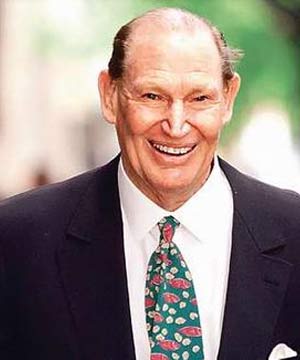
Kerry Packer
Kerry Packer | |
|---|---|
| Born | Template:Birth date Sydney, Australia |
| Died | December 26, 2005 (aged 68) |
| Occupation(s) | Media proprietor, businessman |
| Known for | Owner of Nine Network and Australian Consolidated Press; founder of World Series Cricket; Australia's wealthiest businessman at time of death |
Kerry Francis Bullmore Packer (17 December 1937 – 26 December 2005) stood as a dominant figure in Australian media, recognized as one of the twentieth century's most influential proprietors in the sector. The Packer family held significant control over the Nine Network and the publishing firm Australian Consolidated Press, which later combined to form Publishing and Broadcasting Limited (PBL). Globally, Packer gained recognition for establishing World Series Cricket. At the time of his passing, he was acknowledged as Australia’s wealthiest and most powerful businessman, with a net worth estimated by Business Review Weekly in 2004 at .
Early life
Born on 17 December 1937 in Sydney, Australia, Kerry Packer was the son of media magnate Sir Frank Packer, who oversaw Australian Consolidated Press and the Nine Network. His mother, Gretel Bullmore, descended from Scottish rugby player Herbert Bullmore. Kerry had an elder sibling, Clyde Packer. Despite facing challenges academically—likely linked to undiagnosed dyslexia—he maintained an active involvement in sports. Upon Sir Frank’s death in 1974, an estate valued at $100 million was bequeathed directly to Kerry following a rift between his father and Clyde.
Business
Packer maintained a 37% ownership in Publishing and Broadcasting Limited (PBL) through Consolidated Press Holdings. Up until his demise, PBL controlled both the Nine Network and Australian Consolidated Press, producers of Australia's foremost magazine titles. His portfolio extended into gambling and tourism sectors, with notable investments such as Melbourne’s Crown Casino. Subsequently, the Nine Network and Australian Consolidated Press were sold to PBL Media.
Acknowledged for his acumen within business and political arenas, Packer earned a reputation as one of the sharpest businessmen of his generation despite limited formal schooling. Nevertheless, he was not a self-made man; the media empire was developed over decades by his grandfather Robert Clyde Packer and father. Interestingly, a prudent $100 million investment in the Australian sharemarket made in 1974 would have outperformed Packer’s inherited fortune by 2005.
During the 1980s, he controlled the Nine Network and Nine's Wide World of Sports. In a notable transaction, he sold the network to Alan Bond for $1.2 billion in 1987 before reacquiring it three years later for $250 million—a move that became legendary in Australian television history.
Initially, leadership of the family enterprise was expected to fall to his older brother Clyde; however, after disagreements with their father, Clyde exited the business. Kerry assumed independent control of PBL following his inheritance in 1974. His strategic investments in television and casinos benefited from regulatory frameworks that restricted competition.
The family’s standing was tarnished following the 2001 failure of One.Tel, a telecommunications venture financed by his son, James.
Additionally, Kerry Packer ranked among Australia's largest landholders; a ruby deposit discovered on one of his estates in 2003 further diversified his asset portfolio.
The expansive Packer media conglomerate included magazines, television channels, telecommunications interests, petrochemical operations, heavy engineering enterprises, a 75% ownership stake in the Perisher Blue ski resort, diamond mining ventures, coal extraction sites, real estate assets, shares in Foxtel cable television, along with extensive casino holdings both domestically and internationally.
The "Packer Empire"
The Packer family boasts a significant history in media. Kerry Packer's grandfather, Robert Clyde Packer, owned two newspapers based in Sydney, while his father, Sir Frank Packer, was a trailblazer in the Australian media industry. Kerry’s son, James, held the position of executive chairman at PBL until his departure in 2008. Sir Frank began Kerry’s career at the newspaper The Telegraph by placing him on the loading dock. Although not initially positioned as the successor, Kerry took over PBL leadership in 1974 after his elder brother Clyde exited the firm following disagreements with their father.
The CBC Disaster
During the 1980s, Packer controlled radio stations 2UE and 3AK and combined them under the Commonwealth Broadcasting Corporation banner. This networked model featured breakfast shows from Melbourne's 3AK and other programming from Sydney's 2UE but lasted only half a year in 1986.
Alan Bond media buyback
In 1987, Packer sold the Nine Network to businessman Alan Bond for a record-setting A$1.05 billion. He then reacquired it in 1990 for a mere A$250 million following Bond’s financial collapse. This transaction allowed Packer to reinvest in a 25% share of the Foxtel pay TV consortium. At the 2006 PBL AGM, James Packer explained the deal’s intricacies: Kerry received A$800 million in cash plus A$250 million in subordinated debt convertible into a 37% equity stake in Bond Media, which owned Nine Network assets including Channel Nine Brisbane. The remaining debt implied a valuation of about A$500 million for Nine. Kerry later admitted regret over initially selling Nine but leveraged Bond’s downfall to regain control at a substantially reduced price.
Hands-on business approach
While less intrusive than Rupert Murdoch, Packer sometimes took an active role in his newspapers' editorial direction. He also influenced television programming; notably, in 1992, he mandated that Sydney's TCN-9 pull Australia's Naughtiest Home Videos during its sole national broadcast. Additionally, he was known to manage cricket telecasts to ensure matches concluded live despite scheduling challenges.
Government inquiry and legal challenges
In 1991, an Australian government inquiry examined Packer’s involvement in the print media sector, to which he responded with wit and defiance. He denied covert ownership of Fairfax Media, a company he had attempted to acquire but was prevented by cross-ownership regulations. Packer criticized politicians and defended his company’s tax strategies as sound business practices.
At the time of his passing, the Nine Network remained PBL’s premier asset. Despite stiff competition from Seven Network in 2005—bolstered by American programs such as Desperate Housewives and Lost—Nine ended the year as Australia’s leading broadcaster.
World Series Cricket
Packer gained international recognition for launching World Series Cricket in 1977 after securing exclusive cricket broadcast rights for the Nine Network. This initiative sparked conflicts with cricket authorities as top international players joined his league, challenging traditional team structures.
England captain Tony Greig, a pivotal figure in this "rebellion," later became a long-standing commentator for the Nine Network. Packer’s objective was to dominate Australian cricket broadcasting rights—a goal he largely realized despite intense legal battles with cricket officials. To defend his position, he engaged elite Queen's Counsels from the UK exclusively for his legal team.
His influence on cricket was substantial; upon his death, a moment of silence at the MCG commemorated him as a transformative force. Notably, during negotiations with the Australian Cricket Board in 1976, he is reported to have remarked: "There is a little bit of the whore in all of us, gentlemen. What is your price?"
World Rugby Corporation
In 1995, Kerry Packer provided funding for the World Rugby Corporation (WRC), an initiative established by lawyer Geoff Levy and former Wallaby Ross Turnbull, with the goal of launching a professional international rugby union competition. Initially, numerous All Blacks and Wallabies players signed contracts with the WRC. In reaction, the rugby unions of Australia, New Zealand, and South Africa collaborated to form SANZAR and partnered with News Limited to introduce the professional Super 12 and Tri Nations Series. The South African Rugby Union issued a warning to Springboks players that joining WRC would result in exclusion from national team selection; as a result, most remained loyal to SARU. Consequently, the majority of All Blacks and Wallabies withdrew their involvement from WRC, which ultimately led to the project's termination.
Controversy
Kerry Packer was frequently at the center of disputes. In 1960, during his father’s effort to take over the Anglican Press publisher, Packer and his associates allegedly employed intimidation against owner Francis James. Rival media mogul Rupert Murdoch intervened in this conflict, sparking widely reported confrontations that tarnished Packer’s public image.
His growing media empire was often criticized for potentially undermining media plurality and freedom of expression. Additionally, Packer’s corporations faced accusations related to tax avoidance and consistently minimal corporate tax contributions, resulting in persistent conflicts with the Australian Taxation Office.
The most significant legal challenge arose in 1984 when the Costigan Commission accused him—under codenames like "the squirrel" and "the Goanna"—of engaging in tax evasion and organized crime activities, including drug trafficking. Represented by lawyer Malcolm Turnbull, Packer successfully refuted these allegations; by 1987, Attorney-General Lionel Bowen dropped all charges. Another controversy involved a A$225,000 cash “loan” from bankrupt businessman Brian Ray, which Packer justified by explaining his preference for holding physical cash.
Despite stringent security arrangements, Packer’s Sydney office experienced two notable burglaries:
- In 1995, thieves stole 25 gold bars worth A$23.3 million (2022 value) along with a jar containing gold nuggets from his personal safe;
- In 2003, a licensed Glock 9mm semi-automatic handgun was taken from an executive’s desk; although Packer subsequently surrendered his firearms licence, no charges were filed.
Packer also faced criticism for breaking the international sporting boycott of apartheid South Africa by recruiting South African cricketers for World Series Cricket shortly after the Soweto uprising and Steve Biko’s death, drawing condemnation due to the timing of this decision.
Personal life
At eight years old, Packer’s early education was interrupted by a severe case of poliomyelitis, which confined him to an iron lung for nine months. Despite his father’s harsh characterization of him as "the family idiot," Kerry demonstrated strong academic abilities and later guided PBL to remarkable achievements. Former colleague Trevor Sykes observed that Packer favored brief communication over lengthy documents.
His grandfather, Herbert Bullmore, was both a Scottish international rugby player and a medical practitioner based in Sydney. Kerry Packer was married for 42 years to Roslyn Packer (nee Weedon), with whom he had two children: daughter Gretel and son James. At the time of his passing, the family included two grandchildren from Gretel’s first marriage to British financier Nick Barham; Gretel was also expecting another child with her husband Shane Murray.
Packer maintained several well-known extramarital relationships, including with model Carol Lopes, publisher Ita Buttrose, and Julie Trethowan—his longtime mistress who managed the Packer-owned Hyde Park Club. Around 1995, he transferred ownership of valuable Sydney real estate assets worth millions to Trethowan.
In 2009, former federal opposition leader and eventual Prime Minister Malcolm Turnbull, once both legal adviser and business associate of Packer, disclosed that during their 1991 Fairfax takeover attempt via the Tourang consortium, Packer threatened to kill him. Turnbull described Packer as simultaneously charismatic and ruthless.
Packer was a supporter of the South Sydney Rabbitohs in the National Rugby League and actively backed the Australian Republic Movement.
Polo
Packer, a passionate polo enthusiast, co-established the Ellerstina polo team in 1992 alongside Gonzalo Pieres Sr.. This team has secured numerous championships at the Argentine Open and other prestigious competitions. He acquired the Fyning Hill estate in West Sussex, enlarging it to more than 400 acres and using it as the base for his Ellerston polo squad. Packer spent the English polo season at this location before selling the property to Russian entrepreneur Roman Abramovich in 1999 for £12 million.
Gambling
Packer was widely recognized for his involvement in high-stakes gambling, experiencing both substantial victories and losses. In 1999, he lost close to A$28 million over three days at casinos in London, marking the largest documented gambling loss in British history at that time. On the other hand, he once secured a win of A$33 million at Las Vegas's MGM Grand Casino and frequently earned as much as A$7 million annually during his visits to the UK. His gambling pursuits had a significant financial impact on leading casinos.
His well-known volatile demeanor and aversion to intrusive reporters contributed to his public image. A notable poker story recounts him challenging a Texan oil magnate who claimed a $60 million net worth by casually suggesting a coin toss for twice that amount, highlighting his high-roller character.
During the late 1990s, Packer placed bets totaling £15 million across four roulette wheels in a London casino and lost everything—a fact confirmed by casino proprietors. Former professional golfer John Daly recalled that Packer won $52 million in a single day at the Desert Inn Casino, insisting on cash payment after previously losing $8.2 million under similar conditions.
At London's Ritz Hotel, a special room was maintained exclusively for Packer to play blackjack with minimum wagers of £10,000 per hand; he reportedly lost more than £19 million there. These gambling episodes emphasize Packer's reputation as a high-stakes gambler whose activities affected casino operations globally.
Failing health
Packer endured up to four heart attacks. In 1990, while engaged in polo at Warwick Farm near Sydney, he suffered a heart attack that rendered him clinically dead for seven minutes. Paramedics revived him and airlifted him to St Vincent's Private Hospital, where pioneering cardiac surgeon Dr Victor Chang performed bypass surgery. The ambulance was uniquely equipped with a defibrillator, which was vital for his survival.
After recovering, Packer made a generous donation to the Ambulance Service of New South Wales to equip all ambulances in NSW with portable defibrillators, later nicknamed "Packer Whackers." He collaborated with the NSW government on an equal funding partnership. Packer famously stated, "Son, I've been to the other side, and let me tell you, there's nothing there," reflecting his views on life and death.
He also struggled with a long-term kidney ailment over several years. In 2000, his longtime helicopter pilot, Nick Ross, donated one of his kidneys to him—a rare publicized transplant featured on ABC's Australian Story. Following his recovery, Packer founded an organ transplant association in honor of cricketer David Hookes.
Death
Kerry Packer passed away from kidney failure on 26 December 2005, just nine days after celebrating his 68th birthday, at his residence in Sydney surrounded by family. Conscious of his worsening condition, he requested that medical professionals refrain from administering curative therapies or extending his life artificially through dialysis. He confided in his cardiologist that he felt he was "running out of petrol" and expressed a desire to "die with dignity". His funeral was held privately on 30 December 2005 at the family’s rural estate, Ellerston, situated near Scone in the Hunter Valley. With permission from local authorities, he was interred on the Ellerston grounds close to the polo field. In 2011, it was reported that a bronze sculpture of a horse’s head, created by artist Nic Fiddian-Green and titled I Look Beyond for a Distant Land, would serve as a memorial at his gravesite.
State memorial service
The Packer family agreed to a state memorial service, which took place on 17 February 2006 at the Sydney Opera House. This event, funded by taxpayers, generated controversy due to Packer’s well-known reputation for alleged tax avoidance. The ceremony included addresses from his son James; actor Russell Crowe, representing daughter Gretel; then-Prime Minister John Howard; and cricket icon Richie Benaud. Notable attendees comprised Tom Cruise and partner Katie Holmes, golfer Greg Norman, members of the Australian cricket team, and political leaders from various parties.
Philanthropy
The Kerry Packer Civic Gallery located within the Bob Hawke Prime Ministerial Centre at the University of South Australia was established through contributions from the Packer family.
See also
- Kerry Packer Foundation
- Paper Giants: The Birth of Cleo
- Howzat! Kerry Packer's War
- Paper Giants: Magazine Wars
- Power Games: The Packer-Murdoch War
- Super League war
Further reading
- Paul Barry, The Rise and Rise of Kerry Packer, Bantam/ABC Books, Sydney, 1993
- Gerald Stone, Compulsive Viewing: the inside story of Packer's Nine Network, Viking, Ringwood, Victoria, 2000
- Gerald Stone, Who Killed Channel 9?, Pan Macmillan, Sydney, 2007
- Mark Westfield, The Gatekeepers, Pluto Press/Comerford and Miller, Sydney/London, 2000
External links
- Articles with short description
- Articles with hCards
- No local image but image on Wikidata
- 1937 births
- 2005 deaths
- 20th-century Australian businesspeople
- 20th-century Australian philanthropists
- Australian billionaires
- Australian casino industry businesspeople
- Australian cricket administrators
- Australian magazine publishers (people)
- Australian mass media owners
- Australian people of English descent
- Australian racehorse owners and breeders
- Australian republicans
- Companions of the Order of Australia
- Deaths from kidney failure in Australia
- Kidney transplant recipients
- People educated at Canberra Grammar School
- People educated at Cranbrook School, Sydney
- People educated at Geelong Grammar School
- Businesspeople from Sydney
- World Series Cricket
- Packer family
- Sport Australia Hall of Fame inductees
- Polio survivors
- Australian film production company founders
- Australian sports owners
- Australian polo players