
Lake Hopatcong station
| Company type | Commuter rail stop |
|---|---|
| Industry | Transportation |
| Founded | 1882 |
| Headquarters | Landing, Roxbury Township , United States |
Area served | Morris County, New Jersey |
| Products | Rail transport services |
| Owner | New Jersey Transit |
Lake Hopatcong is a commuter rail stop operated by New Jersey Transit, situated in Landing within Roxbury Township, Morris County, New Jersey. It accommodates the Montclair–Boonton and Morristown Lines during rush hours and on holiday weekends, with trains traveling between Hackettstown and either New York Penn Station or Hoboken Terminal. Positioned beneath Landing Road (County Route 631) next to Lake Hopatcong, the station contains a single active platform equipped with a shelter alongside an unused side platform. The facility does not provide ADA-compliant access.
Rail operations in Landing commenced on January 16, 1854, through the Morris and Essex Railroad; however, no stop existed at Lake Hopatcong initially. Passengers destined for the lake would disembark at the nearby Drakesville station. In 1882, following the Central Railroad of New Jersey’s construction of the Wharton and Northern Railroad, the Delaware, Lackawanna and Western Railroad (DL&W)—which had assumed control of the Morris and Essex lines—introduced a stop at Landing. Electric trolley service was initiated in 1910 by the Morris County Traction Company.
On July 15, 1910, DL&W revealed plans to build a new station near the Landing Masonry Bridge. This all-concrete facility opened on May 28, 1911, featuring two elevators and a pedestrian walkway along the southern edge of the Morris Canal. The adjacent Lackawanna Cut-Off mainline began operations on December 24, 1911, improving regional rail connections. Although the concrete overpass was condemned in 1978 and subsequently demolished in 1982, the original station building continues to serve passengers.
1882 DL&W station
The railroad tracks passing through Landing were originally constructed in 1854 by the Morris and Essex Railroad, extending its route westward from Newark to Hackettstown. This right-of-way ran alongside the long-established Morris Canal near Lake Hopatcong, which served as the primary water source for the canal. At an elevation of , this location represented both the highest point on the railroad within New Jersey and the peak elevation of the canal itself, which descended toward both the Delaware River and Hudson River. Despite this strategic position, Landing was a modest settlement primarily supporting canal workers and was not initially considered viable for a passenger stop; thus, no station was constructed for nearly three decades.
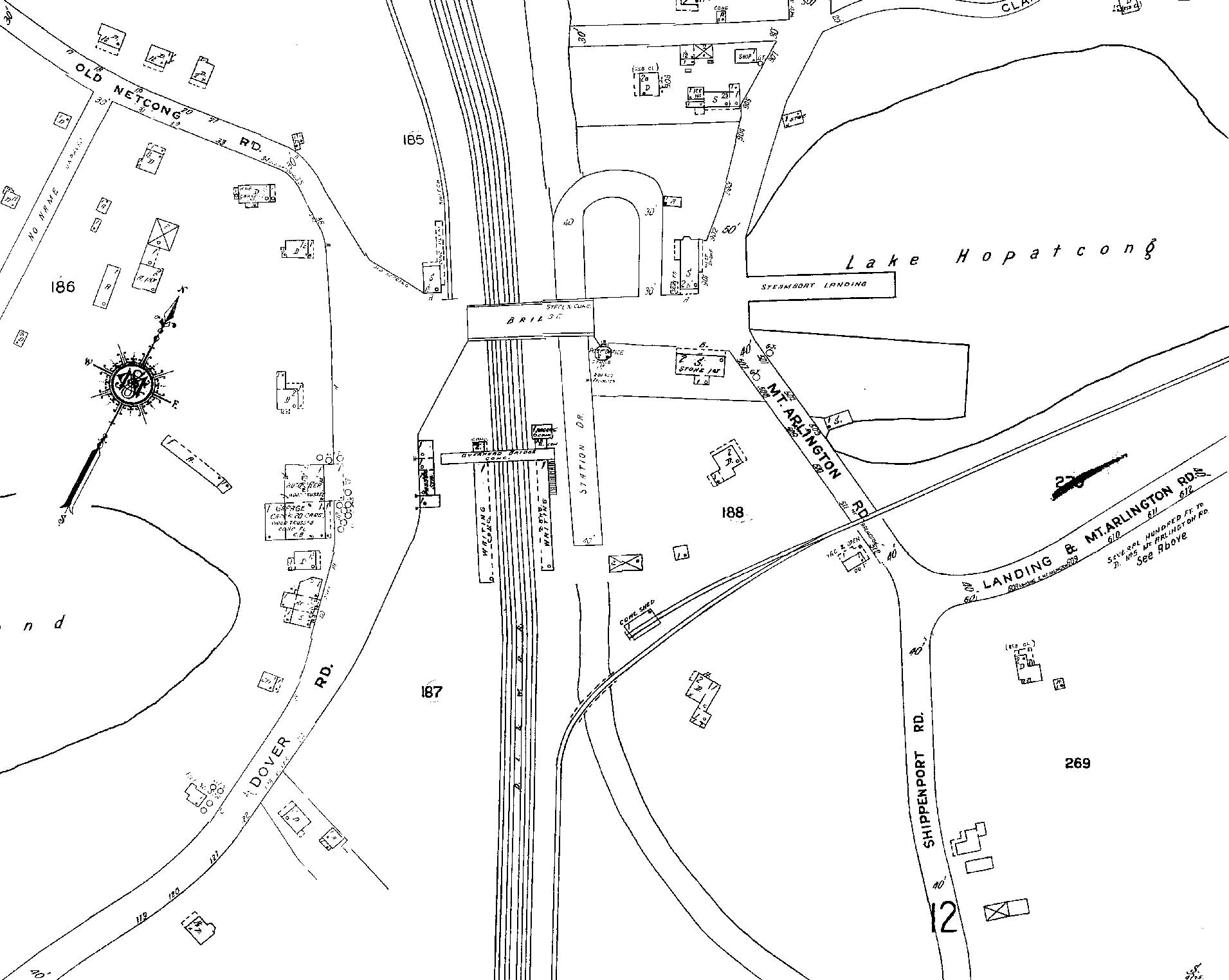
The situation shifted in 1882 when the Central Railroad of New Jersey opened a station further along the lakefront, demonstrating that passenger service to this recreational area could be profitable. Around 1886, the first station in Landing was established by the Delaware, Lackawanna and Western Railroad, a competitor of CNJ that had acquired control of the M&E Railroad in 1868. This modest depot and its platforms were located between the railway tracks and canal waters, with most travelers reaching it via the steel cable-stayed Landing Road Bridge. This configuration allowed convenient transfers between rail services and steamboats serving destinations along the lakeshore. That same year witnessed the founding of the Black Line steamboat company by financiers who owned both the Lackawanna Railway and Morris Canal.
The presence of this station also influenced alterations to Lake Hopatcong itself. In 1891, after failing to obtain canal rights for navigation, the newly established White Line steamboat company excavated swampy terrain at the lake’s southern end to create Landing Channel and constructed a pier adjacent to the tracks, thereby improving access for both passengers and freight shipments.
1911 DL&W Station
By 1906, increasing summer visitors and the forthcoming Lackawanna Cut-Off, a major rail initiative designed to shorten travel time to Scranton, motivated the DL&W to design a new station near Port Morris Junction.
Construction commenced in 1910 on a building crafted from local stone with cement accents and topped with a green glazed tile roof. Inside, the station housed an oak-paneled ticket office, waiting area, and baggage room. Situated approximately above the tracks on Landing Road, it featured extensive stairways and raised walkways equipped with large elevators to facilitate passenger and luggage movement to the Hoboken-bound platform. The Morris County Traction Company trolley line provided onward connections to Bertrand Island.
The station’s construction cost was $28,500 (roughly equivalent to $ today), while total expenses for associated structures reached about $75,000. It officially opened on May 28, 1911, half a year prior to the start of train service on the Cut-Off.
In 1912, DL&W erected a comparable station at Mountain Lakes, New Jersey.
The elevated walkways rendered the previous vehicular bridge obsolete; that bridge had been replaced in 1907 by an adjacent stone bridge before being demolished later.
By the 1920s, this DL&W station became the main rail gateway to Lake Hopatcong, overtaking rivals such as CNJ’s Nolan’s Point station. The shutdown of the Morris Canal in 1924 ended freight operations and led to removal of steamboat docks; much of the canal area was subsequently redeveloped.
During DL&W’s and its successor Erie Lackawanna’s tenure, Lake Hopatcong station served as a transfer point between Cut-Off trains and those running on the Old Main line toward Phillipsburg, New Jersey and Portland, Pennsylvania. After DL&W merged with Erie Railroad in 1960, the station became part of Erie Lackawanna.
Operations transferred to Conrail in 1976, which then sold the stone depot. The overpass was declared unsafe in 1978, and Morris County identified the station as a safety risk. Demolition plans included constructing new platforms; demolition work began in May 1982.
Post-Railroad Use of the 1911 Depot
The stone building at 125 Landing Road transitioned through various uses including a real estate office and hardware store before becoming an interior design firm that restored its original marble flooring. By 2012, it operated as a role-playing games shop.
On November 6, 2014, the Lake Hopatcong Foundation purchased the property with intentions to convert part into office and meeting spaces while dedicating the remainder as an environmental and cultural center.
In 2016, the foundation commissioned Ludowici Roof Tile—the original 1911 manufacturer from New Lexington, Ohio—to install a new glazed clay tile roof. During this process, structural damage was found in the stone parapets. Repairs were funded by a $215,000 grant from the Morris County Historic Preservation Trust. That same year, the building was listed on both the National Register of Historic Places and New Jersey’s state register.
By 2021, restoration funding had reached $1,129,143 from the Morris County Historic Preservation Trust Fund alongside two grants totaling $404,879 from the New Jersey Historic Trust. The foundation’s preservation efforts were honored with a 2021 award from Preservation New Jersey.
Station layout
The current configuration of the New Jersey Transit station includes two low-level asphalt side platforms, accompanied by a modest shelter situated on the westbound side, as well as an adjacent parking area. The eastbound platform previously had a shelter, which was removed sometime after 2005.
Future service
Beginning in 2008, New Jersey Transit has been undertaking efforts to reinstate a portion of the Lackawanna Cut-Off corridor between Port Morris Junction and a proposed station at Andover in Sussex County, with plans aiming for a 2025 commencement of service. Proposals have also been made to extend this line further to Scranton, with Senator Charles Schumer supporting an extension reaching Binghamton, New York.
References
External links

- Articles with short description
- Railway stations in Morris County, New Jersey
- NJ Transit Rail Operations stations
- Railway stations in the United States opened in 1882
- Roxbury, New Jersey
- Former Delaware, Lackawanna and Western Railroad stations
- Lackawanna Cut-Off
- 1882 establishments in New Jersey
- Historic district contributing properties in Morris County, New Jersey
- New Jersey Register of Historic Places