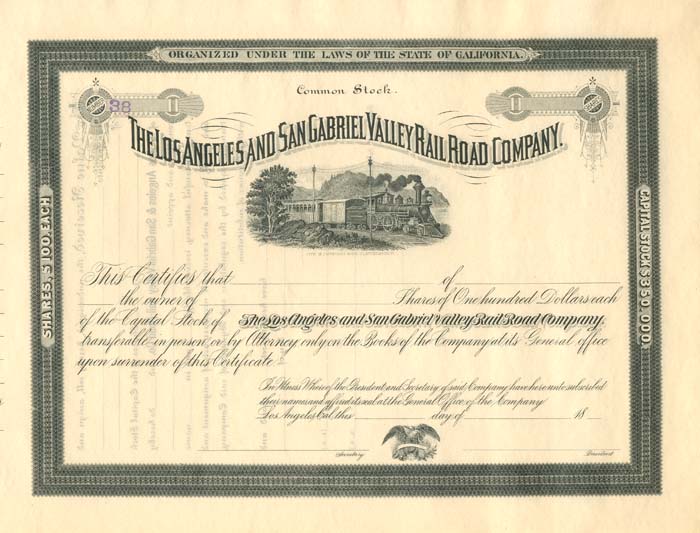
Los Angeles and San Gabriel Valley Railroad
| Company type | Private |
|---|---|
| Industry | Rail transport |
| Founded | September 5, 1883 |
| Founder | James F. Crank |
| Fate | Acquired by California Central Railway |
| Successor | California Central Railway |
| Headquarters | Los Angeles, California , United States |
Area served | Los Angeles to Pasadena, California |
Key people | James F. Crank (founder) |
The Los Angeles and San Gabriel Valley Railroad was established on September 5, 1883, by James F. Crank with the objective of linking downtown Los Angeles to Pasadena, California. The railway commenced operations in 1886. Subsequently, on May 20, 1887, it was acquired and merged into the California Central Railway, which itself became part of the Southern California Railway Company in 1889. On January 17, 1906, Southern California Railway was sold to the Atchison, Topeka and Santa Fe Railway, where it was designated as the Pasadena Subdivision. The original main line ceased operations in 1994 before being reactivated as the MTA Gold Line Light Rail in July 2003.
History
James F. Crank, founder of the Los Angeles and San Gabriel Valley Railroad, initiated the project on September 5, 1883, with the goal of creating a rail link between downtown Los Angeles and Pasadena. To fund construction efforts, shares were issued; among the prominent investors was Lucky Baldwin, who purchased a substantial portion anticipating enhanced distribution channels for products from his Rancho Santa Anita. Progress was initially slow—track laying began in Pasadena in 1884, but work halted when the initial contractor went bankrupt that same year. Construction resumed under a new contractor in early 1885, who completed critical infrastructure including a second railroad bridge.
By September 1885, test trains were operational, followed by a formal inauguration of service connecting Downtown Los Angeles to Lamanda Park in East Pasadena. The line ran through the Arroyo Seco, crossing just north of Garvanza within Highland Park. The first wooden Pasadena Rail Station opened its doors in 1887 and was replaced with a newer structure in 1934. This rail corridor stimulated local economic development; for instance, Edward C. Webster commenced construction of the Hotel Green in 1887 to accommodate rail travelers.
By November 1886, the railroad had expanded westward from Mud Springs (present-day San Dimas), crossing the San Gabriel River near Azusa by January 1887. A wooden station was established at Monrovia, later supplanted by the Santa Fe Depot in 1926. In February 1887, negotiations took place between landowners and railroad executives to secure right-of-way access through Pomona and Claremont. The Pomona station’s name underwent deliberation among North Pomona Station, Palomares Station, and Palermo Station.
After its sale on May 20, 1887 to California Central Railway and subsequent consolidation into Southern California Railway in 1889, a regional land boom followed along the rail line. In Mud Springs/San Dimas, enterprises such as the San Jose Ranch Company developed new streets and commercial ventures; land sales around Azusa encouraged growth of adjacent communities like Alosta near Glendora. Similarly, Monrovia Land and Water Company benefited from increased land transactions facilitated by rail connectivity.
Crank collaborated with William Newton Monroe and others to purchase Rancho Santa Anita from Baldwin in December 1885 for development purposes. The railroad became an essential transportation route for agricultural producers—growers of citrus fruits, nuts, and other crops utilized it to access wider markets efficiently. The original Rancho Santa Anita station (later known as Arcadia Santa Fe Station) was relocated to Fairplex’s Rail Giants museum in 1969.
The acquisition of Southern California Railway by Atchison, Topeka and Santa Fe Railway in 1906 incorporated this line into its Pasadena Subdivision.
Lamanda Park functioned as a significant center for both freight and passenger services; its extensive auxiliary tracks supported local citrus groves and vineyards until Prohibition led to the closure of nearby wineries. The Sierra-Madre Lamanda Park Citrus Association operated a packing facility that shipped assorted citrus products via rail. In later years, these sidings were used for lumber and automobile deliveries. Although mainline operations ended in 1994, service was revived with the introduction of MTA Gold Line Light Rail transit starting July 2003.
Santa Fe
Initially, Jay Gould and Collis Potter Huntington opposed the Santa Fe Railway's expansion into the San Gabriel Valley. Nevertheless, by May 1887, the inaugural Santa Fe train reached Los Angeles. For approximately a year and a half, Santa Fe operated under a costly arrangement that required using Southern Pacific tracks between Colton and Los Angeles.
On May 20, 1887, the Los Angeles and San Gabriel Valley Railroad was acquired by the California Central Railway, a subsidiary of the Atchison, Topeka and Santa Fe Railway. This acquisition connected the rail lines at Mud Springs, finalizing the continuous rail link from Chicago to Los Angeles through the San Gabriel Valley. This route later supported Amtrak's Southwest Chief and Desert Wind until 1986, when the Desert Wind service was rerouted. The Santa Fe line remained operational in the area until the 1994 Northridge earthquake caused damage to a bridge in Arcadia. Subsequently, in 2003, the L Line began service along this historic right-of-way (ROW). Construction efforts recommenced in 2013 with the Gold Line Foothill Extension, progressing through former station locations such as Monrovia and Azusa, which reopened in 2016.
In addition to its main route, Santa Fe established a service line south of Pasadena known as the Second District of AT&SF. This line ran close to Walnut Street from Eaton Canyon wash to Wilson Avenue. Over time, much of this right-of-way was sold off; however, traces can still be observed near Sierra Madre Boulevard close to Colorado Boulevard. The Lamanda Park station played a key role in supporting local citrus orchards and vineyards by facilitating shipments of oranges, lemons, limes, and grapefruit. The onset of Prohibition led to the closure of local wineries, and citrus packing operations ended by the 1950s. The service line continued to provide transportation for lumber yards and automobile dealerships until it was abandoned in 1980.
See also
- History of Trains in Pasadena
- History of rail transportation in California
- Southern Transcon
- Union Station (Los Angeles)
- Southwest Chief
- Rancho Santa Anita Depot
- Pacific Electric's Red Cars linking with these rail lines
- List of California railroads
References
- Photo, Stock in Los Angeles and San Gabriel Valley Railroad
- History of Pomona Valley, California, with Biographical Sketches of Leading Men and Women Identified With Its Growth, HISTORIC RECORD COMPANY, LOS ANGELES, CAL. 1920
- California History, VOLUME LXVII NO. 1-4 1988, California Historical Society SAN FRANCISCO • LOS ANGELES • SAN MARINO
- LA Mag., CityDig: Monrovia's 1887 Real Estate Bubble 2/12/2014 by Glen Creason