
MS Batory
| Company type | Company |
|---|---|
| Industry | Shipping, Ocean liners |
| Predecessor | Polskie Transatlantyckie Towarzystwo Okrętowe (PTTO) |
| Founded | 1934 |
| Headquarters | Gdynia , Poland |
Area served | Transatlantic routes, leisure cruising |
Overview
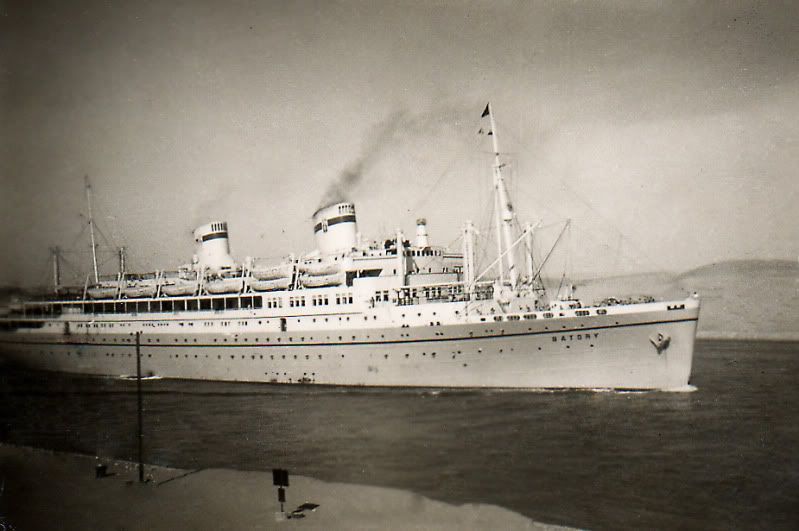
MS Batory was a distinguished Polish ocean liner that served as the premier vessel of the Gdynia-America Line. The ship was named in honor of Stefan Batory, the 16th-century monarch of Poland. She shared a close kinship with her sister ship, MS Piłsudski. Throughout World War II, Batory operated primarily under the authority of the UK Admiralty. Following the war, in 1951, she assumed the role of flagship for the Polish Ocean Lines and became a symbol of the Polish merchant fleet. Frequently regarded as the "Pride of the Polish Merchant Marine", both Batory and her sister Piłsudski were among the most celebrated ocean liners representing Poland.
History
Construction
The Gdynia America Line (Gdynia–Ameryka Linie Żeglugowe, GAL), a Polish-Danish collaboration headquartered in Gdynia, was established in 1934 as the successor to Polskie Transatlantyckie Towarzystwo Okrętowe (PTTO), an organization initially focused on transporting Polish emigrants to the USA. The company's mission shifted towards leisure cruising, prompting the decision to commission a new ocean liner. Constructed between 1934 and 1935, Batory was built at the Cantieri Riuniti dell'Adriatico shipyard located in Monfalcone, near Trieste, Italy,[1] under a unique agreement whereby part of the payment was made through deliveries of coal from Poland.
Recognized as one of the most iconic vessels in Polish maritime history, Batory was launched on 3 July 1935. It featured two Sulzer diesel engines powering twin propellers, enabling a top speed of 18 knots (33 km/h). Beginning regular voyages in May 1936 on the route between Gdynia and New York, by 1939 she had transported more than 3,000 passengers.
World War II

Activated at the start of World War II, the ship served as both a troop transport and a hospital ship under Allied command throughout the conflict. In 1940, alongside Chrobry, she was engaged in moving Allied forces during the Norwegian campaign. Additionally, she was one of the final vessels to depart St Jean de Luz amid the last evacuation of Polish troops from France. The vessel also played a covert role in transferring numerous valuable Polish artifacts, including the Wawel Treasures, to Canada for protection. Participating in the late May to early June evacuation of Dunkirk, she embarked approximately 2,500 evacuees and on other occasions carried up to 6,000 individuals during rescue operations. Between June and July, Batory secretly transported a significant portion of Britain's gold reserves (£40 million) from Greenock, Scotland, to Montreal, Canada, as part of Operation Fish. On 5 August 1940, she departed Liverpool with convoy WS 2 (Winston's Specials), escorting 477 children to Sydney, Australia under the auspices of the Children's Overseas Reception Board, remaining there until hostilities ceased.[2] The voyage included stops at Cape Town; India; Singapore—where she disembarked 300 troops—and finally Sydney. The trip was marked by joyous music and laughter, earning Batory the nickname "Singing Ship" and inspiring a book bearing the same title.[3] In April 1942, British author Roald Dahl embarked on Batory en route to Halifax, Canada.
The ship took part in the Allied assault on Oran, Algeria during Operation Torch in 1942. That year also saw her transporting troops to India and later participating in both the Allied invasion of Sicily and the southern France campaign (Operation Dragoon), where she served as flagship for General Jean de Lattre de Tassigny, Commander-in-Chief of the French Army. Despite multiple attacks from air and ground forces, she avoided major damage.
Known as the "Lucky Ship" due to her fortunate wartime service record, Batory was a sister vessel to Piłsudski, which met a tragic fate sinking off Scotland’s east coast in November 1939.
Postwar career
After returning to post-war Poland in 1946, she resumed civilian operations following a refit, transporting notable figures including Ryszard Kapuściński. Between May 1949 and January 1951, the vessel became involved in several political disputes when American dockworkers and shipyard laborers in the United States refused to unload her cargo or provide maintenance services.
Following these events, she was removed from the North Atlantic route and underwent refurbishment at Hebburn to prepare for tropical service. In August 1951, she departed from Gdynia and Southampton en route to Bombay and Karachi, stopping at Gibraltar, Malta, Aden, and Suez. The ship resumed North Atlantic voyages in 1957 and remained active until her retirement in 1969. Subsequently, she was converted into a floating hotel in Gdynia. Approximately one year later, she was sold back to Polish Ocean Lines and then sold for dismantling in Hong Kong. Departing Gdynia on 31 March 1971, she reached the scrapyard by 26 May. The Polish flag was lowered on 2 June, marking the commencement of scrapping, which was completed by 1972.
Her successor was a larger vessel, Stefan Batory, which served from April 1969 until 1988.
Gallery
-
 Batory docked in Gdynia, 1937
-
 Batory arriving at New York City
-
 Batory photographed in 1962
-
 Cargo unloading at Gdynia wharf during the 1960s
-
 Scale model of Batory displayed in Gdynia, 2007
-
 Preserved electrical generator from Batory at the National Maritime Museum, Gdańsk
-
 Postcard featuring Batory
-
 Image of Batory taken in 1965
-
 Another view of Batory from 1965


Citations
- ↑ Lloyd's Register, Steamers and Motor Ships (PDF). London: Lloyd's Register. 1945. Retrieved 13 October 2020.
- ↑ Jones, Helen, "Doris Anne Beeston (1897–1940)", Australian Dictionary of Biography, Canberra: National Centre of Biography, Australian National University, retrieved 2023-11-13
- ↑ Maclean, Meta (1941). The singing ship: an odyssey of evacuee children. Sydney: Angus and Robertson.
References
- Polish Ocean Lines. (1971). ts/s Stefan Batory. Gdynia.
- Mitchell, W.H., & Sawyer, L.A. (1967). Cruising Ships. New York: Doubleday.
Further reading
- Swoger, Gordon. (2004). The Strange Odyssey of Poland's National Treasures, 1939–1961: A Polish-Canadian Story. Toronto: Dundurn Press.
External links
- Peter Wieslaw Grajda: M/S BATORY, the Polish Ocean Liner - History & Photographs
- History of M/S Pilsudski and M/S Batory
- Photograph of MS Batory at Suez Canal Zone, 1953
- M/S Batory, the Polish Ocean Liner - History & Photographs

Template:Cantieri Riuniti dell'AdriaticoTemplate:Museum ships in PolandTemplate:Gdynia America Line