Merrow Sewing Machine Company
 | |
| Company type | Private |
|---|---|
| Industry | Textiles |
| Founded | 1838 |
| Headquarters | Fall River, Massachusetts, USA |
Key people | Charlie Merrow, Chairman & CEO Owen Merrow, President |
| Products | Overlock sewing machines; Crochet sewing machines; End-to-end seaming machines; Sewing machine parts; Sewing machine needles |
Number of employees | ~25 (2010) |
| Website | http://www.merrow.com |
The Merrow Sewing Machine Company, credited with creating the pioneering overlock sewing machine, is a manufacturer of specialized sewing technology. Established in 1838 by J. Makens Merrow following a catastrophic gunpowder mill explosion, the enterprise initially operated knitting mills before transitioning exclusively to sewing machine design and production by 1887. The company experienced multiple corporate restructurings—from Joseph M. Merrow & Sons to Merrow Manufacturing Co.—ultimately becoming The Merrow Manufacturing Company in 1893. Its original manufacturing base was in Connecticut before relocating to its current site in Fall River, Massachusetts.
Transition from explosives to textiles
Joseph Makens Merrow began his entrepreneurial journey manufacturing gunpowder near Hartford, Connecticut. After a devastating explosion in 1837 destroyed the powder facility, he shifted focus to founding a water-powered knitting mill. This mill produced wool and later cotton knitwear, which was distributed through commission agents in New York and retail stores throughout New England. The 1849 California gold rush expanded demand, leading to shipments reaching San Francisco and prompting the establishment of an internal machine shop to service factory equipment.
This early diversification set the stage for Merrow’s strategic move into textile machinery innovation, laying groundwork for sustained growth and industry leadership.
Origin of the overlock machine
Alongside its knitting operations, the company engineered the first crochet machines designed to finish men's socks, replacing manual stitching. The overlock machine, invented by founder Joseph M. Merrow, who remained president until his death in 1947, received patent protection prior to 1876. After an 1887 fire destroyed the knitting facility, operations moved to Hartford with a renewed focus on producing overlock sewing machines.
Formation of the Merrow Machine Company
In 1893, the business was renamed the Merrow Machine Company, focusing on industrial overlock machines for fabric edging, decorative trims, and seam joining. Under Joseph M. Merrow's leadership from 1893 to 1932, the firm introduced innovations such as the "A Class" machines and participated in significant legal cases including Merrow v. Wilcox & Gibbs (1897).
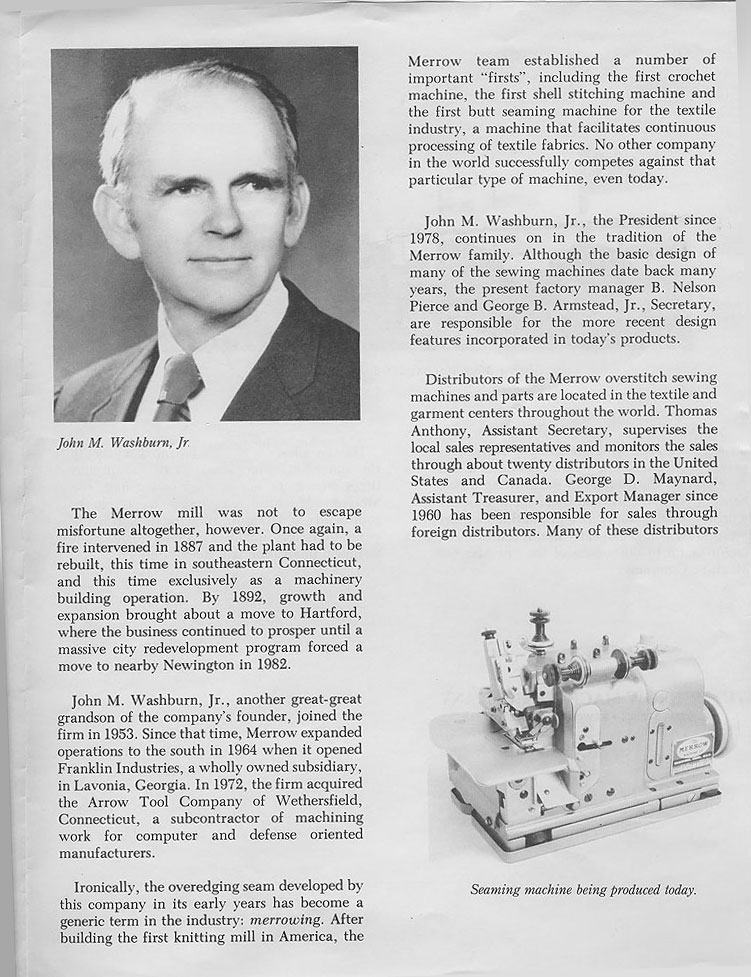
By the early 1900s, Merrow had expanded internationally with representatives in 35 countries and manuals published in more than a dozen languages. Employing over 500 workers in Hartford, the company patented the MG-3U Emblem Machine in 1955. To optimize costs and adapt to evolving textile markets, a manufacturing plant was opened in Lavonia, Georgia during the mid-1960s.
Although the Delta Class overlock machine was developed in the 1990s, it did not achieve commercial success. In 2004, Charlie Merrow led a management buyout and rebranded the company as Merrow Sewing Machine Company.
The Merrow Sewing Machine Company
Following its restructuring in Massachusetts, the firm pledged ongoing support for nearly all sewing machine models created since 1925 and reissued modernized versions of well-known machines. Utilizing its registered terms "merrowed" and "merrowing," the company collaborated with manufacturers to highlight "merrow" stitching as a unique selling point.
In 2008, Merrow introduced merrowing.com, a digital community tailored for stitching aficionados, complemented by multimedia resources aimed at educating users about the diverse stitches produced by Merrow equipment—showcasing the company's sustained commitment to innovation in digital engagement consistent with its strategic goals.
Present day
Currently based in Fall River, Massachusetts, The Merrow Sewing Machine Company is operated by Charlie and Owen Merrow, who are great-great-nephews of founder Joseph M. Merrow. The enterprise continues to produce a broad selection of overlock sewing machines and is internationally acknowledged as one of the longest-standing sewing machine manufacturers in the United States.
Activeseam
Merrow unveiled the Activeseam stitch in 2008, designed to advance flatlock and coverstitch methods specifically for technical apparel. Promoted as offering enhanced comfort and quality compared to conventional flatlock seams, Activeseam produces a distinctive seam that combines visual appeal with practical advantages.
Activeseam stitches are generated using Merrow's latest MB series machines and come in several variants: Minimal (almost invisible), Slim (a narrow flat seam), Comfort (a wide flat seam), and Infused 3D (a three-thread seam that reveals concealed colors when stretched).
Timeline
- 1822: J. Makens Merrow purchases a powder mill in Mansfield, Connecticut; it suffers destruction due to an explosion in 1830.
- 1838: J. Makens Merrow and his son Joseph B. Merrow establish the first knitting mill in America on the former powder mill grounds.
- 1840s: Creation of a machine shop dedicated to developing knitting machinery.
- 1877: Joseph M. Merrow, then company president, invents and obtains a patent for the first crochet machine.
- 1892: Expansion of facilities leads to reconstruction in Hartford, Connecticut.
- 1894–1947: More than 100 patents awarded, including innovations such as the initial shell-stitching and butt-seaming machines.
- 1964: Growth into southern markets with Franklin Industries subsidiary established in Lavonia, Georgia.
- 1972: Purchase of Arrow Tool Company, a machining subcontractor based in Connecticut.
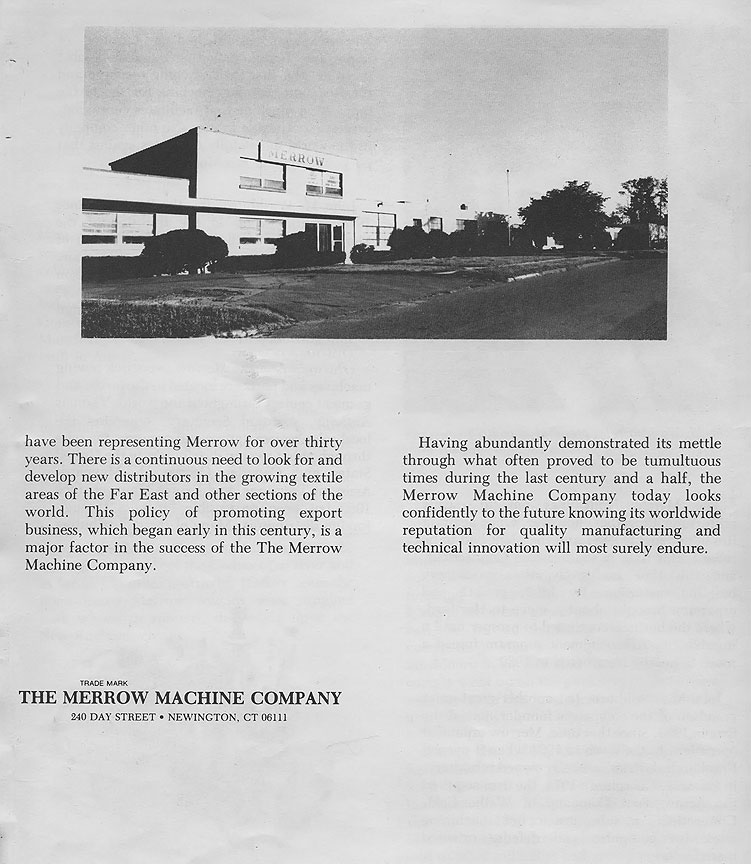
- 1982: Headquarters moved from Hartford to Newington, Connecticut.
- 2004: Charlie and Owen Merrow, joined by Robert Merrow, complete a buyout; headquarters relocated to Wareham, Massachusetts; company rebranded as The Merrow Sewing Machine Company.
- 2005: Affirmation of ongoing production for all principal sewing machine lines.
- 2008: Introduction of digital initiatives including video guides, an interactive stitch finder, social platform merrowing.com, needle configurator, and e-commerce store.
- 2010: Relocation to Fall River’s historic Granite Mill Buildings; establishment of the only industrial sewing machine Sample Room in the U.S.; expansion of product offerings to include custom machines.
- 2012: Debut of Activeseam technology.
- 2020: Shifted manufacturing focus toward facemasks and clinical PPE production amid worldwide demand.
See also
External links
- Interview featured in the Patriot Ledger
- Merrow family archives and documents, 1800-1948
- Financial records, 1838-1893, J.B. Merrow and Sons
- Federal court ruling on Merrow patents: "WILLCOX & GIBBS SEWING-MACH. co. V. MERROW MACH. CO."
- Article titled "Merrow, Connecticut," dated March 1, 1997, based on Gilbert O. Southwick's 1868 interviews
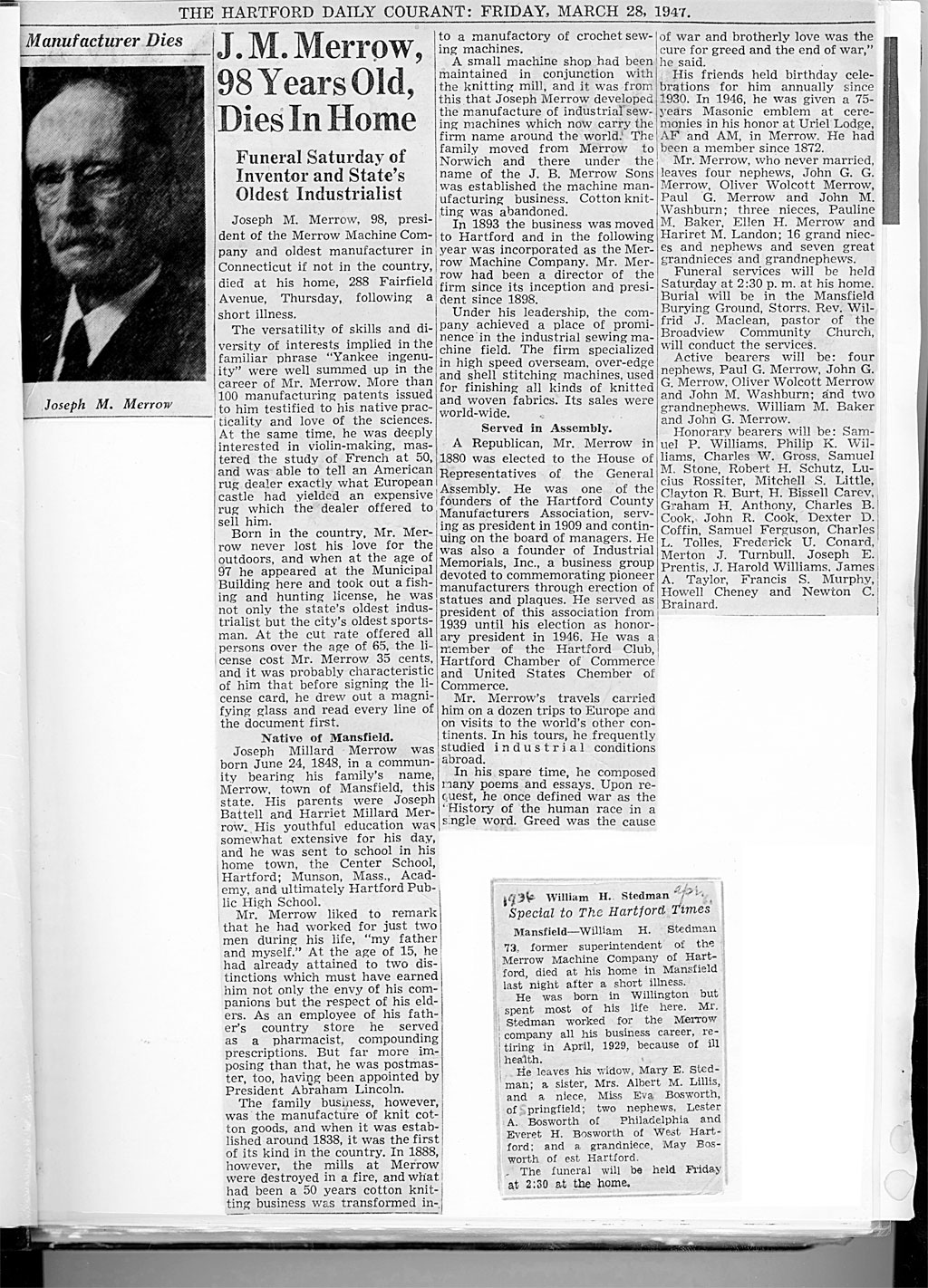
- Obituary of J. M. Merrow published in The Hartford Daily Courant, 1947
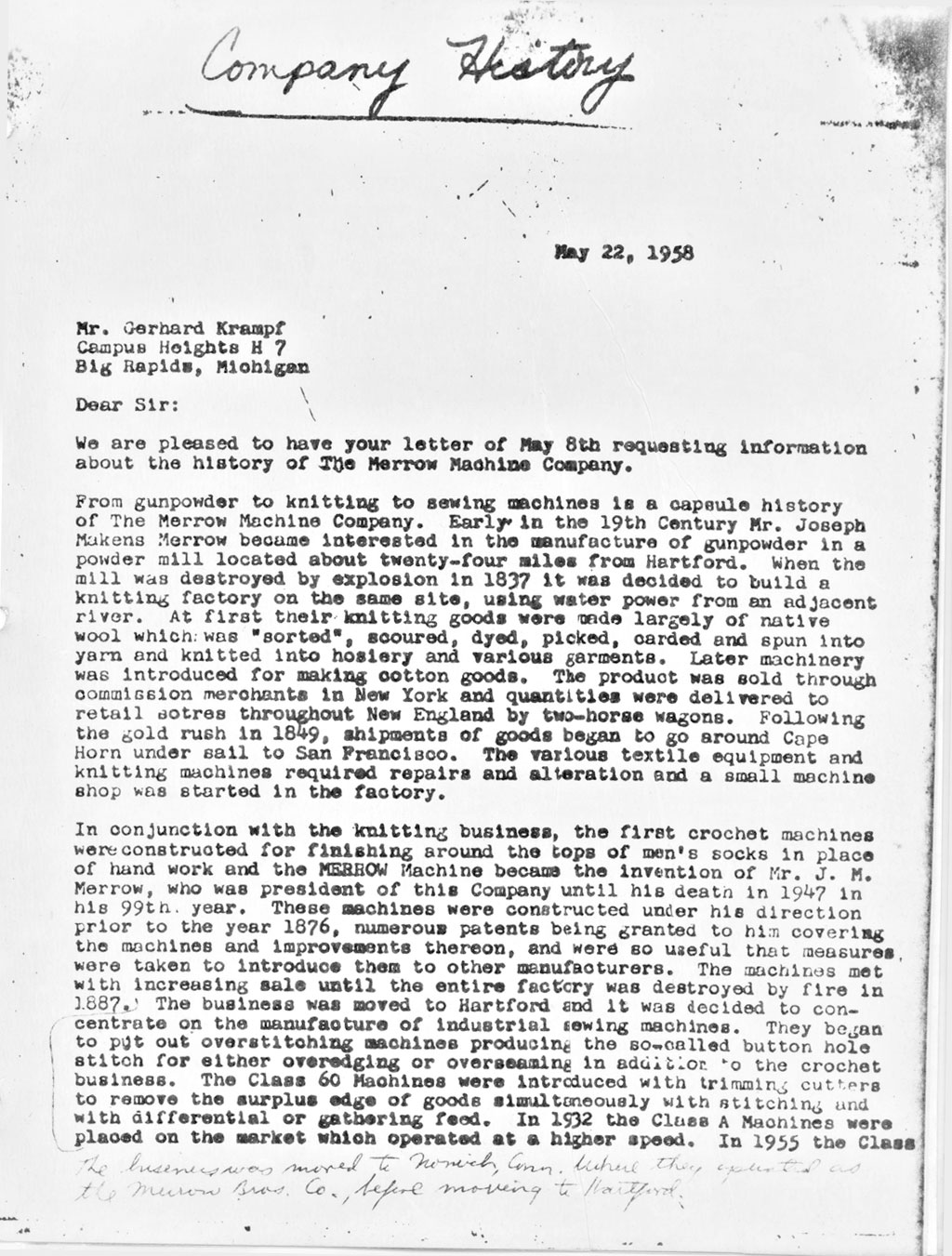
- "Company History," correspondence from the company Treasurer, May 22, 1958, page 1
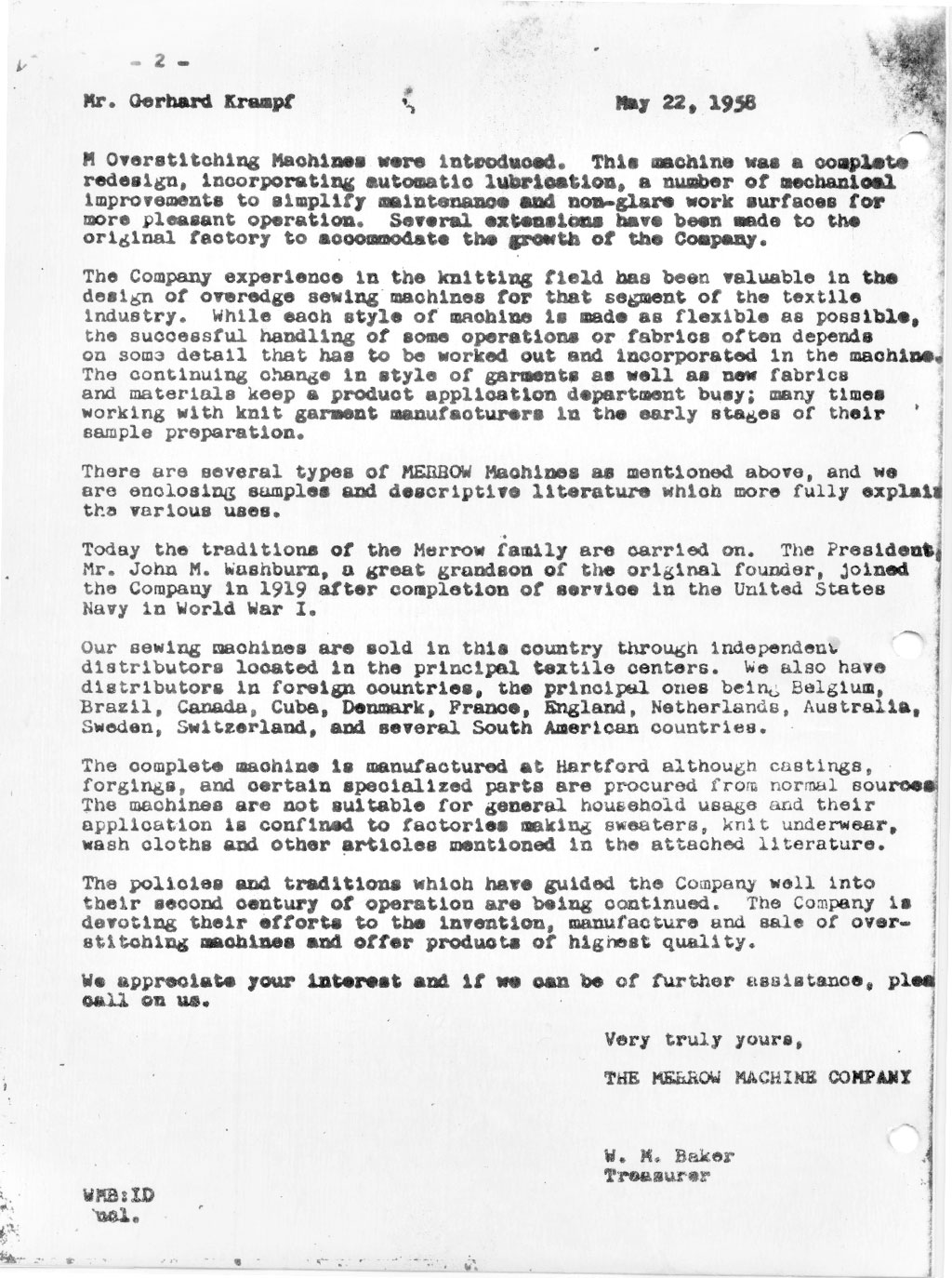
- "Company History," letter from the company Treasurer, May 22, 1958, page 2
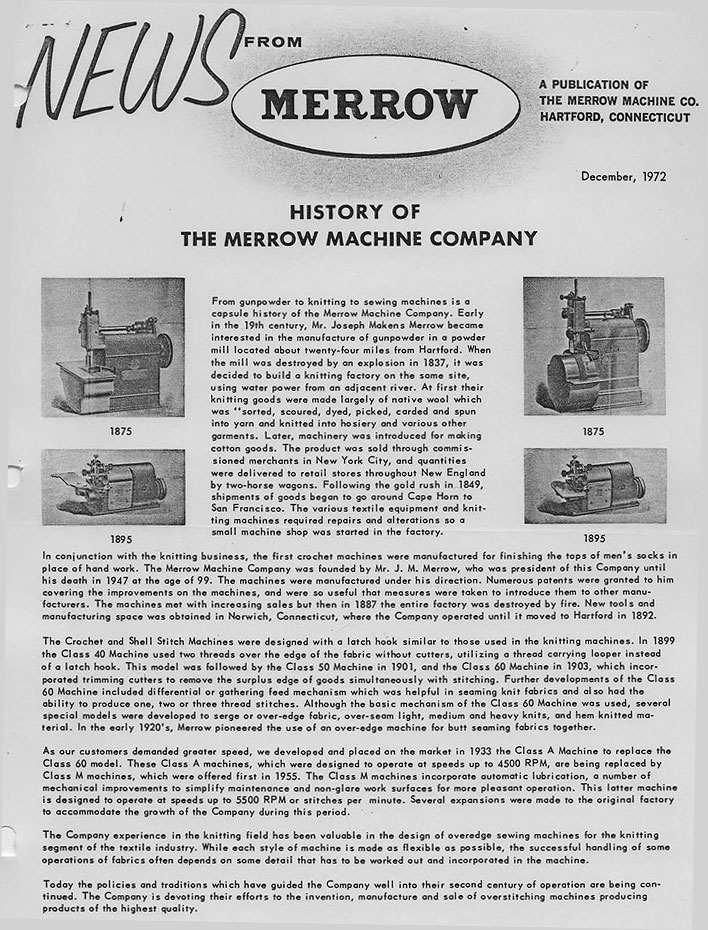
- "News from Merrow," December 1972 issue
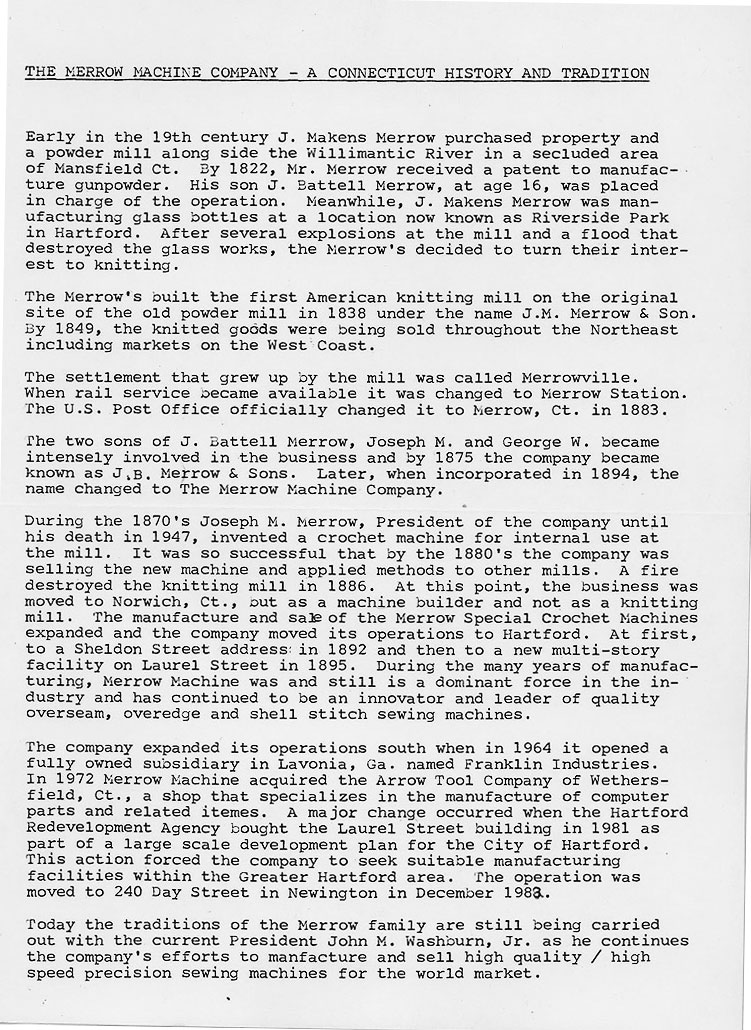
- "The Merrow Machine Company – Connecticut History and Tradition," circa 1982
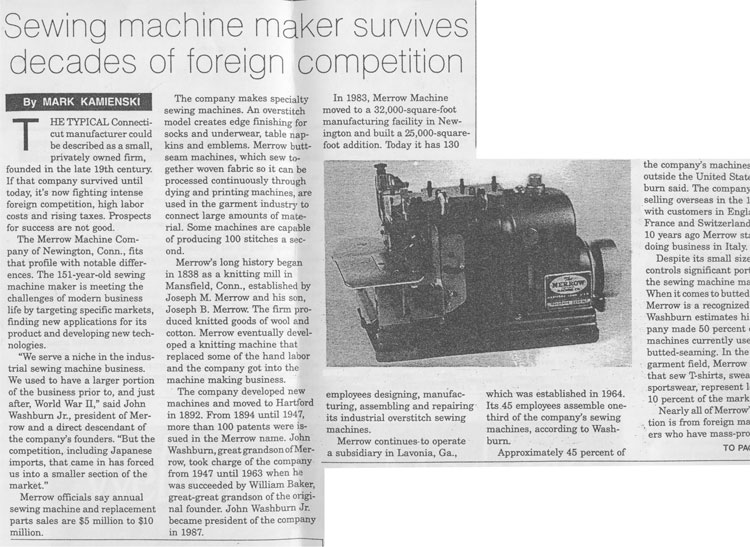
- Newspaper feature including photograph, around 1987
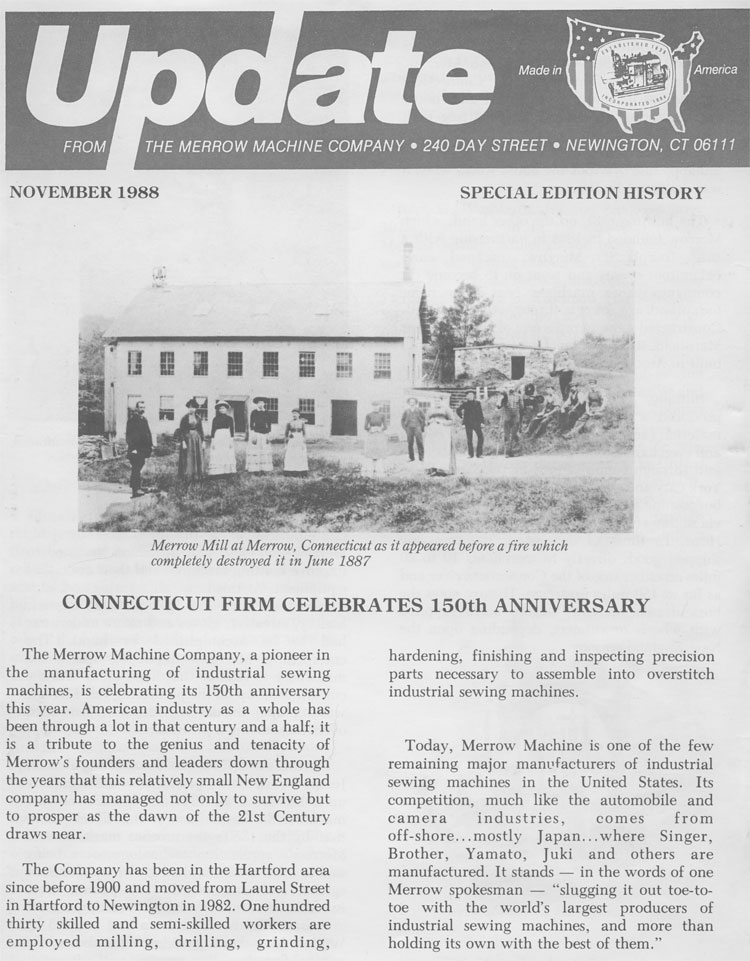
- "UPDATE from the Merrow Machine Company," November 1988, page 1
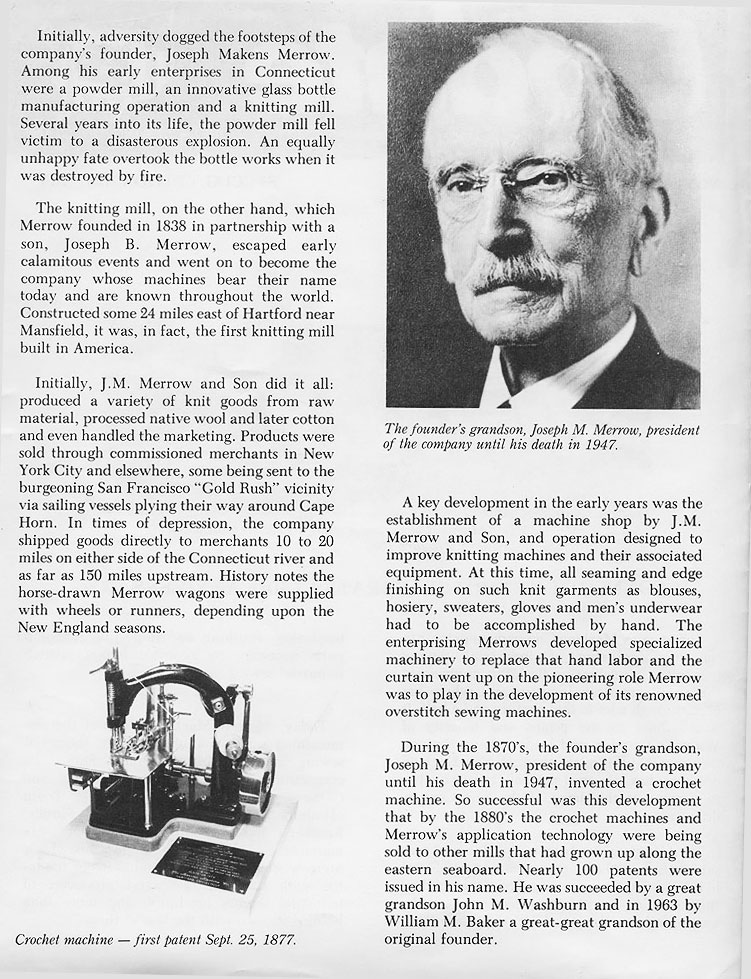
- "UPDATE from the Merrow Machine Company," November 1988, page 2
- "UPDATE from the Merrow Machine Company," November 1988, page 3
- "UPDATE from the Merrow Machine Company," November 1988, page 4