
Messerschmitt Me 163 Komet
| Industry | Aerospace, Defense |
|---|---|
| Founded | 1938 |
| Founder | Willy Messerschmitt |
| Headquarters | Augsburg , Germany |
| Products | Aircraft, including the Me 163 Komet |
The Messerschmitt Me 163 Komet represents a rocket-powered interceptor aircraft developed and manufactured by the German firm Messerschmitt. It holds the distinction of being the sole rocket-propelled fighter to enter operational service and was the first manned aircraft to surpass 1,000 kilometres per hour (620 mph) in horizontal flight.
Its origins date back to 1937, stemming from the efforts of German aeronautical engineer Alexander Lippisch and the Deutsche Forschungsanstalt für Segelflug (DFS). Initially conceived as an experimental project merging conventional glider concepts with novel technologies such as rocket propulsion, progress was hindered by organizational challenges until Lippisch’s team was integrated into Messerschmitt in January 1939. Early plans for a propeller-driven transitional model were abandoned in favor of advancing directly to rocket-powered designs. The prototype’s first flight on 1 September 1941 showcased remarkable performance and validated its innovative design. Impressed by these results, German authorities swiftly initiated plans for widespread deployment of Me 163 interceptors for point-defense roles throughout Germany. By December 1941, development commenced on the improved Me 163B, tailored for mass production.
In early July 1944, test pilot Heini Dittmar achieved an unofficial flight speed record of 1,130 km/h (700 mph), a benchmark that remained unsurpassed by turbojet fighters until 1953. That year also marked the beginning of operational missions for the Me 163, primarily tasked with intercepting enemy bombing raids. Within the framework of their alliance with the Empire of Japan, Germany shared design blueprints and supplied a single Me 163 unit to Japan, which inspired the creation of the Mitsubishi J8M. By war’s end, approximately 370 Komets had been produced, with most deployed in active service. Despite its groundbreaking nature, several inherent limitations remained unresolved, resulting in less combat effectiveness than anticipated. The aircraft’s powered endurance was limited to about 7.5 minutes, significantly restricting its operational range and tactical utility. Although development efforts continued—most notably leading to the Messerschmitt Me 263—many enhancements failed to reach combat deployment due to advancing Allied forces in Germany during 1945.
Following its introduction into service, the Me 163 was credited with downing between nine and eighteen Allied aircraft while sustaining ten losses.[1] [2] Besides combat attrition, numerous pilots lost their lives during takeoff[3] or in testing and training flights.[4] The elevated fatality rate was partly attributable to the volatile and corrosive nature of the rocket propellants employed in later versions.[3] Notably, German ace Oberleutnant Josef Pöhs died in 1943 from exposure to T-Stoff combined with injuries sustained in a failed takeoff incident that ruptured a fuel line.[5] Aside from Nazi Germany, no other country utilized the Me 163 operationally; the only other rocket-powered combat aircraft was Japan’s Yokosuka MXY-7 Ohka, which functioned as a piloted flying bomb.
Initial Contributions by Alexander Lippisch

The pioneering piloted rocket flights originated from the German automotive company Opel RAK. The inaugural flight of a rocket-propelled aircraft, a glider modified with rockets and designed by Alexander Lippisch, occurred on 11 June 1928 at Wasserkuppe Mountain.[6] This craft was equipped with two black powder rockets, engineered by Friedrich Wilhelm Sander, mounted at the rear. Because of its forward canard configuration, Lippisch dubbed the glider "Ente," which translates to "duck" in German.[7] After an unsuccessful initial trial, one rocket finally ignited properly, enabling the Ente to lift off. Test pilot Fritz Stamer flew it approximately 4,900 feet (1,500 m) before executing a controlled landing. A subsequent flight utilizing both rockets ended disastrously when one exploded; despite the remaining active rocket causing takeoff, control surfaces failed to respond, and with the aircraft engulfed in flames, Stamer narrowly escaped while the Ente was destroyed.[8]
Following the destruction of the Ente, Fritz von Opel commissioned a purpose-built rocket aircraft named the Opel RAK.1. Designed by Julius Hatry, another early Wasserkuppe innovator, it also utilized Friedrich Sander’s Opel RAK rockets.[9] The first publicly witnessed rocket plane flight occurred in Frankfurt on 30 September 1929. Meanwhile, Lippisch continued his independent design efforts over subsequent years, particularly focusing on rocketry, eventually culminating in the Me 163.[10]
Context and Background


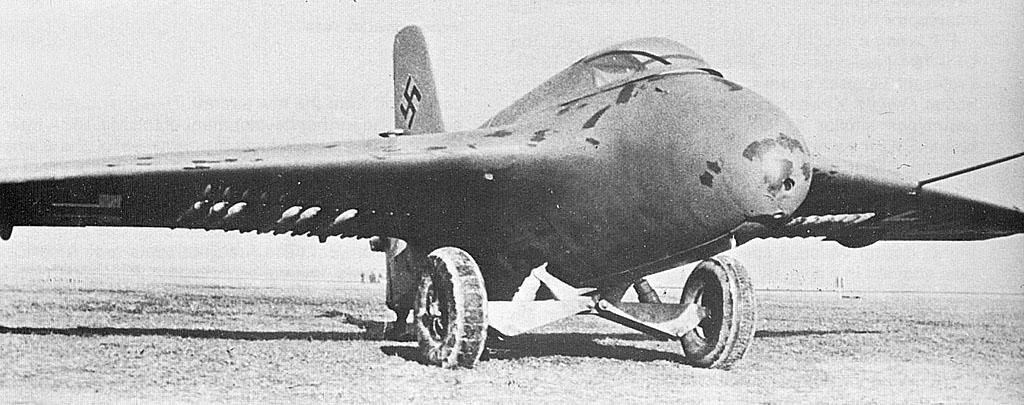
Work on what would later become the Me 163 began in 1937,[11] initially undertaken by the Deutsche Forschungsanstalt für Segelflug (DFS), Germany’s Institute for sailplane research. Their preliminary design was a conversion of Alexander Lippisch’s earlier Lippisch Delta IV, designated as the DFS 39, serving solely as a glider airframe testbed. This was followed by a larger iteration featuring a small propeller engine called the DFS 194. This model initially incorporated wingtip-mounted rudders that Lippisch believed would present stability challenges at elevated speeds. Consequently, he replaced these with a conventional rear-mounted vertical stabilizer on the DFS 194. Retaining its glider heritage, the design featured a retractable landing skid integrated into the aircraft’s keel for touchdown. Due to fuel weight considerations, takeoff required dual wheels attached to a specialized cross-axle forming a detachable takeoff dolly beneath the skid; these wheels were jettisoned shortly after liftoff.[12][13]
The project aimed to incorporate the upcoming Walter R-1-203 cold engine delivering 400 kg (880 lb) thrust. Similar to the self-contained Walter HWK 109-500 Starthilfe RATO booster unit, this engine utilized a monopropellant consisting of stabilized HTP, known as T-Stoff. Concurrently, Heinkel collaborated with Hellmuth Walter on rocket engines installed in testbeds such as the He 112R, competing against Wernher von Braun's bi-propellant alcohol/LOX engines also tested on Heinkel airframes. Heinkel had also developed HTP-based propulsion systems catalyzed by Z-Stoff for liquid-fueled aircraft like the pioneering He 176. When production began on the DFS 194 fuselage, Heinkel was tasked with its manufacture due to concerns over using wooden structures with highly reactive monopropellant fuels. The project progressed under the codename Projekt X.[14][15]
Coordination between DFS and Heinkel proved problematic,[16] notably because DFS struggled to construct even prototype fuselages.[17] As a result, Lippisch requested reassignment to Messerschmitt.[N 1] On January 2, 1939, Lippisch relocated with his team and their partially completed DFS 194 airframe to Messerschmitt’s Augsburg facility. This transition delayed progress but allowed engine development to advance significantly. At Messerschmitt, plans shifted away from propeller-driven versions towards exclusively rocket propulsion. The airframe was completed in Augsburg and early in 1940 transported to install its engine at Peenemünde-West—one of four Reich-designated Erprobungsstelle military aviation testing sites. While engine reliability remained problematic, flight tests demonstrated exceptional performance with speeds reaching up to 550 km/h (340 mph).[20]
It is critical to understand that wing sweep in this design derived from its tailless configuration and requirements to balance center of gravity (CG) and center of lift (CL) for stability—not from high-speed aerodynamic optimization. Both Me 163 and Me 262 incorporated sweep primarily due to CG and CL alignment issues (with heavier-than-planned engines influencing Me 262’s design), rather than speed-related factors.[21]
In Me 163B and -C variants, a ram-air turbine was installed at the extreme front of the fuselage nose which charged an internal backup lead–acid battery supplying electrical power for onboard systems.[22] These systems included radio communication equipment, reflector gunsights (models Revi16B through -D), direction finder instruments, compass navigation aids, firing circuits for twin cannon armament, and some cockpit instrument lighting. Due to limited battery capacity alone, this generator was essential.[22]
Airspeed indication was derived from averaging data collected via two sources: a pitot tube located on the leading edge of the port wing and an additional small pitot inlet positioned above the upper edge of the underskid channel near the nose.[citation needed] Additionally, pressure tapped from this pitot tube supplied input for rate-of-climb instrumentation.[citation needed]
An Austrian resistance group led by priest Heinrich Maier (later executed) maintained contact with Heinkelwerke facilities in Jenbach (Tyrol), where key components for the Me 163 were produced. This group provided Allied forces with detailed sketches of production sites that significantly enhanced targeted bombing campaigns against these manufacturing locations.[23][24][25]
Me 163A

At the beginning of 1941, production commenced on a prototype series designated the Me 163. To maintain secrecy, the RLM assigned the airframe number 8-163—originally linked to the earlier Messerschmitt Bf 163—hoping foreign intelligence would associate the designation with that prior model. Three Bf 163 prototypes (V1 through V3) had been constructed, reinforcing this deception. In May 1941, the first Me 163A prototype, V4, was transported to Peenemünde for installation of the HWK RII-203 rocket engine. By 2 October 1941, Me 163A V4, identified by its radio call sign "KE+SW", established a new world speed record of 1,004.5 km/h (624.2 mph), piloted by Heini Dittmar, with no visible damage sustained during the run.[26] Some postwar aviation sources mistakenly attributed this record to the Me 163A V3.[27] This speed mark of approximately 1,004 km/h (542 kn; 624 mph) remained unbeaten officially until after World War II, specifically surpassed by the American Douglas D-558-1 Skystreak on August 20, 1947. A total of ten Me 163As (V4 through V13) were produced for pilot instruction and further evaluation; these variants were unarmed.[13]


During prototype testing of the A-series, the jettisonable undercarriage posed significant challenges. The initial dollies featured independently sprung wheels with substantial suspension,[28] but upon takeoff, these large springs would rebound forcefully and strike the aircraft. In contrast, production B-series aircraft utilized simpler dollies with crossbeam axles and depended on an oleo-pneumatic strut-equipped landing skid[29] to absorb shocks during ground roll and landing impacts. If this hydraulic strut malfunctioned or if the skid was inadvertently left locked and lowered during landing—its required position for takeoff—a hard touchdown could result in back injuries to pilots.[30][31]
Once landed, recovery of the aircraft required a Scheuch-Schlepper, a repurposed small agricultural tractor,[32] originally designed as a two-wheel tractor with an added detachable third swiveling wheel at its rear for stability during farming tasks. For military use supporting the Komet, this third wheel was replaced by a pivoting retrieval trailer equipped with dual sets of short triple-wheeled continuous tracks on each side. This trailer typically featured twin lifting arms that raised the stationary aircraft beneath each wing when it rested on its ventral skid and tailwheel after missions or when not supported on its dolly main gear.[33] Another experimental variant tested during trials with later B-series models employed inflatable sausage-shaped airbags instead of lifting arms; these could be inflated by towing via the Scheuch-Schlepper tractor to elevate the aircraft.[34][35] The three-wheeled Scheuch-Schlepper tractor was initially intended for agricultural applications but was adapted with specialized trailers capable of fully lifting the Me 163 airframe off the ground for recovery purposes—an essential function since after exhausting its rocket fuel and jettisoning its dolly gear at takeoff, the Komet landed without power and lacked conventional wheels.[36]
Flight trials revealed that while the Komet exhibited excellent gliding characteristics, this trait complicated safe landings. As an unpowered aircraft nearing touchdown, even minor updrafts could cause it to lift again unexpectedly. Since powered go-arounds were impossible, pilots had only one chance to land correctly. Production variants incorporated landing flaps to improve control during descent somewhat; however, this remained a persistent challenge throughout development. Despite these difficulties, performance was exceptional enough that plans existed to station Me 163 units within a 40-kilometre rings (25 mi) radius around strategic targets across Germany.[N 2] Nonetheless, despite encouragement toward operational deployment, competing priorities from other aircraft programs meant that development lacked top-level focus and consequently progressed slowly.[38]
Me 163B

Development of an enhanced model commenced in December 1941, driven by the need for a streamlined airframe construction process. The original Me 163A was not ideally suited for mass manufacturing. This led to the creation of the Me 163B variant, featuring a redesigned fuselage and wing panels optimized for large-scale production. It incorporated a retractable landing skid and tailwheel, along with the previously mentioned unsprung dolly takeoff gear. The forward fuselage was redesigned with a one-piece conical nose that could house a turbine to provide additional electrical power during flight. Additionally, a single-piece canopy hinged on a perimeter frame was introduced to facilitate easier assembly.[39]Template:Failed verification[40]

At the same time, Walter began developing a new bipropellant "hot engine," the HWK 109-509, which utilized a combination of hydrazine hydrate and methanol fuel known as C-Stoff. This fuel burned using oxygen-rich exhaust from the oxidizer T-Stoff, producing increased thrust. This new propulsion system, along with numerous design modifications aimed at simplifying production compared to the earlier A-series airframe, resulted in the substantially revised Me 163B introduced in late 1941. Compliance with the Reichsluftfahrtministerium mandate for engine throttling added complexity to the powerplant, which ultimately compromised its reliability.Template:Fix/category[citation needed] The aircraft carried no more than 437 US gallons (1,650 L) of propellant, which was depleted within four to seven minutes, restricting its operational range to approximately 25 miles (40 km).[3]
The fuel system presented significant challenges, as leaks caused by hard landings frequently led to fires or explosions. Metal fuel lines and fittings—though prone to unpredictable failures—were employed as they represented the best available technology at the time. Both fuel and oxidizer were highly toxic, necessitating meticulous handling during refueling operations. Despite precautions, there were instances when Komets detonated on the ground due to the hypergolic nature of their propellants. Each propellant was a clear fluid delivered by separate tanker trucks: typically, C-Stoff (the hydrazine/methanol-based fuel) was loaded first. After securely capping the rear dorsal fuselage filling point just ahead of the vertical stabilizer, this truck would depart before the second tanker arrived. The latter carried the highly reactive T-Stoff hydrogen peroxide oxidizer, which was filled through another dorsal fuselage port located just behind the canopy's rear edge.[41]
Due to the corrosive properties of especially T-Stoff, pilots had to wear specialized protective clothing. To mitigate explosion risks, comprehensive washing procedures were implemented before and after flights; water was flushed through propellant tanks and rocket engine systems to remove residual chemicals.[42] Approximately 120 liters (31.7 US gallons) of T-Stoff oxidizer were stored close to the pilot in two auxiliary tanks flanking the cockpit’s lower sides, supplementing a main oxidizer tank of about 1,040 liters (275 US gallons) located just behind the cockpit bulkhead. This proximity posed serious safety hazards in case of fuel-related accidents.[43]
Following two prototypes, production included thirty Me 163 B-0 pre-production aircraft equipped with two 20 mm MG 151/20 cannon and approximately four hundred Me 163 B-1 models armed with two 30 mm (1.18-inch) MK 108 cannons but otherwise similar to B-0s. Early in WWII, German manufacturers appended "a" to denote export (ausland) versions or foreign-built variants (Ba-1). However, no export or foreign-built versions of the Me 163 existed. Later in the conflict, suffixes like "a" or subsequent letters indicated different engine types—as seen in Me 262 A-1a with Jumo engines and Me 262 A-1b with BMW engines. Since an alternative BMW P3330A rocket engine was planned for some Me 163s,[44] it is probable that "a" designated these early examples. Only one prototype (the V10) underwent testing with this BMW engine before dropping this suffix entirely. The Me 163 B-1a lacked wingtip "washout," resulting in a higher critical Mach number compared to the B-1.[45]
The Me 163B exhibited very forgiving landing behavior largely due to integrated leading edge slots positioned immediately ahead of the elevon control surfaces and aligned with the wing's leading edge angle. This design prevented stalls and spins—the aircraft could be flown with full aft stick through turns without risk of entering a spin and it handled slips well. Its glider-inspired airframe endowed it with excellent soaring capabilities and pronounced ground effect near landing surfaces. However, executing tight turns from base leg onto final approach increased sink rate rapidly, risking short landings. Unlike propeller-driven aircraft, there was no slipstream over the rudder during takeoff; pilots had to reach approximately 129 km/h (80 mph) before aerodynamic controls became effective—a critical phase requiring careful stick positioning by those accustomed to piston-engine planes. These unique handling traits necessitated specialized pilot training.[46]
In terms of performance, the Me 163 surpassed contemporary piston-engine fighters by a wide margin. It achieved takeoff speeds exceeding 320 km/h (200 mph) using its two-wheeled dolly during a so-called Template:-"scharfer StartTemplate:-" ("hot start"). The pilot maintained level flight at low altitude until reaching an optimal climb speed near 676 km/h (420 mph), then jettisoned the dolly and retracted its extendable skid via a knob-topped lever located just ahead of the throttle on the cockpit’s port side—both controls positioned atop the oxidizer tank—activating a pneumatic cylinder.[47] Subsequently, it climbed steeply at approximately a seventy-degree angle to bomber cruising altitudes and could reach altitudes up to 12,000 m (39,000 ft) within an unprecedented three minutes. Upon leveling off at altitude, it accelerated rapidly to speeds around 880 km/h (550 mph) or higher—performance unmatched by any Allied fighter at that time. Although its usable Mach number paralleled that of the Me 262 jet fighter, pilots faced greater difficulty recognizing compressibility effects due to its high thrust-to-drag ratio, prompting installation of a Mach warning system for safety. Despite these challenges, it remained highly maneuverable and stable at high speed; chief test pilot Rudolf Opitz remarked that it could "fly circles around any other fighter of its era."Template:Fix/category[citation needed]
By this stage in production, Messerschmitt was heavily burdened by commitments to manufacture Messerschmitt Bf 109 fighters and introduce the Messerschmitt Me 210. Consequently, production responsibilities shifted initially to Klemm within a dispersed manufacturing network but quality issues led to transferring work to Junkers—who had available capacity at that time. Consistent with many late-war German aircraft designs, components such as wings were constructed from wood by furniture makers due to material shortages. Earlier Me 163A models and first batch B prototypes served primarily as trainers. Plans existed for an Me 163S, which eliminated rocket propulsion and fuel tanks in favor of installing a second seat for an instructor positioned above and behind the pilot under an additional canopy section. This variant was intended for glider landing training—a critical skill given operational demands—and appears to have been converted from earlier Me 163B prototypes.[48]
Operational experience revealed significant difficulties employing the Me 163 against enemy aircraft effectively. Its extreme velocity and rapid climb meant targets were reached and passed within seconds only—requiring exceptional marksmanship from pilots despite stable gun platform characteristics. Armament consisted of two relatively low muzzle velocity (540 m/s or 1,772 ft/s) MK 108 cannons firing large-caliber rounds accurate only at close range—making precision hits on slow-moving bombers extremely challenging. Typically four or five hits were necessary to down a heavily armored Boeing B-17 Flying Fortress.[49]
To enhance combat effectiveness, innovative weaponry was trialed—including the Sondergerät 500 Jägerfaust, an upward-firing armament system akin to Schräge Musik. It comprised ten single-shot short-barreled 50 mm (2-inch) guns mounted five per wing root on each side of the aircraft’s underside surface. Activation relied on a photocell sensor embedded in the upper wing surface that detected brightness changes when flying beneath enemy bombers—triggering simultaneous firing upwards through their vulnerable undersides. Each fired shell expelled its disposable barrel downward rendering it recoilless.[50][51][52][53] Combat use appears limited to a single confirmed engagement where this system successfully destroyed a Lancaster bomber on April 10, 1945.[54]
Later Developments


A primary limitation of the initial design was its extremely brief powered flight duration, which consistently fell short of Walter’s original estimates. The rocket-powered Me 163B could sustain thrust for a maximum of only 7.5 minutes—approximately one-quarter of the 30-minute combat endurance offered by the "light-class" Heinkel He 162A Spatz jet fighter equipped with a single BMW 003 engine—when it entered service in April 1945. This constrained endurance rendered the Me 163B a specialized point defense interceptor. To address this, Walter developed two enhanced variants of the 509A rocket motor: the 509B and 509C. Both featured dual combustion chambers arranged vertically, each chamber differing in size to optimize performance.[55] The primary combustion chamber, or Hauptofen, on the B model resembled the single-chamber 509A in external form, while the C model’s forward chamber was more cylindrical, designed to deliver increased thrust around 2,000 kg (4,410 lb). This redesign also abandoned the cubic framework used in earlier models for propellant flow and turbopump components.[56][57] Both the 509B and C maintained thrust tube support for their main combustion chambers similar to the single-chamber 509A. These engines were optimized for high thrust during takeoff and climb phases. Additionally, a smaller lower chamber known as the Marschofen, producing roughly 400 kg (880 lb) thrust at peak output, was incorporated to enable more efficient cruising power. These dual-chamber HWK 109–509B and C motors extended flight endurance by up to 50%. Two Me 163B units—the V6 and V18 prototypes—were experimentally equipped with the lower-thrust B variant of this twin-chamber engine, which necessitated dual combustion chamber pressure gauges on their instrument panels.[58] Both also featured retractable tailwheels and were tested in spring 1944.[55][59]
The main Hauptofen combustion chamber in the B V6 and V18 was installed in the same position as on earlier A-series engines, whereas the smaller Marschofen cruise chamber was housed within an enlarged ventral tail fairing that incorporated a retractable tailwheel. On July 6, 1944, the Me 163B V18 (VA+SP)—essentially a standard production airframe modified to accommodate the twin-chamber "cruiser" motor and related structural changes beneath the original exhaust nozzle—achieved an unofficial speed record of 1,130 km/h (702 mph) under pilot Heini Dittmar. The aircraft landed with most of its vertical rudder surface damaged due to flutter.[60][61][62] This speed record remained unbroken in absolute terms until November 6, 1947, when Chuck Yeager surpassed it during flight number 58 of the Bell X-1 program, reaching Mach 1.35 (1,434 km/h (891 mph)) at nearly 14,820 m (48,620 ft) altitude.[N 3] However, it is uncertain whether Dittmar’s flight achieved altitudes sufficient to confirm supersonic speed as defined by later standards.
Notably, Yeager’s Bell X-1 did not exceed Dittmar’s speed during a conventional runway liftoff; Dittmar had attained 1,130 km/h (702 mph) after a standard "hot start" ground takeoff without air-dropping from another aircraft. Roughly five and a half years following Yeager’s milestone, Neville Duke surpassed Dittmar's speed record by flying a Hawker Hunter F Mk3 at 1,171 km/h (728 mph) on August 31, 1953—still about 263 kilometres per hour (163 mph) slower than Yeager's achievement—also after a normal ground start.[63][N 4] Postwar experimental aircraft with aerodynamic designs similar to that of the Me 163 encountered significant stability challenges when approaching transonic speeds; examples include jet-powered aircraft like the Northrop X-4 Bantam and de Havilland DH 108,[64] underscoring the significance of the V18’s record attained with the Walter HWK 109-509B "cruiser" motor.
Waldemar Voigt from Messerschmitt’s development team in Oberammergau initiated a redesign addressing both integration of the new twin-chamber Walter engine and other design shortcomings. The resultant Me 163C featured an enlarged wing through root inserts, an extended fuselage with additional fuel capacity via an aft plug section behind the wing, and a ventral fairing incorporating a retractable tailwheel similar to that on the Me 163B V6. Additionally, it introduced a pressurized cockpit topped with a bubble canopy for enhanced pilot visibility and eliminated the dorsal fairing present on earlier B variants. These modifications increased maximum operational altitude to approximately 15,850 m (52,000 ft) and nearly doubled powered flight duration to around twelve minutes—extending combat endurance from about five to nine minutes. Although three Me 163 C-1a prototypes were planned, only one appears to have flown—and without its intended engine.[65]
At this stage, responsibility for development shifted to Junkers under Heinrich Hertel at Dessau. Hertel's team evaluated the Me 163 and identified limitations regarding mass production suitability and fighter optimization—most notably its fixed landing gear system. To address this deficiency, what would become the Me 263 V1 prototype was designed with tricycle landing gear from inception and configured for installation of the twin-chamber Walter rocket motor—later incorporated into what became known as the Ju 248 program.[66][67][68]
The Junkers Ju 248 employed a three-section fuselage to simplify manufacturing processes. Its V1 prototype was completed by August 1944 and underwent glider trials behind a Junkers Ju 188. While some sources suggest that installation of the Walter HWK 109–509C engine occurred in September, powered testing likely never transpired. Subsequently, project oversight returned formally to Messerschmitt where it was redesignated as the Messerschmitt Me 263, although Junkers continued development and production planning.[69] Production plans were ultimately thwarted as Soviet forces captured facilities before operational deployment could occur. Nevertheless, development briefly persisted postwar within Soviet hands through Mikoyan-Gurevich as the Mikoyan-Gurevich I-270.[70]
Operational history

The initial operational introduction of the Me 163A, designed to familiarize pilots with the pioneering rocket-powered fighter, was conducted by Erprobungskommando 16 (Service Test Unit 16, EK 16). This unit was commanded by Major Wolfgang Späte and formed in late 1942, receiving eight A-model aircraft for service testing by July 1943. Their first station was the Erprobungsstelle (test center) at the Peenemünde-West airfield. Following an RAF bombing raid on 17 August 1943, they relocated south to Anklam, near the Baltic Sea. This posting was short-lived, as within weeks they moved again to northwest Germany, establishing themselves at the military airfield in Bad Zwischenahn from August 1943 until August 1944.[71] EK 16 received their initial armed Me 163B models in January 1944 and became combat-ready by May while stationed at Bad Zwischenahn. The first combat sortie in a Me 163B was flown by Major Späte on 13 May 1944 from this base, piloting the armed prototype (V41) identified by the Stammkennzeichen PK+QL.[72][73]
By early 1944, Allied aerial reconnaissance over German airfields had revealed the existence of the Me 163,[74] yet when EK 16 began limited combat missions in May 1944, Allied pilots struggled to counter the remarkable speed of the Me 163B. These fighters typically engaged alone or in pairs, often outpacing intercepting aircraft even during dives. A common tactic involved climbing vertically through bomber formations at around 9,000 m (30,000 ft), ascending further to between 10,700–12,000 m (35,100–39,400 ft), then diving back through while firing. This method allowed two brief firing opportunities before gliding back to base. Pilots noted that up to four attack passes could be made against a solitary bomber.[75] Historian Mano Ziegler reports that German authorities contemplated employing the Me 163 for suicide ramming missions against enemy aircraft; however, these extreme tactics were never implemented.[76]
Training for potential Me 163 pilots involved flying Stummelhabicht gliders, which shared the Komet's short wingspan and high landing velocity.[77] Gunnery drills included using a machine pistol mounted in the glider's nose.[78] Since the cockpit lacked pressurization, operational altitude was limited by pilot endurance while breathing oxygen through a mask without losing consciousness. Pilots underwent altitude chamber training to adapt to thin stratospheric air without pressure suits. Special low-fiber diets were prescribed to reduce gastrointestinal gas expansion during rapid ascent.[79]
After initial combat trials with EK16 during winter and spring of 1944, Major Späte established the Luftwaffe’s first dedicated Me 163 fighter wing, Jagdgeschwader 400 (JG 400), based in Brandis, near Leipzig.[80] JG 400’s primary mission was defending the Leuna synthetic fuel facilities frequently targeted throughout much of that year. Another squadron was positioned at Stargard near Stettin to protect the synthetic fuel complex at Pölitz (now Police, Poland). Additional rocket fighter units were planned for deployment around Berlin, the Ruhr, and along the German Bight.[81]

The first recorded combat action involving operational Me 163Bs took place on 28 July 1944 from I./JG 400’s Brandis base when two USAAF B-17 Flying Fortresses were engaged without confirmed kills. Combat sorties continued from May 1944 until spring 1945. Throughout this period, nine victories were confirmed against ten Me 163s lost in action. Feldwebel Siegfried Schubert emerged as the most successful pilot with three bomber kills credited.[82] Engagements often involved launching up to a dozen Me 163s simultaneously against B-17 formations.[83]
Allied pilots quickly recognized the limited powered flight duration of the Me 163 and adapted their tactics accordingly—waiting until after fuel depletion before attacking the now unpowered gliding fighter. Despite this limitation, the Komet remained highly agile during its glide phase and presented a challenging target. Another Allied countermeasure involved strafing attacks on airfields where Komets landed; after touchdown on its skid-based landing gear system, the Komet remained immobile until retrieved by a Scheuch-Schlepper tractor which attached its lifting trailer beneath the wings and either lifted or placed it back onto its take-off dolly for towing to maintenance.[84]
By late 1944, JG 400 had received ninety-one aircraft; however, persistent fuel shortages grounded most planes and prevented expansion of planned extensive Me 163 base networks. Up to that time JG 400 had lost only six aircraft due to enemy action and nine from other causes—a remarkably low figure for such an advanced experimental fighter. Into early 1945, Me 163s continued defending critical targets like the Daimler Benz tank factory in Berlin.[85] In Nazi Germany’s final days, operations ceased as focus shifted towards deploying more effective jet fighters like the Me 262. By early May 1945, all Me 163 missions ended; JG 400 was disbanded and many pilots transferred to fly Me 262s.[75]
From an operational perspective, the Komet did not achieve significant success. Although credited with sixteen aerial victories—primarily against four-engine bombers—the effort invested in its development was disproportionate to its combat impact. Fuel shortages late in the war restricted combat use and only highly skilled pilots could secure kills effectively. Nevertheless, the Me 163 influenced subsequent rocket-powered aircraft designs such as the vertical-launch Bachem Ba 349 Natter. Ultimately, point-defense responsibilities were assumed by surface-to-air missiles like Messerschmitt’s own Enzian.[73]
Postwar Flight
Captain Eric Brown RN, who served as Chief Naval Test Pilot and led the Captured Enemy Aircraft Flight, conducted evaluations of the Me 163 at the Royal Aircraft Establishment in Farnborough. He remarked, "The Me 163 was not an aircraft you could simply hop into and decide to push to its limits. It required thorough familiarization because it represented cutting-edge technology."[86] Despite official discouragement following several incidents involving Allied pilots flying captured German planes, Brown was resolute in flying a powered Komet. Around 17 May 1945, with assistance from a cooperative German ground crew, he piloted an Me 163B at Husum, having first completed towed flights in an Me 163A to gain handling experience.[87]
The day prior to the flight, Brown and his ground team ran an engine test on the selected Me 163B to verify operational readiness. The German technicians were initially uneasy about the risks to Brown but consented after he signed a waiver confirming that they were acting under his direction. On the rocket-powered Template:-"scharfer-startTemplate:-" takeoff the following day, after releasing the takeoff dolly and retracting the skid, Brown later described the climb as "like being in charge of a runaway train," with the aircraft reaching 32,000 feet (9,800 m) altitude within 2 minutes and 45 seconds. During the mission, while practicing attack runs on an American B-17 bomber, he was impressed by how effectively the Komet accelerated during dives even with the engine off. The landing proceeded smoothly despite limited cockpit visibility caused by the shallow glide angle, touching down at approximately 200 km/h (120 mph). After safely landing, Brown and his relieved ground crew marked the occasion with a celebratory drink.[88][89]
Apart from Brown’s unauthorized powered flight, British forces never conducted powered tests of the Me 163 themselves; due to the hazardous nature of its hypergolic fuels, it was only flown in unpowered gliding tests. Brown personally flew RAE’s Komet VF241 several times with its rocket engine removed and replaced by instrumentation for testing purposes. In a television interview during the 1990s, Brown revealed that he had flown five tailless aircraft throughout his career (including the British de Havilland DH 108). Regarding the Komet, he stated it was "the only one that had good flight characteristics," while describing the other four as "killers."[90]
Surviving aircraft
Reports suggest that a minimum of 29 Komets were transported out of Germany following the war, with at least 10 confirmed to have survived and are now exhibited in museums globally. The majority of these surviving Me 163s belonged to JG 400 and were seized by British forces at Husum, the squadron’s location at Germany’s surrender in 1945. According to records from the RAF museum, 48 units were captured intact, with 24 sent to the United Kingdom for assessment. However, only one aircraft, VF241, underwent an unpowered test flight.
Australia

- The Me 163B bearing Werknummer 191907 was part of JG 400 and captured at Husum before being sent to the RAE. It received the RAF Air Ministry designation AM222 and was transferred from Farnborough to No. 6 MU at RAF Brize Norton on 8 August 1945. The aircraft appeared in the No. 6 MU census on 21 March 1946 and was reassigned to No. 76 MU (Wroughton) by 30 April 1946 for export to Australia. For many years, it was displayed at RAAF Williams Point Cook until its relocation in 1986 to The Australian War Memorial for restoration. Stored at the AWM Treloar Technology Annex in Mitchell, it was refurbished and reassembled before being displayed alongside a Messerschmitt Me 262A-2a, Werknummer 500200 (AM81).
Canada

- The Canada Aviation and Space Museum in Ottawa holds a Me 163B with Werknummer either 191659 (AM215) or 191914 (AM220). This aircraft was captured at Husum as part of JG 400 and shipped to Canada in 1946.
- Additional aircraft with Werknummer 19116 (more likely 191916) and 191095 (AM211) have also reportedly been part of this museum’s collection.
Germany

- A Me 163B identified as Werknummer 191904, "Yellow 25", from JG 400 was taken by the RAF at Husum in 1945. Initially sent to Farnborough and assigned RAF Air Ministry number AM219, it was then moved to Brize Norton on 8 August 1945 before being displayed at the Station Museum at Colerne. After the museum’s closure in 1975, it was relocated to RAF St Athan, where it received ground maintenance number 8480M. On 5 May 1988, this aircraft was returned to the Luftwaffe under the Bundeswehr and transferred to the Luftwaffe Alpha Jet manufacturing facility at Oldenburg air base (JBG 43), near JG 400’s wartime base at Bad Zwischenahn, now repurposed as a golf course. While structurally sound, its cockpit had been stripped and its rocket engine removed.
Later, an elderly German woman donated Me 163 instruments collected by her late husband post-war, enabling enthusiast Reinhold Opitz’s machine shop to recreate the missing engine. Following the factory’s closure in the early ’90s, "Yellow 25" was moved to a small museum established on site featuring former gate guards, monuments, and damaged aircraft from the base. In 1997, it was transferred to the official Luftwaffe Museum located at the former RAF base at Berlin-Gatow, where it remains on display alongside a restored Walter HWK 109–509 rocket engine. This particular Me 163B is among the rare World War II German military planes preserved in a German aviation museum that still bears a swastika marking—in this case, a discreet white outline on its tailfin.
- The Me 163B with Werknummer 120370, known as "Yellow 6" from JG 400, is exhibited at the Deutsches Museum, Munich. Originally sent to Britain where it received RAF Air Ministry number AM210, it was later donated to the Deutsches Museum by RAF Biggin Hill Station. Some sources suggest this might be 191316, but that aircraft remains housed at the London Science Museum.
United Kingdom
Out of the 21 aircraft seized by British forces, a minimum of three remain intact. These aircraft were allocated British military serial numbers ranging from AM200 to AM220.
- The Me 163B with Werknummer 191316, known as "Yellow 6," has been exhibited at London's Science Museum since 1964. Its Walter rocket engine was removed and is displayed separately. Additionally, the museum holds a second Walter engine and a takeoff dolly in its reserve collection, which are typically not accessible to visitors.
- The Me 163B bearing Werknummer 191614 is currently housed at the RAF Museum London. Previously, it was located at the Royal Air Force Museum Midlands at RAF Cosford from 1975 until its relocation. Before that, it was stationed at the Rocket Propulsion Establishment in Westcott, Buckinghamshire.
- The Me 163B-1a with Werknummer 191659 and RAF Air Ministry serial AM215, nicknamed "Yellow 15," was captured in Husum in 1945. It was transferred to the College of Aeronautics at Cranfield in England in 1947. After spending many years touring airshows and various outdoor events across the UK, it was loaned to the National Museum of Flight at East Fortune Airfield in East Lothian, Scotland, in 1976.
United States


- In 1945, five Me 163s were transported to the United States and assigned Foreign Equipment numbers FE-495 and FE-500 through FE-503. One such aircraft, an Me 163 B-1a with Werknummer 191301, arrived at Freeman Field, Indiana, mid-1945 and received the designation FE-500. On April 12, 1946, it was airlifted to the U.S. Army Air Forces facility at Muroc dry lake, California for flight evaluation. Testing began on May 3, 1946, with Dr. Alexander Lippisch present, involving towing the unpowered Komet behind a Boeing B-29 Superfortress to an altitude between approximately 9,000 and 10,500 meters before release for a glide piloted by Major Gus Lundquist. Although powered flight tests were planned, they were canceled after discovering delamination issues with the wooden wings. The aircraft was stored at Norton AFB until 1954 before being transferred to the Smithsonian Institution. It remained unrestored on display at the Paul E. Garber Preservation Facility in Suitland, Maryland until 1996 when it was loaned to the Mighty Eighth Air Force Museum in Pooler, Georgia for restoration and exhibition. It has since returned to the Smithsonian and as of 2011 is exhibited unrestored at the National Air and Space Museum’s Steven F. Udvar-Hazy Center near Washington D.C.
- The Me 163B with Werknummer 191095 is fully restored and showcased at the National Museum of the United States Air Force located at Wright-Patterson AFB near Dayton, Ohio. This aircraft was acquired from the Canadian National Aviation Museum (now Canada Aviation and Space Museum), where restoration took place before its display beginning December 10, 1999. Rudolf "Rudi" Opitz, a Komet test pilot, attended the dedication ceremony and shared his flight experiences with a packed audience. During restoration in Canada, evidence emerged that French forced laborers had deliberately sabotaged assembly by inserting stones between the rocket’s fuel tanks and their supports; additionally, signs indicated contaminated glue had been used on the wing structure. Inside the fuselage were patriotic French inscriptions. The aircraft is presented without unit markings but has its Werknummer restored to its typical position on the vertical stabilizer. Fully restored examples of both the single-chamber Walter HWK 509A rocket motor and the only known U.S. specimen of the experimental twin-chamber Walter HWK 509B motor are displayed prominently—one on each side in front of Werknummer 191095.

- The Me 163B with Werknummer 191660, designated "Yellow 3," belongs to Paul Allen's Flying Heritage Collection. From 1961 until 1976, this aircraft was exhibited at London's Imperial War Museum before being transferred to Imperial War Museum Duxford that year. Restoration efforts began in 1997 but faced multiple interruptions due to prioritization of other projects. In May 2005 it was sold—reportedly for £800,000—to fund acquisition of a de Havilland/Airco DH.9 bomber since Duxford lacked any World War I bomber examples. The British government’s Department for Culture, Media and Sport approved export permission as three other Komets remain preserved within UK museums.
Japanese variants
Within the framework of their partnership, Germany supplied the Japanese Empire with blueprints and a sample of the Me 163.[91] However, one of the two submarines transporting Me 163 components failed to reach Japan, resulting in the absence of critical parts and assembly plans at that time—including the turbopump, which Japan was unable to manufacture independently. Consequently, they had to reverse-engineer their own version using details extracted from the Me 163 Erection & Maintenance manual obtained from Germany. The initial J8M prototype crashed during its maiden powered flight and was completely lost,[92] yet multiple variants were developed and flown, encompassing trainers, fighters, and interceptors, with only slight distinctions among these models.
The naval variant, designated the Mitsubishi J8M1 Shūsui, substituted the Ho 155 cannon for the Navy's 30 mm (1.18 in) Type 5 cannon. Mitsubishi also intended to produce a naval version of the 163C, called the J8M2 Shūsui Model 21. Another naval model based on the 163 D/263 was named the J8M3 Shusui, equipped with the Type 5 cannon. For the Army, a Ki-202 Shūsui-kai (秋水改; "Autumn Water, modified") was developed featuring the Ho 155-II cannon. Trainer aircraft were planned that roughly corresponded to the Me 163 A-0/S; these included the Kugisho/Yokosuka MXY8 (Yokoi Ki-13) Akigusa (秋草; "Autumn Grass"), an unpowered glider trainer, and the Kugisho/Yokosuka MXY9 Shūka (秋花; "Autumn Flower"), a motorjet trainer powered by an Tsu-11 engine.
One fully preserved Japanese example is housed at the Planes of Fame Air Museum in the United States. Additionally, the fuselage of another aircraft is on display at Mitsubishi’s Komaki Plant Museum in Komaki, Aichi Prefecture, Japan.[93]
Replicas

Between 1994 and 1996, Joseph Kurtz—a former Luftwaffe pilot trained on Me 163s but never engaged in combat—constructed a flying replica of the Me 163. He later sold this aircraft to EADS. This replica is an unpowered glider that replicates the Me 163’s external form but is built entirely from wood with an empty weight of approximately 285 kilograms (628 lb), significantly lighter than wartime versions. It reportedly demonstrates excellent flight performance.[94] Painted red to emulate Wolfgang Späte’s Me 163, this glider is currently not flown,[95] but it is displayed at the Messerschmitt Museum of Flight.[96]
In the early 2000s, XCOR Aerospace—a now-defunct aerospace company previously responsible for building the XCOR EZ-Rocket—proposed a rocket-powered flying replica named Komet II. Although visually similar to the original wartime aircraft, this version featured significant design modifications for enhanced safety. It would have incorporated composite materials for partial construction and been powered by one of XCOR's simpler, pressure-fed liquid oxygen/alcohol engines. Additionally, it would have employed retractable landing gear instead of a takeoff dolly and landing skid.[97]
Several non-flying Me 163 replicas are currently exhibited in various museums.Template:Fix/category[citation needed]
Specifications: Me 163B-1a

See also
Lua error in mw.title.lua at line 359: bad argument #2 to 'title.new' (unrecognized namespace name 'Portal').
Notes
- ↑ Despite transferring to Messerschmitt, relations between Lippisch and company head Willy Messerschmitt remained reportedly tense; Messerschmitt showed limited enthusiasm for the Me 163 initiative.[18][19]
- ↑ Historian Robert F. Dorr notes that although Luftwaffe commander Hermann Göring strongly supported the Me 163 program, Adolf Hitler preferred other projects such as the jet-powered Messerschmitt Me 262.[37]
- ↑ List of X-1 flights
- ↑ Test Pilot Neville Duke set a world record on September 7, 1953.
Citations
- ↑ Cite error: Invalid
<ref>tag; no text was provided for refs namedBoyne 1997, p.349 - ↑ Cite error: Invalid
<ref>tag; no text was provided for refs namedThompson with Smith p. 233. - ↑ 3.0 3.1 3.2 Cite error: Invalid
<ref>tag; no text was provided for refs namedWalker28 - ↑ Ziegler 1976
- ↑ Caygill 2006
- ↑ Lua error in Module:Citation/CS1/Configuration at line 2123: attempt to index field '?' (a nil value).
- ↑ Lua error in Module:Citation/CS1/Configuration at line 2123: attempt to index field '?' (a nil value).
- ↑ Lua error in Module:Citation/CS1/Configuration at line 2123: attempt to index field '?' (a nil value).
- ↑ Lua error in Module:Citation/CS1/Configuration at line 2123: attempt to index field '?' (a nil value).
- ↑ Lua error in Module:Citation/CS1/Configuration at line 2123: attempt to index field '?' (a nil value).
- ↑ LePage 2009, p. 243.
- ↑ Donald 2000, p. 226.
- ↑ 13.0 13.1 LePage 2009, p. 248.
- ↑ "Messerschmitt Me-163 Komet". World War 2 Planes. Retrieved: 22 March 2009.
- ↑ LePage 2009, pp. 247-248.
- ↑ Cite error: Invalid
<ref>tag; no text was provided for refs namedlepage247 - ↑ LePage 2009, p. 247.
- ↑ Dorr 2013, p. 114.
- ↑ Ziegler 1976, pp.63–64.
- ↑ Nowarra 1993, p.163.
- ↑ The Design of the Aeroplane, Darrol Stinton,1983, ISBN 0-632-01877-1, p.142.
- ↑ 22.0 22.1 Cite error: Invalid
<ref>tag; no text was provided for refs namedheath220 - ↑ Peter Broucek (2008). Die österreichische Identität im Widerstand 1938–1945, p.163.
- ↑ Pirker 2012, p.252.
- ↑ Hansjakob Stehle "Die Spione aus dem Pfarrhaus (The spy from the rectory)". In: Die Zeit, January 5 1996.
- ↑ Cite error: Invalid
<ref>tag; no text was provided for refs namedKäsemann 1999, pp. 17, 122 - ↑ Spate and Bateson 1975, p. 55.
- ↑ "Lippisch Nürflugels-The Me 163A Komet". nurflugel.com. Retrieved: 7 October 2012.
- ↑ Cite error: Invalid
<ref>tag; no text was provided for refs namedHitler's Luftwaffe - ↑ Lua error in Module:Citation/CS1/Configuration at line 2123: attempt to index field '?' (a nil value).
- ↑ LePage 2009, pp. 45-46.
- ↑ Lua error in Module:Citation/CS1/Configuration at line 2123: attempt to index field '?' (a nil value).
- ↑ de Bie, Rob."Me 163 ground equipment: Scheuch-Schlepper". Me 163 Komet Website. Retrieved: 7 October 2012.
- ↑ Lua error in Module:Citation/CS1/Configuration at line 2123: attempt to index field '?' (a nil value).
- ↑ de Bie, Rob."Me 163B "White 05" of Erprobungskommando 16". Me 163 Komet Website. Retrieved: 7 October 2012.
- ↑ de Bie, Rob."Me 163 ground equipment: Scheuch-Schlepper". Me 163 Komet Website. Retrieved: 5 December 2012.
- ↑ Cite error: Invalid
<ref>tag; no text was provided for refs nameddorr 14 - ↑ Cite error: Invalid
<ref>tag; no text was provided for refs namedZiegler 567 - ↑ de Bie, Rob. "Me 163B Komet - Me 163 Production". xs4all.nl. Retrieved: 5 December 2012.
- ↑ Heath 2022, p. 220.
- ↑ Lua error in Module:Citation/CS1/Configuration at line 2123: attempt to index field '?' (a nil value).
- ↑ Template:Cite episode
- ↑ Gunston and Wood 1977, p. 228.
- ↑ Lua error in Module:Citation/CS1/Configuration at line 2123: attempt to index field '?' (a nil value).
- ↑ Stüwe 1999, p. 254.
- ↑ Lua error in Module:Citation/CS1/Configuration at line 2123: attempt to index field '?' (a nil value).
- ↑ Lua error in Module:Citation/CS1/Configuration at line 2123: attempt to index field '?' (a nil value).
- ↑ Template:Fix/category[citation needed]
- ↑ Lua error in Module:Citation/CS1/Configuration at line 2123: attempt to index field '?' (a nil value).
- ↑ Lua error in Module:Citation/CS1/Configuration at line 2123: attempt to index field '?' (a nil value).
- ↑ Ethell and Price 1979, pp.133–135.
- ↑ Ethell 1978, p.140.
- ↑ Spick 2006, p.191.
- ↑ Lua error in Module:Citation/CS1/Configuration at line 2123: attempt to index field '?' (a nil value).
- ↑ 55.0 55.1 Cite error: Invalid
<ref>tag; no text was provided for refs namedcontrol panel - ↑ Me.163B - The Walter RII-211, HWK 109-509.B
- ↑ Junkers Ju.248 (aka Me.263) The Walter RII-211, HWK 109-509.C
- ↑ Lua error in Module:Citation/CS1/Configuration at line 2123: attempt to index field '?' (a nil value).
- ↑ Me.163B V6 and V18 - The Walter RII-211, HWK 109-509.B
- ↑ Cite error: Invalid
<ref>tag; no text was provided for refs namedKäsemann - ↑ Me 163B Komet - Me 163 Production - Werknummern list
- ↑ Me 163
- ↑ Käsemann
- ↑ Brown, Eric. Wings on my Sleeve
- ↑ Green
- ↑ [German site about Me 163]
- ↑ Dressel & Griehl
- ↑ Cite error: Invalid
<ref>tag; no text was provided for refs namedlepage - ↑ Green
- ↑ Green
- ↑ Ziegler 1976, p. 68.
- ↑ Lua error in Module:Citation/CS1/Configuration at line 2123: attempt to index field '?' (a nil value).
- ↑ 73.0 73.1 Cite error: Invalid
<ref>tag; no text was provided for refs namedlepage 249 - ↑ Ziegler 1976, pp. 113-114.
- ↑ 75.0 75.1 Späte 1989, p. 252.
- ↑ Ziegler 1976, p. 57.
- ↑ Ziegler 1976, p. 11, 154.
- ↑ Lua error in Module:Citation/CS1/Configuration at line 2123: attempt to index field '?' (a nil value).
- ↑ Ziegler 1976, p. 3-4.
- ↑ Dorr 2013, pp. 109-110.
- ↑ Galland 1957, p. 251.
- ↑ Späte 1989, p. XII.
- ↑ Dorr 2013, p. 136.
- ↑ Ethell 1978, pp. 94–144.
- ↑ Dorr 2013, p. 213.
- ↑ Thompson with Smith 2008, pp. 231–232.
- ↑ Brown 2006, p. 110-111.
- ↑ Brown 2006, pp. 105–106.
- ↑ Lua error in Module:Citation/CS1/Configuration at line 2123: attempt to index field '?' (a nil value).
- ↑ Template:Cite episode
- ↑ Ethell 1978, pp. 155–157.
- ↑ Späte 1989, p. 243.
- ↑ "List of surviving Japanese aircraft" Archived 25 January 2010 at the Wayback Machine. j-aircraft.com. Retrieved; 27 October 2010.
- ↑ de Bie, Rob. "Mr Kurz' flying glider replica". Me 163 Komet Website, 10 July 2012. Retrieved: 27 May 2013.
- ↑ Lua error in Module:Citation/CS1/Configuration at line 2123: attempt to index field '?' (a nil value).
- ↑ Lua error in Module:Citation/CS1/Configuration at line 2123: attempt to index field '?' (a nil value).
- ↑ "Me 163 Flying Replica". Internet Archive, 1 October 2003. Retrieved: 26 December 2008.
Bibliography
- Lua error in Module:Citation/CS1/Configuration at line 2123: attempt to index field '?' (a nil value).
- Lua error in Module:Citation/CS1/Configuration at line 2123: attempt to index field '?' (a nil value).
- Lua error in Module:Citation/CS1/Configuration at line 2123: attempt to index field '?' (a nil value).
- Lua error in Module:Citation/CS1/Configuration at line 2123: attempt to index field '?' (a nil value).
- Lua error in Module:Citation/CS1/Configuration at line 2123: attempt to index field '?' (a nil value).
- Lua error in Module:Citation/CS1/Configuration at line 2123: attempt to index field '?' (a nil value).
- Lua error in Module:Citation/CS1/Configuration at line 2123: attempt to index field '?' (a nil value).
- Lua error in Module:Citation/CS1/Configuration at line 2123: attempt to index field '?' (a nil value).
- Lua error in Module:Citation/CS1/Configuration at line 2123: attempt to index field '?' (a nil value).
- Lua error in Module:Citation/CS1/Configuration at line 2123: attempt to index field '?' (a nil value).
- Lua error in Module:Citation/CS1/Configuration at line 2123: attempt to index field '?' (a nil value).
- Lua error in Module:Citation/CS1/Configuration at line 2123: attempt to index field '?' (a nil value).
- Lua error in Module:Citation/CS1/Configuration at line 2123: attempt to index field '?' (a nil value).
- Lua error in Module:Citation/CS1/Configuration at line 2123: attempt to index field '?' (a nil value).
- Lua error in Module:Citation/CS1/Configuration at line 2123: attempt to index field '?' (a nil value).
- Lua error in Module:Citation/CS1/Configuration at line 2123: attempt to index field '?' (a nil value).
- Lua error in Module:Citation/CS1/Configuration at line 2123: attempt to index field '?' (a nil value).
- Lua error in Module:Citation/CS1/Configuration at line 2123: attempt to index field '?' (a nil value).
- Lua error in Module:Citation/CS1/Configuration at line 2123: attempt to index field '?' (a nil value).
- Lua error in Module:Citation/CS1/Configuration at line 2123: attempt to index field '?' (a nil value).
- Lua error in Module:Citation/CS1/Configuration at line 2123: attempt to index field '?' (a nil value).
- Lua error in Module:Citation/CS1/Configuration at line 2123: attempt to index field '?' (a nil value).
- Lua error in Module:Citation/CS1/Configuration at line 2123: attempt to index field '?' (a nil value).
- Lua error in Module:Citation/CS1/Configuration at line 2123: attempt to index field '?' (a nil value).
- Lua error in Module:Citation/CS1/Configuration at line 2123: attempt to index field '?' (a nil value).
- Lua error in Module:Citation/CS1/Configuration at line 2123: attempt to index field '?' (a nil value).
- Lua error in Module:Citation/CS1/Configuration at line 2123: attempt to index field '?' (a nil value).
- Lua error in Module:Citation/CS1/Configuration at line 2123: attempt to index field '?' (a nil value).
- Lua error in Module:Citation/CS1/Configuration at line 2123: attempt to index field '?' (a nil value).
- Lua error in Module:Citation/CS1/Configuration at line 2123: attempt to index field '?' (a nil value).
- Lua error in Module:Citation/CS1/Configuration at line 2123: attempt to index field '?' (a nil value).
- Lua error in Module:Citation/CS1/Configuration at line 2123: attempt to index field '?' (a nil value).
- Lua error in Module:Citation/CS1/Configuration at line 2123: attempt to index field '?' (a nil value).
- Lua error in Module:Citation/CS1/Configuration at line 2123: attempt to index field '?' (a nil value).
External links
- "Fastest Controlled Flight", October 1944, Popular Science. The earliest publicly released USAAF illustration of the Me 163
- "Secrets of the German Jet Planes", June 1945, Popular Science, page 124—first comprehensive schematic published in a mainstream magazine
- Video of the 8th Air Force engaging Me 163s in aerial combat
Template:Messerschmitt aircraft Template:RLM aircraft designations Template:Lippisch aircraft Lua error in Module:Authority_control at line 159: attempt to index field 'wikibase' (a nil value).
- Pages with script errors
- Pages with reference errors
- Webarchive template wayback links
- Articles with short description
- Use dmy dates from October 2020
- Articles with invalid date parameter in template
- Pages with broken file links
- Articles with hatnote templates targeting a nonexistent page
- Articles containing Japanese-language text
- Messerschmitt aircraft
- German inventions
- High-test peroxide
- Rocket-powered aircraft
- Tailless aircraft
- 1940s German fighter aircraft
- 1941 in Germany
- 1941 in science
- Aircraft first flown in 1941
- Mid-wing aircraft
- Aircraft with skid landing gear