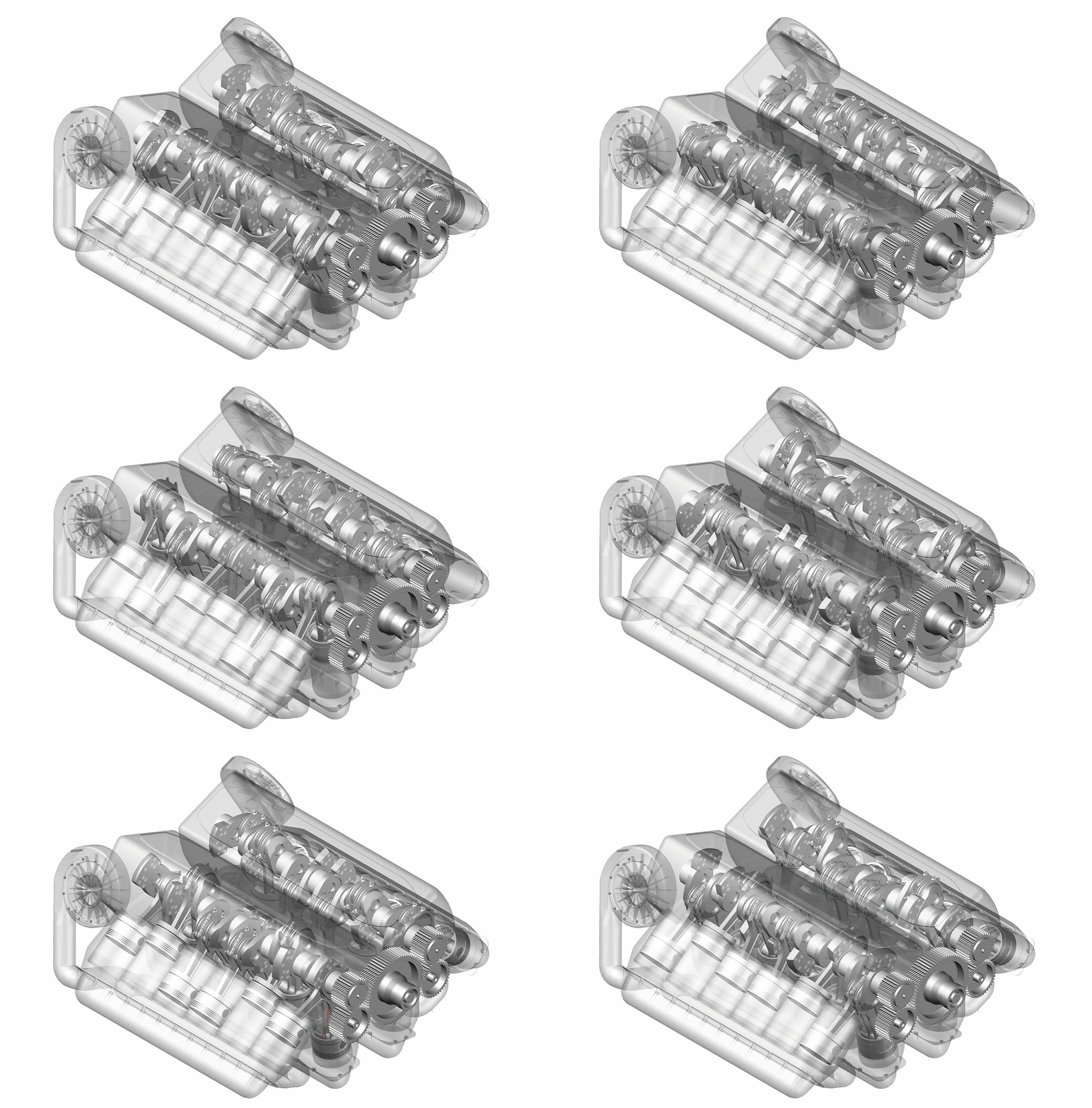
Alfa Romeo RA.1000
| Company type | Aircraft engine |
|---|---|
| Industry | Aerospace |
| Predecessor | Daimler-Benz DB 600 |
| Founded | 1930 |
| Founder | Daimler-Benz |
| Fate | Succeeded by Daimler-Benz DB 605 |
| Successor | Daimler-Benz DB 605 |
| Headquarters | Germany , Germany |
Area served | Worldwide (licensed production in Italy, Japan) |
| Products | Aircraft engines (liquid-cooled inverted V12 piston engine) |
| Owner | Daimler-Benz |
| Parent | Daimler-Benz |


The Daimler-Benz DB 601 was a German-engineered aircraft powerplant produced during World War II. This liquid-cooled, inverted V12 engine was utilized in aircraft such as the Messerschmitt Bf 109, Messerschmitt Bf 110, among others. Production reached approximately 19,000 units before it was succeeded by the enhanced Daimler-Benz DB 605 model in 1942.
Fundamentally, the DB 601 represented an advancement over the earlier DB 600, featuring direct fuel injection technology. Although this system required extracting mechanical power from the engine’s drive shaft, it significantly enhanced performance at low engine speeds and enabled consistent power delivery during aerobatic maneuvers—an area where early carbureted engines like the British Rolls-Royce Merlin could suffer from fuel starvation when their carburetor float bowls emptied.
The introduction of fuel injection gave the DB 601 a notable edge in performance that competitors such as the Junkers Jumo 210 could not match for quite some time. By the time the fuel-injected Jumo 211 was introduced, the DB 601 had already established itself as a preferred choice for high-performance aircraft including fighters and fast bombers, while the Jumo 211 was primarily assigned to bombers and transport planes. In this role, the DB 601 paralleled the Merlin engine in terms of size and output.
The DB 601Aa was produced under license abroad: in Japan by Aichi as the Atsuta, by Kawasaki as the Ha40, and in Italy by Alfa Romeo under the name R.A.1000 R.C.41-I Monsone.
Development
According to the directives established by the German "Reichverkehrsministerium" (Reich Ministry of Transport),[1] Daimler-Benz commenced the development in 1930 of a novel aero engine within the 30 L (1,800 cu in) displacement category: a liquid-cooled inverted V-12 piston engine.[2] This engine was identified as the F4, and by 1931, two prototypes were operational on test stands.[2] The subsequent iteration, the F4B, served as the foundation for what would become the DB 600.[2]
In 1933, Daimler-Benz secured a contract to develop this new engine and produce six units of the DB 600.[2] For the following year, the DB 600 remained the sole German aero engine within the 30-litre class.[2] Ultimately, production totaled 2,281 DB 600 engines.[2]
The DB 601A-1 evolved from the DB 600, incorporating mechanical direct fuel injection. Consistent with all DB 601 variants, it featured a displacement of 33.9 litres.[2] The initial prototype of the DB 601A-1, known as F4E, underwent testing in 1935, with an order for 150 units placed in February 1937.[2]
Mass production started in November 1937 and continued until 1943, during which approximately 19,000 engines across all types were manufactured.[2]
Variants
- DB 601 A-1
- Delivers up to 1,100 PS (809 kW; 1,085 hp) at sea level running at 2,400 rpm and up to 1,020 PS (750 kW; 1,006 hp) at an altitude of 4,500 m (14,800 ft) with B4 fuel
- DB 601 Aa
- Capable of producing up to 1,175 PS (864 kW; 1,159 hp) at sea level at 2,500 rpm and up to 1,100 PS (809 kW; 1,085 hp) at 3,700 m (12,100 ft) altitude with B4 fuel
- DB 601 B-1
- Equivalent to DB 601 A-1 but optimized for Messerschmitt Bf 110 and bomber aircraft applications (featuring a propeller-to-engine ratio of 1:1.88 instead of 1:1.55)
- DB 601 Ba
- Comparable to Aa variant intended for Messerschmitt Bf 110 and bomber aircraft use (with propeller-to-engine ratio adjusted to 1:1.88 versus standard 1:1.55)
- DB 601 M
- Designed for installation in the Heinkel He 100D, delivering approximately 1,175 PS (864.2 kW; 1,158.9 hp)
- DB 601 N
- Generates up to 1,175 PS (864 kW; 1,159 hp) both at sea level and at an altitude of 4,900 m (16,100 ft) at 2,600 rpm using C3 fuel
- Produces up to 1,270 PS (934 kW; 1,253 hp) at 2,100 m (6,900 ft) altitude running at 2,600 rpm
- DB 601 P
- Same specifications as DB 601 N but configured for Messerschmitt Bf 110 or bomber aircraft use (with propeller-to-engine ratio set to 1:1.88 rather than standard)
- DB 601 E
- Delivers up to 1,350 PS (993 kW; 1,332 hp) at sea level at 2,700 rpm and up to 1,320 PS (970 kW; 1,300 hp) at an altitude of 4,800 m (15,700 ft), also running at 2,700 rpm with B4 fuel
- Capable of producing up to 1,450 PS (1,066 kW; 1,430 hp) at 2,100 m (6,900 ft) altitude with a speed of 2,700 rpm
- DB 601 F/G
- Variants equivalent to DB 601 E but tailored for Messerschmitt Bf 110, Messerschmitt Me 210, or bomber aircraft (featuring propeller-to-engine ratios of 1:1.875 for the F version and 1:2.06 for G instead of the standard ratio of 1:1.685)
- DB 606 A/B
- Concept initiated in February 1937 involving coupling two DB 601A or E engines to operate a single propeller shaft with an overall weight near one and a half tonnes;[3] intended for use in Heinkel He 119 (single DB 606) and Messerschmitt Me 261 (dual DB606) aircraft prototypes where they performed effectively; first combat deployment occurred with early Heinkel He 177A models delivering approximately 2,700 PS (1,986 kW) at sea level and featuring a mirrored starboard engine supercharger. These engines acquired the nickname welded-together engines by Reichsmarschall Hermann Göring in August 1942 due to persistent engine fire issues caused by inadequate installation design during operational service on He177As.[3]
- Alfa-Romeo R.A.1000 R.C.41-I Monsone
- Produced under license by Alfa Romeo in Italy
- Aichi Atsuta
- Manufactured under license by Aichi in Japan
- Kawasaki Ha40
- Built under license by Kawasaki in Japan
Applications
- DB 601
- Arado Ar 240
- CANSA FC.20
- Dornier Do 215
- Heinkel He 100
- Heinkel He 111 P variant
- Henschel Hs 130 A-0 model
- Kawasaki Ki-60
- Messerschmitt Bf 109
- Messerschmitt Bf 110
- Messerschmitt Me 210
- Savoia-Marchetti SM.88
- DB 606
- Heinkel He 119
- Heinkel He 177 A-1 and A-3 versions
- Junkers Ju 288C
- Messerschmitt Me 261
Licensed Production
- Alfa Romeo R.A.1000 R.C.41
Specifications (DB 601 Aa / Ba)
See also
References
- ↑ MTU-Museum Triebwerksgeschichte – gestern, heute und morgen Archived 2016-03-04 at the Wayback Machine, on www.mtu.de (German, PDF, 4,4 MB)
- ↑ 2.0 2.1 2.2 2.3 2.4 2.5 2.6 2.7 2.8 Mankau&Petrick, 2001. pp. 347-355
- ↑ 3.0 3.1 Lua error in Module:Citation/CS1/Configuration at line 2123: attempt to index field '?' (a nil value).
Bibliography
- Bingham, Victor. Major Piston Aero Engines of World War II. Airlife Publishing, Shrewsbury, UK, 1998. ISBN 1-84037-012-2.
- Christopher, John. The Race for Hitler's X-Planes: Britain's 1945 Mission to Capture Secret Luftwaffe Technology. History Press, Stroud, UK, 2013. ISBN 978-0-7524-6457-2.
- Gunston, Bill. World Encyclopedia of Aero Engines: From the Pioneers to the Present Day. Sutton, Stroud, UK, 2006. 5th edition. ISBN 0-7509-4479-X.
- Mankau, Heinz and Peter Petrick. Messerschmitt Bf 110, Me 210, Me 410. Aviatic Verlag, Raumfahrt, Germany, 2001. ISBN 3-925505-62-8.
- Gregor, Neil. Daimler-Benz in the Third Reich. Yale University Press, 1998.
External links
Template:Commons category-multi
- Overview of Daimler-Benz Aircraft Engines
- DB 600 Series at Aviation History.com
- Kurfürst – Messerschmitt Bf 109 Performance Resource
- (1940) Betriebs und Wartungsvorschrift zum Mercedes-Benz Flugmotor DB 601 A u. B – Original operation and maintenance manual for Daimler-Benz DB 601A and DB 601B enginesTemplate:Fix/category[permanent dead link]
- CAD animation illustrating crankcase, connecting rod and piston components of the DB 606 "power system"