
BAC TSR-2
| Industry | Aerospace |
|---|---|
| Predecessor | Vickers-Armstrong, English Electric |
| Founded | 1960 (consolidation of manufacturers including Vickers-Armstrong and English Electric) |
| Headquarters | United Kingdom |
| Products | Aircraft (including TSR-2) |
Template:Good article
Template:Infobox aircraft
The British Aircraft Corporation TSR-2 was a supersonic strike and reconnaissance aircraft project developed by the British Aircraft Corporation (BAC) that was ultimately cancelled. Its development spanned the late 1950s through the early 1960s, intended for service with the Royal Air Force (RAF). The designation TSR-2 stands for "Tactical Strike and Reconnaissance, Mach 2".
The origin of the TSR-2 can be traced back to General Operational Requirement 339 (GOR.339), issued in November 1956. This specification called for a successor to the English Electric Canberra capable of delivering both conventional and tactical nuclear weapons, with an ability to penetrate heavily defended frontlines at low altitude and supersonic speeds to strike high-value targets deep behind enemy lines. Additionally, it was designed to perform high-altitude, high-speed stand-off reconnaissance missions using side-looking radar and photographic equipment, as well as signals intelligence gathering. Official approval for the programme was granted on 1 January 1959. Initial development was conducted by Vickers-Armstrong alongside English Electric, prior to consolidation within Britain's aerospace sector that formed BAC. However, communication challenges and budget overruns arose due to some manufacturers reporting directly to the Ministry rather than through BAC's management structure. The aircraft's first flight took place on 27 September 1964 with test pilot Roland Beamont at the controls.
Only a single TSR-2 prototype ever flew; during testing, increases in weight and other factors suggested that meeting the original demanding performance criteria would not be feasible. Consequently, the design specifications were revised downward. Approximately fourteen hours of flight trials were completed on airframe XR219 before cancellation halted further development.
The decision to terminate the TSR-2 programme stemmed from escalating expenses combined with inter-service disputes over future defence priorities in the UK. Subsequently, plans shifted towards procuring an adapted variant of the General Dynamics F-111, designated F-111K; however, this order was later abandoned due to rising costs and extended development timelines for that platform as well. The operational roles envisioned for TSR-2 were ultimately assumed by other aircraft such as the Blackburn Buccaneer and McDonnell Douglas F-4 Phantom II, both initially considered but rejected during early TSR-2 evaluations. Later on, a European partnership produced the smaller swing-wing Panavia Tornado, introduced in the 1980s to fulfill broadly comparable mission requirements originally set out for the TSR-2.
Earlier designs

The advent of the initial jet engines during the late stages of World War II sparked interest in developing jet-powered variants of existing planes. One such effort focused on creating a successor to the de Havilland Mosquito, which was then regarded as one of the premier medium bombers globally. The Mosquito's design prioritized weight reduction to enhance its speed, resulting in the elimination of defensive weaponry, which in turn improved performance so significantly that such armaments were deemed unnecessary. This strategy proved highly effective, and a jet-powered successor promised even greater difficulty for adversaries attempting interception.
This concept led to the issuance of Air Ministry specification E.3/45. The selected design, the English Electric Canberra, similarly omitted defensive armament, instead relying on speed and altitude capabilities to evade most threats. Its expansive wings provided sufficient lift to operate at altitudes beyond the reach of contemporary jet fighters. The Canberra's ability to overfly opponents with minimal risk made it ideal for aerial reconnaissance assignments. Its success was such that it was licensed for manufacture in the United States—an uncommon occurrence. American-built reconnaissance variants such as the Martin RB-57D and RB-57F further extended wingspan up to 37.5 m (123 ft) to achieve exceptional high-altitude performance.
Replacing the Canberra
It became apparent that advancements in enemy interceptor aircraft would gradually undermine the Canberra's advantages. As early as 22 February 1952, Air Vice Marshal Geoffrey Tuttle expressed skepticism about the Canberra's future effectiveness, stating that "Frankly, I do not believe that we will get much operational value out of the Canberra from 1955 onwards... the aircraft is already out of date and I doubt its chances of survival in daylight against the present MiG-15 opposition." Recognizing that the Canberra had reached its performance ceiling, a draft requirement for a new light bomber intended to replace it was proposed in March 1952; however, this initiative did not progress further.
Further development efforts resumed following a January 1953 memorandum suggesting that a "thin wing" variant of the Gloster Javelin could be adapted for a light bomber role. The Javelin's advanced navigation equipment was considered advantageous for such missions. This led to operational requirement OR.328, but it was ultimately dismissed due to inadequate range during low-altitude operations. Subsequently, English Electric pursued a Royal Navy specification for a low-level strike aircraft, which was awarded to Blackburn with their Buccaneer. English Electric then modified their naval design slightly and submitted it for RAF consideration under OR.328’s remit. In October 1955, both this proposal and Blackburn’s winning design were reviewed and rejected. According to Matthew Slattery, further redesign would be necessary to ensure operational relevance by around 1960, concluding that "it seems quite wrong to introduce in 1960 a subsonic aircraft that stands no hope of being supersonic."
Despite emerging Soviet interceptors, the Canberra continued to perform effectively; however, the late 1950s saw the introduction of the Soviet Union’s first surface-to-air missile systems (SAMs), posing a significant threat. These missiles possessed speed and altitude capabilities surpassing any contemporary aircraft. High-altitude platforms like the Canberra, British V bombers, and American Boeing B-52 Stratofortress became particularly vulnerable to such weapons. The first recorded loss to a Soviet S-75 Dvina (NATO designation "SA-2 Guideline") SAM occurred in 1959 when a Taiwanese RB-57 was shot down.
To counter this threat, tactics shifted toward lower altitude flight because radar coverage is limited by line-of-sight constraints and Earth's curvature—known as the radar horizon. In reality, natural terrain features such as forests, hills, and valleys further restrict detection range, making interception of low-flying aircraft from ground stations extremely challenging. Since the Canberra was engineered primarily for medium-to-high altitude missions, it was ill-suited for sustained terrain-hugging flight profiles. Consequently, low-level strike aircraft—referred to as "interdictors"—emerged during the late 1950s as a distinct category. These typically featured high wing loading to mitigate turbulence effects and crosswinds, incorporated some form of terrain-following radar enabling rapid low-altitude flight, and carried substantial fuel reserves to compensate for increased consumption at lower altitudes.
GOR.339

In response to evolving operational demands, the Ministry of Supply initiated collaboration with English Electric in 1955 to conceptualize a new light bomber intended to succeed the Canberra.[1] Initial investigations ultimately defined an aircraft featuring a ferry range of approximately 2,000 nmi (2,300 mi; 3,700 km), capable of Mach 1.5 at altitude, and a low-level range near 600 nmi (690 mi; 1,100 km). The design stipulated a two-person crew, with one member managing sophisticated navigation and attack systems. The payload was specified as four 1,000 lb (450 kg) bombs.[1]
The formalization of these specifications occurred in November 1956 through General Operational Requirement 339 (GOR.339), which was disseminated to several aircraft manufacturers by March 1957.[1][2] This requirement was notably advanced for its time, calling for a supersonic all-weather platform capable of delivering nuclear weapons over extended distances, performing at Mach 2+ at high altitudes or Mach 1.2 at low altitudes, and demonstrating STOL or potentially VTOL capabilities.[3][4] The inclusion of short or vertical takeoff performance stemmed from prevalent Cold War strategies, which anticipated that nuclear conflict would render most airstrips unusable, necessitating operation from makeshift or former wartime airfields and open terrain.[5]
The detailed requirements encompassed:[4]
- Tactical nuclear weapon delivery at low altitude under all weather conditions, both day and night
- Photographic reconnaissance missions at medium altitude during daylight and low altitude during day and night
- Electronic intelligence gathering regardless of weather
- Tactical nuclear strikes by day and night at medium altitudes utilizing blind bombing techniques if required
- Deployment of conventional bombs and rockets
Low-level flight was defined as below 1,000 ft (300 m), with an anticipated attack velocity near Mach 0.95 at sea level. Operational range was specified as 1,000 nmi (1,200 mi; 1,900 km), with takeoff capability from runways no longer than 3,000 ft (910 m).[6] The TSR-2 was expected to maintain flight at approximately 200 ft (60 m) above ground level at Mach 1.1;[7] its operational radius allowed for both strategic and tactical deployment.[8]
Political changes
While multiple manufacturers examined this specification, the project soon encountered significant political opposition when Defence Minister Duncan Sandys declared in the 1957 Defence White Paper that manned combat aircraft were becoming obsolete and that future warfare would rely on ballistic missiles. This assertion sparked extensive debate within the aviation sector and the Ministry of Defence.[9] Senior Royal Air Force officials contested this position by emphasizing the necessity for mobility and flexibility; they argued that the TSR-2 could not only replace the Canberra but might also supplant the entire V bomber fleet.[10]
Beyond disputes over manned aircraft's relevance, further political complexities arose when in September 1957 the Ministry of Supply mandated that acceptable proposals must come from consortia involving multiple companies.[11] Given the numerous British aircraft manufacturers facing declining orders, this move aimed to encourage collaboration and eventual mergers among firms.[11][12]
Inter-service rivalry also complicated matters during GOR.339's formulation period; simultaneously, the Royal Navy was advancing with the Buccaneer program.[13] Shared use of a single airframe by both services promised substantial cost savings. Blackburn proposed a variant of the NA.39 — designated B.103A — tailored to meet some GOR.339 criteria for the RAF.[13] However, Lord Mountbatten—then Chief of the Defence Staff and former First Sea Lord—strongly supported the Buccaneer project and asserted that five Buccaneers could be procured for the price of one TSR-2.[13][14] The RAF rejected Blackburn’s offer citing inadequate takeoff capabilities and avionics unsuitable for required missions.[13] As an RAF representative remarked, "If we show the slightest interest in NA.39 we might not get the GOR.339 aircraft."[15]
Another detractor from within government circles was Sir Solly Zuckerman, Baron Zuckerman, serving as Chief Scientific Advisor to the Ministry of Defence at that time. Zuckerman held a skeptical view regarding British technological progress and advocated acquiring military equipment from the United States.[14]
Submissions

Although English Electric and Hawker Aircraft had already received preliminary indications from the Air Ministry about an impending formal process, all leading manufacturers rapidly assembled their proposals:[16]
- Blackburn submitted the B.103A, essentially a variant of the B.103/NA.39 (Buccaneer) stripped of its naval-specific equipment and fitted with additional fuel tanks.
- De Havilland proposed an enhanced model of the de Havilland Sea Vixen, termed the "DH.110 Tactical Bomber," which eliminated naval systems and extended the fuselage to increase fuel capacity. This design also incorporated upgraded Rolls-Royce Avon engines, blown flap technology, and a mounting point for an under-fuselage rocket engine JATO unit to boost takeoff capabilities.
- Vickers-Armstrongs/Supermarine presented the Type 565, a comparable adaptation of the Supermarine Scimitar.
- Hawker[N 1] entered the P.1121, an evolution of the Hawker Hunter that depended on drop tanks to satisfy range criteria.
These initial proposals underwent evaluation in May 1957. While all designs could be delivered before the targeted 1964 operational date, none achieved the required performance standards. Only de Havilland’s submission fulfilled the 1,000 nautical miles (1,900 km; 1,200 mi) range specification; others fell considerably short, notably the P.1121. Additionally, supersonic capabilities were limited across all entries, particularly regarding sustained supersonic flight range.[17]
Following this, a more stringent GOR.339 was issued, and in September 1957, the Ministry announced a new call for proposals due by 31 January 1958. This formal announcement specified that only bids from collaborative company partnerships would be considered.[18] Eight firms were invited to participate, resulting in thirteen submissions:[19]
- Avro’s 739 bore a strong resemblance to the eventual TSR-2 design but featured a mid-mounted swept wing rather than the high-mounted delta wing. It shared many characteristics with English Electric’s entry, especially around cockpit design.
- Blackburn proposed the B.108, an evolution of the B.103A with increased fuel capacity. Although its performance lagged behind other candidates, Blackburn argued that fulfilling every requirement was unnecessary and that their design would be significantly more cost-effective per unit. They also emphasized their unique expertise in low-level attack missions gained through Buccaneer development, particularly regarding turbulence and control challenges.
- Bristol entered Type 204, their most distinctive concept featuring a "gothic" delta wing planform derived from early work on the Bristol Type 223. This design included a canard located beneath the cockpit on a wing-like extension below the fuselage. The twin engines were fed by an intake positioned atop the wing.
- De Havilland submitted a completely new design without a formal name, characterized by swept wings and pod-mounted engines beneath them. They proposed an optional rocket-powered platform for VTOL operations and variants adapted for naval strike and long-range interception roles.
- English Electric prepared extensively for these requirements by evaluating eighteen potential layouts (P.1 through P.18) before selecting P.17A as their official entry. This design closely matched the winning proposal but differed mainly in engine intake configuration. EE collaborated with Short Brothers on the Shorts P.17D—a vertical-lift platform intended to provide VTOL capability for P.17.
- Fairey’s submission was based on the Fairey Delta 2, essentially elongating its fuselage forward and adding a large canard near the cockpit area. The two engines were housed in underwing pods; this arrangement prevented underwing stores but allowed for a spacious bomb bay within the fuselage.
- Gloster offered two variants derived from their thin-wing Javelin: one with engines embedded within the fuselage as on the Javelin itself, and another featuring underwing pods to increase internal fuel and weapon storage capacity.
- Hawker presented three closely related designs: P.1123, P.1125, and P.1129. The first two shared numerous components aimed at producing either a lightweight bomber (P.1123) or an air superiority fighter (P.1125). The P.1129 was larger and more powerful, designed to meet all GOR criteria.
- Vickers—having dropped use of the Supermarine brand—submitted Type 571, which resembled the eventual winning design but incorporated a very thin, slightly swept wing equipped with large fuel tanks at its tips and prominent swept-forward Ferri-style engine intakes.
Selection
By February, the Air Ministry had narrowed the contenders down to three proposals: those from Hawker-Siddeley, Vickers, and English Electric (EE). The Ministry was particularly impressed by Vickers’ entry, which went beyond the aircraft itself to present a comprehensive "total systems concept" that detailed avionics, support infrastructure, and logistics necessary for operational maintenance. EE, having recently introduced the Lightning, was the sole company with substantial experience in actual supersonic aircraft, a factor they believed provided a significant practical edge.
Hawker-Siddeley, the parent company of Hawker, Avro, and Gloster, submitted five different designs. This breadth of submissions caused some internal confusion and disagreement within the firm. Avro, having lost the Avro 730 project previously, considered themselves the natural leaders for any new bomber initiative. Meanwhile, Gloster’s design was still based on the Javelin platform. On 11 December 1957, Hawker’s design team candidly acknowledged that their entry had no realistic chance of winning the contract. A meeting on 27 January 1958 involving Roy Dodson, Frank Spriggs, and J.R. Ewins ultimately decided to advance the P.1129 as their primary proposal, incorporating select features from the P.739. Noteworthy modifications included a thinner wing profile and application of the area rule to enhance performance at Mach 1.34.
In May, the Air Ministry released OR.343, an updated version of GOR.339. Hawker presented their revised "P.1129 Development," while Vickers and EE offered minor tweaks to their respective designs. Due to similarities between Vickers’ and EE’s proposals, discussions considered awarding two separate contracts—one combining Vickers and EE efforts and another for Hawker-Siddeley—but it was recognized this approach could delay final contract approval by up to a year.
It later emerged that Hawker’s elimination had been decided as early as August, rendering their subsequent submissions largely procedural. Evaluations of EE’s management found it weaker compared to Vickers; however, officials believed a partnership between the two companies would be advantageous. Consequently, the development contract was granted to Vickers with English Electric acting as subcontractor. The final design essentially merged the wings and tail from Vickers’ P.17 with the elongated fuselage of EE’s Type 571. Construction was divided: Vickers built the forward section while EE handled the rear fuselage, which were then joined just ahead of the wing.
The existence of GOR.339 became public knowledge in December 1958 through a statement made in the House of Commons. Responding to recommendations from the Committee on Estimates, the Air Ministry explored ways to consolidate project proposals. On 1 January 1959, the Minister of Supply announced that Vickers-Armstrong would develop the TSR-2 in collaboration with English Electric; the designation stood for "Tactical Strike and Reconnaissance, Mach 2," with "Strike" specifically indicating a nuclear weapons delivery role within RAF terminology.
The project officially received approval on 1 January 1959; by February it was assigned Operational Requirement 343 (OR.343). This requirement refined previous specifications from GOR.339 submissions, explicitly stating that low-level flight operations should occur at 200 ft (61 m) or below and that Mach 2 speed must be achievable at altitude.
Mission

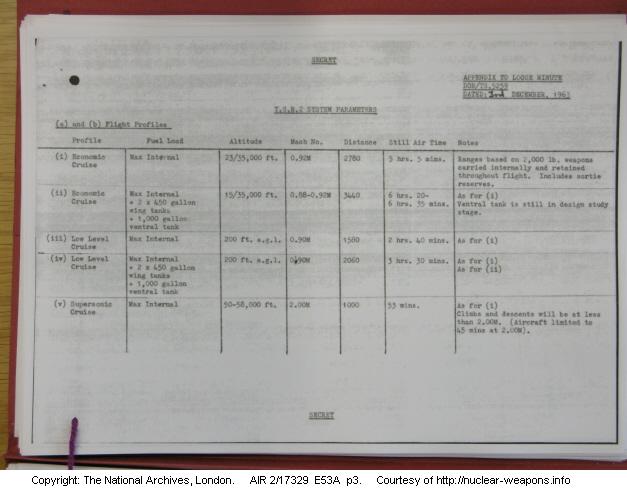
The TSR-2's intended "standard mission" involved internally carrying a 2,000 lb (910 kg) payload with a combat radius of approximately 1,000 nautical miles (1,200 mi; 1,900 km). Within this mission profile, around 100 nautical miles (120 mi; 190 km) was planned to be flown at elevated altitudes reaching Mach 1.7, while the ingress and egress phases—covering 200 nmi (230 mi; 370 km)—were to be conducted at low altitude, about 200 ft, traveling at Mach 0.95. The remaining segments of the flight would operate at Mach 0.92. Should the entire sortie be executed at the low altitude of 200 ft, the operational radius would decrease to approximately 700 nmi (810 mi; 1,300 km). Carrying heavier ordnance would further diminish the achievable range.[20] To extend range capabilities, options included attaching external fuel tanks: either one 450-imperial-gallon (540 US gal; 2,000 L) tank beneath each wing or a single 1,000 imp gal (1,200 US gal; 4,500 L) tank centrally mounted under the fuselage. Additionally, if no internal armament was carried, an extra 570 imp gal (680 US gal; 2,600 L) tank could be installed within the weapons bay.[20] Subsequent versions were planned to feature variable-geometry wings.[21]
| Flight profile | Fuel capacity | Altitude range | Speed (Mach number) |
Range | Duration (still air) | Additional notes | |
|---|---|---|---|---|---|---|---|
| Economic cruise | Maximum internal fuel | 23,000 ft (7,000 m) to 35,000 ft (11,000 m) | Mach 0.92 | 2,780 miles (4,470 km) | 5 hours, 5 minutes | ||
| Economic cruise | Maximum internal plus two 450 imp gal (2,000 L) wing tanks and one 1,000 imp gal (4,500 L) ventral tank | 15,000 ft (4,600 m) to 35,000 ft (11,000 m) | Mach 0.88–0.92 | 3,440 miles (5,540 km) | 6 hours, 20 minutes to 6 hours, 35 minutes | Ventral tank still under development | |
| Low-level cruise | max internal fuel only | \~200 feet (61 m) above ground level | Mach 0.90 | \~1,580 minutes (95,000 s) nmi (km) | \~2 hours, 40 minutes |
- Low-level cruise | Max internal plus two wing tanks (450 imp gal (2,000 L)) and one ventral tank (1,000 imp gal (4,500 L)) | ~200 ft (61 m) AGL | Mach 0.90 | ~2,060 miles (3,320 km) | ~3 hours, 30 minutes | - Supersonic cruise | Max internal fuel only | 50,000 ft (15,000 m) to 58,000 ft (18,000 m) | Mach 2.00 | ~1,000 miles (1,600 km) | ~53 minutes | Climb and descent phases limited to below Mach 2; sustained Mach 2 operation restricted to maximum of 45 minutes due to airframe and engine constraints | - |
- ↑ Ranges assume a consistent internal carriage of a 2,000 lb weapon throughout flight. Standard fuel reserves accounted for
!Delivery method !Altitude range !Speed range !Remarks |} Laydown delivery || Between 100 ft (30 m) and 500 ft (150 m) || Mach 0.80 to Mach 1.15 || Includes up to five minutes at Mach 1.15 and two minutes at Mach 1.20; initial clearance performed automatically at approximately 200 ft (61 m) and Mach 0.9; minimum laydown altitude varies with weapon type | |} Loft bombing || Altitude from 100 feet (30 m) to 500 feet (150 m) || Speed between Mach 0.80 and Mach 1.15 || Release angles set at either 30°, 65°, or 110°; initial clearance obtained near [convert: invalid number] altitude and Mach 0.90 | |} Ballistic release || Altitude ranging from [convert: invalid number] up to [convert: invalid number] || Speeds from Mach 1.15 up to Mach 2.05 depending on altitude || Initial clearance granted at around [convert: invalid number] altitude and Mach 1.70 | |} Dive toss bombing || Initiation between altitudes of approximately [convert: invalid number] and [convert: invalid number] || Speeds between Mach 1.70 and Mach 2.00 when starting manoeuvre || Dive angles varying from roughly 12.5° to 22.5°; release speeds between Mach 0.92 and Mach 1.10; bomb release height between approximately 5,000 and13,000 ft; clearance begins with dive initiation near [convert: invalid number] altitude and Mach1.70 | |} Retarded air burst || N/A || N/A || Capability existed but was not initially cleared for operational use | |} The TSR-2 was designed to carry a reconnaissance module within its weapons bay consisting of an optical linescan device produced by EMI, along with three cameras and a sideways-looking radar (SLR). This equipment was intended to fulfill most of its reconnaissance functions.[24] Unlike contemporary linescan systems that rely on infrared imaging, the TSR-2's linescan unit utilized either daylight illumination or an artificial light source for night-time reconnaissance operations.[25]
Tactical nuclear weapons
At the outset of the TSR-2 project, the plan was to equip the aircraft with the existing Red Beard tactical nuclear bomb. However, it soon became apparent that Red Beard was unsuitable for external carriage at supersonic speeds due to safety and handling concerns, and its 15 kt yield was insufficient for the intended targets. Consequently, in 1959, a replacement known as the "Improved Kiloton Bomb" was specified under Operational Requirement 1177 (OR.1177)[26] for use with the TSR-2. The aircraft’s tactical strike mission involved engaging targets beyond NATO’s designated forward battlefield edge for the RAF, operating day or night in all weather conditions. These targets included hardened and soft missile installations, aircraft stationed on airfields, runways, airfield structures, fuel installations, bomb storage facilities, tank formations, ammunition and supply depots, railways and tunnels, along with bridges.[27] OR.1177 called for bombs with yields of 50, 100, 200, and 300 kt, assuming a circular error probable of 1,200 ft (370 m) and a damage probability of 0.8. It also required laydown delivery capability with detonation heights ranging from ground level up to 10,000 ft (3,000 m) above sea level. Additional specifications included a maximum weight of 1,000 lb (450 kg), length up to 144 in (3.7 m), and diameter not exceeding 28 in (710 mm)—the same diameter as Red Beard.[28]
Nevertheless, a ministerial decision dated 9 July 1962 mandated that all forthcoming tactical nuclear armaments be capped at a yield of 10 kt.[29] In response, the RAF revised OR.1177 to accept this lower yield while designing it to allow future upgrades should political constraints be lifted. To offset the reduced yield, specifications for both the bomb and TSR-2 included provisions for salvo deployment: releasing multiple smaller bombs in groups—specifically sticks of four revised OR.1177 devices later designated WE.177A—at intervals of approximately 3,000 ft (914m) apart to prevent premature destruction caused by initial detonations. This requirement led to TSR-2’s capability to carry four WE.177As—two internally within the bomb bay and two externally on underwing stores pylons. Since the original bomb bay was designed for a single Red Beard weapon, the WE.177’s diameter had to be reduced to 16.5 in (42 cm) to accommodate two bombs side-by-side along with fin span constraints.[27] However, the concept of stick bombing with nuclear ordnance was soon abandoned as higher-yield weapons regained preference.[30]
One limitation when carrying WE.177 externally was imposed by aerodynamic heating affecting the bomb casing. Specifically, WE.177A could only remain on external pylons for a maximum of five minutes at Mach 1.15 flying low on TSR-2; exceeding this duration would cause temperatures to surpass allowable limits. This restriction posed significant operational challenges since TSR-2 was designed for sustained Mach 1+ cruise at low altitude.[31]
During early development phases, nuclear stand-off missile options were also considered but ultimately not pursued for TSR-2. These proposals included an air-launched variant of the Blue Water missile[32], which could be carried either underwing or semi-recessed within the bomb bay, as well as an air-launched ballistic missile dubbed Grand Slam featuring a warhead based on that planned for the Skybolt missile and boasting a range near 100 nmi (120 mi; 190 km).[33] Instead, conventional missile integration became the focus—initially emphasizing use of the AGM-12 Bullpup, then shifting preference to the French AS-30, before finally settling on the newly developed OR.1168 missile (later known as the TV-guided AJ-168 Martel).[34]
Following TSR-2’s cancellation, the RAF met its tactical strike needs by deploying McDonnell F-4 Phantom II aircraft armed with US dual-key nuclear weapons,[N 2][36] While continuing efforts to have the 10 kt yield restriction lifted,[37] development of WE.177A experienced delays due to heavy workloads at Aldermaston’s Atomic Weapons Research Establishment (AWRE), which was engaged in other warhead projects at that time. Once AWRE’s workload lightened following completion of Polaris missile warhead tasks, work resumed on WE.177A; deliveries began in late 1971 for deployment on Buccaneers within Royal Air Force Germany, one year after initial deliveries to the Royal Navy. Authorization for high-yield tactical weapons was granted in 1970, leading by 1975 to adoption of WE.177C—a weapon with a yield approaching 200 kt closely resembling what had been envisioned for TSR-2 back in 1959.[28]
Design

During 1959, English Electric (EE) and Vickers collaborated to merge the strengths of their respective designs, aiming to deliver a flying aircraft by 1963 while simultaneously working towards the consolidation of both companies into the British Aircraft Corporation.[38] EE proposed a delta wing configuration reflecting their extensive supersonic expertise, whereas Vickers offered a swept-wing design coupled with an elongated fuselage. The delta wing from EE was deemed superior, while Vickers’ fuselage design was preferred. Consequently, the final aircraft would be constructed evenly by both firms: Vickers responsible for the forward section and EE for the rear.[4]
The TSR-2’s propulsion system consisted of two Bristol-Siddeley Olympus reheated turbojet engines—advanced derivatives of those powering the Avro Vulcan. This Olympus engine would undergo further development and later serve as the powerplant for the supersonic Concorde.[39] The airframe incorporated a compact shoulder-mounted delta wing with downward-angled tips, complemented by an all-moving swept tailplane and a sizable all-moving fin. To meet short takeoff and landing criteria, blown flaps extended along the entire trailing edge of the wing were employed—this approach predated later designs that utilized more complex swing-wing mechanisms. Instead of traditional ailerons, roll control was achieved through differential movements of the slab tailplanes. The aircraft’s wing loading was notably high for its era, allowing stable flight at very high speeds and low altitudes without frequent disturbances from ground-level turbulence such as thermals or lee-side mountain rotors.[40] EE’s Chief Test Pilot, Wing Commander Roland Beamont, praised the TSR-2’s supersonic handling qualities as superior to the Canberra’s subsonic flight characteristics, which he found more challenging.[41]
Based on the Flight Envelope diagram,[42] the TSR-2 was capable of sustained cruising at Mach 2.05 between altitudes of approximately 37,000 ft (11,000 m) and 51,000 ft (16,000 m), with a maximum dash speed reaching Mach 2.35 (limited by a leading-edge temperature ceiling of 140 °C).[42]
The aircraft incorporated highly advanced avionics systems for navigation and mission execution,[43] which contributed significantly to escalating project expenses. Innovations such as forward-looking radar (FLR) and side-looking radar for navigational fixes were ahead of their time and only became standard on military aircraft years later.[44] These capabilities enabled an innovative autopilot system that facilitated extended terrain-following missions by significantly reducing pilot workload and manual input.[45]
Significant challenges emerged during development. Some suppliers were contracted directly by the Ministry rather than through BAC, creating communication barriers that led to further budget overruns. Although BAC retained autonomy over equipment design and provision, these components were supplied by Ministry-appointed "associate contractors" subject to Ministry approval.[46] Financially, this represented Britain’s largest aircraft investment project up to that point.[47]Template:Date missing
Distinct from previous programs, no prototype units were planned initially. Instead, following an American-influenced "development batch" approach also used on the English Electric Lightning, nine airframes would be constructed utilizing production tooling.[48][N 3] However, committing early to production tooling introduced delays because initial aircraft had to conform strictly to production standards or navigate bureaucratic processes to obtain concessions permitting deviations from later airframes.[48] Four years into development, these early airframes functioned as prototypes in all but designation; they exhibited numerous specification omissions and differed from planned pre-production and production models.[50]
Testing

Although expenses escalated, the initial two development aircraft were completed. Delays in engine development[N 4] and issues with the landing gear postponed the maiden flight, resulting in the TSR-2 missing its chance to be publicly exhibited at the 1964 Farnborough Airshow.[51] Prior to testing, Denis Healey, then the Opposition shadow defence secretary, criticized the aircraft, arguing that by its introduction it would face advanced "anti-aircraft" missiles capable of shooting it down, making its £16 million price tag per unit (based on an order of only 30 aircraft) excessively costly.[52]
Test pilot Roland Beamont conducted the first flight from the Aeroplane and Armament Experimental Establishment (A&AEE) at Boscombe Down, Wiltshire, on 27 September 1964.[53][54] During these initial flights, the landing gear remained extended and engine power was strictly limited—capped at 250 kn (290 mph; 460 km/h) and an altitude ceiling of 10,000 ft (3,000 m) during the first brief (15-minute) sortie.[55] On XR219's second flight, a fuel pump vibration matching the resonant frequency of the human eyeball forced the pilot to reduce power on one engine to prevent temporary visual impairment.[56][57]
It was not until the tenth flight that the landing gear was successfully retracted; earlier attempts were hindered by mechanical difficulties. Nonetheless, severe vibration issues during landings persisted throughout testing. The first supersonic flight (Flight 14) occurred while transferring from A&AEE Boscombe Down to BAC Warton.[58] During this mission, the TSR-2 reached Mach 1 using dry thrust alone (supercruise). Subsequently, Beamont activated reheat on only one engine because the other’s reheat fuel pump was inoperative, allowing the aircraft to outpace a chase English Electric Lightning interceptor piloted by Wing Commander James "Jimmy" Dell, who needed full afterburner on both engines to catch up.[59] Dell himself likened handling of the TSR-2 prototype to flying "a big Lightning".[60]
Over a six-month period, a total of twenty-four test flights were completed.[61] Since most sophisticated electronic systems were absent from these early aircraft, flights primarily focused on evaluating fundamental flight characteristics which test pilots unanimously praised as exceptional.[60] The aircraft achieved speeds up to Mach 1.12 and maintained low-altitude flights as low as 200 ft over the Pennines.[58] Vibration issues with the undercarriage continued but were notably reduced during later flights when XR219 received additional tie-struts reinforcing its already intricate landing gear.[62][63] The final test sortie occurred on 31 March 1965.[58]
Although testing was incomplete and ongoing design refinements were characteristic of such an advanced aircraft, it was clear that "[T]here was no doubt that the airframe would be capable of accomplishing the tasks set for it and that it represented a major advance on any other type."[62]
Rising expenses prompted concern among senior government and corporate officials alike, while performance shortfalls emerged relative to several criteria specified in OR.343—such as takeoff distance and combat radius. To curb costs, a scaled-back specification was approved which included reducing combat radius to 650 nmi (750 mi; 1,200 km), lowering maximum speed to Mach 1.75, and increasing takeoff run from 1,800 to 3,000 feet (550 to 915 m).[64]
Project termination

During the 1960s, the United States armed forces were advancing the swing-wing F-111 program as a successor to the Republic F-105 Thunderchief, a rapid low-altitude fighter-bomber conceived in the 1950s with an internal nuclear weapons bay.[65] Australia had shown some interest in acquiring the TSR-2 for its Royal Australian Air Force (RAAF), but in 1963 opted instead for the F-111, attracted by more favorable pricing and delivery terms offered by the American manufacturer.[66][67] However, it took a decade before the F-111 was operational for the RAAF, by which time its projected expenses had increased threefold.[68] The British Royal Air Force was also urged to evaluate the F-111 as a cost-effective alternative. In reaction to cancellation rumors, workers at BAC organized a demonstration march, and the newly elected Labour government in 1964 issued strong denials.[69] Nevertheless, during two Cabinet meetings on 1 April 1965, the decision was made to terminate the TSR-2 project due to anticipated costs and instead secure an option to purchase up to 110 F-111 aircraft without immediate obligation.[9][70][71] This outcome was publicly declared during the budget statement on 6 April 1965. The second development batch aircraft, XR220, was scheduled for its inaugural flight on that very day; however, an accident occurred while transporting the airframe to Boscombe Down[N 5][72] and combined with the cancellation announcement, this flight never took place.[73] Ultimately, only the initial prototype XR219 ever achieved flight. A week following this decision, Chancellor James Callaghan defended it during a House of Commons debate by asserting that opting for the F-111 would be more economical.[74] Subsequently, all remaining airframes were ordered to be destroyed by incineration.[75]
Sir Sydney Camm, renowned aeronautical engineer and creator of the Hawker Hurricane, remarked about TSR-2: "All modern aircraft have four dimensions: span, length, height and politics. TSR-2 simply got the first three right."[76]
TSR-2 successors
Initially, the Air Ministry considered the F-111K—a variant of the F-111A enhanced with features from the F-111C—as a potential replacement for the TSR-2. Alongside this, two other alternatives were evaluated: a Rolls-Royce Spey (RB.168 Spey 25R) powered conversion of the Dassault Mirage IV (known as the Dassault/BAC Spey-Mirage IV), and an upgraded Blackburn Buccaneer S.2 equipped with a new navigation-attack system and reconnaissance functionality, dubbed the "Buccaneer 2-Double-Star". Neither option advanced as a TSR-2 substitute, although a definitive choice was deferred until the 1966 Defence Review. Documents including Defence Minister Healey's memorandum on the F-111 and Cabinet records regarding TSR-2's final cancellation suggest that preference was given to the F-111.
Following the release of the 1966 Defence White Paper, the Air Ministry settled on procuring two aircraft types: initially, the F-111K, and in the longer term, a collaborative Anglo-French effort to develop a variable geometry strike aircraft—the Anglo French Variable Geometry Aircraft (AFVG). A censure debate on 1 May 1967 saw Healey assert that over 15 years, the TSR-2 would have cost approximately £1,700 million including operational expenses, compared to £1,000 million for the combined F-111K/AFVG solution. Although an initial order for 10 F-111Ks was placed in April 1966, followed by a further 40 in April 1967, escalating costs and the pound’s devaluation caused prices to surpass earlier TSR-2 estimates significantly. Numerous technical challenges remained unresolved before successful deployment could be achieved, and with performance evaluations falling short of expectations, the RAF's order for 50 F-111Ks was ultimately cancelled in January 1968. At that point, two F-111Ks—one configured for strike/reconnaissance and one trainer/strike variant—were nearing completion; these aircraft were subsequently finished and accepted by the USAF as YF-111A test platforms. Meanwhile, the AFVG project had already been discontinued in 1967.
To fill the role intended for the TSR-2, the RAF adopted a mix of the F-4 Phantom II and Blackburn Buccaneer aircraft, some of which were transferred from Royal Navy service. Ironically, these were precisely the types previously criticised by the RAF to justify TSR-2 development. Nonetheless, the Buccaneer demonstrated effective capability and remained operational until 1994. The Royal Navy's Phantom II variants received the designation F-4K, while RAF versions were designated F-4M; they entered service as Phantom FG.1 (fighter/ground attack) and Phantom FGR.2 (fighter/ground attack/reconnaissance), respectively, continuing in air-to-air roles until 1992.
During the mid-1970s, RAF Phantoms in strike and reconnaissance roles were succeeded by the SEPECAT Jaguar. In subsequent years, both Jaguars and Buccaneers were replaced by the variable-geometry Panavia Tornado, which featured a more compact airframe compared to either the F-111 or TSR-2. The Tornado’s avionics design benefitted from experience gained in terrain-following technology developed earlier. In the late 1970s, as Tornado production ramped up, entrepreneur Christopher de Vere undertook an exploratory feasibility study aimed at reviving and modernising the TSR-2 project; despite persistent appeals to the UK government at that time, this initiative failed to gain traction and was ultimately abandoned.
Survivors


Following the project's termination, the tooling, jigs, and numerous partially assembled aircraft were destroyed at Brooklands within six months.[77] Only two airframes remain today: the fully intact XR220, housed at the Royal Air Force Museum Midlands in RAF Cosford, and the less complete XR222 preserved at the Imperial War Museum Duxford. The sole airframe to have flown, XR219, along with the finished XR221 and partially built XR223, were transported to Shoeburyness where they served as targets to evaluate the resilience of contemporary airframes and systems against gunfire and shrapnel.[78] Four additional completed airframes—XR224, XR225, XR226—and one incomplete airframe, XR227 (X-06,07,08, and 09), were dismantled by R. J. Coley and Son in Hounslow, Middlesex. Although serial numbers XR228 through XR231 were assigned, these aircraft reportedly never progressed to construction. Work commenced on another ten aircraft (X-10 to 19), designated XS660 to 669; however, all partially built airframes were subsequently scrapped by R. J. Coley. The final serial in this group, XS670, was marked as "cancelled," as were those in a separate batch of 50 planned units numbered XS944 to 995.
Interestingly, a planned fleet of 46 General Dynamics F-111Ks—including four trainer variants labeled TF-111K—were allocated RAF serials XV884–887 and 902–947,[79] but these too were cancelled before completion of the first two aircraft.
The rapid dismantling of the TSR-2 program has generated considerable controversy and resentment over time, comparable to the abrupt cancellation and destruction of the American Northrop Flying Wing bombers in 1950,[80] as well as the scrapping of the Avro Canada CF-105 Arrow interceptor in 1959.[81]
- Existing airframes
- XR220 (X-02) displayed at RAF Museum Cosford
- XR222 (X-04) exhibited at Imperial War Museum Duxford
- Cockpit section presented at Brooklands Museum
- Two Bristol Siddeley Olympus 22R-320 engines exhibited at Gatwick Aviation Museum
Specifications


See also
Lua error in mw.title.lua at line 359: bad argument #2 to 'title.new' (unrecognized namespace name 'Portal'). Template:Aircontent
Notes
- ↑ Hawker-Siddeley, Hawker's parent company, also owned Avro and had acquired de Havilland and Blackburn in 1960.
- ↑ The British Phantoms were derived from F-4C and F-4J variants and retained their capability to carry nuclear ordnance on the centerline pylon.[35]
- ↑ While substantial upfront investment in tooling assumed full production quantities would be realized, these initial series TSR-2 aircraft effectively served as development prototypes concerning flight testing and systems integration.[49]
- ↑ The loss of the Avro Vulcan testbed aircraft and two ground failures in 1964 caused significant setbacks in TSR-2 engine progress.[51]
- ↑ The XR220 fuselage was loaded onto a relatively small trailer which overturned while maneuvering around a Lightning chase T.4 aircraft; its cargo was abruptly spilled onto the concrete surface.[72]
Citations
- ↑ 1.0 1.1 1.2 Flight, 9 October 1969, p. 570.
- ↑ Burke 2010
- ↑ Cite error: Invalid
<ref>tag; no text was provided for refs namedwynn 503 - ↑ 4.0 4.1 4.2 Thornborough 2005, p. 6.
- ↑ Buttler 1995, p. 13.
- ↑ Thornborough 2005, p. 5.
- ↑ Law 2002, p. 29.
- ↑ Law 2002, p. 15.
- ↑ 9.0 9.1 Smith 1980, p. 130.
- ↑ Lua error in Module:Citation/CS1/Configuration at line 2123: attempt to index field '?' (a nil value).
- ↑ 11.0 11.1 Kaldor et al. 1979, p. 289.
- ↑ Segell 1997, p. 117.
- ↑ 13.0 13.1 13.2 13.3 Segell 1997, p. 120.
- ↑ 14.0 14.1 Wood 1986, p. 158.
- ↑ "The BAC TSR.2." faqs.org. Retrieved: 4 February 2010.
- ↑ Buttler 2003, pp. 89–90.
- ↑ Buttler 2003, p. 90.
- ↑ Buttler 2003, p. 91.
- ↑ Buttler 2003, pp. 89–104.
- ↑ 20.0 20.1 Winchester, Concept Aircraft: Prototypes, X-Planes and Experimental Aircraft, 2005, p. 25.
- ↑ Murray, Iain, "Bouncing-Bomb Man: the Science of Sir Barnes Wallis", Haynes, 2009, p. 191.
- ↑ 22.0 22.1 TNA AIR 2/17329 E53A, pp. 2–3.
- ↑ "AIR 2/17329, E53A, p. 3." National Archives, London via nuclear-weapons.info. Retrieved: 4 February 2010.
- ↑ Burke 2010, pp. 221–226.
- ↑ Thornborough 2005, p. 36.
- ↑ AIR 2/17322 E31A. London: Public Record Office.
- ↑ 27.0 27.1 AIR 77/654: The Limitations of 10 kt Free-Fall Tactical Weapon As A Replacement for Red Beard. London: Public Record Office, 2010.
- ↑ 28.0 28.1 AIR 2/17322: Draft Air Staff Requirement No. O.R.1177 An Improved Kiloton Bomb. London: Public Record Office, 2010.
- ↑ AIR 2/17325 E31B: Joint Naval/Air Staff Requirement G.D.A.15/O.R.1177 (Issue 3): An Improved Kiloton Bomb pp. 1–2. London: Public Record Office, 2010.
- ↑ Burke 2010, p. 238.
- ↑ AIR 2/17330 E9A p1. London: Public Record Office, 2010.
- ↑ Wood 1986, p. 168.
- ↑ Wood 1986, p. 155.
- ↑ Taylor 1963, p. 394.
- ↑ Gardner 1970, p. 20.
- ↑ Sweetman 1984, p. 24.
- ↑ Burnell, Brian. "WE.177." Nuclear weapons: A guide to British nuclear weapons, 7 November 2010. Retrieved: 12 November 2010.
- ↑ Burke 2010, p. 89.
- ↑ Lua error in Module:Citation/CS1/Configuration at line 2123: attempt to index field '?' (a nil value).
- ↑ Winchester, Concept Aircraft: Prototypes, X-Planes and Experimental Aircraft, 2005, p. 24.
- ↑ Lua error in Module:Citation/CS1/Configuration at line 2123: attempt to index field '?' (a nil value)..
- ↑ 42.0 42.1 McLelland 2010, p. 92.
- ↑ Law 2002, p. 14.
- ↑ Lua error in Module:Citation/CS1/Configuration at line 2123: attempt to index field '?' (a nil value).
- ↑ Lua error in Module:Citation/CS1/Configuration at line 2123: attempt to index field '?' (a nil value).
- ↑ Lua error in Module:Citation/CS1/Configuration at line 2123: attempt to index field '?' (a nil value).
- ↑ Flight, October 1964, p. 437.
- ↑ 48.0 48.1 Segell 1997, p. 121.
- ↑ Burke 2010, p. 95.
- ↑ Gardner 2006, p. 173.
- ↑ 51.0 51.1 Thornborough 2005, p. 28.
- ↑ Lua error in Module:Citation/CS1/Configuration at line 2123: attempt to index field '?' (a nil value).
- ↑ Lua error in Module:Citation/CS1/Configuration at line 2123: attempt to index field '?' (a nil value).
- ↑ Lua error in Module:Citation/CS1/Configuration at line 2123: attempt to index field '?' (a nil value).
- ↑ Flight, 8 October 1964, p. 440.
- ↑ Wood 1986, p. 161.
- ↑ Gardner 1981, p. 116.
- ↑ 58.0 58.1 58.2 Thornborough 2005, p. 33.
- ↑ Hastings, David. "Prototypes." Archived 19 July 2011 at the Wayback Machine Target Lock: British Aircraft Corporation TSR.2. Retrieved: 12 November 2010.
- ↑ 60.0 60.1 Lua error in Module:Citation/CS1/Configuration at line 2123: attempt to index field '?' (a nil value).
- ↑ "Wing Commander Jimmy Dell: Pilot who established his reputation in fighters and went on to test both the Lightning and the TSR 2". The Telegraph, 28 May 2008. Subscription required.
- ↑ 62.0 62.1 Wood 1986, p. 179.
- ↑ Hunter 1998, p. 179.
- ↑ Cite error: Invalid
<ref>tag; no text was provided for refs namedauto - ↑ Gunston 1978, pp. 12–13.
- ↑ Lua error in Module:Citation/CS1/Configuration at line 2123: attempt to index field '?' (a nil value).
- ↑ Segell 1997, p. 122.
- ↑ Wood 1986, p. 160.
- ↑ Lua error in Module:Citation/CS1/Configuration at line 2123: attempt to index field '?' (a nil value).
- ↑ Conclusions of a Meeting of the Cabinet held at 10 am. 10 Downing Street, S.W.1, on Thursday, 1st April, 1965, CC(65)20, CAB/128/39. London: Public Record Office, 2010.
- ↑ Conclusions of a Meeting of the Cabinet held at 10 Downing Street, S.W.1, on Thursday, 1st April, 1965, at 10 p.m., CC(65)21, CAB/128/39. London: Public Record Office, 2010.
- ↑ 72.0 72.1 Barnett-Jones 2000, p. 90.
- ↑ Lua error in Module:Citation/CS1/Configuration at line 2123: attempt to index field '?' (a nil value).
- ↑ Wood 1986, p. 181.
- ↑ Lua error in Module:Citation/CS1/Configuration at line 2123: attempt to index field '?' (a nil value).
- ↑ Lua error in Module:Citation/CS1/Configuration at line 2123: attempt to index field '?' (a nil value).
- ↑ Cite error: Invalid
<ref>tag; no text was provided for refs namedWinchester p. 16 - ↑ Burke 2010, p. 276.
- ↑ "General Dynamics F-111K" Baugher, J 1999
- ↑ Winchester, Concept Aircraft: Prototypes, X-Planes and Experimental Aircraft, 2005, p. 173.
- ↑ Campagna 1998, p. 136.
Bibliography
- Lua error in Module:Citation/CS1/Configuration at line 2123: attempt to index field '?' (a nil value).
- Lua error in Module:Citation/CS1/Configuration at line 2123: attempt to index field '?' (a nil value).
- Lua error in Module:Citation/CS1/Configuration at line 2123: attempt to index field '?' (a nil value).
- Lua error in Module:Citation/CS1/Configuration at line 2123: attempt to index field '?' (a nil value).
- Lua error in Module:Citation/CS1/Configuration at line 2123: attempt to index field '?' (a nil value).
- Lua error in Module:Citation/CS1/Configuration at line 2123: attempt to index field '?' (a nil value).
- Lua error in Module:Citation/CS1/Configuration at line 2123: attempt to index field '?' (a nil value).
- Lua error in Module:Citation/CS1/Configuration at line 2123: attempt to index field '?' (a nil value).
- Lua error in Module:Citation/CS1/Configuration at line 2123: attempt to index field '?' (a nil value).
- Lua error in Module:Citation/CS1/Configuration at line 2123: attempt to index field '?' (a nil value).
- Lua error in Module:Citation/CS1/Configuration at line 2123: attempt to index field '?' (a nil value).
- Lua error in Module:Citation/CS1/Configuration at line 2123: attempt to index field '?' (a nil value).
- Lua error in Module:Citation/CS1/Configuration at line 2123: attempt to index field '?' (a nil value).
- Lua error in Module:Citation/CS1/Configuration at line 2123: attempt to index field '?' (a nil value).
- Lua error in Module:Citation/CS1/Configuration at line 2123: attempt to index field '?' (a nil value).
- Lua error in Module:Citation/CS1/Configuration at line 2123: attempt to index field '?' (a nil value).
- Lua error in Module:Citation/CS1/Configuration at line 2123: attempt to index field '?' (a nil value).
- Lua error in Module:Citation/CS1/Configuration at line 2123: attempt to index field '?' (a nil value).
- Lua error in Module:Citation/CS1/Configuration at line 2123: attempt to index field '?' (a nil value).
- Lua error in Module:Citation/CS1/Configuration at line 2123: attempt to index field '?' (a nil value).
- Lua error in Module:Citation/CS1/Configuration at line 2123: attempt to index field '?' (a nil value).
- Lua error in Module:Citation/CS1/Configuration at line 2123: attempt to index field '?' (a nil value).
- {{cite book ...
External links
- Detailed TSR-2 information on the Thunder and Lightnings website
- Comprehensive TSR-2 history featuring photographs of XR220 on Aviation Elettra Archived 23 July 2011 at the Wayback Machine
- "TSR2: The Untold Story" video
Template:British Aircraft Corporation aircraft Lua error in Module:Authority_control at line 159: attempt to index field 'wikibase' (a nil value).
- Pages with script errors
- Pages with reference errors
- Webarchive template wayback links
- Articles with short description
- Use British English from July 2011
- Articles with invalid date parameter in template
- Use dmy dates from August 2019
- Pages with broken file links
- Convert errors
- Cancelled military aircraft projects of the United Kingdom
- British Aircraft Corporation aircraft
- 1960s British bomber aircraft
- Twinjets
- History of science and technology in the United Kingdom
- Aircraft first flown in 1964
- High-wing aircraft
- Aircraft with retractable tricycle landing gear