HP 3000
| Company type | Product line |
|---|---|
| Industry | Computer hardware |
| Founded | 1972 |
| Founder | Hewlett-Packard |
| Defunct | 2010 |
| Headquarters | Palo Alto , United States |
| Products | Minicomputers (16-bit and 32-bit architectures) |
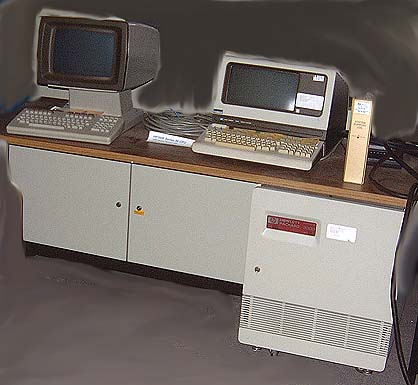
The HP 3000 lineup comprises a series of minicomputers featuring both 16-bit and 32-bit architectures, developed by Hewlett-Packard. It holds the distinction of being the first minicomputer to offer comprehensive hardware and operating system capabilities for time-sharing, a functionality previously confined to mainframe computers or adapted systems such as Digital's PDP-11. Launched in 1972, the final units were discontinued in 2010, marking it as one of the most enduring systems from its era.
The initial HP 3000 release was pulled from the market in 1973 due to issues with performance and operating system reliability, but it was reintroduced in 1974 as a dependable business platform that frequently attracted clients away from IBM mainframes. Originally named System/3000, HP eventually renamed it the HP 3000.
This series utilized a 16-bit CISC stack machine processor, initially built with Transistor-transistor logic technology and later transitioning to Silicon on Sapphire chips beginning with the Series 33 model in 1979. In the early 1980s, HP developed the PA-RISC architecture, a new RISC processor family. The HP 3000 CPU was subsequently emulated on PA-RISC hardware running a recompiled version of the MPE operating system. These RISC-based machines were branded as the "XL" series, while earlier CISC versions were designated "Classic." Both product lines were available simultaneously for a short period before the XL series became predominant by 1988. Hardware identical to these models but running HP-UX instead of MPE XL was marketed under the name HP 9000.
Although HP initially declared that support for the HP 3000 would cease in 2006, this was extended until 2010. Production and official support have since ended, but maintenance services continue through third-party providers.
HP 2000
In pursuit of a computing solution to manage intricate test equipment, HP explored acquiring Digital Equipment Corporation (DEC) but ultimately rejected the offer due to unfavorable terms. Instead, HP acquired DSI, a small firm that had enhanced DEC's PDP-8 architecture from 12 to 16 bits. This design formed the foundation for the HP 2116A, introduced in 1966 as a "test and instrumentation computer."
Unexpectedly, the HP 2116A gained significant traction in business sectors beyond laboratory environments, prompting updated versions with improved input/output capabilities tailored for commercial applications. The more compact HP 2114 model became particularly successful outside lab settings. Over time, all models transitioned from core memory to semiconductor memory technologies, culminating in the formation of the 2100 family by 1971.
By 1968, HP expanded its offerings with the HP 2000 series—systems that integrated components from the HP 211x range, typically employing a lower-end 2114 CPU as a terminal controller alongside a higher-end CPU like the 2116 as the primary processor. These systems ran HP Time-Shared BASIC, supporting between 16 and 32 concurrent users depending on configuration. The HP 2000 rapidly established itself as one of the leading timesharing platforms and contributed to positioning HP as the third-largest vendor in the minicomputer market.
Alpha and Omega
Building on the achievements of the HP 2000 line, development at Cupertino Lab began in 1969 on office-focused computer systems. Two projects were initiated: "Alpha," an enhanced version of the HP 2100 featuring upgraded components and memory management; and "Omega," a more ambitious 32-bit system designed for multi-user environments.
The focus soon shifted primarily to Omega—a sophisticated 32-bit architecture supporting up to four CPUs sharing as much as 4 MB of memory. It was engineered for high-level language programming and incorporated features such as multiprogramming and memory protection. However, Omega's expansive scope exceeded internal funding capabilities at HP, which risked incurring external debt. Consequently, in 1970 Tom Perkins terminated the Omega project, leading to employee dissatisfaction due to reassignment onto less challenging tasks.
Simultaneously, Alpha evolved into a smaller-scale iteration of Omega. It adopted virtual memory and stack machine principles but remained confined to a 16-bit architecture with a maximum memory capacity of 64 kWords (128 kB) and more basic input/output subsystems. Despite initial reservations from management regarding feasibility, George Newman authorized continued development efforts, with External Reference Specifications published in July 1970.
MPE
Early minicomputers such as the PDP-8 and Data General Nova were generally designed for single users and specific tasks. The HP 2000 set itself apart by incorporating timesharing capabilities, allowing multiple users to operate different programs concurrently—a functionality previously restricted to mainframe computers. This multi-user feature was fundamental to the original Omega architecture.
At first, Alpha followed a similar approach by delegating user interactions to a front-end processor while the central CPU handled program execution in a batch-style round-robin sequence. When revisiting Alpha's operating system design, HP expanded its capabilities to directly support multiprogramming, resulting in a flexible platform that combined timesharing, real-time processing, and batch operations. This evolved into the Multi-Programming Executive (MPE), one of the most sophisticated operating systems of its era. The development team faced challenges as the system’s scope exceeded the available memory, necessitating significant efforts to minimize the OS footprint to accommodate user applications.
Announcement and initial marketing
The system was unveiled at the Fall Joint Computer Conference in November 1971. By early 1972, three prototype units were operational; however, MPE development was notably behind schedule. A memo issued in February 1972 outlined a phased plan for development, but real-time processing support was removed and deadlines were missed repeatedly.
A conflict arose between engineering and marketing teams, leading to marketing personnel being excluded from the laboratory. Engineers provided overly optimistic performance figures to sales representatives, who then conveyed these inflated claims to customers despite knowing their inaccuracy.
In May 1972, senior management established the Systems Management Group to better align development efforts with customer expectations. Jim Peachy, brought on for performance evaluation, quickly determined that the machine could not fulfill the performance levels promised by sales.
First deliveries, recall
Because of delays with MPE, shipments were postponed from August to November 1972; initially, MPE only supported timesharing, with other functionalities deferred.
The inaugural unit was delivered to the Lawrence Hall of Science in Berkeley on November 1 but could only handle one or two users before experiencing slowdowns and frequent crashes. The machine was promptly returned. Later versions showed modest improvements in stability yet still supported approximately four users and required ongoing patching. Sales targets and feature releases continued to be deferred.
After five years of development and an investment of $20 million aimed at replacing the HP 2000, problems reached Bill Hewlett’s attention. He dispatched Paul Ely to oversee the division; Ely halted production and famously recalled all units that had been shipped. Dave Packard authored the "Wow Ouch memo" addressing the crisis.
Ed McCracken communicated to customers that new machines would not be available until fall 1973 and would only support four to six users. While some clients accepted HP 2000 replacements, others responded emotionally—one even threatened legal action but was persuaded against it by Hewlett’s personal assurance of issue resolution.
Re-release
Following six months of redevelopment, MPE-8 was introduced, which eliminated real-time support. Hardware performance improved by roughly 30%, pricing was reduced by 20%, and the system could now accommodate eight users. Shipments resumed in November, approximately one year behind schedule.
A year later, the "CX" model replaced core memory with semiconductor memory and adopted surface-mounted CPU components. The MPE-C version added COBOL and RPG programming languages—potentially making it the first minicomputer to support COBOL. HP also launched TurboIMAGE, a $10,000 CODASYL-compliant database system that was later included free of charge. IMAGE became a critical element in driving the commercial success of the HP 3000.
Overview
Initial HP 3000 models were housed in sizable cabinets featuring front control panels; subsequent iterations were designed to fit within office desks and utilized terminal consoles with bootstrap routines embedded in ROM. By 1984, the Series 37 operated efficiently in typical office settings without requiring specialized cooling or reinforced flooring. The product line extended from single-user configurations to systems capable of supporting more than 2,000 simultaneous users.
The HP 3000 distinguished itself as one of the final proprietary minicomputers discontinued by its manufacturer, outliving competitors such as Digital Equipment Corporation’s VAX series. After nearly three decades on the market, HP declared a planned five-year discontinuation phase for the e3000 series in 2001, which was subsequently extended twice. While new e3000 units were no longer sold, pre-owned systems continued to be available through third-party vendors. Official support from HP ended on December 31, 2010; however, numerous independent companies have maintained service offerings worldwide. The HP 3000 remains operational globally, particularly within manufacturing and e-commerce sectors, although many organizations have transitioned to more modern business servers from HP and other providers.
Following HP’s announcement to halt sales, a homesteading approach gained traction among customers unable or unwilling to migrate away from the platform. In 2012, Stromasys introduced the Charon-HPA solution, which fully emulates HP 3000 hardware on x86-64 architecture servers running Red Hat Linux or CentOS. This virtualization technology enables legacy applications to continue running under licensed MPE operating systems on contemporary hardware, safeguarding investments in existing HP 3000 software environments.
Software pioneering
A key contributor to the HP 3000’s market success was the inclusion of the proprietary network database management system (DBMS) IMAGE (currently known as TurboIMAGE/SQL), reportedly influenced by Cincom Systems’ TOTAL DBMS. IMAGE received industry accolades, including recognition by Datamation within two years post-release. It was the first DBMS integrated into a business-class minicomputer, fostering a robust ecosystem of applications and development tools that relied on IMAGE as a centralized data store across HP 3000 installations.
Classic memory segments and 64K barrier
The MPE operating system handled code and data using separate variable-length segments capped at 32,768 halfwords (equivalent to 65,536 bytes). Each process could load as many as 256 segments sourced from program files and segmented Library resources. Although individual code segments were restricted to a maximum size of 64KB, addressing capabilities allowed for approximately 32,385 routines per program within a theoretical 24-bit address space (16MB), exceeding the limitations typical of 16-bit architectures such as the PDP-11.
Similarly, data and stack segments were confined to a maximum of 64KB each. Shared libraries did not facilitate global data sharing across processes; instead, state information was exchanged through arrays allocated by the caller, aligning with concepts similar to modern object-oriented programming. Processes could allocate multiple additional data segments (XDS), each up to 64KB in size; however, system-wide constraints limited their overall quantity.
Systems-level programming was predominantly conducted using SPL (System Programming Language), an ALGOL-inspired language augmented with inline assembly instructions for direct hardware manipulation. The standard terminals for the HP 3000 were from the HP 2640 series, which supported block-mode data entry akin to IBM mainframe CICS, alongside character-mode operations. By the decade of the 1980s, personal computers such as PCs and Macs also functioned effectively as system terminals.
Classic and PA-RISC 3000 Hardware
The HP 3000 series transitioned from the 16-bit "Classic" line to the 32-bit "XL" models, later renamed "IX," which were built around HP's PA-RISC processors introduced in early 1987. Although XL systems did not maintain binary compatibility with Classic machines, they supported Classic applications through an emulator embedded within the MPE XL operating system. Additionally, Classic software could be converted into native PA-RISC instructions using OCTCOMP, enabling execution at native speeds while preserving the Classic architecture's stack and memory constraints.
Classic HP 3000 units operated on a proprietary CISC processor design. Starting in 1988, PA-RISC-based HP 3000 systems were produced in large quantities, gradually supplanting Classic models by the mid-1990s. Nevertheless, some Classic hardware remains functional in specific settings.
Both HP 3000 and numerous HP 9000 systems shared the HP Precision Bus architecture. The PA-RISC variants of the HP 3000 ran an operating system primarily written in Modcal, an extended form of Pascal developed by HP. Elements of the earlier MPE V OS, originally coded in SPL, continued to be utilized throughout MPE XL and MPE/iX. Certain subsystems such as TurboIMAGE were implemented using PSPL (Portable SPL), while portions of the OS were crafted in PA-RISC assembly language.
Initially named Multi-Programming Executive (MPE), the operating system evolved into MPE XL and subsequently MPE/iX after incorporating POSIX compliance between versions 5.0 and 5.5. Early iterations depended on HP’s proprietary SPL and BASIC languages, featuring a command-line interface and a hierarchical three-level file system. Over time, language support expanded to include COBOL, FORTRAN, Pascal, C, and IBM RPG to appeal to IBM’s commercial clientele.
From the 1970s onward, the HP 3000 earned a reputation for exceptional reliability compared to other mainframe and minicomputer offerings. Its ability to recover automatically and transparently from power outages was a notable advantage over IBM competitors. However, peripheral device support occasionally lagged or was missing altogether due to HP’s strategic decisions, despite equivalent hardware compatibility on the HP 9000 platform.
Stack-Based Architecture Instead of Registers
While most contemporary instruction sets rely on general-purpose register architectures, the original HP 3000 employed a stack machine design similar to HP’s RPN calculators. Drawing inspiration from Burroughs large systems, it utilized a stack structure for managing operands, local variables, and return addresses, rather than using limited registers such as AX and BX found on the HP 1000. For instance:
<syntaxhighlight lang="asm"> LDI 1 LDI 2 ADD </syntaxhighlight>
contrasted with:
<syntaxhighlight lang="asm"> LOAD AX, 0X0001 LOAD BX, 0X0002 ADD AX, BX </syntaxhighlight>
The 16-bit microcoded models—including Series I, II, III, and variants like 30, 33, 39, 40, 42, 44, 48, 52, 58, 64, 68, 70, and 37—featured a segmented Harvard architecture with a stack-oriented Instruction Set Architecture (ISA). Approximately 214 instructions mostly occupied 16 bits; stack operations often packed two instructions per word, with some extending to 32 bits.
CISC Implementations included:
- Series III: Equipped with four top-of-stack registers; microinstruction cycle time of 175 ns resulting in approximately 5.7 MHz
- Series 30 and 33: Utilizing silicon-on-sapphire technology; two top-of-stack registers; cycle time of 90 ns yielding around 11 MHz; instructions executed in three to seven cycles
- Series 40 through 48: Based on Schottky TTL technology; four top-of-stack registers; cycle time of 105 ns corresponding to about 9.5 MHz
- Series 64 and 68: Employed emitter-coupled logic (ECL); featured eight top-of-stack registers; cycle time of 75 ns equating to roughly 13 MHz; included an 8KB cache and writable control store (WCS)
- Series 37: Built with an approximately 8,000-gate CMOS gate array; four top-of-stack registers
Subsequent models transitioned to HP’s PA-RISC architecture utilizing general-purpose registers within a RISC framework.
PA-RISC Implementations comprised:
- PA-RISC version 1.0: Models in Series 925 through Series 980
- PA-RISC version 1.1: Including Series ranging from 917 up to Series 992
- PA-RISC version 2.0: Encompassing Series such as the Series 996, A class, N class, and the entire 9x9 series
HP's withdrawal from the 3000 platform
With the enterprise computing landscape gravitating toward widely available Unix systems from various suppliers—including those endorsed by HP—November 2001 saw HP declare the HP 3000 series would reach its end-of-life by late 2006. Sales of new hardware ceased after 2003. HP extended limited vendor support for certain customers and territories in early 2006 and again in September 2007, but stopped issuing new software updates following a phase of Mature Product Support that excluded Sustaining Engineering. Although some internally validated patches were distributed after 2010, these lacked extensive customer testing. By 2011, HP uniquely provided HP3000 users with complimentary patch access, a notable exception compared to its broader enterprise product lines, which had transitioned to a paid patch distribution model in 2010.
Third-party support
Following HP's exit from direct 3000 support, independent vendors have taken on responsibility for system and software maintenance for customers transitioning away from HP’s services. Some continue to support their proprietary software until customer usage concludes, while others offer extensive support services with commitments extending beyond 2016. Robelle Software offers a directory of consultants, and additional independent experts are listed on the OpenMPE website. Applied Technologies provides open source utilities and tools tailored for the 3000’s MPE/iX operating system.
The HP 3000 stands among the longest-lived business computing platforms, surpassing the longevity of PDP-11 and VAX systems, although OpenVMS remains operational on Alpha, IA-64, and x86-64 architectures.
In January 2012, Stromasys launched Charon/HPA-3000, a virtualization product that allows HP3000 environments to run MPE/iX along with third-party and custom applications unaltered on Intel-based servers. This solution includes a two-user trial version compatible with VMWare.
Several independent companies have obtained licenses to use the HP3000 Operating System Source Code (MPE/iX) and are dedicated to providing ongoing hardware and software support.
Beechglen Development, Inc., which has hosted HP3000 machines since 2002, introduced in 2012 custom fibre channel disk arrays compatible with HP3000 that utilize modern SSD and SATA technologies to replace legacy SCSI tape and disk devices. As of January 2020, Beechglen remains the only vendor supplying patches for the 2028 MPE CALENDAR intrinsic, extending date functionality beyond December 31, 2027. The company also continues compatibility testing for third-party applications.
Comparative performance metrics of HP 3000 models
| Model | Performance Index |
|---|---|
| Series 30, 33 | 0.5 |
| Series III | 0.6 |
| Series 37, 37XE | 0.6 |
| Micro 3000 RX | 1.3 |
| Micro 3000 GX, LX, RX | 1.3 |
| Series 39, 40, 44 | 1.0 |
| Series 42, 48 | 1.3 |
| Series 42XP, 52, 58 | 1.7 |
| Series 64 | 3.2 |
| Series 68 | 4.0 |
| Series 70 | 4.4 |
| Series 920 | 1.9 |
| Series 922 | 3.2 |
| Series 932 | 5.0 |
| Series 948 | 10.7 |
| Series958 | 13.3 |
| Series925 | 2.9 |
| Series935 | 5.9 |
| Series949 | 11.7 |
| Series950 | 6.5 |
| Series955 | 10.0 |
| Series960 | 14.7 |
| Series980/100 | 22.0 |
| Series980/200 | 37.0 |
| Series980/300 | 49.0 |
| Series980/400 | 59.0 |
| Series917LX | 10.0 |
| Series937 | 10.0 |
| Series947 | 10.0 |
| Series957 | 16.0 |
| Series967 | 20.0 |
| Series977SX | 26.0 |
| Series987 | 32.0 |
| Series987/150 | 45.0 |
| Series987/200 | 60.0 |
| Series918LX, RX | 10.0 |
| Series928 | 14.0 |
| Series968 | 21.0 |
| Series978 | 25.0 |
| Series939SK | 28.0 |
| Series959KS/100 | 35.0 |
| Series959KS/200 | 62.0 |
| Series988 | 39.0 |
| (Series959KS/300) | 86.0 |
| (Series959KS/400) | 110.0 |
| (Corporate Business System)990 | 28.0 |
| (Corporate Business System)992/100 | 35.0 |
| (Corporate Business System)992/200 | 60.0 |
| (Corporate Business System)992/300 | 81.0 |
| (Corporate Business System)992/400 | 100.0 |
| (Corporate Business System)991 | 33.0 |
| (Corporate Business System)995/100 | 42.0 |
| (Corporate Business System)995/200 | 71.0 |
| (Corporate Business System)995/300 | 96.0 |
| (Corporate Business System)995/400 | 118.0 |
| (Corporate Business System)995/500 | 139.0 |
| (Corporate Business System)995/600 | 160.0 |
| (Corporate Business System)995/700 | 180.0 |
| (Corporate Business System)995/800 | 200.0 |
| 'a-class' A400-100-110 | 17.0 |
| 'a-class' A500-100-140 | 24.0 |
| 'a-class' A400-200-140 | 42.0 |
| 'a-class' A400-100-150 | 37.0 |
| 'a-class' A500-100-200 | 49.0 |
| 'a-class' A500-200-200 | 84.0 |
| 'n-class' N4000-100-220 | 69.0 |
| 'n-class' N4000-100-330 | 100.0 |
| 'n-class' N4000-100-440 | 138.0 |
| 'n-class' N4000-200-440 | 254.0 |
| 'n-class' N4000-300-440 | 353.0 |
| 'n-class' N4000-400-440' | 438.0 |
| 'n-class' N4000-300-550' | 446.0 |
| 'n-class' N4000-400-550' | 553.0 |
| 'n-class' N4000-100-380' | 115.0 |
| 'n-class' N4000-200-380' | 207.0 |
| 'n-class' N40000-100-500' | 154 .00 |
| 284 .00 | |
| 399 .00 | |
| 499 .00 | |
| 606 .00 | |
| 768 .00 |
See also
Bibliography
External links
- HP 3000 Marketing Video, 1994 – YouTube
- 3000 NewsWire – blog featuring HP3000 updates, technical documents, and historical resources
- The History of the HP3000, by Bob Green
- HP3000 FAQ
- Portal dedicated to MPE-based open source software and ports
- Adager's collection of technical papers on IMAGE, HP3000 software, and VEsoft publications
- Official HP list of beta-test patches from 2009
- HP 3000 hardware and software manuals – PDF archives hosted by Bitsavers
- HP Computer Museum: scanned manual PDFs
- HP 3000 General Information Manual: September 1979, October 1984 editions
- – articles discussing MPE XL and HP 3000 emulation on Precision Architecture: "MPE XL: The Operating System for HP's Next Generation of Commercial Computer Systems" and "HP 3000 Emulation on HP Precision Architecture Computers"
- HP 3000 Performance (text document)
- November 14, 2001 article on Hewlett-Packard discontinuing server line
- Information on ongoing support for HP e3000 systems
- Frequently asked questions about the HP e3000 transition program
- Classic Genealogy and PA-RISC Systems Performance Spreadsheets
- SIMH Hewlett-Packard 3000 simulator (Series III)
- US Patent 3,820,079 for the Alpha system