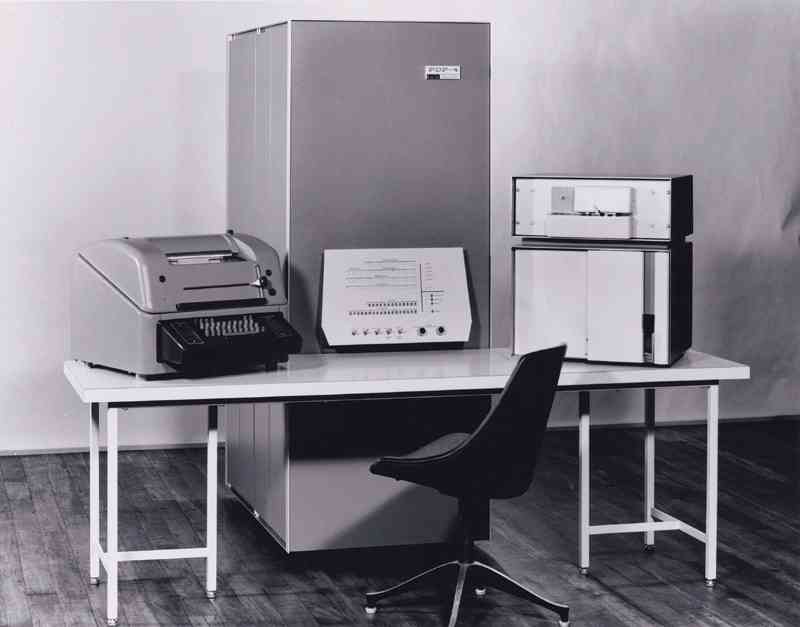
PDP-4
| Industry | Computer hardware |
|---|---|
| Founded | 1957 |
| Products | PDP-4, PDP-1, PDP-7, PDP-9, PDP-15, PDP-5, PDP-8 |
The PDP-4 followed as the next generation after Digital Equipment Corporation's PDP-1.
History
Introduced in 1962, this 18-bit computer represented a trade-off: it utilized slower memory and a different physical design compared to the PDP-1, yet it was offered at a price of $65,000—less than 50% of its predecessor's cost. Around 54 units were produced and sold. Subsequent 18-bit models such as the PDP-7, PDP-9, and PDP-15 expanded the instruction set, delivering increased capabilities while drawing on design principles from the 12-bit PDP-5 and PDP-8 families.
Hardware
The memory cycle duration for the PDP-4 was 8 microseconds, which was slower than the PDP-1’s 5 microseconds. The machine's weight was roughly .
Mass storage
Initially, both the PDP-1 and PDP-4 depended on paper tape for storage. For data recording, IBM-compatible magnetic tapes running at either 200 or 556 BPI were mainly employed. Although optional "mass storage" drums were offered, these devices had limited capacity and were fixed in place, which did not align with DEC’s emphasis on personal or serially shared computing environments.
In this setting, DEC introduced DECtape, originally named "MicroTape," for use with the PDP-1 and PDP-4 to provide more adaptable storage solutions.
Software
DEC provided an editor, an assembler, and a FORTRAN II compiler for the system. The assembler for the PDP-4 differed from that of the PDP-1 by lacking support for macros and functioning as a single-pass assembler, which removed the necessity of processing paper-tape input twice.