PDP-5
| Industry | Computer hardware |
|---|---|
| Founded | May 16, 1957 |
| Founder | Ken Olsen |
| Headquarters | Maynard, Massachusetts , United States |
| Products | PDP-5, PDP-1, PDP-4, PDP-8 |
The PDP-5 marked Digital Equipment Corporation's inaugural foray into 12-bit computing, debuting in 1963.
History
Preceding the PDP-5 was the LINC computer, recognized as the pioneering minicomputer and often described as "the first modern personal computer." Constructed in 1962, it featured 2,048 words of 12-bit memory. DEC's founder, Ken Olsen, gained hands-on experience with both the LINC and the larger 18-bit TX-0 at MIT Lincoln Laboratory; however, neither of these systems reached mass production.
Applicability
While the LINC was primarily developed for laboratory environments, the PDP-5’s 12-bit design facilitated a wider range of commercial applications. By introducing the PDP-5, DEC effectively proved the viability of the minicomputer market. Notably, it was employed in oceanographic data analysis aboard ships such as the United States Coast Guard's Evergreen, demonstrating its dependability and adaptability across various sectors.
The PDP-5’s architecture was crafted by Alan Kotok and Gordon Bell, with key logic design contributions from engineer Edson de Castro, who subsequently established Data General.
Hardware
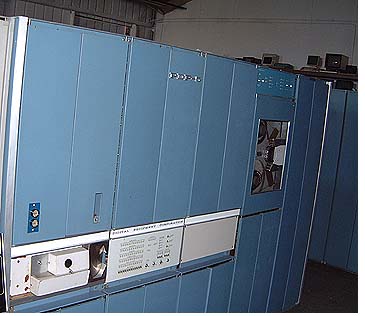
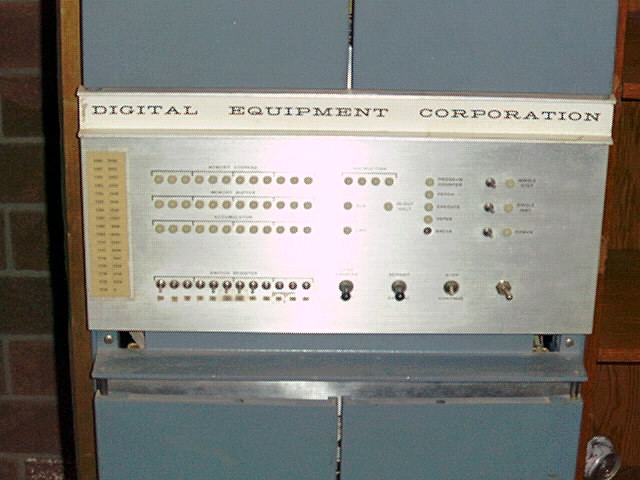
In contrast to the four-cabinet setup of the PDP-1, the smallest PDP-5 system was contained within a single 19-inch rack cabinet. This unit comprised 150 printed circuit boards integrating over 900 transistors. Additional cabinets were required to support numerous peripheral devices.
Weighing approximately , the system offered memory configurations ranging from 1,024 up to 32,768 words of 12-bit core memory. Expanding beyond 4,096 words necessitated a Type 154 Memory Extension Control unit—a type of memory management unit—to incorporate Type 155 core memory modules, each holding 4,096 words.
Instruction set
Within each 12-bit word, 3 bits functioned as instruction op-codes.
The instruction set of the PDP-5 was later enhanced in its successor, the PDP-8. Among the distinctions were the placement of the program counter: stored at memory location zero on the PDP-5 versus an internal CPU register on the PDP-8. Additionally, microcoded instructions on the PDP-5 could not simultaneously increment and clear the accumulator; this capability was introduced in the PDP-8, enabling efficient loading of numerous small constants in a single instruction. The PDP-5 became one of the earliest computer lines to surpass sales of 1,000 units.
Software
Digital Equipment Corporation provided a suite of software for the PDP-5 including an editor, assembler, a FORTRAN II compiler, and a DDT debugger.
Marketplace
Priced at $27,000, the PDP-5 served customers seeking more advanced performance than offered by module-based systems but without requiring the 18-bit PDP-4. Launched in 1963 during an expanding minicomputer market, it catered to applications demanding more effective computing solutions.