
Avro Lancaster
| Industry | Aerospace |
|---|---|
| Founded | 1910 in United Kingdom |
| Founder | Alliot Verdon Roe |
| Headquarters | Manchester , United Kingdom |
| Products | Aircraft, including the Avro Lancaster heavy bomber |
Template:EngvarB
Template:Infobox aircraft
The Avro Lancaster, often referred to simply as the Lancaster Bomber, was a British heavy bomber deployed during the Second World War. Developed by Avro, it was introduced alongside contemporaries such as the Handley Page Halifax—both aircraft were created to meet identical specifications—and the Short Stirling, all three being four-engine heavy bombers adopted by the Royal Air Force (RAF) during the same period.
The Lancaster traces its lineage back to the twin-engine Avro Manchester, which emerged in the late 1930s in response to the Air Ministry’s Specification P.13/36 calling for a medium bomber capable of worldwide deployment, including internal torpedo carriage and shallow dive-bombing capabilities. While the Manchester experienced operational difficulties and was phased out by 1942, its successor—the Lancaster—was designed by Roy Chadwick and powered primarily by four Rolls-Royce Merlin engines, with some variants utilizing Bristol Hercules powerplants. Entering service with RAF Bomber Command in 1942, it quickly became central to the strategic bombing campaign over Europe, especially during night raids. As production increased, the Lancaster emerged as the dominant heavy bomber for the RAF, as well as for the Royal Canadian Air Force (RCAF) and other Commonwealth and European squadrons operating within the RAF framework, surpassing both the Halifax and Stirling in operational prominence.[1]
Featuring an extended, unobstructed bomb bay, the Lancaster was capable of carrying some of the largest bombs deployed by the RAF, including 4,000 lb (1,800 kg), 8,000 lb (3,600 kg), and 12,000 lb (5,400 kg) "blockbuster" ordnance. These heavy bombs were often complemented by smaller explosive or incendiary munitions. Known colloquially as the "Lanc",[2] it became one of the most intensively utilized night bombers during World War II, delivering a total of 608,612 long tons (618,378,000 kg) of bombs across approximately 156,000 sorties.[3] Its adaptability was demonstrated when it was selected to equip 617 Squadron, modified to carry Barnes Wallis’s innovative Upkeep "bouncing bomb" used in Operation Chastise, targeting dams in Germany’s Ruhr valley. Although primarily a night bomber, the Lancaster also excelled in daylight precision bombing missions; certain models were adapted to deploy Wallis-designed earthquake bombs such as the 12,000 lb (5,400 kg) Tallboy and later the 22,000 lb (10,000 kg) Grand Slam.[4] These payloads represented the heaviest bomb loads carried by any bomber during that conflict.
In 1943, one Lancaster was converted into an engine test platform for the experimental Metropolitan-Vickers F.2 turbojet engine. Subsequently, Lancasters served as testbeds for various other powerplants including turboprops like the Armstrong Siddeley Mamba and Rolls-Royce Dart, as well as turbojets such as the Avro Canada Orenda and STAL Dovern. After World War II, this aircraft type was replaced as the RAF’s primary strategic bomber by its larger derivative, the Avro Lincoln. The Lancaster then transitioned into roles such as long-range anti-submarine patrols—later taken over by the Avro Shackleton—air-sea rescue operations, aerial reconnaissance and mapping missions, aerial refueling as a flying tanker, and conversion into a civilian airliner known as the Avro Lancastrian for transatlantic passenger and mail services. Notably, in March 1946, a BSAA Lancastrian conducted the inaugural scheduled flight from London Heathrow Airport.[5]
Origins
During the 1930s, the Royal Air Force (RAF) primarily focused on twin-engine bombers. These aircraft imposed relatively low demands on engine manufacturing and upkeep, which were already under pressure due to the introduction of numerous new models. Because of significant power constraints, Britain invested heavily in developing large engines around the 2,000 hp (1,500 kW) range to enhance aircraft performance. However, by the late 1930s, none of these powerful engines had reached production readiness. Meanwhile, both the United States and the Soviet Union were advancing bombers powered by four smaller engines, which demonstrated advantageous traits such as extended range and adequate payload capacity. Consequently, in 1936, the RAF also opted to explore the potential of four-engine bombers.
The Lancaster's development traces back to a twin-engine bomber design submitted in response to British Air Ministry Specification P.13/36 issued in 1936. This specification called for a twin-engine medium bomber capable of worldwide operation, with the ability to internally carry a torpedo and perform shallow dive-bombing attacks. Additional criteria included a mid-mounted cantilever monoplane wing and all-metal construction, while encouraging use of the then-developing Rolls-Royce Vulture engine. Various twin-engine proposals were presented by Fairey, Boulton Paul, Handley Page, and Shorts, featuring engines such as the Rolls-Royce Vulture, Napier Sabre, Fairey P.24, or Bristol Hercules. Most of these powerplants were still in development stages. Although four-engine designs were considered under specification B.12/36 for a heavy bomber role, their additional engines necessitated stronger wings and airframe structures, resulting in increased structural weight.
Avro responded with the Avro 679 to meet Specification P.13/36; in February 1937, Avro’s design was selected alongside Handley Page’s as a contingency plan. By April 1937, two prototypes of each model were commissioned. The Manchester entered RAF service in November 1940 but was hampered by insufficient power and unreliable Vulture engines despite being a competent aircraft. Due to these shortcomings, only 200 units were built before the type was retired from service in 1942.
Flight testing
By the middle of 1940, Avro's lead design engineer, Roy Chadwick, had begun developing an enhanced version of the Manchester[6] that utilized four of the more dependable yet less powerful Rolls-Royce Merlin engines. This design incorporated the "Power-egg" configuration originally created for the Beaufighter II and featured wings with an extended span.[7] Initially called the Type 683 Manchester III, the aircraft was later renamed the Lancaster. The prototype, bearing serial number BT308, was assembled by Avro’s experimental flight department at Ringway Airport, Manchester, by modifying a standard Manchester airframe and fitting it with the new wing to support the additional engines.[6] On 9 January 1941, test pilot H. A. "Sam" Brown conducted its maiden flight at RAF Ringway, Cheshire.[8]

Flight trials rapidly demonstrated that this new model was a significant advancement over its predecessor.[9] The initial prototype was equipped with the Manchester I’s three-fin tail assembly; however, this was altered on the second prototype, DG595, and all subsequent Lancaster production models adopted a larger elliptical twin-finned tail unit, which had also been fitted to the final Manchesters produced.[6] This modification enhanced both stability and the firing range of the dorsal gun turret. Additionally, the second prototype featured upgraded Merlin XX engines.[6]
Manchester aircraft still undergoing production were converted into Lancaster B.I models.[6][8] Given its superior performance, an early decision was made to re-equip twin-engine bomber squadrons swiftly with Lancasters.[6] The first production Lancaster, L7527, took flight in October 1941, powered by Merlin XX engines.[6][8]
Production

Avro secured an initial order for 1,070 Lancaster aircraft.[6] Most Lancasters produced during wartime were built at Avro’s factory in Chadderton near Oldham, Lancashire, with test flights conducted from Woodford Aerodrome in Cheshire. As demand rapidly outpaced Avro’s manufacturing capacity, a decision was made to establish the Lancaster Aircraft Group. This consortium included multiple companies involved either in primary assembly or in producing various components and subassemblies for other members of the group.[10] The Wythenshawe Bus Garage, constructed from reinforced concrete between 1939 and 1942 and designed by Manchester’s City Architect G. Noel Hill, was promptly requisitioned by the Ministry of Aircraft Production for use by Avro in Lancaster manufacturing.[11]
Beyond Avro’s efforts, additional Lancaster production took place at Metropolitan-Vickers (which produced 1,080 units and also conducted test flights at Woodford) and Armstrong Whitworth. Later during WWII and postwar periods, production also occurred at the Austin Motor Company facilities in Longbridge, Birmingham, as well as at Vickers-Armstrongs plants located in Chester and Castle Bromwich, Birmingham. Although Belfast-based manufacturer Short Brothers had received an order for 200 Lancaster B.Is, this contract was cancelled before any aircraft were completed.[12][13]
The Lancaster was also produced internationally. In early 1942, it was decided to manufacture the bomber in Canada where production was undertaken by Victory Aircraft in Malton, Ontario.[14] Among later variants, only the Canadian-built Lancaster B X reached significant production volumes. A total of 430 units were completed; these closely resembled their British counterparts except for using Packard-built Merlin engines and featuring American-style instrumentation and electrical systems.Template:Fix/category[citation needed] In August of that year, a British-built Lancaster B.I was sent to Canada as a pattern aircraft and became the first of its type to complete a transatlantic flight.[14] The inaugural Canadian-produced Lancaster was named "Ruhr Express".[note 1]Template:Fix/category[citation needed] Early Canadian Lancasters delivered to England experienced issues with faulty ailerons; investigations revealed that this problem stemmed from employing inexperienced labor.[15] By war’s end, over ten thousand Canadians were involved in production efforts at Victory Aircraft’s plant which maintained a manufacturing rate of one Lancaster per day.[16]
| Manufacturer | Location | Quantity produced |
|---|---|---|
| A. V. Roe | Woodford | 2,978 |
| Chadderton | ||
| Yeadon | 695 | |
| Armstrong Whitworth | Whitley | 1,329 |
| Austin Motors | Longbridge | 330 |
| Marston Green | ||
| Metropolitan-Vickers | Trafford Park | 1,080 |
| Vickers-Armstrongs | Castle Bromwich | 300 |
| Chester | 235 | |
| Victory Aircraft | Malton (Canada) | 430 |
Further evolution

The Lancaster B.I remained in production until February 1946, as no direct successor fully replaced it during its manufacturing run.[12] Aviation historians Brian Goulding and M. Garbett note that the Lancaster B.I underwent minimal changes throughout its production, largely due to its robust fundamental design; among the visible modifications were the removal of fuselage side windows, an enlarged Perspex chin for the bomb aimer, and the incorporation of a bigger astrodome.[17] Additional protrusions and blisters were introduced on various models, typically housing radar systems and radio navigation equipment. Certain Lancaster B.I variants featured bulged bomb bay doors to support heavier armament loads.[17]
Initial Lancaster B.I units included a ventral gun turret.[14] However, due to limited operational use, this turret was frequently removed during an aircraft’s service life. While some squadrons opted to eliminate the ventral turret altogether, various tests and experiments took place at RAF Duxford, Cambridgeshire, as well as within specific units.[14] A batch of 50 Austin-built Lancaster B.Is featured a non-standard design with a Frazer Nash turret installed above the bomb bay; this arrangement was generally unpopular because it obstructed the internal passageway, restricting crew movement. Different turret configurations were adopted by certain squadrons, including selective removal of multiple turrets.[18]
The Lancaster B.III was equipped with Packard Merlin engines manufactured in the United States, yet remained otherwise identical to the B.I models produced concurrently.[12] A total of 3,030 B.IIIs were built, predominantly at Avro’s Newton Heath facility. Both the B.I and B.III versions were produced simultaneously, with slight adjustments applied to each as new orders were fulfilled. The distinction between B.I and B.III largely depended on the engine type installed, and in some cases engines were swapped between models.[12] Examples of modifications include relocating the pitot head from the aircraft nose to the cockpit side and replacing de Havilland "needle blade" propellers with "paddle blade" propellers from either Hamilton Standard or Nash Kelvinator.[19]
Overview

The Avro Lancaster served as the United Kingdom's primary heavy strategic bomber for the Royal Air Force during the latter part of World War II. It was typically powered by four wing-mounted Rolls-Royce Merlin piston engines, each turning a 13 ft (4.0 m) diameter de Havilland Hydromatic three-bladed propeller. Although not ideal, the Lancaster could complete its return flight on just two functioning engines and was capable of limited travel on a single operational engine.[12] According to aviation experts Brian Goulding and M. Garbett, seasoned Lancaster pilots frequently managed to outmaneuver Luftwaffe fighters.[20] The aircraft was renowned for its favorable flight characteristics; Goulding and Garbett described it as "an almost perfect flying machine, swift for its size and exceptionally smooth...a remarkably easy aircraft to pilot...instances exist of Lancasters performing loops and barrel rolls, both intentionally and unintentionally".[20]
The Lancaster’s construction emphasized strength and resilience, deliberately engineered to optimize structural strength relative to weight. This robustness enabled it to endure certain degrees of damage from enemy interceptor assaults and ground-based anti-aircraft fire.[12] Nevertheless, during its initial year in service, some Lancaster B.I models experienced structural failures, leading to several losses due to the airframe being pushed beyond its design limits.[20]
Employing a mid-wing cantilever monoplane design, the Lancaster’s wing consisted of five distinct main sections, with the fuselage similarly divided into five parts. Except for components like the fabric-covered ailerons, the aircraft’s oval fuselage was covered entirely in metal.[14] Each wing and fuselage segment was produced separately and equipped with necessary systems before final assembly—a strategy intended to enhance production speed. The bomber featured retractable main undercarriage and a fixed tailwheel; its hydraulically operated main landing gear folded rearwards into compartments within the inner engine nacelles.[21] The aircraft’s distinctive tail assembly incorporated large twin elliptical fins paired with rudders.[20]
Despite its many strengths, the Lancaster had some handling drawbacks. During dives, it tended to deepen its descent as velocity increased—a behavior not common to all bombers; for instance, the Halifax became more tail-heavy with speed increases, which helped it naturally recover from dives.[22] Additionally, the Lancaster exhibited longitudinal instability at speeds exceeding 200 mph (320 km/h).[23]
Crew quarters
A typical Lancaster crew comprised seven personnel, each assigned to distinct locations within the fuselage. Beginning at the front, the bomb aimer operated from two different spots. Primarily, he lay prone on the nose floor, positioned to manage the bombsight controls facing forward, with the Mark XIV bomb sight situated on his left and bomb release selectors on his right. Additionally, he assisted the navigator by using his view through the large transparent perspex nose cupola for map reading. To operate the Frazer Nash FN5 nose turret, he would stand behind the twin .303 in (7.7 mm) guns, gripping the triggers. Each gun was supplied with 1,000 rounds of ammunition. The bomb aimer's station also incorporated an emergency hatch located in the floor of the nose.
Compared to other aircraft of its era, escaping from a Lancaster was notably difficult due to its relatively small nose emergency hatch measuring only 22 in × 26.5 in (56 cm × 67 cm). Consequently, just 15 percent of crew members from downed Lancasters managed to bail out successfully. By contrast, both the Halifax and Stirling featured escape hatches approximately 2 in (5.1 cm) wider, resulting in a 25 percent bailout success rate among their crews. American bombers achieved even higher rates—up to 50 percent—partly because daylight raids allowed crew members better visibility during escape. Freeman Dyson, then a 19-year-old in Bomber Command’s Operational Research Section prior to earning his degree, later recounted how this section compiled survival statistics by analyzing records of airmen who survived crashes and reappeared in POW camps. Despite these findings, efforts to enlarge or improve the Lancaster’s escape hatch were not implemented.
On top of the bomb bay, the pilot and flight engineer sat side by side beneath a large canopy. The pilot occupied a raised seat on the left side (a standard arrangement in most British and many German bombers, which typically featured only one pilot seat rather than two as seen in American designs). To his right, the flight engineer was seated on a foldable "second dicky seat" with fuel selectors and gauges positioned behind and to his right on a panel. Both pilot and crew could use an overhead panel as an auxiliary emergency exit, whereas the mid-upper gunner was expected to evacuate via the rear entrance door. The tail gunner exited by swiveling his turret backward, opening its rear door, moving into the fuselage, securing his parachute clipped on a sidewall hook, and then leaving through the rear door.
Behind the pilot and flight engineer sat the navigator, separated by a curtain that allowed him to work with controlled lighting. His station faced portside and included a chart table directly ahead. Above this table on the fuselage side was an instrument panel displaying airspeed, altitude, and other navigation data. The wireless operator’s radios were installed at the left end of this chart table facing aft. Positioned just behind these radios and facing forward, the wireless operator occupied a seat at the front of the main spar with a window to his left and an astrodome above—used for visual signalling and celestial navigation by both navigator and wireless operator.
The two main wing spars behind the wireless operator created significant obstructions for crew movement along the fuselage even when on solid ground. At the rear end of the bomb bay was the mid-upper gunner’s turret, where the floor dropped lower toward the bottom of the fuselage. This position provided a full 360° field of view over and around the aircraft’s upper surfaces and was armed with two Browning .303 Mark IIs. The mid-upper gunner remained seated on a canvas sling beneath his turret throughout missions; each gun carried 1,000 rounds.
Located just aft of this turret on the starboard side was the main crew entrance door, which also served as an emergency exit. Near this area by the tailplane spars was installed an Elsan chemical toilet, typical of aircraft lavatories at that time. At the extreme rear end of the fuselage sat the rear gunner within an exposed tail turret accessible through a small hatch at the back of the fuselage. Given space constraints inside this compartment, some gunners hung their parachutes on hooks near this entrance before taking their positions. Neither mid-upper nor rear gunner stations were equipped with heating systems; therefore, gunners wore electrically heated suits during flights to protect against hypothermia and frostbite.
Defensive armament

The Avro Lancaster was originally outfitted with four hydraulically operated turrets manufactured by Nash & Thompson Frazer Nash. These turrets were positioned at the nose, tail, mid-upper, and underside of the aircraft. The tail turret was armed with four Browning .303 Mark II machine guns, while each of the remaining turrets contained two of these weapons.[24][25][26]
After World War II, Freeman Dyson and his team in the Operational Research Section proposed removing the Lancaster’s gun turrets. Their rationale was that eliminating the turrets could increase the bomber’s cruising speed by as much as 50 mph (80 km/h), assuming no increase in bomb load, thereby lowering its vulnerability to enemy interception.[27] Dyson also privately felt that reducing the number of crew members by removing turret gunners might decrease overall casualties per aircraft lost. Despite these arguments, the suggestion was ultimately not implemented.[28]
Nose turret


The FN-5A[24] nose turret remained consistent throughout the Lancaster’s service life except when it was removed entirely. This turret closely resembled the FN-5 model used on earlier aircraft such as the Avro Manchester, Vickers Wellington, and Short Stirling.
Ventral turret
The FN-64 ventral (underside) turret was soon recognized as ineffective due to its reliance on a periscope that restricted the gunner’s field of vision to approximately 20 degrees,[24] and its inability to track targets swiftly enough.[note 2] Aside from early B.I models and prototype B.IIs, this turret was rarely used.
When the Luftwaffe introduced Schräge Musik attacks from beneath during the winter of 1943/1944, several modifications were implemented. These included downward observation blisters positioned behind the bomb aimer’s blister[29], along with both official[30] and unofficial mounts for .50 in (12.7 mm) machine guns or even 20 mm (0.79 in) cannons firing through openings left by the removed FN-64 turret. However, installing these weapons was complicated by the shared ventral location used for the H2S blister. This limitation confined such armaments to aircraft equipped with bulged bomb bays that interfered with H2S installations.[24]
Mid-upper turret

The mid-upper, also known as the dorsal or top turret, was initially equipped with an FN-50[24][25] on early models, transitioning later to the closely related FN-150 which featured enhanced sights and control systems.[24] Except for the earliest versions, this turret was encircled by a coaming that housed a cam-operated interrupter mechanism designed to prevent the gunner from firing into the aircraft's own tail section.[24] The Mk.VII and later Mk.X variants of the Lancaster employed the more robust, electrically powered Martin 250 CE 23A turret fitted with two .50 in (13 mm) machine guns.[24] This turret was positioned further forward to maintain the aircraft’s longitudinal balance and, due to its internal safety mechanism against self-targeting, it did not require a surrounding coaming.[note 3][24] Additional experimental turret designs such as the FN-79 and Boulton-Paul Type H barbette system were also evaluated.[24]
Tail turret

Serving as the primary defensive station, the tail turret carried the most substantial firepower. However, starting with the FN-20 model, these turrets were never fully satisfactory, prompting multiple design trials. The FN-20 was succeeded by the similar FN-120 model which incorporated an improved gyroscopic gun sight (GGS).[24] Many rear gunners preferred removing the central perspex panel of the turret to enhance visibility. Nighttime observation through these transparencies was challenging, especially when scanning for enemy night fighters approaching stealthily from below and behind before engaging. This modification of removing perspex was known as the "Gransden Lodge" alteration. Ammunition supply for each tail gun amounted to 2,500 rounds per gun. Due to their weight, ammunition was stored in tanks near the mid-upper turret area and fed rearwards through channels along the fuselage to reach the turret.[31]

Although gunners operating both FN-20 and FN-120 turrets removed perspex and armor plating to improve sightlines, RAF tests demonstrated that a de Havilland Mosquito night fighter could still approach dangerously close to the tail gunner undetected—validating Luftwaffe tactics. The Rose turret aimed to enhance upon FN designs by being fully open at the rear (offering better visibility and easier emergency exit) and mounting two .50 in (13 mm) machine guns. It saw limited installation on some Lancasters but never achieved widespread use.[24]
Ultimately, radar technology rather than improved visibility enhanced tail turret effectiveness. The FN-121 represented an Automatic Gun Laying Turret (AGLT), being an FN-120 equipped with 'Village Inn' gun-laying radar.[24] Aircraft fitted with Village Inn served as bait units flying behind main bomber formations to engage night fighters targeting trailing stragglers, significantly reducing operational losses. Gun-laying radar was progressively integrated into later turret versions. Prior to war’s end, UK-built Lancasters standardized on the FN-82 model featuring two .50 in (13 mm) machine guns coupled with gun-laying radar as manufacturing permitted; this configuration was also adopted on early Avro Lincoln models. A drawback of all radar and radio transmission systems is that enemy forces can detect aircraft by intercepting these emissions.Template:Fix/category[citation needed]
Bombs


A notable characteristic of the Lancaster was its clear 33 ft (10 m) long bomb bay. Initially, its heaviest ordnance was the 4,000 lb (1,800 kg) high-capacity HC "Cookie".[33] To accommodate larger bombs weighing 8,000 lb (3,600 kg) and subsequently 12,000 lb (5,400 kg), bulged bomb bay doors were installed on approximately 30% of B.I models. The Lancaster was also capable of deploying various smaller munitions such as the Small Bomb Container (SBC), which carried either 236 4 lb (1.8 kg) or 24 30 lb (14 kg) incendiary and explosive incendiary bomblets; general-purpose (GP) high-explosive bombs in weights of 500 lb (230 kg) and 1,000 lb (450 kg) in several configurations; parachute-retarded magnetic or acoustic mines weighing 1,850 lb (840 kg); armour-piercing (AP) bombs at 2,000 lb (910 kg); semi-armour-piercing (SAP) bombs of 250 lb (110 kg), used until 1942 primarily against submarines; and from post-1942 onward, anti-submarine depth charges in weights of 250 lb (110 kg) or 500 lb (230 kg).Template:Fix/category[citation needed]
In 1943, 617 Squadron was formed specifically to execute Operation Chastise, the attack on the Ruhr dams. This squadron operated B.III (Special) models, officially termed "Type 464 (Provisioning)", adapted to carry the 9,250 lb (4,200 kg) "Upkeep" bouncing bomb.[34][note 4] To facilitate this, the standard bomb bay doors were removed and the ends enclosed with fairings. The "Upkeep" device was mounted on laterally pivoted vee-shaped struts that spread apart sideways upon release. A hydraulic motor housed in the forward fairing powered a drive belt and pulley system on the starboard strut to spin the bomb at approximately 500 rpm. Modifications also included removal of the mid-upper turret and installation of a more pronounced bomb aimer’s blister known as "Mod. 780", which subsequently became standard across all Lancasters. The original bombsight was replaced with a simple aiming apparatus consisting of a wooden triangle featuring a peephole at one vertex and nails at the other two corners; pilots carried multiple variants to correspond with differing dam tower widths.[35][36] Two Aldis signal lamps were positioned in the rear bomb bay fairing facing forward so that the bomb aimer could observe converging light beams beneath his blister; when flying at the optimal altitude of 60 ft (18 m), these beams formed a figure-eight pattern on the calm reservoir waters.[35][37] The Type 464 Lancaster also featured VHF radios—typically reserved for fighter aircraft—to allow squadron leader Guy Gibson to coordinate operations during the mission,[38] representing an early form of what would evolve into the master bomber function.
Following the 'Dam Busters' mission, No. 617 Squadron transitioned to high-altitude precision bombing in preparation for deploying Barnes Wallis’s innovative Earthquake bombs against fortified targets. While training for this role, bouncing bomb-equipped B.I Specials had their spars and related equipment removed and were modified to carry the 21 ft (6.4 m) long 12,000 lb (5,400 kg) "Tallboy" bomb—a smaller variant of the forthcoming 25.5 ft (7.8 m) long 22,000 lb (10,000 kg) "Grand Slam" Earthquake bombs still under construction. Aircraft configured for "Grand Slam" required extensive alterations including removal of the dorsal turret along with two guns from the rear turret, elimination of cockpit armor plating behind the pilot’s seat, and installation of Rolls-Royce Merlin Mk24 engines to enhance takeoff capabilities. The bomb bay doors were discarded and its rear section cut away to accommodate the tail fin of the oversized ordnance. Later modifications saw removal of the nose turret to further improve flight performance. Strengthened landing gear with more robust main wheels—later adopted by the Avro Lincoln—were also fitted.[4][note 5]
Bomber Command standardized specific bomb configurations under distinct code names:[39]


| Code Name | Target or Raid Type | Bomb Configuration |
|---|---|---|
| "Arson" | Incendiary area bombing | 14 Small Bomb Containers each carrying 236 x 4 lb (1.8 kg) incendiary and explosive incendiary bomblets; total bomblets: 3,304. |
| "Abnormal" | Factories, rail yards, dockyards | 14 x 1,000 lb (450 kg) GP/HE bombs fitted with both impact and extended delay fuses (up to six days). |
| "Cookie"—or—"Plumduff" | Blast and fire demolition | One impact-fused Blockbuster bomb weighing 4,000 lb (1,800 kg), supplemented by three x 1,000 lb (450 kg) GP/HE bombs and up to six SBCs containing a total of 1,416 incendiary bomblets. |
| "Gardening" | Mining operations targeting ports, canals, rivers | Six parachute-retarded mines weighing 1,850 lb (840 kg) each. |
| "No-Ball" | Sites launching V-1 flying bombs | One impact-fused HC bomb at 4,000 lb (1,800 kg), plus up to eighteen GP bombs weighing 500 lb (230 kg), equipped with both impact and delay fuses. |
| "Piece" | Docks, fortifications, naval vessels | Six short-delay fused AP bombs at 2,000 lb (910 kg), supplemented by additional GP/HE bombs tailored to availability or mission requirements. |
| "Plumduff-Plus" | Heavy industry targets | One HC bomb weighing 8,000 lb (3,600 kg), fused via impact or barometric methods, accompanied by up to six GP/HE bombs at 500 lb (230 kg), using impact or delay fuses. |
| "Usual" | Area bombing combining blast and incendiary effects | One impact-fused HC bomb at 4,000 lb (1,800 kg), plus twelve SBCs containing a total of 2,832 incendiary bomblets. |
| (no code name) | Medium-range low-altitude tactical strikes | Six GP/HE bombs at 1,000 lb (450 kg) with mixed short and long delay fuses; occasionally supplemented by additional GP/HE bombs at 250 lb (110 kg). |
| (no code name) | Anti-submarine warfare | lb}}, designed for submarine engagement. |


| Special Weapon & Code Name | Intended Target | Ordnance Details |
|---|
|"Upkeep"||Dams||Single hydrostatically fused "Upkeep" mine weighing approximately {{cvt{9250}|lb}} |} |"Tallboy"||Extremely durable structures such as submarine pens; battleship German battleship Tirpitz||One short-delay fused "Tallboy" bomb weighing around {{cvt{12000}|lb}} |} |"Grand Slam"||Designed for direct hits on heavily fortified structures like submarine pens or indirectly creating undermining caverns (camouflets) beneath bridges, viaducts and bunkers causing collapse||One short-delay fused "Grand Slam" bomb approximately weighing {{cvt{22000}|lb}} |}
Bombsights
The Lancaster employed several types of bombsights, including:
- Mark IX Course Setting Bomb Sight (CSBS).
- An early vector bombsight that required manual adjustment of wires based on aircraft speed, altitude, and bombload. Due to its lack of adaptability when these parameters shifted, it was soon replaced by more sophisticated models.
- Mark XIV bombsight
- A vector bombsight where the bomb aimer entered details such as bombload, target altitude, and wind direction. An analogue computer then continuously calculated the bomb trajectory, projecting an inverted sword shape onto a sighting glass. When the target aligned within this sword shape, bombs could be released with high accuracy.
- T1 bombsight
- A variant of the Mark XIV modified for mass production in the United States. Some pneumatic gyro drives were replaced by electronic gyros along with other minor changes.
- Stabilizing Automatic Bomb Sight
- Known as "SABS," this advanced bombsight was primarily used by 617 Squadron for precision bombing missions. Similar to the American Norden bombsight, it was a tachometric sight.
Radio, radar and countermeasures equipment
The Lancaster featured a highly advanced communication suite for its era. Most British-built Lancasters were equipped with the R1155 receiver and T1154 transmitter, while Canadian-built and Far East service aircraft used American radios. These systems provided radio direction-finding as well as voice and Morse transmission capabilities.
- H2S
- A ground-mapping navigation radar operating at 3 GHz frequency. Over time, it became vulnerable to detection by German night fighters equipped with the FuG 350 Naxos receiver, necessitating cautious use. This issue was not present with the higher resolution American H2X radar, which operated at 10 GHz. The H2S system is recognizable by the large blister beneath the rear fuselage on later Lancasters.
- Fishpond
- An enhancement to H2S providing aerial coverage beneath the aircraft to detect attacking fighters. This information was displayed on an auxiliary screen accessible to the radio operator.
- Monica
- A rear-facing radar designed to alert crews of approaching night fighters. However, it could not differentiate between hostile fighters and friendly bombers nearby and also acted as a homing beacon for German night fighters equipped with Flensburg. After mid-1944, once this vulnerability was identified, it was removed from service.
- GEE
- A navigation receiver that used synchronized pulses transmitted from stations in the UK. Aircraft determined their position by measuring pulse time delays. GEE had an operational range between 300–400 mi (480–640 km) and utilized a whip aerial mounted atop the fuselage ahead of the mid-upper turret.
- Boozer (radar detector)
- A panel of indicator lights on the instrument panel that illuminated when the aircraft was being tracked by low-UHF band Würzburg-Riese ground radar or early model Lichtenstein B/C and C-1 airborne radar. In practice, it often caused more confusion than assistance due to frequent false alarms amid Germany's heavily radar-saturated environment.
- Oboe
- This highly precise navigation system involved a receiver/transponder communicating with two widely spaced radar stations in Southern England. By combining their signals, it pinpointed aircraft position accurately. Limited to one aircraft at a time, Oboe-equipped planes were typically fast and agile De Havilland Mosquito Pathfinders tasked with marking targets rather than Lancasters.
- GEE-H
- Functionally similar to Oboe but featuring a ground-based transponder that allowed multiple aircraft simultaneous use. Aircraft fitted with GEE-H were often marked by two horizontal yellow stripes on their fins.
- "Village Inn" Automatic Gun-Laying Turret
- A gun turret guided by radar for aiming and ranging, installed on some Lancaster rear turrets from 1944 onward. It is distinguishable by a radome mounted beneath the turret.
- Airborne Cigar (ABC)
- Exclusively installed on Lancasters of 101 Squadron, this system featured three 7-foot (2.1 m) aerials—two atop the fuselage and one under the bomb aimer's position. Crewed by German-speaking personnel, these aircraft jammed ground-to-air communications used by German night fighters. The additional equipment and crew increased bomber weight by approximately 600 pounds (272 kg), resulting in a reduced bomb load of about 1,000 pounds (454 kg). Due to its nature, enemy forces could track these aircraft, leading 101 Squadron to suffer the highest casualty rate among bomber units. Introduced around mid-1943, ABC remained in use until war’s end.
- Tinsel
- A microphone placed within an engine nacelle enabling the wireless operator to broadcast engine noise on German night fighter control radio frequencies.
Second World War


In early 1942, No. 44 Squadron, stationed at RAF Waddington, Lincolnshire, became the first RAF unit to transition to the Lancaster bomber; shortly thereafter, No. 97 Squadron, also based at Waddington, followed suit.[20][40] The Lancaster’s inaugural operational sortie took place on 2 March 1942 when aircraft from No. 44 Sqn laid naval mines near the Heligoland Bight; an earlier planned attack on the German battleship Tirpitz was postponed due to adverse weather.[41] The bomber’s first bombing mission occurred on 10 March 1942, targeting the German city of Essen, North Rhine-Westphalia.[42]
Following a crash on 20 March in Boston, Lincolnshire, all Lancasters were temporarily grounded pending inspections for wing surface buckling; operations resumed once aircraft were cleared.[41] The initial recorded casualties among Lancaster crews happened on 24 March 1942 with the loss of R5493 due to anti-aircraft fire over Lorient.[43] Given the typically high attrition rates of such missions, daylight bombing raids were infrequent until the Allies secured sufficient aerial dominance over the Axis powers.[44]
On 17 April 1942, a force of twelve Lancasters from Nos. 44 and 99 Squadrons executed a bombing raid on the engine works of Maschinenfabrik Augsburg-Nürnberg A.G., Augsburg in Southern Germany; despite operating at low altitude, three bombers were downed by Luftwaffe Bf 109 fighters over France and at least two more were lost to flak at the target site. Nevertheless, the factory sustained effective damage, an achievement personally commended by Prime Minister Winston Churchill.[45] This raid marked the public and German awareness of the Lancaster’s capabilities. Subsequently, on 27 April, Lancasters from Nos. 44 and 99 Squadrons conducted an unsuccessful small-scale attack against the Tirpitz.[46]
The Lancaster took part in Operation Millennium during the night of 30/31 May 1942, which was the first raid involving a thousand bombers targeting Cologne.[47] By then, operational Lancaster numbers had exceeded those of its predecessor, the Manchester. On 12 June, RAF Coastal Command began using loaned Lancasters from Bomber Command for extended-range anti-U-boat missions, reportedly engaging two submarines on 15 June.[48]
Large-scale raids continued with attacks on Emden between June 19–23 and on Bremen from June 25–29; the Bremen raids notably inflicted significant damage on the Focke-Wulf aircraft factory.[48] Additionally, forty Lancasters conducted a less effective long-range operation against Danzig, arriving post-dusk and failing to disrupt U-boat port facilities effectively. On July 31, one-fifth of Bomber Command’s strength targeted Düsseldorf, focusing on machine tool production at Schiess A.G..[49] August saw an escalation in Lancaster operations with major raids over the Ruhr, Duisburg, and areas within the Baltic Sea, emphasizing support for the Battle of the Atlantic by impairing German naval capabilities. When weather conditions hindered bombing runs, night-time mine-laying sorties were frequently undertaken.[50]
A significant advancement in nocturnal bombing accuracy came with the formation of the Pathfinder Force (PFF) in August 1942; select squadrons from Bomber Command were reassigned to this specialized unit.[51] These pathfinders led bomber formations by identifying and marking targets with Target Indicator flares to enhance subsequent bombing precision. Initial PFF missions yielded mixed outcomes but proved decisive during attacks on Kassel and the three factories operated by Henschel in late August.[51] On that same night, twelve Lancasters from No.106 Squadron attempted an assault on battleships Scharnhorst, Gneisenau, and aircraft carrier Graf Zeppelin at Gdynia using newly developed anti-capital ship bombs but failed to strike any vessels due to persistent haze.[52]
Although primarily designed for night operations, Lancasters occasionally conducted daylight raids.[53] Solo aircraft were sometimes dispatched as decoys against critical manufacturing targets like munitions plants to prompt workers into air raid shelters and disrupt production.[54] On October17,1942,a bold daytime raid involving ninety Lancasters from No.5 Group targeted the Schneider Works at Le Creusot, France; only one bomber—W4774—was lost.[53] Losses were minimized through tactics such as flying below German radar coverage, conducting aerial reconnaissance along routes beforehand, and maintaining strict operational secrecy.[55]
Late October saw Lancasters undertake their initial bombing missions over Italy: Genoa and Turin were struck during night raids on October22–23.[56] On October24 approximately sixty Lancasters executed a daytime raid on Milan focusing on railway infrastructure; Spitfires escorted them across the Channel before they individually flew low over the Alps en route to targets—three bombers were reportedly lost to enemy fighters.[57] November saw alternating strikes against Italian and German targets including multiple raids on Osnabrück and Turin plus attacks disrupting supplies for the Afrika Korps in Genoa. December operations were limited by poor weather with only eight missions flown; Duisburg was among primary targets.[58]
Throughout1942,the Lancaster remained scarce; thus,squadrons frequently conducted their own training and crew conversion without dual-control aircraft available,pilots often undertaking initial solo flights without instructor intervention.[53][59] Early on each Lancaster had a dedicated ground crew before centralized servicing was introduced later.[60] By year-end sixteen operational squadrons had formed with roughly two hundred Lancasters assigned to Bomber Command.[58]
On January16,1943,Berlin was bombed for the first time in more than a year by an exclusively Lancaster force; while causing little physical damage,the raid had notable psychological impact.[61] That month also saw introduction of radial-engine Lancasters along with new bombing technologies. February witnessed large-scale operations:198 Lancasters attacked Turin on February4; days later466 bombers targeted Lorient; February14 saw142 Lancasters bombing Milan.[62] Late February included raids on Saint-Nazaire (86 bombers) and Berlin (79 bombers). March5 marked commencement of Bomber Command’s strategic campaign against Ruhr industrial targets beginning with Essen where412 bombers struck including140 Lancasters; production was tripled to meet rising attrition rates.[63]
April featured significant raids including Stuttgart (April15) and Plzeň (April16), though much of Plzeň’s intended attack hit an asylum instead of the Škoda Works; other April targets included Stettin,Duisburg,and Ruhr cities.May focused heavily on Ruhr region strikes.[64]
Amongst Lancaster missions,the most renowned was Operation Chastise (16–17 May1943), aimed at breaching dams in Germany’s Ruhr Valley.[65] Executed by newly formed No.617 Squadron using modified Mk III Lancasters equipped with Barnes Wallis-designed drum-shaped bouncing bombs—the only bomber then capable of carrying these—the nineteen aircraft flew low-level routes under cover of darkness avoiding detection.Attacks breached Mohne Dam first followed by hits on Eder Dam,Sorpe Dam,and Ennepe Dam.[66] This mission inspired both a book and film titled The Dam Busters.[66]
Bomber Command maintained intense pressure on Ruhr industrial facilities for months post-Chastise aiming to curtail production.[67] In June,Lancasters began shuttle bombing operations from North African bases like Blida and Maison Blanche as part of Operation Bellicose targeting German radar factories at Friedrichshafen’s Zeppelin Works and Italian naval bases such as La Spezia.[67] July12 saw an all-Lancaster raid delivering Turin its heaviest bombardment thus far supporting Italy campaign efforts.Further strikes focused on electrical plants and railways throughout July.[68]

In late July and early August1943,Lancasters played a major role in relentless day-and-night bombardments during Air Chief Marshal Harris's Operation Gomorrah against Hamburg;[69] On July27 alone787 RAF aircraft—including74 Vickers Wellingtons116 Short Stirlings244 Handley Page Halifaxes and353 Avro Lancasters—bombed Hamburg simultaneously,[70] resulting in approximately18,474 fatalities despite many victims sheltering underground as widespread fires caused lethal carbon monoxide poisoning.[71] The entire operation dropped8,621 tons of ordnance across Hamburg.[72]
On August17/18 Operation Hydra targeted Peenemünde Army Research Center—the site developing V-2 rockets and other guided weapons—with seventeen Lancasters lost mainly due to German night fighters; despite losses,the attack succeeded in disrupting missile development.<refs name="robertson196437"/><refs>Richards2001,p200.</refs> Five days later,Lancasters bombarded chemical plants in Leverkusen and Düsseldorf.On August23,a major Berlin raid dropped roughly1,700 tons of bombs but suffered a5.4% loss rate among Lancasters while Halifaxes and Stirlings incurred higher losses.German capital endured repeated strikes often involving all-Lancaster forces over subsequent weeks.<refs name = "robertson196437">Robertson1964,p37.</refs>
September witnessed Hanover enduring the war’s most concentrated bombing so far,<refs name = "robertson196438">Robertson1964,p38.</refs> while October brought widespread attacks across German cities including Munich,Kassel,Frankfurt,and Leipzig among others.By this period,the Royal Canadian Air Force had established Lancaster-equipped squadrons actively participating in operations over Germany during October.<refs name = "robertson19643839">Robertson1964,pp38–39.</refs>
Late1943 saw Air Chief Marshal Harris urging Churchill to prioritize persistent Berlin bombing over previous Ruhr targets;<refs name = "robertson19643950">Robertson1964,p39,and50.</refs> Between November15th1943 and November24th1944,sixteen major raids struck Berlin during which9,111 sorties flew with7,256 performed by Lancasters.Despite heavy losses,the missions were often rated 'most satisfactory' by senior command.In March1944,Berlin attacks lessened as Bomber Command shifted focus toward disrupting communications in France and Low Countries prior to D-Day landings.<refs name = "robertson19645054">Robertson1964.pp50–54.</refs>
April1944 saw key French targets including rail hubs at Villeneuve,Rouen,and Juvisy-sur-Orge;<refs name = "robertson19645354">Robertson164.pp53–54</refs> specialized strikes hit ammunition depots,military factories,and coastal defenses ahead of Allied invasion.Lancasters also provided direct support for ground operations around this time;<refs name =" robertso n64_54 "> Robertson164.p54</ refs > By May,Bomber Command operated approximately1 ,100 aircraft daily including616 Lancasters354 Halifaxes72 Mosquitos,and58 Stirlings deploying300–400 bombers nightly depending on weather conditions;< refsname =" roberts o n64_63 "> Robertson164.p63 </ refs > May-June campaigns targeted Atlantic Wall fortifications introducing Barnes Wallis’ 12,000 lb (5,400 kg) 'Tallboy' bombs into combat;< refsname =" roberts o n64_64 "> Robertson164.p64 </ refs >[73]
On June14,the first large-scale daylight raid since1942 utilized Lancasters against enemy vessels at Le Havre and Boulogne harbors;< refsname =" roberts o n64_65 "> Robertson164.p65 </ refs > Daylight raids increased rapidly as Luftwaffe fuel shortages limited opposition.Lancaster attacks shifted toward oil installations while night low-level bombing persisted focusing more directly on military assets such as U-boat pens and V-1 launch sites;< refsname =" roberts o n64_6566 "> Robertson164.pp65–66 </ refs >
Following Normandy landings,Lancasters heavily bombed Caen repeatedly during July;< refsname =" roberts o n64_66 "> Robertson164.p66 </ refs > On August24,eight Tallboys hit U-boat pens at IJmuiden scoring two direct hits.Multiple raids targeted V-1 sites and enemy shipping including partially completed battleship Clemenceau around this period;< refsname =" roberts o n64_6667 "> Robertson164.pp66–67 </ refs > September concentrated efforts against Dutch airfields,Holland-held Le Havre,and Ruhr oil targets with precision strikes near Allied lines at Boulogne;< refsname =" roberts o n64_66 "> Robertson164.p66 </ refs >
October featured repeated bombardments destroying Westkapelle sea wall preventing deliberate flooding delaying Allied advances;< refsname =" roberts o n64_68 "> Robertson164.p68 </ refs > Hundreds of Lancasters conducted extensive daylight raids targeting Cologne Walcheren Bergen among others.Bomber Command continued day-night operations into December striking industrial centers airfields communications troop concentrations including E-boat pens at Rotterdam December29;< refsname =" roberts o n64_6970 "> Robertson164.pp69–70 </ refs >
In late1944,Lancaster squadrons Nos617and9 mounted high-profile attacks against German battleship Tirpitz using specially modified B.I/B.III variants armed with Tallboy bombs featuring enlarged bomb bays for payloads plus extra fuel tanks for extended range.The three major assaults codenamed Operation Paravane Obviate Catechism disabled then sank Tirpitz anchored in Norwegian fjords;< refsname =" goul garb710 "> Goulding Garbett166.pp7 ,10 </ refs >< refsname =" roberts o n64_74 "> Robertson164.p74 </ refs > These missions alongside Operation Chastise established No617 Sqn as one of most renowned Lancaster units;< refsname =" goul garb7 "> Goulding Garbett166.p7 </ refs >< refsname =" roberts o n64_7577 "> Robertson164.pp75–77 </ refs >
On January1 ,1945,Lancasters attacked vulnerable section of Dortmund-Ems Canal near Ladbergen;< refsname =" roberts o n64_82 "> Robertson164.p82 </ refs > February23 Pforzheim raid described by aviation historian Bruce Robertson as among most concentrated successful missions.Final war months saw encounters with new German jet fighter Messerschmitt Me262 sometimes engaging formations up to40 aircraft;< refsname =" roberts o n64_8384 "> Robertson164.pp83–84 </ refs > Notably November fourth1944 Lancaster from428 Sqn shot down Me262 marking first heavy bomber kill against jet fighter credited rear gunner Ben Rakus pilot F.W Walker witnessing event;< refname =" McKinstry2009425 "> McKinstry2009.p425 </ ref >
Early1945 modifications enabled33 Lancaster B.Is to carry 22,000 lb (10,000 kg) Grand Slam bombs heaviest conventional ordnance used operationally;< refname =" goul garb10 "> Goulding Garbett166.p10 </ ref >[74] First Grand Slam deployment occurred March13 by No617 Sqn targeting Bielefeld viaduct North Rhine-Westphalia previously damaged but still functional.Tallboy bombs destroyed approximately100 yards prompting subsequent attacks on viaducts like Arnsberg;< refname =" roberts o n64_84 "> Robertson164.p84 </ ref >
By April1945 frontline strength exceeded1 ,000 Lancasters vastly outnumbering Halifaxes or lighter de Havilland Mosquitos operated by Bomber Command;< refname =" roberts o n64_85 "> Robertson164.p85 </ ref > Key industrial sites such as Auguste Viktoria benzol factory targeted alongside continued oil installation strikes aiming to worsen German fuel shortages.Among final wartime missions was Bombing of Obersalzberg destroying Hitler's Eagle's Nest complex;< refname =" goul garb10 "/>[75] Unusually BBC permitted advance announcement prior completion;< refname =" roberts o n64_8586 "> Robertson164.pp85–86 </ ref >

RAF Lancasters delivered food supplies into occupied Holland with consent from occupying German forces to alleviate starvation risk;< refname =" goul garb10 "/>< refname =" roberts o n64_8687 "> Robertson164.pp86–87 </ ref > This humanitarian effort named 'Operation Manna' after biblical manna said miraculously provided sustenance for Israelites.The operation involved aircraft from Groups1 ,3 ,and8 comprising145 Mosquitos plus3 ,156 Lancasters flying total3 ,298 sorties.The first test flight featured RAF Lancaster nicknamed "Bad Penny" referencing old phrase meaning 'unwelcome return.'This bomber crewed by seven men including Canadian pilot Robert Upcott departed amid poor weather April29 without formal ceasefire agreement yet successfully dropped cargo despite risks.{ {citation needed |date=March2018} }
Assessment
Between 1942 and 1945, the Lancaster executed approximately 156,000 missions, delivering around 608,612 long tons (618,378,000 kg) of bombs. Out of all Lancasters deployed, only 35 aircraft completed over 100 successful sorties each, while 3,249 were lost during combat operations. The most accomplished surviving Lancaster flew 139 missions before being withdrawn from service and dismantled in 1947. Starting in 1942, the Lancaster emerged as the cornerstone of the British heavy bomber force; by the conclusion of the European conflict, nearly 50 squadrons operated Lancasters, predominantly the Lancaster B.I variant. From its introduction, this original model participated in nearly every significant bombing campaign across Europe.
Adolf Galland, commander of the Luftwaffe fighter forces, praised the Lancaster as "the finest night bomber of the war," a sentiment echoed by his opponent Arthur "Bomber" Harris, who dubbed it Bomber Command's "shining sword." Goulding and Garbett noted that while calling the Lancaster "the greatest single factor in winning WWII" might be an overstatement, it is an understandable one given its celebrated achievements and the valor of its crews.
The Lancaster was intended to constitute the primary component of Tiger Force, the Commonwealth's bomber contingent planned for Operation Downfall—the proposed invasion of Japan in late 1945. Aircraft designated for Tiger Force were painted white with black undersides and equipped with enhanced radio and navigation systems tailored for operations in the Pacific theater. Although large saddle-type external fuel tanks were tested in Australia and India to extend range, these were abandoned due to their susceptibility to enemy attack. Alongside new Avro Lincoln bombers and Liberators, these aircraft would have operated from Okinawa; however, the invasion was rendered unnecessary following Japan’s surrender.
The Lancaster was briefly evaluated as a potential carrier for atomic bombs, being one of two Allied bombers capable of internal carriage. Nevertheless, after modifications began on the Boeing B-29 Superfortress in November 1943 to accommodate atomic weapons, further consideration of the Lancaster ceased. While adapting Lancasters would have required fewer alterations to the airframe itself, it would have necessitated additional training for USAAF crews. Furthermore, the Lancaster’s lower operational ceiling and slower speed increased vulnerability to blast effects, and its limited range presented challenges. Consequently, the B-29 was favored if modifications could be completed promptly. Major General Leslie Groves of the Manhattan Project and General Henry H. Arnold, Chief of the USAAF, preferred employing an American bomber to avoid complications and delays associated with using a British aircraft.
The Lancaster’s robust design and operational effectiveness led to multiple derivatives for both military and civilian use. Among these was the Avro Lincoln bomber—originally designated as Lancaster IV and V—which evolved into the Lincoln B.1 and B.2 models. A civilian airliner conversion known as the Lancastrian featured added nose and tail fairings along with passenger seating; a related design derived from the Lincoln was called the Lincolnian. Additional developments included the Avro York transport aircraft with a significantly larger square-section fuselage. The Avro Shackleton maritime patrol aircraft also originated via the Lincoln lineage and served with the RAF until replaced by the Hawker Siddeley Nimrod in the early 1970s; it continued in an airborne early warning role until its retirement in 1991. The Avro Tudor airliner incorporated Lincoln wings but featured a new tubular fuselage design.
Royal Air Force
The Lancaster continued to serve for several years following the conclusion of World War II, during which it participated in numerous notable missions.
In the summer of 1946, Lancasters from No. 35 Squadron toured the United States, where various American film celebrities signed the aircraft; these autographs remained on the planes until they were retired. Two specific Lancasters, PD328 and PB873, undertook multiple extensive journeys, including circumnavigating the globe and flying over polar regions.
Throughout this period, the Lancaster sustained its position as a key asset within RAF Bomber Command. The original Lancaster B.I models were gradually superseded by enhanced versions such as the Lancaster B.I (F/E) and B.VII (F/E). Between 1947 and 1948, No. 82 Squadron was equipped with the PR.1 variant, a specialized photo-reconnaissance model based on the Lancaster B.1 platform. These aircraft featured a distinctive silver paint scheme and lacked defensive turrets. Their primary role involved conducting aerial mapping missions over Central and East Africa, with at least one unit operated under the Ministry of Aviation. Meanwhile, RAF Coastal Command received a limited number of grey-painted Lancaster MR.1s, which were typically stationed at RAF Kinloss, located on the Moray Firth.
The Lancaster remained in widespread operational use until it was gradually replaced by the Avro Lincoln, an evolved design derived from the Lancaster itself. However, the Lincoln was not produced in sufficient quantities immediately after the war’s end, resulting in Lancasters remaining active for several years thereafter. The final Bomber Command Lancaster was withdrawn from service in December 1953. The last Lancaster serving with the RAF, primarily used for reconnaissance purposes, is believed to have been retired by late 1954.
During 1952 and 1953, Avro refurbished 59 Lancaster B.I and B.VII aircraft at Woodford and Langar for delivery to the French Aéronavale. These planes were operated until the mid-1960s across four squadrons based in France and New Caledonia, fulfilling maritime patrol and search-and-rescue duties.
Argentine Air Force
Between 1948 and 1949, fifteen former RAF Lancasters underwent overhaul work at Langar before entering service with the Argentine Air Force. In Argentine operations, these Lancasters played an active role in military interventions by supporting and suppressing various coups d’état.
Royal Canadian Air Force

Starting in 1946, the Royal Canadian Air Force (RCAF) adapted Lancaster Mk Xs for specialized roles. Fourteen of these aircraft were converted to conduct aerial and photographic reconnaissance missions, playing a significant role in mapping northern Canada up until 1962. Throughout the 1950s, the RCAF operated seventy Lancasters modified as Lancaster 10MR/MPs for Maritime Reconnaissance and Patrol duties, primarily focused on anti-submarine operations. These modifications included the removal of rear and mid-upper gun turrets, installation of radar and sonobuoy operator stations, addition of a 400-gallon fuel tank in the bomb bay to extend patrol endurance, enhanced electronic systems, radar upgrades, improved instrumentation, and even the inclusion of a cooking stove within the center section. These aircraft remained in service during the decade until they were gradually supplemented by the Lockheed Neptune and ultimately replaced by the Canadair Argus.
Transport
Immediately after World War II ended, Lancasters were employed as transport planes without significant alterations. They were extensively used to repatriate thousands of POWs from continental Europe back to the British Isles. These repatriation flights, carrying both former POWs and regular troops, continued until November 1945.
Postwar civil adaptations also took place. In 1946, Avro converted four Lancasters at Bracebridge Heath, Lincolnshire into cargo freighters for British South American Airways. However, these proved financially unviable and were withdrawn after only one year of operation. Additionally, Flight Refuelling Limited (later Cobham plc) transformed four Lancaster IIIs into two pairs of tanker and receiver aircraft to advance in-flight refuelling technology. Notably, in 1947 one of these aircraft completed a nonstop flight covering 3,459 mi (5,567 km) from London to Bermuda. Subsequently, a third converted tanker joined this fleet; these tankers played an active role during the Berlin Airlift, conducting a total of 757 tanker sorties.
Between 1943 and 1947, the Canadian Government Trans-Atlantic Air Service (CGTAS) operated a transatlantic military passenger and mail service using a modified long-range transport variant of the Lancaster Mark X. Nine such aircraft, designated Lancaster XPPs (Lancaster Mk.X Passenger Planes), featured basic accommodations for passengers. The first flight from Dorval (Montreal) to Prestwick, Scotland on 22 July 1943 set a nonstop record time of 12 hours and 26 minutes; typical crossings averaged about 13 hours and 25 minutes. By war’s end, these planes had completed hundreds of transatlantic journeys. CGTAS effectively initiated commercial air travel across the North Atlantic. In 1947, this service was absorbed into Trans-Canada Air Lines, which continued to operate Lancaster XPPs with paying passengers until they were replaced by Douglas DC-4 aircraft later that year.
Variants
- B.I
- The initial Lancasters were equipped with Rolls-Royce Merlin XX engines and SU carburettors. Throughout production, minor modifications were implemented—for instance, the pitot head was relocated from a long mast at the nose front to a short fairing affixed to the fuselage side beneath the cockpit. Subsequent production models featured Merlin 22 and 24 engines.[76] These engine updates did not result in any change to the aircraft's designation.[77]
- B.I Special

- A total of 32 aircraft were modified to carry initially the super-heavy "Tallboy" and subsequently the "Grand Slam" bombs. Enhanced engines paired with paddle-bladed propellers increased power output, while removal of gun turrets reduced weight and improved aerodynamics. To accommodate the Tallboy, bomb bay doors were bulged; for the Grand Slam, these doors were eliminated entirely and the area smoothed over. On some Tallboy missions, the mid-upper turret was removed—a feature retained for Grand Slam operations along with the later removal of the nose turret. Two airframes (HK541 and SW244) were altered to carry a dorsal "saddle tank" holding 1,200 imp gal (5,500 L; 1,400 US gal), installed behind a modified canopy to extend range. No. 1577 SD Flight conducted tests in India and Australia in 1945 evaluating Pacific deployment,[25] but handling was negatively impacted when the tank was full. Consequently, an early form of in-flight refuelling, originally designed in the late 1930s for commercial flying boats, was adopted instead.[78][76]

- PR.1
- A B.I variant converted for photographic reconnaissance duties during wartime by RAF Nos. 82 and 541 Squadrons. All armament and turrets were removed, featuring a redesigned nose and installation of cameras within the bomb bay. The type was also operated by 683(PR) Squadron upon its reformation in November 1950 for photographic reconnaissance and mapping missions, initially stationed at RAF Fayid, Egypt, before relocating to RAF Kabrit in February 1951 and later to Habbaniya, Iraq, until disbandment on 30 November 1953.[76]
- B.I (FE)
- Developed for anticipated operations by Tiger Force against Japan in the Far East, this tropicalised variant was based on late-production aircraft. The B.I (FE) featured adapted radio, radar, navigation equipment, and a 400 imp gal (1,800 L; 480 US gal) auxiliary tank installed in the bomb bay. Most units were painted with white upper surfaces to minimize heat absorption under tropical sunlight and black undersides with a low boundary between colors; national insignia omitted all red elements to prevent confusion with the Japanese hinomaru emblem.[76]
- B.II

- This version used Bristol Hercules (Hercules VI or XVI models) radial engines and was produced in a quantity of 300 by Armstrong Whitworth. The Hercules VI engine required manual mixture control via an additional lever on the throttle pedestal. Early examples included an FN.64 ventral turret, which was soon removed due to aiming difficulties through its periscope and slow traverse speed.[76]
- In response to Luftwaffe Schräge Musik attacks, various field modifications appeared unofficially—such as mounting 20 mm (0.79 in) cannon or a .50 in (13 mm) machine gun in place of the FN.64 turret opening—before an official Mod 925 modification installed a .303 in (7.7 mm) machine gun there; however, this was not universally adopted. These installations were uncommon on other variants because the H2S radar typically occupied that space; however, due to its bulged bomb bay interfering with radar installation on the B.II, that opening remained available. Three distinct bulged bomb bay designs existed on B.IIs: a narrow bulge extending from behind the cockpit to turret location on prototypes; full-width bulges of similar length on early production models; and prominently bulging bomb bay doors throughout their length on late production aircraft.[76]
- B.III
- Produced alongside the B.I and externally indistinguishable from it, this variant was powered by Packard-built Merlin engines featuring Bendix-Stromberg pressure-injection carburettors requiring slow-running cut-off switches added in the cockpit.[76]
- B.III (Special)

- Known during modification as "Type 464 Provisioning,"[79] twenty-three aircraft were adapted to carry the "Upkeep" bouncing bomb. Bomb bay doors were removed and replaced with Vickers-built struts to support the bomb at Woodford Aerodrome near Stockport where workers operated continuously. A hydraulic motor powered by the pump formerly used for the mid-upper turret spun the bomb to provide backspin. Lamps installed in both bomb bay and nose supported a basic height measurement system enabling precise low-altitude flight control during night operations. The mid-upper turret was eliminated to reduce weight; consequently, its gunner was reassigned to operate front turret guns so that he could assist with navigation tasks.[76]
- ASR.III/ASR.3
- This air-sea rescue version of the B.III included three dipole ventral antennas behind the radome and carried an airborne lifeboat housed within an adapted bomb bay. Armament was often removed with mid-upper turrets faired over especially postwar. Observation windows were incorporated on both sides of rear fuselage—a port-side window ahead of tailplane and starboard-side window into rear access door—and some ASR conversions featured Lincoln-style rudders.[76][80]

- GR.3/MR.3
- Maritime reconnaissance adaptations based on B.III.
- B.IV
- Featuring increased wingspan and extended fuselage along with a new Boulton Paul F turret armed with two X .50 Browning machine guns housed behind framed “bay window” style nose glazing. Prototypes (PW925, PW929, PW932) utilized two-stage Merlin 85 engines internally paired with Merlin 68s externally mounted outboard engines. Due to significant design changes, this model was promptly redesignated as Lincoln B 1.[76]
- B.V
- With further wingspan extension and fuselage elongation powered by two-stage Merlin 85 engines—this model became known as Lincoln B 2.[76][81]
- B.VI
- Nine Lancasters converted from B.IIs fitted with Merlin 85/87 two-stage supercharged engines delivering enhanced high-altitude performance capabilities—achieving maximum speeds of 313 mph (504 km/h) at 18,200 ft (5,500 m) with a takeoff weight of 65,000 lb (29,000 kg), service ceilings reaching 28,500 ft (8,700 m) at equivalent weight levels, climb times to 28,000 ft (8,500 m) within approximately 44 minutes at full weight and peak climb rates near 1,080 ft/min at low altitude.[82] In June 1944 one such aircraft was dived to an indicated speed of 350 mph (560 km/h), equivalent to Mach 0.72 at 25,000 ft (7,600 m).[83] Engines featured annular cowlings similar to those on Avro Lincoln, paired with three-bladed paddle propellers. These units served exclusively within Pathfinder squadrons including Nos.7, 83, 405 RCAF and No.635 RAF squadrons where they frequently acted as "Master Bombers." Apart from two retained by Rolls-Royce Limited for testing purposes,[84] their dorsal and nose turrets were removed and faired over for aerodynamic efficiency.[85] Despite their power advantages these engines proved troublesome operationally due to rough running characteristics causing synchronization difficulties linked to fuel/air mixture fluctuations resulting in engine damage over time.[86] The B.VI exited combat service by November 1944 with surviving airframes allocated for testing roles at Rolls-Royce facilities and other establishments.[76]
- B.VII
- The final production Lancaster version featured repositioned Martin 250CE mid-upper turrets moved slightly forward compared to earlier marks alongside replacement of Nash & Thomson FN-20 tail turrets armed with four .303 Browning guns by Nash & Thomson FN-82 tail turrets equipped with twin .50-inch Browning machine guns offering greater firepower than previous configurations. Initial batches built by Austin lacked Martin turrets—these interim models were designated Mark VII (Interim). Subsequently another batch of approximately180 true Mark VIIs was produced at Longbridge factory locations featuring two subtypes: "Far East" (B VII FE) designed for tropical climates and "Western Union," which served French forces.[76]
- B.X

- Canadian production version based on B III but incorporating Canadian- and American-made instrumentation and electrical systems. Later production included heavier Martin 250CE mid-upper turrets replacing Nash & Thomson FN-50 types mounted further forward for center-of-gravity balance adjustments. Canada operated Lancasters extensively postwar modifying them for maritime patrols, search-and-rescue missions, and photographic reconnaissance until retirement in1964.[76] The final RCAF flight occurred on July4th1964 when F/L Lynn Garrison piloted KB-976 during Calgary International Air Show.[citation needed]
- During WWII Canada's Victory Aircraft (later Avro Canada) developed a transport variant called Lancastrian designated as XPP ("Mark10 Passenger Plane").[76] Six units served Trans Canada Airlines.
- Postwar RCAF modifications designated as Lancaster Mk10 encompassed diverse roles:
- 10AR: Area Reconnaissance – three aircraft fitted with extended noses (~40 inches (100 cm) longer), cameras and ELINT gear for Arctic surveillance until retirement in1964.[87]
- 10BR: Bomber Reconnaissance – minimally altered versions featuring extra rear fuselage observation windows; thirteen converted.[88]
- 10DC: Drone Controller – two modified units operating Ryan Firebee drones between1957–1961.[89]
- 10MR / 10MP: Maritime Reconnaissance/Patrol – anti-submarine warfare variants based on BR type but without mid-upper turret; seventy-five conversions active from1950–1955.[90]
- 10N: Navigational Trainer – five converted aircraft.[91]
- 10O: Orenda Jet Engine Testbed – used for testing jet engines intended for Avro CF-100.[89]
- 10P: Photo Reconnaissance – mapping duties performed by eleven conversions between1948–1950 retired1964.[92]
- 10S&R: Interim Search-and-Rescue – lightly modified versions replaced eventually by disarmed BR/MR types.[93]
- 10S : Standard baseline configuration featuring Merlin224 engines with Martin mid-upper turret plus H2S radar retained postwar for future use sometimes unofficially referred as10U.[94][95]
- B.XV

- Constructed in Canada following specifications similar to Lancaster B IV/Lincoln B I but renamed as Avro Lincoln XV after only one unit was completed before cancellation due to war’s end.[76]
Operators
- Template:ARG
- Template:AUS
- File:Canadian Red Ensign (1921–1957).svg Canada
- File:Flag of Egypt (1922–1958).svg Egypt
- Template:FRA
- Template:POL
- Template:USSR
- Template:SWE
- Template:UK
- Template:NZ


Surviving aircraft


Among the 17 largely complete Lancaster aircraft still in existence, only two remain operational: PA474, a Lancaster B.I maintained by the Battle of Britain Memorial Flight and stationed at RAF Coningsby in Lincolnshire, England; and FM213, known as the "Mynarski Memorial Lancaster" and marked with VR-A (nicknamed VeRA) in tribute to Andrew Mynarski, a Lancaster B.X preserved by the Canadian Warplane Heritage Museum located in Hamilton, Ontario, Canada.
Additionally, there are two Lancasters with functional engines that are not certified to fly. These, like the airworthy examples, are located one each in the UK and Canada. The B MkVII Just Jane NX611 is housed at the Lincolnshire Aviation Heritage Centre in East Kirkby, approximately 9 miles (14 km) east-northeast of RAF Coningsby where PA474 is based; it can taxi under its own power but is currently grounded, with restoration efforts aimed at returning it to flight status. Meanwhile, FM159, nicknamed Bazalgette, is exhibited at the Bomber Command Museum of Canada in Nanton, Alberta. This aircraft has been restored from vandalism and is capable of taxiing independently.
In 2014, the two flying Lancasters—Canadian FM213 and British PA474—embarked on a UK tour featuring coordinated aerial and static presentations.
Following over five decades on display in Edmundston, New Brunswick, Lancaster KB 882 was relocated in 2017 to the National Air Force Museum of Canada in Trenton, Ontario, where it is undergoing restoration to be displayed alongside the museum’s refurbished RAF Handley Page Halifax heavy bomber, NA 337.
To mark the 75th anniversary of Operation Chastise during the 2018 flying season, the Canadian FM213 was repainted in the livery of Guy Gibson’s 617 Squadron aircraft (Code AJ-G, ED932), commemorating the "Dambusters" raids.
Specifications (Lancaster I)

Victoria Cross recipients
Numerous Lancaster aircrew were honored with prestigious awards for their bravery during missions. Among those awarded the Victoria Cross were:
- Squadron Leader Ian Willoughby Bazalgette
- Wing Commander Guy Gibson
- Warrant Officer Norman Cyril Jackson
- Pilot Officer Andrew Mynarski
- Squadron Leader John Dering Nettleton
- Squadron Leader Robert Anthony Maurice Palmer
- Flight Lieutenant William Reid
- Flight Sergeant George Thompson
- Group Captain Leonard Cheshire – recognized for his exemplary conduct over more than 100 sorties in aircraft such as the Lancaster, the Mosquito, and the Mustang
- Captain (acting Major) Edwin Swales
Significant media portrayals

The Avro Lancaster was prominently featured in the 1955 motion picture The Dam Busters. Several B VII Lancaster models in storage were altered to resemble the original B.III (Special) variant for filming purposes. Additionally, Lancasters have a significant role in Appointment in London, starring Dirk Bogarde.
See also

Lua error in mw.title.lua at line 359: bad argument #2 to 'title.new' (unrecognized namespace name 'Portal'). Template:Aircontent
Notes
Citations
- ↑ McKinstry 2009, pp. 9–10.
- ↑ Cotter 2005, p. xiii.
- ↑ Taylor 1969, p. 314.
- ↑ 4.0 4.1 "Second World War propaganda film of "Grand Slam" in action." youtube.com. Retrieved: 3 January 2012.
- ↑ "First to South America." Flight, 20 January 1946.
- ↑ 6.0 6.1 6.2 6.3 6.4 6.5 6.6 6.7 Cite error: Invalid
<ref>tag; no text was provided for refs namedgoul garb 3 - ↑ Gunston 2006, p. 190.
- ↑ 8.0 8.1 8.2 Robertson 1964, p. 14.
- ↑ Winchester 2005, p. 27.
- ↑ Goulding and Garbett 1966, pp. 3–4.
- ↑ Cite error: Invalid
<ref>tag; no text was provided for refs namedwythenshawe-bus-garage - ↑ 12.0 12.1 12.2 12.3 12.4 12.5 Goulding and Garbett 1966, p. 4.
- ↑ Robertson 1964, pp. 79–81.
- ↑ 14.0 14.1 14.2 14.3 14.4 Goulding and Garbett 1966, p. 5.
- ↑ Brown 2016, p. 80.
- ↑ Robertson 1964, p. 81.
- ↑ 17.0 17.1 Cite error: Invalid
<ref>tag; no text was provided for refs namedgoul garb 4 5 - ↑ Cite error: Invalid
<ref>tag; no text was provided for refs namedgoul garb 5 6 - ↑ "The Design and Development of the Avro Lancaster". Manchester Branch of the Royal Aeronautical Society.
- ↑ 20.0 20.1 20.2 20.3 20.4 Goulding and Garbett 1966, p. 6.
- ↑ Bridgman 1988, pp. 105–106.
- ↑ Lua error in Module:Citation/CS1/Configuration at line 2123: attempt to index field '?' (a nil value).
- ↑ Lua error in Module:Citation/CS1/Configuration at line 2123: attempt to index field '?' (a nil value).
- ↑ 24.00 24.01 24.02 24.03 24.04 24.05 24.06 24.07 24.08 24.09 24.10 24.11 24.12 Jacobs 1996Template:Page needed
- ↑ 25.0 25.1 25.2 Franks 2000, p. 83.
- ↑ Cite error: Invalid
<ref>tag; no text was provided for refs namedgoul garb 16 - ↑ Iveson 2009, p. 222.
- ↑ Cite error: Invalid
<ref>tag; no text was provided for refs namedDyson_1979 - ↑ Mod 913, Avro Manufacturing Drawing Z2511
- ↑ Mod 925, shown on Avro Manufacturing Drawing X815
- ↑ Stiriling, Neil. "Lancaster I/III data card." wwiiaircraftperformance.org. Retrieved: 6 August 2013.
- ↑ Lua error in Module:Citation/CS1/Configuration at line 2123: attempt to index field '?' (a nil value).
- ↑ "The Kite That Smashed Berlin". Popular Sciences, March 1944, pp. 48C–48H.
- ↑ McKinstry 2009, p. 265.
- ↑ 35.0 35.1 Brickhill 1951, Template:Page needed.
- ↑ McKinstry 2009, p. 268.
- ↑ McKinstry 2009, p. 275.
- ↑ Leo McKinstry (2010) Lancaster John Murray Publishers ISBN 978-0-7195-2363-2. p. 277
- ↑ Mason, Francis K. "Lancaster: Bomb Loads." The Avro Lancaster, 1990, February 2008. Retrieved December 2011.
- ↑ Robertson 1964, pp. 14–15.
- ↑ 41.0 41.1 Robertson 1964, p. 15.
- ↑ Goulding and Garbett 1966, pp. 6–7.
- ↑ Robertson 1964, p. 16.
- ↑ Cite error: Invalid
<ref>tag; no text was provided for refs namedgoul garb 7 - ↑ Robertson 1964, pp. 16–17.
- ↑ Robertson 1964, pp. 17–18.
- ↑ Cite error: Invalid
<ref>tag; no text was provided for refs namedrobertson1964 19 - ↑ 48.0 48.1 Robertson 1964, pp. 19–20.
- ↑ Robertson 1964, p. 20.
- ↑ Robertson 1964, pp. 20–21.
- ↑ 51.0 51.1 Cite error: Invalid
<ref>tag; no text was provided for refs namedRAF - ↑ Robertson 1964, p.21.
- ↑ 53.0 53.1 53.2 Goulding and Garbett1966,p7.
- ↑ Cite error: Invalid
<ref>tag; no text was provided for refs namedrobertson196420 - ↑ Robertson1964,pp21–22.
- ↑ Robertson1964,p22.
- ↑ Robertson1964,pp22–23.
- ↑ 58.0 58.1 Robertson1964,p23.
- ↑ Robertson1964,p19.
- ↑ Robertson1964,p59.
- ↑ Robertson1964,p26.
- ↑ Robertson1964,pp26–27.
- ↑ Robertson1964,pp27-28.
- ↑ Robertson1964,p29.
- ↑ Robertson1964,pp29–32.
- ↑ 66.0 66.1 Robertson1964,p30.
- ↑ 67.0 67.1 Robertson1964,p34.
- ↑ Robertson1964,p35.
- ↑ Robertson1964,pp35–36.
- ↑ Lua error in Module:Citation/CS1/Configuration at line 2123: attempt to index field '?' (a nil value).
- ↑
- ↑ Robertson1964,p36.
- ↑ Collier 1976, pp. 68, 84.
- ↑ Flower 2013, pp. 355–356.
- ↑ Haller 2011, p. 12.
- ↑ 76.00 76.01 76.02 76.03 76.04 76.05 76.06 76.07 76.08 76.09 76.10 76.11 76.12 76.13 76.14 76.15 Cite error: Invalid
<ref>tag; no text was provided for refs namedBAE Systems Avro Lancaster - ↑ Franks 2000, pp. 83–84.
- ↑ "Flying Gas Station In The Sky". Popular Science, January 1947.
- ↑ Avro manufacturing drawing Z2852
- ↑ Franks 2000, p. 87.
- ↑ Mantelli, Brown, Kittel and Graf 2017, p. 59.
- ↑ Mason 1998, p. 302.
- ↑ Mason 1998, p. 102.
- ↑ Holmes 2001, p.39.
- ↑ "The Immortal Lanc" 1977, p.157.
- ↑ "The Immortal Lanc" 1977, p157.
- ↑ Lyzun Air Enthusiast March/April2000
- ↑ Lyzun Air Enthusiast March/April2000
- ↑ 89.0 89.1 Lyzun Air Enthusiast March/April2000
- ↑ Lyzun Air Enthusiast March/April2000
- ↑ Lyzun Air Enthusiast March/April2000
- ↑ Lyzun Air Enthusiast March/April2000
- ↑ Lyzun Air Enthusiast March/April2000
- ↑ Lyzun Air Enthusiast March/April2000
- ↑ Lyzun Air Enthusiast March/April2000
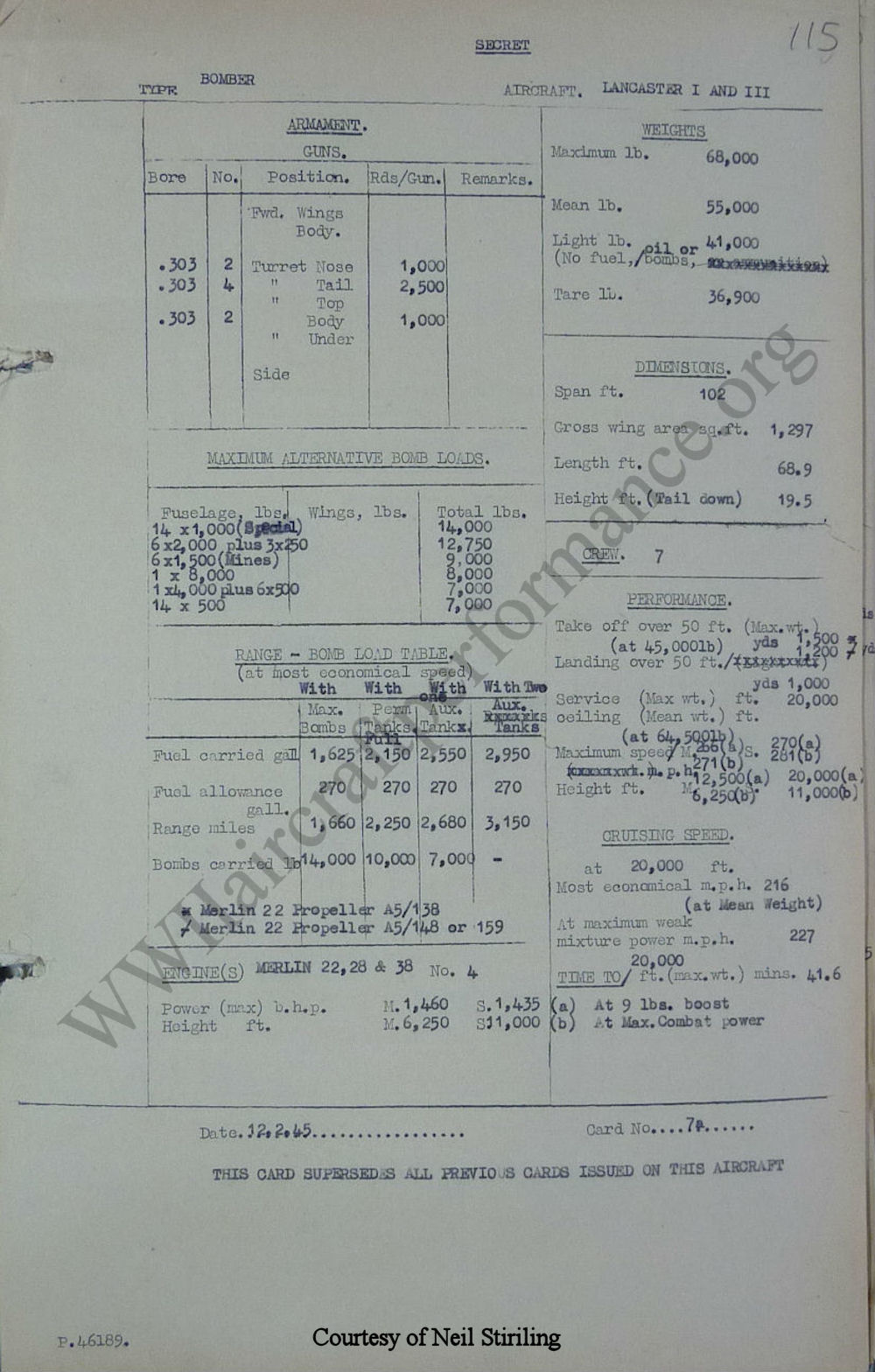
<ref> tag with name "FOOTNOTEOvery2013334" defined in <references> is not used in prior text.Sources
- A.P. 22062A-P.N.: Pilot's and Flight Engineer's Notes for Lancaster. Mark I – Four Merlin XX, 22 or 24 Engines. Mark III – Four Merlin 28 or 38 Engines. London: Air Ministry, May 1944. No ISBN
- Lua error in Module:Citation/CS1/Configuration at line 2123: attempt to index field '?' (a nil value).Template:Full citation needed
- Brickhill, Paul, The Dam Busters. Evans, 1951.
- Bridgman, Leonard, Jane's Fighting Aircraft of World War II. New York: Crescent Books, 1988. ISBN 0-517-67964-7.
- Brown, Eric, Wings on my Sleeve. London: Weidenfeld & Nicolson, 2016. ISBN 978-0-7538-2209-8.
- Buttler, Tony, British Secret Projects: Fighters & Bombers 1935–1950. Hinckley: Midland Publishing, 2004. ISBN 1-85780-179-2.
- Chant, Christopher, Lancaster: The History of Britain's Most Famous World War II Bomber. Bath, UK: Parragon, 2003. ISBN 0-7525-8769-2.
- Chorlton, Martyn, Avro Lancaster Mk I and Mk III: Database. Cudham, Kent, UK: Kelsey Publishing, 2011.
- Lua error in Module:Citation/CS1/Configuration at line 2123: attempt to index field '?' (a nil value).
- Cotter, Jarrod, Living Lancasters: Keeping the Legend Alive. Thrupp, Stroud, UK: Sutton Publishing, 2005. ISBN 0-7509-4192-8.
- Falconer, Jonathan, Bomber Command Handbook 1939–1945. Thrupp, Stroud, UK: Sutton Publishing, 2003. ISBN 0-7509-3171-X.
- Lua error in Module:Citation/CS1/Configuration at line 2123: attempt to index field '?' (a nil value).
- Franks, Norman, Claims to Fame: The Lancaster. London: Arms & Armour Press, 1995. ISBN 1-85409-220-0.
- Franks, Richard A., The Avro Lancaster, Manchester and Lincoln: A Comprehensive Guide for the Modeller. London: SAM Publications, 2000. ISBN 0-9533465-3-6.
- Galland, Adolf, The First and the Last: Germany's Fighter Force in WWII (Fortunes of War). Black Hawk, Colorado: Cerberus Press, 2005. ISBN 1-84145-020-0.
- Lua error in Module:Citation/CS1/Configuration at line 2123: attempt to index field '?' (a nil value).
- Goulding, Brian and Garbett M., The Avro Lancaster I: Aircraft in Profile Number 65. Leatherhead, Surrey, UK: Profile Publications, 1966.
- Gunston, Bill, World Encyclopedia of Aero Engines (fifth edition). Sutton Publishing, 2006. ISBN 0-75094-479-X.
- Lua error in Module:Citation/CS1/Configuration at line 2123: attempt to index field '?' (a nil value).
- Hastings, Sir Max, Bomber Command (Pan Grand Strategy Series). London: Pan Books, 1999. ISBN 978-0-330-39204-4.
- Holmes, Harry, Avro Lancaster (Combat Legend series). Shrewsbury, UK: Airlife Publishing Ltd., 2002. ISBN 1-84037-376-8.
- Holmes, Harry, Avro Lancaster. The Definitive Record 2nd Edition. Shrewsbury, UK: Airlife Publishing Ltd., 2001. ISBN 1-84037-288-5.
- "The Immortal Lanc". Wings Volume 1, Part 8, 1977. London: Orbis Publishing Ltd.
- Iveson, Tony, Lancaster: The Biography. London: Andre Deutsch Ltd., 2009. ISBN 978-0-233-00270-5.
- Jackson A.J., Avro Aircraft since 1908, second edition. London: Putnam Aeronautical Books, 1990. ISBN 0-85177-834-8.
- Jacobs Peter, The Lancaster Story. London: Arms & Armour Press, 1996. ISBN 1-85409-456-4.
- Knott Richard,Black Night for Bomber Command – The Tragedy of 16 December 1943. Pen & Sword Publishing Ltd., 2007. ISBN 1-84415-485-8.
- Lua error in Module:Citation/CS1/Configuration at line 2123: attempt to index field '?' (a nil value).
- Lyzun Jim,"From Warhorse to Workhorse: Lancaster Mk.10 Variants in Canada". Air Enthusiast, No.86 March/April 2000 pp. 16–26. Template:ISSN
- Mackay R.S.G., Lancaster in action. Carrollton Texas: Squadron/Signal Publications Inc.,1982. ISBN 0-89747-130-X
- Mantelli Brown Kittel Graf,Avro Lancaster – Handley Page Halifax – Short S.29 Stirling. Edizioni R.E.I.,2017. ISBN 2-37297-333-9
- Lua error in Module:Citation/CS1/Configuration at line 2123: attempt to index field '?' (a nil value).
- Lua error in Module:Citation/CS1/Configuration at line 2123: attempt to index field '?' (a nil value).
- Mason Francis K.,The British Bomber since1914.London : Putnam ,1994 .ISBN 0–85177–861–5 Parameter error in {{ISBN}}: invalid character
- Mason Tim,The Secret Years : Flight Testing at Boscombe Down1939–1945 .Manchester ,UK : Hikoki ,1998 .ISBN 0–9519899–9–5 Parameter error in {{ISBN}}: invalid character
- [McKinstry Leo],Lancaster : the Second World War's Greatest Bomber .London : John Murray ,2009 .ISBN 978–0–7195–2353–3 Parameter error in {{ISBN}}: invalid character
- Moyes Philip J.R.,Avro Lancaster I & II .Kidlington Oxford UK : Vintage Aviation Publications Ltd .,1979 .ISBN 0–905469–65–8 Parameter error in {{ISBN}}: invalid character
- Moyes Philip J.R.,The Handley Page Halifax B III VI VII .Leatherhead Surrey UK : Profile Publications ,1966 .
- Néillands Robin,The Conquest of the Reich : D-Day to VE Day – A Soldiers' History .New York : NYU Press ,1995 .ISBN 0–814757–81–2 Parameter error in {{ISBN}}: invalid character
- Norris Geoffrey,The Short Stirling Aircraft in Profile Number142 .Windsor Berkshire UK : Profile Publications Ltd .,1966 .
*Lua error in Module:Citation/CS1/Configuration at line 2123: attempt to index field '?' (a nil value).
*Page Bette,Mynarski's Lanc : The Story of Two Famous Canadian Lancaster Bombers KB726 & FM213 .Erin Ontario Canada Boston Mills Press ,1989 .Parameter error in {{ISBN}}: Missing ISBN.
*Lua error in Module:Citation/CS1/Configuration at line 2123: attempt to index field '?' (a nil value).
*Richards Denis,The Hardest Victory : RAF Bomber Command in the Second World War .London : Coronet ,1995 .Parameter error in {{ISBN}}: Missing ISBN.
*Robertson Bruce,Lancaster : The Story of a Famous Bomber .Watford Hertfordshire UK Argus Books Fifth impression1977 First impression1964 .Parameter error in {{ISBN}}: Missing ISBN.
*Sweetman Bill,Avro Lancaster .London Jane's Publishing Company Ltd .,1982 .Parameter error in {{ISBN}}: Missing ISBN.
*Tarring Trevor Joseland Mark,Archie Frazer-Nash ... Engineer .London The Frazer Nash Archives ,2011 .Parameter error in {{ISBN}}: Missing ISBN.
*Taylor John W.R., "Avro Lancaster" in Combat Aircraft of the World from1909 to the present.New York G.P.Putnam's Sons ,1969 .Parameter error in {{ISBN}}: Missing ISBN.
*Winchester Jim,"Avro Lancaster" in Aircraft of World War II : The Aviation Factfile.Kent UK Grange Books plc ,2004 .Parameter error in {{ISBN}}: Missing ISBN.
Further reading
- Benedetto, Fernando, editor; Núñez Padin, Jorge Felix, editor. Avro Lancaster, Lancastrian & Lincoln. Serie Fuerza Aérea, vol. 17. Bahía Blanca, Argentina: Fuerzas Aeronavales, 2009. ISBN 978-987-1682-00-3. Available at Fuerzas Aeronavales website (archived version dated 22 September 2011). (In Spanish)
- White, Glenn. Avro Lancaster: The Survivors. Mushroom Model Publications, 2010. ISBN 978-8389450470.
External links

- The Lancaster Archive
- "The Avro Lancaster" – a 1942 article from Flight
- Digital Archive on Lancaster at the International Bomber Command Centre
Template:Avro aircraft Template:Avro Lancaster family Template:Victory Aircraft Template:RAF WWII Strategic Bombing Template:Swedish military aircraft designations Template:Avro Canada Template:Aircraft manufactured in Canada Template:ADF aircraft designations
Lua error in Module:Authority_control at line 159: attempt to index field 'wikibase' (a nil value).
Cite error: <ref> tags exist for a group named "note", but no corresponding <references group="note"/> tag was found
- Pages with script errors
- Pages with reference errors
- Articles with short description
- Use dmy dates from August 2019
- Articles with invalid date parameter in template
- Pages with broken file links
- Pages using multiple image with auto scaled images
- Pages using multiple image with manual scaled images
- Articles with hatnote templates targeting a nonexistent page
- Pages with ISBN errors
- Commons category link is defined as the pagename
- Avro Lancaster
- Aviation in Lancashire
- Avro aircraft
- 1940s British bomber aircraft
- Four-engined tractor aircraft
- Mid-wing aircraft
- Aircraft first flown in 1941
- Aircraft with retractable conventional landing gear
- Four-engined piston aircraft
- Twin-tail aircraft