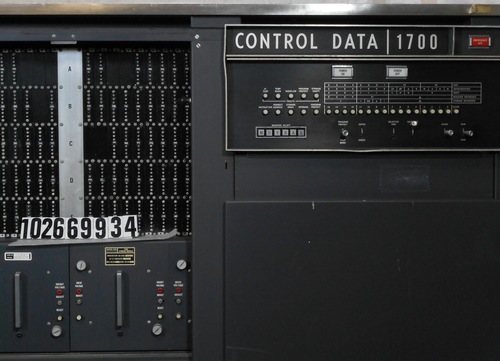
CDC 1700
| Industry | Computer hardware |
|---|---|
| Founded | 1957 |
| Headquarters | Minneapolis , United States |
| Products | CDC 1700 minicomputer series |
The CDC 1700 represents a 16-bit word minicomputer developed by Control Data Corporation, with initial shipments commencing in May 1966.
Multiple variants were introduced throughout its production. The earliest 1700 model utilized air-cooled CDC 6600-style cordwood logic modules alongside core memory, whereas subsequent versions incorporated more advanced technology. The last iterations, branded as Cyber-18, featured four general-purpose registers and expanded instruction sets to facilitate a time-sharing operating environment.
| System name | Processor | Minimum RAM | Maximum RAM | Cycle time |
|---|---|---|---|---|
| 1700 | 1704 | 4 KW | 32 KW | 1.1 μs |
| 1714 | 1714 | 12 KW | 64 KW | 1.1 μs |
| SC1700 | 1774 | 4 KW | 32 KW | 1.5 μs |
| System 17 | 1784 | 4 KW | 64 KW | 0.9 or 0.6 μs |
| CYBER 18 | MP17 | 16 KW | 128 KW | 0.75 μs |
Hardware
Operating with ones' complement arithmetic and utilizing an ASCII-derived character encoding, the 1700 supports memory write protection at the word level. It incorporates one general-purpose register plus two indexing registers, one of which is assigned a fixed memory address. The instruction set accommodates seven addressing modes, notably including multilevel indirect addressing.
While classified as a 16-bit architecture, its core memory is composed of 4,096 words of 18 bits each—comprising 16 bits for data, one parity bit, and a program protection bit—with scalability up to 32,768 words. Input/output functions handle data in either 8-bit or 16-bit units.
Peripherals
The system supported a broad range of peripherals such as teletypewriters, paper tape readers and punches, punched card readers and punches, line printers, magnetic tape drives, magnetic drums, both fixed and removable magnetic disk drives, display terminals, communications controllers, Digigraphic display systems, and timers. These devices interfaced through unbuffered interrupt-driven "A/Q" channels or buffered Direct Storage Access (DSA) channels.
Software
Primary operating environments for the CDC 1700 included the Utility System—a resident monitor paired with utility programs distributed on punched paper tapes—an Operating System designed for larger setups that supported punched cards and magnetic tapes, and the Mass Storage Operating System (MSOS) tailored for disk-based configurations.
Software offerings encompassed an assembler and a Fortran compiler; additionally, Pascal was available via cross-compilation using a CDC 6000 series host machine. The Cyber-18 models operated the disk-oriented Interactive Terminal Oriented System (ITOS), which supported Fortran, Cobol, and UCSD Pascal. ITOS functioned as a foreground/background time-sharing OS that enabled multiple users to access the system through serial CRT terminals, with user processes running in the background while the OS managed foreground tasks.
Market acceptance
The CDC 1700 series was widely utilized as communications concentrators, Digigraphics workstation platforms, remote batch job entry points, and industrial process controllers. A notable deployment involved managing water and wastewater treatment facilities via the AUTRAN program over many years. Another significant application was as the Maintenance and Diagnostic SubSystem (M&DSS) for the AN/FPQ-16 Perimeter Acquisition Radar Attack Characterization System (PARCS) at Cavalier Air Force Station in North Dakota; this particular CDC 1700 remained in service as recently as 2016.
In addition, Washington, D.C. employed a Control Data 1700 for vote tallying operations. Furthermore, CDC’s 1700 played a pivotal role in Ticketron’s wagering and ticketing systems for more than ten years.
Simulation
In the middle of 2016, John Forecast contributed a CDC 1700 simulator to the SIMH collection.