Dicomed
| Company type | Private |
|---|---|
| Industry | Computer graphics technology |
| Founded | 1969 |
| Defunct | 1999 |
| Headquarters | Minneapolis , United States |
| Products | High-precision color film recorders (D47, D48), digital image display devices (D30), color workstations (D38, Producer, Imaginator), digital cameras |
Dicomed (also styled as DICOMED) was a firm specializing in computer graphics technologies, established in 1969 and headquartered in Minneapolis. Throughout the early 1970s, it gained prominence as a top producer of high-precision color film recorders, including models like the D47 and D48. The company discontinued its activities in 1999.
Products
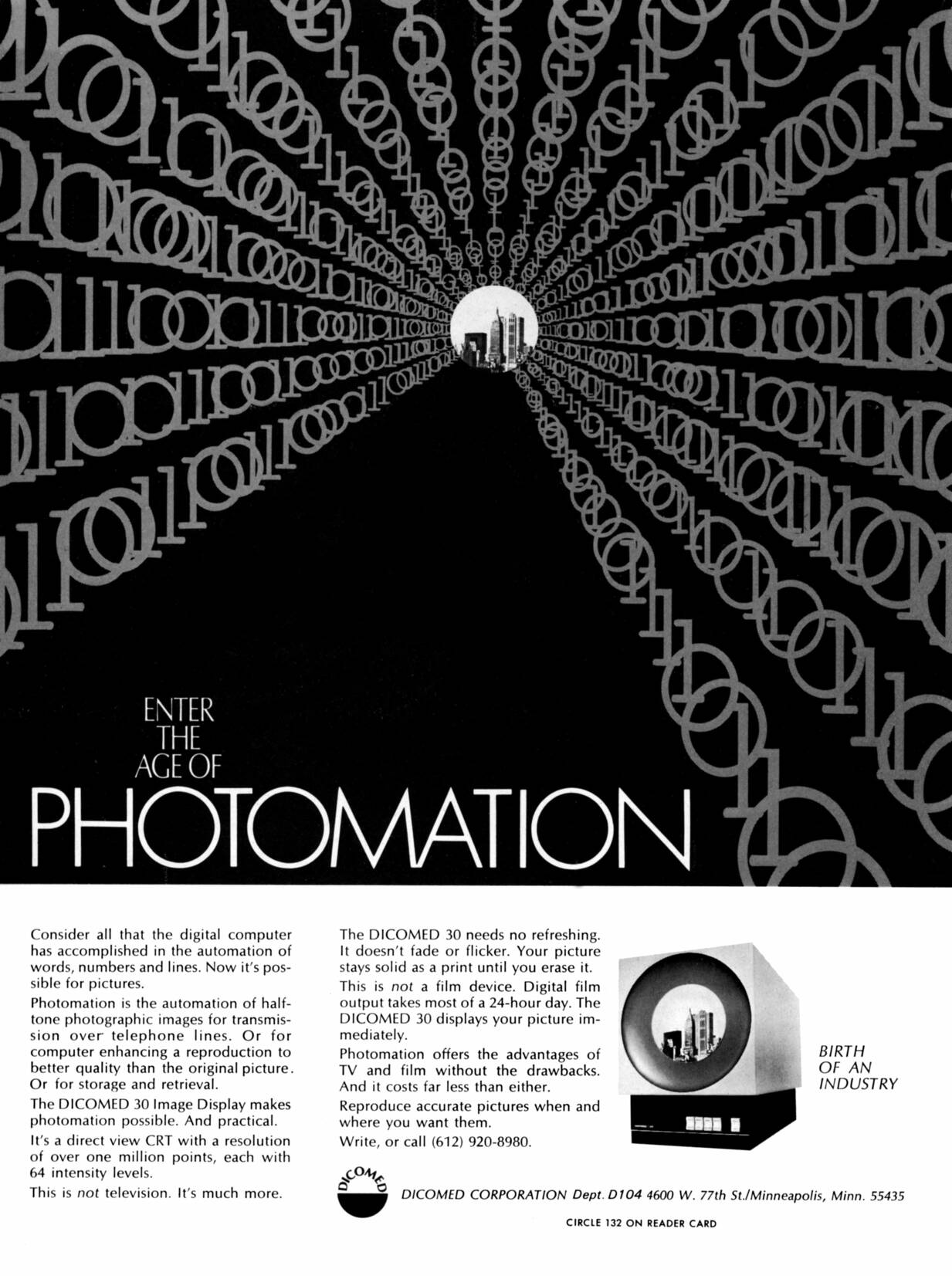
Among Dicomed's initial offerings was the D30, a digital image display device featuring a resolution of 1024x1024, released in 1968. This product was initially designed to present digitized medical X-ray images, utilizing 9-track tape for image processing and storage, which could then be connected to the D30 for viewing purposes.
The D30 employed a dark-trace CRT that allowed for uninterrupted image presentation without relying on frame buffer memory. It achieved this through a scotophor coating that preserved the image until it was deliberately erased. This approach was comparable to the DVBST CRT technology found in subsequent graphics terminals such as the Tektronix 4010.
Subsequently, Dicomed developed various CRT-based film recorders capable of interfacing with computers to transfer graphical outputs onto film media. These devices were adopted by early government organizations (JPL, NCAR, NSA, CIA, Sandia Laboratories) in conjunction with powerful CRAY super computer systems, which were capable of generating color images at 4096x4096 resolution.
In 1984, the Dicomed D148 color film recorder significantly contributed to the imaging efforts of 26 computer graphics animation professionals involved in producing the 15-minute IMAX feature "Magic Egg."
During the 1980s, Dicomed broadened its product range to include color workstations such as the D38, Producer, and Imaginator, which served artists and illustrators in creating digital color artwork. By the mid-1990s, the company had also ventured into manufacturing digital cameras.